If your Google Ads metrics slipped without a clear reason, this article gives a disciplined, operator-level approach to triage, quick fixes, and a tool-backed workflow. You can follow the playbook manually or speed it with tools from ExecWrite.
- Start with a 90-minute triage to identify leakage (bad keywords, poor schedules, wasted spend).
- Fix 1–3 high-impact issues this week: negatives, bid adjustments (by search term and hour), and landing page relevance.
- Use two tools—Wastage Snapshot & Recovery and Search Term Analyzer—to automate audits and bid actions.
Why PPC feels harder now
Google Ads hasn’t gotten easier: automation hides signals, competition raises CPCs, and data gaps make diagnosis noisy. Smart bidding and machine learning require clean inputs—if your account is unstructured, automation amplifies errors. Treat underperformance as a systems problem: measurement, structure, and controls.
The 5 biggest PPC problems marketers face
1) Invisible wasted spend
Symptoms
- High cost with flat/declining conversions.
- Lots of clicks from low-intent queries or poorly matched audiences.
- Daily budgets burning early with no ROI improvement.
Why it happens — Poor negative keyword hygiene, broad match leakage, and unchecked search-term conversions cause steady waste that’s hard to spot on aggregate metrics.
Fix this week
- Export top 1,000 search terms by spend and tag low-intent queries.
- Implement negatives for obvious non-converters (free, jobs, cheap, etc.).
- Pause or reduce budgets on campaigns with CPA above a defined threshold.
2) Bid rules that fight each other (or nothing at all)
Symptoms
- Large hour-over-hour CPA/ROAS swings.
- Bid modifiers unset or inconsistent across campaigns.
- Automated bidding underperforming because data inputs are noisy.
Why it happens — Teams rely on broad automated strategies without granular adjustments (by search term or hour). When the account lacks layered controls, bids either overpay for low-value clicks or miss valuable windows.
Fix this week
- Create a basic hour-of-day ad schedule based on last 90 days.
- Apply conservative bid modifiers (+/−) for the best and worst-performing hours.
- Segment search terms into high-value vs low-value, and override bids at the search-term level where possible.
3) Poor ad-to-landing relevance (Quality Score leaks)
Symptoms
- Low click-through rates relative to impression share.
- High CPCs and low Quality Score in key ad groups.
- Landing pages with mismatched headlines, slow load, or unclear CTA.
Why it happens — Ads and landing pages drift apart after iterative creative changes or when campaigns scale. Quality Score is a compounded metric; small relevance gaps multiply CPCs.
Fix this week
- Audit top-performing ad groups for headline-to-LP message match.
- Test one landing page headline and CTA update per high-volume ad group.
- Pause low-QS ads until you can align copy and page experience.
4) Keyword structure chaos
Symptoms
- Broad match dominating high-spend campaigns.
- Ad groups with dozens to hundreds of unrelated keywords.
- Low relevance and mixed intent within ad groups.
Why it happens — Fast scaling without governance leads to ad groups that confuse Google’s learning systems and reduce signal quality for smart bidding.
Fix this week
- Split the top 10 high-spend ad groups into intent-homogeneous groups.
- Move exact and phrase matches into dedicated ad groups; use broad match with modifiers sparingly.
- Apply negative keywords at campaign level to prevent internal competition.
5) Attribution and conversion tracking problems
Symptoms
- Last-click looks better than it should; cross-channel conversions missing.
- Sudden drops or spikes in conversions after technical changes.
- Inflated conversion counts from soft or duplicated events.
Why it happens — Tracking changes (tag updates, GA4 migration, server-side issues) create noisy conversion signals that break bid strategies.
Fix this week
- Verify event firing for primary conversions and deduplicate tags.
- Compare server logs, GA and Ads conversions for the last 14 days.
- Mark one reliable macro conversion for automated bidding and pause noisy micro-conversions.
Fixes you can apply this week
- Export the top 1,000 search terms and tag negatives (takes 30–60 minutes).
- Run a 90-day hour-of-day performance query; set conservative bid modifiers for the worst 3 hours.
- Pause campaigns or ad groups with CPA > target × 1.5, then reallocate budget to high-converting segments.
- Align headlines and landing pages for three core ad groups; run an A/B test.
- Verify conversion events and mark one macro conversion as the bidding signal.
Automate the top checks—waste snapshot, recovery plan, and search-term bid recommendations—to turn hours of manual work into minutes.
Tool-based workflow
Below are two focused tools to speed diagnosis and fixes. Each shows what it outputs and a three-step usage pattern. Preview images are included for context.
Wastage Snapshot & Recovery (audit + recovery plan)
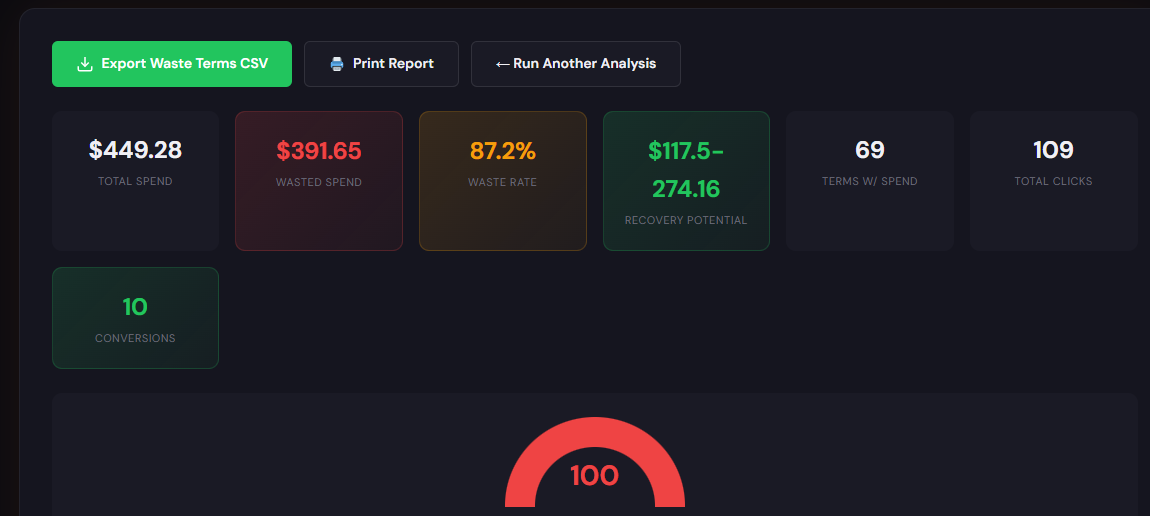
Outputs: dashboard of wasted spend, top leakage categories (keywords, campaigns, audiences), and a prioritized recovery checklist.
How to use (3 steps)
- Connect account and run a 30/90-day snapshot to surface leakage and waste totals.
- Review the prioritized recovery checklist and apply recommended negatives or pauses.
- Export the recovery CSV to Google Ads Editor for fast bulk changes.
Tool URL: Wastage Snapshot & Recovery
Search Term Analyzer — Bid Adjustment by Search Term
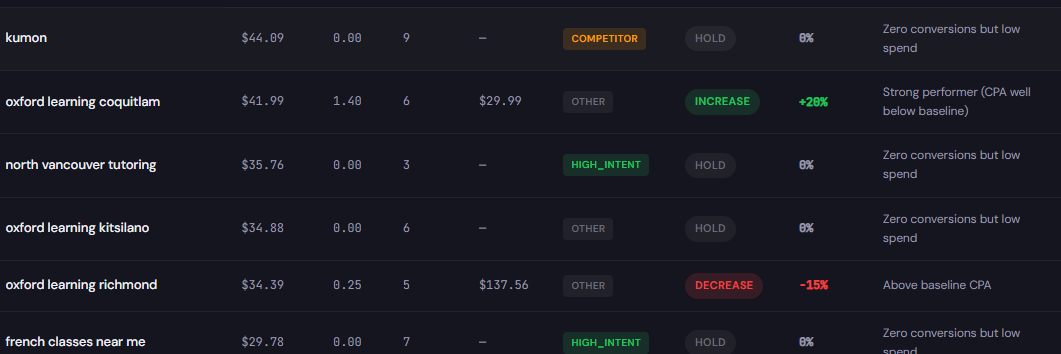
Outputs: per-search-term performance rows, tags (high-value, negative, review), and suggested bid actions.
How to use (3 steps)
- Run the analyzer on top-spend campaigns to get a tagged search-term list.
- Apply negative tags and export recommended bid adjustments for high-value terms.
- Upload actions in Google Ads Editor or apply via script for ongoing enforcement.
Tool URL: Search Term Analyzer
90-minute account triage playbook
- Minutes 0–15: Pull top 1,000 search terms by spend and the last 90-day hour-of-day report.
- Minutes 15–35: Scan search terms and tag clear negatives; mark top 20% of terms by spend for bid review.
- Minutes 35–55: Run a campaign-level waste check: pause campaigns with CPA > target × 1.5 and > 7 days high spend.
- Minutes 55–75: Set crude hour-of-day bid modifiers (−20% for worst 3 hours; +10% for best 2 hours).
- Minutes 75–90: Export changes to Google Ads Editor; schedule tests for landing page headline alignment on top ad groups.
FAQ
You can see lower wasted clicks within 24–48 hours. Full CPA impact may take 7–14 days as machine learning re-adjusts.
Not always. If your automated bids are wildly off because of noisy conversions, switch to manual or Enhanced CPC for 1–2 weeks while you stabilize inputs.
Use at least 30 days; 90 days is better for smoothing weekly patterns. If data is sparse, group days into weekday/weekend buckets.
Weekly for active accounts with >$10k/month spend; biweekly or monthly for smaller accounts. Automate with snapshots to avoid manual drift.
Sources
- Google Ads Help: Ad Schedule — Official guidance on ad scheduling and bid modifiers.
- Google Ads Help: Quality Score — How Quality Score is calculated and affects CPC.
- WordStream: How to Reduce Wasted Ad Spend — Practical tactics for finding and stopping waste.
- Search Engine Land: Why Quality Score Still Matters — Context on the continuing importance of relevance.
Start a wastage snapshot or search-term bid audit and get exportable recovery actions in minutes.