Author: Ahsan Qureshi

  • Why is PPC Getting Harder to Scale?

    PPC Google Ads Marketing Ops

    PPC performance feels like it deteriorates year over year because small leaks compound fast. This post gives a concrete triage playbook and tool-led workflow (including ExecWrite’s Snapshot and Search Term Analyzer) so you can find recoverable spend and act within a week. Learn more at ExecWrite.

    TL;DR
    • Start with a 90-minute account triage that surfaces wasted spend, poor search-term fit, and timing issues.
    • Use two specific tools: Wastage Snapshot (accounts-level leakage + recovery plan) and Search Term Analyzer (search-term bid & negative recommendations).
    • Apply a 7-day checklist: kill obvious waste, add negatives, daypart bids, and test landing-page fixes.

    Why PPC feels harder now

    Scaling paid media has become more expensive and less predictable because ad platforms optimize toward long-term platform metrics, privacy signals mask intent, and account complexity grows as teams and automations pile up. The result: small issues (a bad search term list, an off-hour of spend, one poorly matched landing page) no longer look like single points of failure — they look like an account-wide performance tax.

    The 5 biggest PPC problems marketers face

    1) Wasted spend and budget leakage

    • Symptoms: high impressions with low conversion rate, large spend on low-intent campaigns, sudden CPA spikes.

    Why it happens: Campaigns, audience overlaps, and generic match types accumulate low-quality clicks. Without account-level visibility, leakage hides in dozens of ad groups and search terms.

    • Fix this week: pause top 5 worst-performing ad groups by CPA or ROAS.
    • Run an account-level waste snapshot (see tool workflow below).
    • Add negatives from the top 100 low-value search terms.

    2) Search-term noise and missing negatives

    • Symptoms: clicks from unrelated queries, low conversion rate with surprisingly high spend on a few terms.

    Why it happens: Broad and phrase match variants plus automated bidding expose accounts to long-tail, irrelevant queries unless someone actively harvests negatives.

    • Fix this week: export search term report, tag high-spend/low-value queries, add them as negatives at campaign/account level.
    • Move repeat low-intent terms to a shared negative list.

    3) Poor Quality Score & landing page mismatch

    • Symptoms: low CTR vs. peers, high CPCs, falling conversion rate after copy changes.

    Why it happens: Ads point to landing pages with different messaging, slow load times, or mismatched offer. Quality Score drops and CPCs rise until you align creative and landing experience.

    • Fix this week: audit top 10 low-QS ad groups and rewrite headlines/landing snippets to match keywords.
    • Run an A/B of the landing page with a focused call-to-action for the highest-spend ad group.

    4) Bad dayparting / time-of-day performance swings

    • Symptoms: consistent hours with zero conversions but high spend; odd CPA peaks at night.

    Why it happens: Default ad schedules and automated bidding ignore predictable hourly performance differences. You overbid during low-intent hours and underbid when buyers convert.

    • Fix this week: segment performance by hour-of-day and add -50% bids during worst hours; increase bids during peak converting hours.

    5) Campaign structure bloat & poor SKAG discipline

    • Symptoms: many overlapping keywords, duplicated ad copy, and low control over bids per intent bucket.

    Why it happens: teams add keywords and ad groups to win coverage quickly. Over time, control erodes, and automated bidding masks structural inefficiency.

    • Fix this week: collapse duplicate ad groups, enforce 1–2 intent tiers per ad group, migrate mismatched keywords to separate campaigns.

    Fixes you can apply this week

    • Run a 30, 7, and 1-day spend review: find top 20 terms/ad groups by spend and sort by conversion value.
    • Pause or lower bids on the worst 10% of spend (by CPA/ROAS).
    • Add top negatives from search-term exports into shared lists.
    • Daypart the account: reduce bids during consistently non-converting hours.
    • Test one landing page change for the largest-conversion campaign.
    Run an automated snapshot and find recoverable spend

    Use an account-level Wastage Snapshot to surface the top leakage areas and get a prioritized recovery plan without manual digging.

    Start a snapshot

    Tool-based workflow (map pain points to ExecWrite tools)

    Wastage Snapshot & Recovery — what it outputs
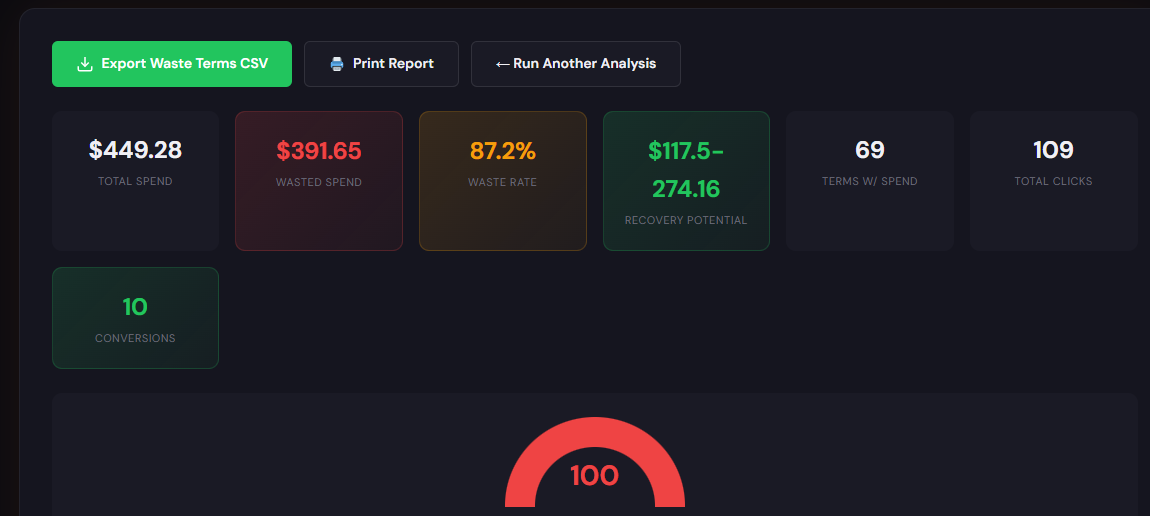
    Wastage snapshot output showing waste totals and recovery plan

    Outputs: account-level waste totals, top leakage areas (campaigns, ad groups, search terms), and a prioritized recovery checklist you can action in hours.

    How to use (3 steps):

    • 1) Upload or connect a 30-day account export into the Snapshot tool.
    • 2) Review the highlighted leakage areas and recommended negative lists.
    • 3) Export the recovery actions and apply them as shared negatives, pauses, and bid changes.

    Open Wastage Snapshot & Recovery

    Search Term Analyzer (Bid Adjustment by Search Term) — what it outputs
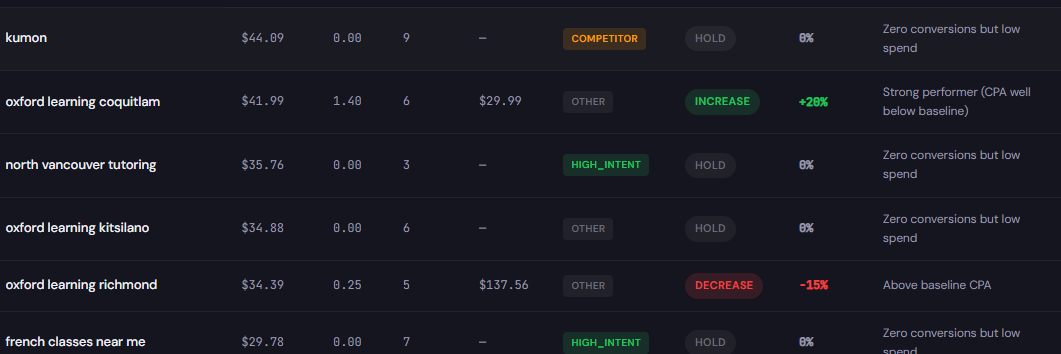
    Search term analyzer output table showing spend, conversions, tags, and recommended bid actions

    Outputs: per-search-term spend, conversions, tags for negative candidates, and recommended bid actions (raise/hold/lower) by term.

    How to use (3 steps):

    • 1) Paste your search term report into the Analyzer.
    • 2) Tag low-intent and high-cost terms; review suggested bid adjustments for high-intent winners.
    • 3) Export recommended negatives and bid adjustments; apply them to campaigns and ad groups.

    Open Search Term Analyzer

    Both tools work together: use Snapshots to prioritize where to run the Analyzer so you don’t waste time analyzing low-impact areas.

    90-minute account triage playbook

    • 0–10 min: Pull top-level metrics (30-day spend, CPA, conversions by campaign). Identify the 3 worst spend buckets.
    • 10–30 min: Run Wastage Snapshot (or run a quick pivot) to get leakage areas—export top 50 low-value search terms.
    • 30–50 min: Feed top leakage campaigns into the Search Term Analyzer and generate a negatives list + bid actions.
    • 50–70 min: Apply immediate actions: add shared negatives, pause worst ad groups, reduce bids in non-converting hours.
    • 70–90 min: Plan two experiments: a landing-page rewrite for the largest campaign and a controlled dayparting test for the next 7 days.
    Ready to recover wasted spend?

    Get the Snapshot and Search Term Analyzer working on your account now — actionable outputs in under an hour.

    Use ExecWrite tools

    FAQ

    How fast will I see results after applying these fixes?

    You should see measurable CPC/CPA improvements within 3–7 days after removing major negatives, pausing wasteful ad groups, and applying dayparting. Structural changes like landing page A/B tests take longer.

    Do these tools require an API connection to Google Ads?

    No — the Snapshot and Analyzer accept standard exports. API connections are available for automated workflows but aren’t required for initial triage.

    Which metric should I prioritize: CPA or ROAS?

    Prioritize the metric tied to your business objective. For lead-gen, start with CPA; for ecommerce, optimize ROAS. The triage process is the same — isolate waste, then reallocate budget to high-value segments.

    Can these tools fix Quality Score issues?

    They identify Quality Score drivers (poor CTR, landing-page mismatch) and recommend headline/landing fixes and where to reallocate spend so you can prioritize pages to rewrite or ads to test.

    Sources

  • Why is my PPC spend rising while conversions fall?

    PPC Google Ads Marketing Ops

    If your account feels like it’s bleeding budget while results slip, this playbook is for operators. We walk through core failure modes, quick fixes, a 90-minute triage, and a tool-first workflow using ExecWrite resources at execwrite.com to recover wasted spend fast.

    TL;DR
    • Stop daily budget leaks: audit wasted spend and negative keywords, then block the biggest offenders.
    • Stabilize bids and schedules: use hour-of-day data and short-term bid rules to control volatility.
    • Fix landing-page relevance and keywords: improve Quality Score and conversion rates with targeted rewrites.

    Why PPC feels harder now

    Paid media is more automated, more competitive, and more opaque than it was five years ago. Auction dynamics, broader match behavior, and algorithmic bidding amplify small data errors into big spend problems. Teams that treat Google Ads like a set-and-forget channel will see rising costs and falling returns; operators who run tight audits and apply surgical fixes win.

    The 5 biggest PPC problems marketers face

    1) Wasted spend and budget leakage

    Common early warning sign of a losing account.

    • Symptoms: high impressions but low conversions; many clicks from irrelevant queries; CTR drift without CVR.

    Why it happens

    Broad and phrase match combined with automated bidding push ads into tangential searches. Without regular negative keyword maintenance or a waste-focused snapshot, small losses compound quickly.

    Fix this week

    • Run a search-term audit and tag top irrelevant queries for negatives.
    • Pause or lower bids for campaigns with high spend/low conversions.
    • Apply quick negative lists at the account level for obvious junk traffic.

    2) Keyword structure and intent mismatch

    • Symptoms: high CPA in broad/ad group; ads that get clicks but drop off on landing page; low Search Impression Share for high-value terms.

    Why it happens

    Ad groups are too large, with mixed intent keywords and ads. That dilutes relevance and drives poor Quality Score and conversion rates.

    Fix this week

    • Split ad groups by intent (buy vs research). Create focused ad copy per group.
    • Use an AI keyword generator to produce high-intent keyword variants and negatives.
    • Export targeted ad groups to Editor for quick bulk updates.

    3) Low Quality Score and landing-page mismatch

    • Symptoms: high CPCs for keywords with good intent; ads drive traffic but landing pages don’t convert; high bounce rates.

    Why it happens

    Ad text, keywords, and landing pages diverge. Automation increases reliance on ad rank signals, so even small relevance gaps increase CPC and reduce visibility.

    Fix this week

    • Run a landing-page relevance check for your top 20 keywords.
    • Rewrite headlines and CTAs to match keyword intent.
    • Test a focused landing page for your highest-spend ad group.

    4) Bidding volatility from automation

    • Symptoms: sudden CPA spikes, inconsistent ROAS across hours or days, bids oscillating without clear cause.

    Why it happens

    Smart bidding reacts to signals; when inputs (conversion tracking, feed changes, seasonality) are noisy, bidding amplifies the noise and swings performance.

    Fix this week

    • Freeze major bid strategy changes and audit conversion tracking.
    • Use hourly performance data to add temporary daypart bid adjustments.
    • Set conservative bid caps or target adjustments while you triage.

    5) Poor account hygiene and reporting blind spots

    • Symptoms: disparate naming, missing UTM tracking, unclear conversion attribution, reports that don’t map to business outcomes.

    Why it happens

    Teams inherit messy accounts. Without a standard naming convention and hygiene checks, it’s hard to find root causes and apply surgical fixes.

    Fix this week

    • Standardize naming and document conversion events.
    • Create a one-page report that ties campaign KPIs to business outcomes.
    • Schedule a weekly 30-minute hygiene checkpoint.

    Fixes you can apply this week

    • Run a wasted-spend snapshot: identify top 10 queries and campaigns that drive low-value clicks.
    • Apply immediate negative keywords for junk queries and pause worst-performing ad groups.
    • Split high-spend ad groups by intent and refresh ad copy for exact/phrase matches.
    • Check conversion tracking and set conservative bid caps while problems are resolved.
    • Use hour-of-day performance to apply temporary bid modifiers for peak efficiency.
    Recover wasted spend fast

    Run a targeted wastage snapshot and generate negative keyword lists automatically to stop the biggest leaks this week.

    Start a snapshot


    Tool-based workflow (map each pain point to ExecWrite tools)

    Wastage Snapshot & Recovery

    Wastage Snapshot dashboard showing waste totals

    What it outputs: A dashboard-style snapshot showing total wasted spend, top leakage areas (search terms, campaigns), and a prioritized recovery plan with negative keyword suggestions.

    How to use it (3 steps)

    • 1) Upload a recent account spend and search-terms export to the Wastage Snapshot (Wastage Snapshot).
    • 2) Review the top leakage areas and export suggested negatives and campaign-level pauses.
    • 3) Implement negatives, pause the worst-performing ad groups, and rerun after 72 hours to measure impact.
    Free AI Keyword Generator

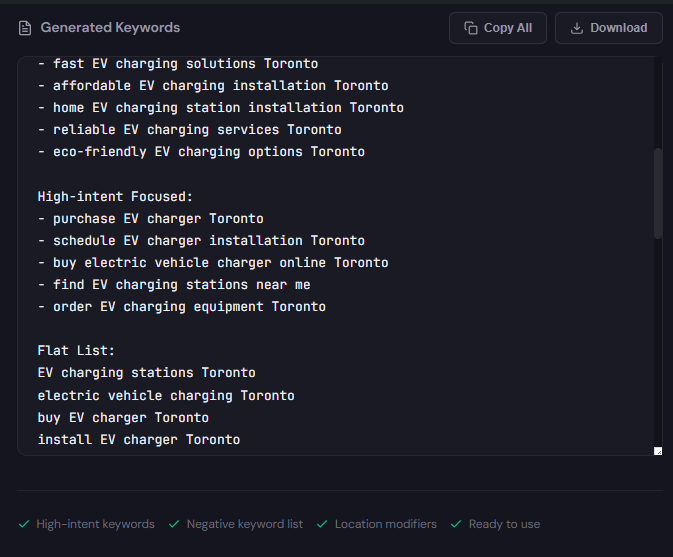
    Keyword generator output with high-intent keyword lists

    What it outputs: Structured keyword lists (high-intent, modifiers, negative candidates) and ad-group suggestions ready for export.

    How to use it (3 steps)

    • 1) Paste 5–10 core product/service phrases into the Free AI Keyword Generator (AI Keyword Generator).
    • 2) Export high-intent keywords and map them to focused ad groups (exact/phrase first).
    • 3) Use the output to create tighter ad copy and landing-page headlines that match intent.

    Between these two tools: use the Wastage Snapshot to stop budget leaks and the AI Keyword Generator to rebuild structure and intent. Implement both within 48–72 hours for visible account stabilization.

    90-minute account triage playbook

    • 0–10m: Check account-level health — conversion count, tracking errors, and major bid changes.
    • 10–30m: Run a Wastage Snapshot and export top 50 search terms by spend and zero/low conversions.
    • 30–45m: Apply immediate negatives and pause the top 3 ad groups with worst spend-to-conversion ratios.
    • 45–60m: Use the AI Keyword Generator to create focused ad groups for the top-performing landing pages.
    • 60–80m: Implement conservative bid caps and hour-of-day bid modifiers for peak hours; document changes.
    • 80–90m: Set a 72-hour monitoring window and schedule follow-up: measure spend reduction and conversion rate improvement.
    Run the 90-minute triage with ExecWrite

    Use the snapshot and keyword tools to stop waste and rebuild structure. Run a triage and get a prioritized recovery plan—fast.

    Start your account triage

    FAQ

    How quickly will I see results after applying negatives?

    Expect meaningful spend reduction within 24–72 hours for the most obvious negatives. Conversion rate improvements depend on how many ad groups you split and whether you update landing pages.

    Can automation (smart bidding) hurt my account?

    Yes—if inputs are noisy. Poor conversion tracking, mixed-intent ad groups, or unchecked search terms feed bad signals. Freeze major changes, fix data quality, then let smart bidding resume.

    Which tool should I run first?

    Start with a Wastage Snapshot to stop bleeding spend, then use the AI Keyword Generator to rebuild structure and ad relevance.

    Are the ExecWrite tools free?

    ExecWrite offers both free and paid tools. The AI Keyword Generator is free to use; the Wastage Snapshot provides a prioritized recovery plan and may include paid upgrade options for deeper diagnostics.

    Sources

  • Why are my Google Ads costs rising—and how can PPC teams fix paid media waste?

    PPC Google Ads Marketing Ops

    Rising CPCs, lower conversion rates, and fading automation signals are suffocating paid media results. This article gives the exact checks, quick fixes, and a tool-based workflow (including ExecWrite tools) to recover budget this week.

    TL;DR
    • Quick wins: stop runaway keywords, fix ad-to-landing-page relevance, and apply hourly bid adjustments to stabilize CPA.
    • Tools: use the Wastage Snapshot to find leaks and the Hourly Bid Adjuster to recover dayparting opportunities.
    • Playbook: a 90-minute triage will identify 60–80% of recoverable waste and give a prioritized action list.

    Why PPC feels harder now

    Costs rarely climb for a single reason. Increased competition, shifting intent, and layered automation make signal interpretation harder. Benchmarks show CPCs and click volatility rising year-over-year, and Quality Score sensitivity means small relevance gaps now compound cost-per-conversion quickly (WordStream Google Ads Benchmarks). At the same time, ad platforms reward tightly relevant creative and landing page alignment—so small mismatches hit both CPC and conversion rate (Google Ads Help: Quality Score).

    The 5 biggest PPC problems marketers face

    1) Wasted spend on low-intent or irrelevant search terms

    Symptoms

    • High clicks with zero conversions from long-tail queries.
    • High cost but poor assisted metrics (time on site, low pages per session).

    Why it happens — Broad match + automated bidding surfaces queries machine-learning models think will convert, but without negative keywords or regular search-term pruning this creates leakage.

    Fix this week

    • Export last 30 days search terms, sort by cost and conversions; tag zero-conversion, high-cost queries.
    • Add immediate negatives for clearly irrelevant queries.
    • Move marginal queries into phrase or exact match ad groups with tailored ads and landing pages.

    2) Quality Score and landing-page mismatch

    Symptoms

    • High impression share but low click-through or conversion rate.
    • QS below 6 for many keywords; high CPC relative to competitors.

    Why it happens — Ads and landing pages diverge on intent or offer. Automation then bids higher to maintain volume, increasing cost-per-conversion.

    Fix this week

    • Audit top-performing and top-cost keywords for headline/landing-page alignment.
    • Use focused headlines with the same primary keyword and a single CTA.
    • Run a fast A/B of landing page headlines and form layouts on top 20 spend keywords.

    3) Hour-of-day and dayparting inefficiency

    Symptoms

    • Sharp CPA swings by hour; peak-hour spend underperforms off-peak.
    • Ad schedule is blanket-based, not performance-driven.

    Why it happens — Many teams set schedules once and forget. Automated bidding masks hour-level performance; without granular adjustment, budgets flow to costly times.

    Fix this week

    • Pull hour-of-day conversion and cost data for the last 90 days.
    • Lower bids during high-CPA hours and raise during low-CPA hours selectively.
    • Monitor and roll back changes over 72 hours if volatility spikes.

    4) Overreliance on one automation signal

    Symptoms

    • Performance collapses when conversion tracking changes or data thresholds drop.
    • Little manual oversight: broad budgets, few exclusions, rare negative-list maintenance.

    Why it happens — Smart bidding needs stable signals. If conversions are sparse or tracking shifts, the algorithm hunts, spending to find conversions.

    Fix this week

    • Enable at least two conversion actions and set proper attribution windows for the main funnel events.
    • Split campaigns by conversion value tiers so automation optimizes homogenous groups.

    5) Campaign structure and keyword cannibalization

    Symptoms

    • Multiple ad groups competing for the same queries; high internal impression overlap.
    • Mixed match types in the same ad group causing allocation issues.

    Why it happens — Fast scaling without structure leads to competing signals; automation can’t optimize efficiently when goals are mixed.

    Fix this week

    • Group keywords by intent and landing page; enforce match type discipline per ad group.
    • Use the search-term list to move queries into the most relevant ad group and add negatives to others.

    Fixes you can apply this week

    • Identify top 20 spend keywords and search terms; add negatives for irrelevant traffic.
    • Run a landing-page headline alignment test for top spend buckets.
    • Apply hourly bid adjustments on the worst-performing hours; throttle budgets during waste spikes.
    • Split campaigns by conversion value and pause any low-intent automated experiments.
    • Schedule a recurring 30-minute search-term prune on your calendar.
    Recover wasted spend faster

    Run a quick waste snapshot and get a prioritized recovery plan you can implement this week.

    Run a free snapshot at ExecWrite

    Tool-based workflow: map problems to ExecWrite tools

    Wastage snapshot preview showing waste totals and recovery plan

    Wastage Snapshot & Recovery

    What it outputs: dashboard-style snapshot of wasted spend, top leakage categories, and an actionable recovery plan that lists negative keywords, budget reallocations, and quick wins.

    How to use it (3 steps)

    1. Upload a 30–90 day Google Ads export into the Wastage Snapshot.
    2. Review the top leakage categories and the generated negative keyword suggestions.
    3. Apply the high-confidence negatives and budget shifts; export the recovery checklist for stakeholders.

    Open the Wastage Snapshot tool to generate your account recovery plan.

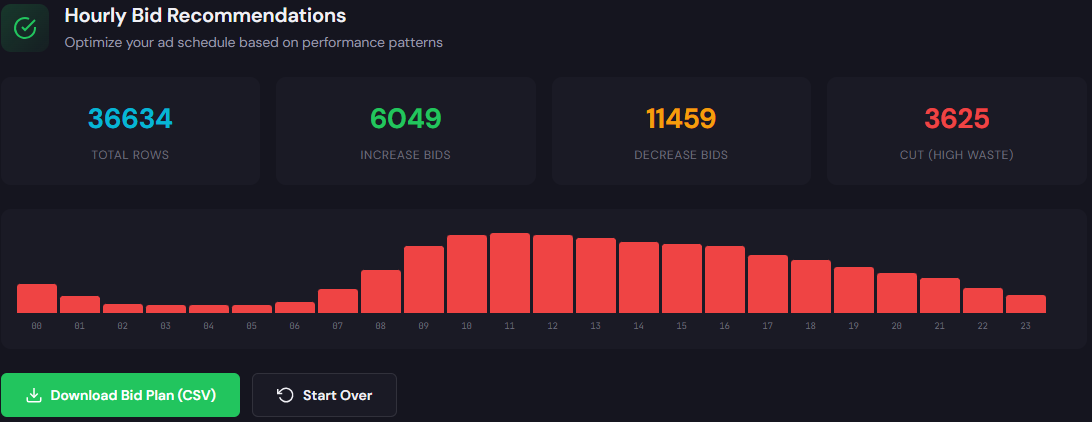
    Hourly bid adjuster table with CPA and bid recommendations

    Hourly Bid Adjuster (Bid Adjustment Suite)

    What it outputs: hour-of-day rows with cost, conversions, CPA, and recommended bid adjustments to improve dayparting decisions.

    How to use it (3 steps)

    1. Pull 60–90 days of performance by hour and upload to the Hourly Bid Adjuster.
    2. Apply suggested bid multipliers for hours with consistent CPA improvements.
    3. Monitor 72 hours and iterate; if CPA worsens, revert the largest adjustments first.

    Open the Hourly Bid Adjuster to create hour-level bid actions.

    Both tools integrate into a weekly cadence: use Wastage Snapshot to triage where the money leaks, then apply Hourly Bid Adjuster recommendations for immediate cost stabilization.

    90-minute account triage playbook

    • 0–10 minutes: Pull last 30–90 days reports: account summary, search terms, ad schedule, and top landing pages.
    • 10–30 minutes: Run Wastage Snapshot to surface top leakage by campaign and keywords; export high-confidence negatives.
    • 30–50 minutes: Apply immediate negatives and pause campaigns/ad groups with clear zero-conversion waste.
    • 50–70 minutes: Run Hourly Bid Adjuster on the same date range; implement conservative bid multipliers for worst hours.
    • 70–85 minutes: Align top 10 spend keywords with landing-page headlines; deploy a quick copy update where mismatch exists.
    • 85–90 minutes: Document changes, set monitoring windows (24/72 hours), and schedule a 1-week follow-up with owners.
    Start your triage

    Execute the 90-minute playbook with tools and exportable recovery checklists from ExecWrite.

    Launch the tools on ExecWrite

    FAQ

    Q: How fast will I see improvements after applying negatives?

    Most accounts show reduced wasted clicks within 24–48 hours. Conversion rate changes can take longer as automation re-learns; watch performance for 72 hours before further large changes.

    Q: Should I pause smart bidding while I fix structure?

    Not always. If conversion volume is sufficient, leave smart bidding but tighten budgets and add exclusions. If conversions are sparse or you’re restructuring heavily, run manual bidding on core campaigns until structure stabilizes.

    Q: Can I export tool outputs back into Google Ads Editor?

    Yes. ExecWrite tools provide export-ready lists and CSVs for negatives, bid adjustments, and campaign mappings compatible with Google Ads Editor.

    Q: Do these fixes work for both B2B and B2C accounts?

    Yes—principles are the same. B2B often needs longer attribution windows and more careful conversion action setup; adjust monitoring windows accordingly.

    Q: What if my account is too large to triage in 90 minutes?

    Prioritize by spend: run the Wastage Snapshot on the top 20% of campaigns by spend to capture most recoverable waste quickly, then expand with the same workflow.

    Sources

  • Why is my Google Ads (PPC) performance dropping—and how do I fix it?

    PPC Google Ads Marketing Ops

    If your account used to hit target ROAS and now misses regularly, this guide gives an operator-first playbook to diagnose and recover performance. We reference tooling and examples from ExecWrite to speed audits and fixes.

    TL;DR
    • Most shortfalls come from wasted spend, structure decay, and automation drift—fix these first.
    • Run a 90-minute triage: waste snapshot, search-term adjustments, and quick bid/daypart changes.
    • Use two focused tools (wastage snapshot + search-term bid adjuster) to recover low-effort wins fast.

    Why PPC feels harder now

    Paid media is a moving target: auctions, privacy changes, and automated bidding have increased volatility. That means smaller structural issues (bad keywords, weak landing relevance, schedule mismatches) compound faster than they used to. Operators who rely on look-and-see reporting lose ground to accounts that run disciplined triage and automation checks.

    The 5 biggest PPC problems marketers face

    1) Wasted spend from low-value queries

    • Symptoms: high impressions with zero conversions, large spend on bottom-of-funnel mismatch, conversion rate drops while clicks remain steady.

    Why it happens: Keyword lists and match types drift over time; negative keyword hygiene falls behind, and broad/phrase match expansions pick up irrelevant queries.

    • Fix this week: Run a top-100 search-term waste report, add negatives for irrelevant intent, pause high-spend zero-conversion queries.

    2) Automation drift: bidding is optimized to the wrong signals

    • Symptoms: stable CPA target but rising CPCs and falling conversion value, or volatile ROAS despite steady traffic.

    Why it happens: Automated bidding learns from noisy conversion signals, conversion delays, or campaign mixing (one conversion tag used for different business units).

    • Fix this week: Segment conversion actions by value, set conservative bid caps, and test switching to manual CPC for unstable campaigns for 7–14 days.

    3) Ad-to-landing-page relevance problems (Quality Score leaks)

    • Symptoms: low CTR relative to peers, high CPCs, low ad relevance scores inside the account diagnostics.

    Why it happens: Messaging drift between ads and destination pages—creative or product changes left landing pages stale against ad copy.

    • Fix this week: Sync headlines with top landing page H1s, test 1–2 headline swaps per ad group, and QA load times and tracking on top landing pages.

    4) Poor campaign structure and bad keyword grouping

    • Symptoms: same search terms triggering multiple ad groups, low relevance ad groups, and poor conversion distribution across ad groups.

    Why it happens: Rapid edits, aggressive keyword expansions, and manual team handoffs create overlapping keyword coverage and cannibalization.

    • Fix this week: Rebuild 2–3 worst-performing ad groups into tight, single-intent groups and export for Google Ads Editor to apply quickly.

    5) Hour-of-day and dayparting mismatches

    • Symptoms: consistent hourly CPA spikes, clear hours with conversions but low spend, or campaigns serving heavily in low-value windows.

    Why it happens: Default ad schedules and automated bid strategies that don’t account for hourly user behavior cause wasted budget during off-hours.

    • Fix this week: Inspect hour-of-day conversion performance, reduce bids for consistently weak hours, and increase bids for peak-conversion windows.

    Fixes you can apply this week

    • Run a wastage snapshot to identify top leakage (top campaigns, ad groups, and search terms).
    • Export top 200 search terms by spend and add negatives for non-converting intent.
    • Apply conservative bid adjustments by hour and pause non-performing hours.
    • Audit 5 landing pages for headline alignment and tracking errors.
    • Set bid caps / switch to manual CPC on unstable automated campaigns for 7–14 days.
    Run a fast account snapshot

    Need a fast, actionable waste audit and prioritized recovery plan? ExecWrite’s snapshot surfaces top leaks and recovery actions so you can act in hours, not weeks.

    Get the ExecWrite snapshot

    Tool-based workflow: map each pain point to ExecWrite tools

    Below are two targeted tools that map directly to the five problems above. Each tool shows what it outputs and a three-step operator workflow. Preview images are included left-aligned for quick recognition.

    Wastage snapshot preview

    Wastage Snapshot & Recovery

    What it outputs: Dashboard-style snapshot listing total wasted spend, top leakage areas, negative keyword candidates, and a recovery plan prioritized by impact.

    How to use it (3 steps):

    1. Upload or connect your account and run the snapshot to get a prioritized leakage report.
    2. Review the top 10 waste items—pause or reduce budgets on clear leaks and export negative keyword lists.
    3. Implement the recovery plan items across campaigns, then rerun the snapshot in 7 days to measure impact.

    Open the Wastage Snapshot & Recovery tool

    Search term analyzer output table showing spend, conversions, tags, and recommended bid actions

    Bid Adjustment by Search Term (Search Term Analyzer)

    What it outputs: Table of search terms with spend, conversions, CPA/ROAS, tags (keep/negate/adjust), and suggested bid actions.

    How to use it (3 steps):

    1. Export the top 200 search terms by spend into the analyzer.
    2. Review suggested tags: add negatives, mark high-value queries, and accept bid recommendations for marginal terms.
    3. Apply bid adjustments or negatives in bulk via Google Ads Editor or the interface; recheck performance after 7 days.

    Open the Search Term Analyzer

    90-minute account triage playbook

    Follow this timed sequence to stabilize an account in 90 minutes.

    • 0–15 min: Run the ExecWrite Wastage Snapshot and export top leakage items.
    • 15–35 min: Open Search Term Analyzer on the top-spend campaigns; tag negatives and high-value queries.
    • 35–55 min: Apply immediate actions: add negatives, pause clear wasteful campaigns, reduce budgets on leaking ad groups.
    • 55–75 min: Inspect hourly conversion table (top campaigns) and apply conservative daypart bid adjustments for low-performing hours.
    • 75–90 min: QA the top landing pages (headlines, tracking) and schedule the next snapshot in 7 days to measure impact.

    FAQ

    Q: How fast will I see improvements after these fixes?

    A: You can expect lower wasted spend within days and measurable CPA/ROAS improvements within 7–14 days if you applied negatives, bid caps, and dayparting changes.

    Q: Do I need to pause automated bidding to fix problems?

    A: Not always. Apply conservative caps and segment conversion actions first. If volatility persists, switch key campaigns to manual CPC temporarily for diagnosis.

    Q: Which reports should I prioritize?

    A: Start with a waste snapshot (spend vs. conversions by campaign/ad group/search term), search-term reports, and hour-of-day performance.

    Q: Can I run these steps without a tool?

    A: Yes—manually—but tools like ExecWrite’s snapshot and search-term analyzer save hours and surface prioritized actions so operators can act fast.

    Q: Will this work for small budgets?

    A: The same principles apply. On small budgets, waste compounds faster—so finding and killing high-spend non-converting queries is even more critical.

    Run a guided recovery with ExecWrite

    Want a prioritized recovery plan you can act on in hours? Run the Wastage Snapshot and Search Term Analyzer to get a step-by-step fix list.

    Run the tools now at ExecWrite

    Sources

  • Why is my Google Ads account wasting budget? PPC triage & fixes

    PPC Google Ads Marketing Ops

    If your account feels like a money-drain, this is a no-fluff, operator-focused playbook. Use the checklists below plus quick scans with ExecWrite (https://execwrite.com) tools to find budget leaks and fix bids without guesswork.

    TL;DR — Quick outcomes
    • Find where budget is leaking and recover wasted spend in the first 30–60 minutes.
    • Use search-term bid actions to stop overbidding on low-intent queries and lift ROAS.
    • Apply three fixes this week to stabilize CPA and create clean signals for automated bidding.

    Why PPC feels harder now

    Advertising platforms matured ML—but they still need clean inputs. Two decades of automation plus noisy signals (privacy changes, broader match, generative search) mean your account needs tighter hygiene: better search-term control, clearer landing page relevance, and faster leak detection. Without those, machine learning optimizes the wrong things and you pay for the waste.

    The 5 biggest PPC problems marketers face

    1) Wasted spend and budget leakage

    Symptoms

    • High impressions and clicks with near-zero conversions from certain campaigns or keywords.
    • Daily spend spikes with no corresponding lift in leads or revenue.
    • High percentage of low-quality search terms in reporting.

    Why it happens

    Poor keyword hygiene, broad-match expansion and missing negatives create traffic that looks like volume but has zero ROI. Automation then ramps spend on that noise.

    Fix this week

    • Run a top-100 search-term audit and flag terms with clicks but zero conversions.
    • Add the worst 20–50 terms as negatives immediately.
    • Pause poorly performing broad-match ad groups until cleaned.

    2) Wrong bids on actual converting search terms

    Symptoms

    • High CPA for some search terms and low CPA for others, inconsistently across hours or days.
    • Conversions concentrated on a small set of search terms but bids don’t reflect that.

    Why it happens

    Aggregate bid strategies or campaign-level bid rules ignore term-level performance. The algorithm can’t raise or lower bids for individual search terms without clear guidance.

    Fix this week

    • Export search-term-level CPA and spend for the last 30 days.
    • Increase bids for top-converting terms and reduce bids or add negatives for high-cost, no-convert terms.
    • Group converting terms into tighter ad groups to improve signal quality.

    3) Poor dayparting / ad scheduling

    Symptoms

    • Conversion rate or ROAS swings wildly by hour-of-day or day-of-week.
    • Manual schedules that don’t reflect current conversion windows.

    Why it happens

    Historical schedules become stale. Without hourly-level insights, budgets are wasted during low-converting times and underutilized during peak windows.

    Fix this week

    • Pull hour-of-day performance and mark low-ROI hours for -20% or -50% bids.
    • Raise bids during proven high-converting hours and monitor for three days.
    • Limit ad delivery during weekends or nights if conversion rates fall below target.

    4) Low Quality Score / landing-page mismatch

    Symptoms

    • High CPCs versus competitors, poor ad rank, and low ad relevance scores.
    • Landing pages that don’t match ad messaging or search intent, causing high bounce rates.

    Why it happens

    QA gaps between ad copy and landing page erode expected click-through and conversion rates—both signals Google uses to set costs.

    Fix this week

    • Map top ad groups to focused landing pages (one dominant CTA per page).
    • Refine headlines to match the top search-term intent for the ad group.
    • A/B test one headline and one CTA to restore relevance within 7–14 days.

    5) Slow testing and creative decay

    Symptoms

    • Same ad set running for months with declining CTR and conversions.
    • Low volume of new headline or landing page variants being tested.

    Why it happens

    Teams deprioritize creative because ad ops are buried in reporting. Without a rapid creative supply, performance decays and automation starves for useful signals.

    Fix this week

    • Create three new headlines and two new CTAs for top ad groups and launch them in rotating tests.
    • Set a 14-day evaluation window and automatically pause the worst performer.
    • Standardize naming so winners are easy to export to other campaigns.

    Fixes you can apply this week

    • Run a 30–60 minute search-term sweep; add 20–50 immediate negatives.
    • Export and sort search-term CPA; apply manual bid adjustments to top/worst terms.
    • Pull hour-of-day performance and set ad schedule bid modifiers for low-conversion hours.
    • Map high-volume ad groups to single-purpose landing pages; align headlines and CTAs.
    • Ship at least 3 new creative variants to top ad groups and test for 14 days.
    Recover wasted spend fast with an audit

    Use a focused audit to find budget leaks, then apply term-level bid fixes. ExecWrite has tools that automate both scans.

    Start a free scan at ExecWrite


    Tool-based workflow — map pain to ExecWrite tools

    Tool: Wastage Snapshot & Recovery

    Wastage snapshot preview showing waste totals and recovery plan

    What it outputs: Dashboard-style snapshot of wasted spend, top leakage areas (terms, campaigns, match types), and an actionable recovery plan with prioritized negatives and budget shifts.

    How to use it — 3 steps

    1. Upload a last-30/90-day report or connect the account to generate the snapshot.
    2. Review top leakage items (search-term, campaign, device) and accept suggested negatives.
    3. Export the recovery plan and deploy changes in Google Ads; monitor spend changes over 3 days.

    Open Wastage Snapshot & Recovery

    Tool: Bid Adjustment by Search Term (Search Term Analyzer)

    Search term analyzer output table showing spend, conversions, tags, and recommended bid actions

    What it outputs: A search-term-level table with spend, conversions, CPA/ROAS, tags and recommended bid actions (raise / lower / negative) so you can make surgical changes quickly.

    How to use it — 3 steps

    1. Upload search-term performance or pull directly from the account and set your CPA/ROAS targets.
    2. Review the tool’s recommended actions and accept or tweak the suggested adjustments.
    3. Export a CSV for Google Ads Editor or apply changes directly via the tool’s recommendation list.

    Open Search Term Analyzer

    Both tools are designed to be used together: Wastage Snapshot finds the leakiest areas; Search Term Analyzer turns that insight into precise bid actions.


    90-minute account triage playbook

    Follow this minute-by-minute triage to stabilize spend fast.

    • 0–10 min: Global check — overall spend vs. target, CPA/ROAS deviation, campaigns running over budget.
    • 10–30 min: Run Wastage Snapshot & Recovery to identify top leakage buckets (terms, campaigns, devices).
    • 30–50 min: Run Search Term Analyzer on the leakiest campaigns; flag 20–50 negatives and export recommended bid changes.
    • 50–70 min: Apply high-confidence negatives and bid cuts (worst 20% of terms). Pause any campaign spending >2x target CPA.
    • 70–90 min: Set ad-schedule modifiers based on hour-of-day data; push 3 creative variants to top ad groups. Document changes and assign next 7-day monitoring owner.
    Actionable next step

    Run the two tools together to turn audit insights into immediate actions. Fast scans + precise bid changes = recovered budget and cleaner signals for automated bidding.

    Run your account scan at ExecWrite


    FAQ

    Q: How fast will I see improvements after applying negatives and bid cuts?

    Expect CTR and CPA to stabilize within 24–72 hours. Performance improvements on ROAS can show within the first week as the algorithm re-learns on cleaner traffic.

    Q: Can I trust automated bid changes from a search-term tool?

    Tools provide recommendations. Treat high-confidence suggestions (clear high-CPA, high-spend terms) as safe to apply; review edge cases manually. Exporting to Google Ads Editor is safest for bulk edits.

    Q: Will adding negatives hurt long-term volume?

    Proper negatives remove irrelevant or low-intent traffic and improve quality of signal. You may see lower volume but higher conversion efficiency—better for automated bidding.

    Q: Which is more important: fixing bids or landing pages first?

    Start with quick hygiene (negatives, bids) to stop waste, then prioritize landing page relevance fixes to improve Quality Score and sustainable performance.


    Sources

  • Why is my Google Ads PPC account bleeding budget? (Quick fixes and a 90-minute triage)

    PPC Google Ads Marketing Ops

    If your account feels like it’s leaking budget with little to show for it, this guide gives measurable checks, quick fixes, and a tool-based workflow you can run this week. For fast audits and data-backed bid actions, see execwrite.com for linked tools and previews below.

    TL;DR
    • Top causes: wasted keywords, poor ad-to-page relevance, wrong bids by hour, and campaign structure leaks.
    • Weekly fixes: negative keywords, quick Quality Score checks, hourly bid adjustments, and a wastage snapshot.
    • Use two fast tools: Wastage Snapshot to find leaks, and Search Term Analyzer to set exact bid actions.

    Why PPC feels harder now

    Performance pressure, rising CPCs, and automation that hides decisions make PPC feel unpredictable. Marketers must reconcile machine decisions with strategic controls: automated bidding optimizes for signals but needs clean inputs (keywords, negatives, landing relevance). Without routine triage and tactical bid actions you see spend but not efficient outcomes.

    The 5 biggest PPC problems marketers face

    1) Wasted spend from low-value search terms

    Symptoms

    • High spend on search terms with few/no conversions.
    • Lots of broad or unfiltered query matches in search query reports.
    • Conversions only from a small subset of terms.

    Why it happens

    Broad match and automated match-type expansion let low-intent queries trigger ads. If you don’t tag, negative, and re-bid specifically by search term, automated bidding optimizes across noisy inputs.

    Fix this week

    • Export last 30 days of search terms and sort by spend-to-conversions ratio.
    • Add top non-converting, high-cost queries as negatives.
    • Tag mid-value terms for tailored bidding rather than blanket negatives.

    2) Ad-to-landing-page mismatch killing Quality Score

    Symptoms

    • Low or falling Quality Scores, high CPCs.
    • High CTR but low conversion rate (traffic that clicks but doesn’t convert).
    • Message mismatch between ad headlines and landing content.

    Why it happens

    Ads promise one thing and landing pages deliver another. Automated systems penalize relevance; lower Quality Scores increase CPC and lower impression share.

    Fix this week

    • Run a headline-to-landing copy audit: ensure the top 1–2 headlines mirror landing H1 and CTA.
    • Duplicate high-volume ad groups into landing-page-specific groups.
    • Prioritize pages with best conversion rates for higher bids.

    3) Wrong bids by hour (dayparting ignored)

    Symptoms

    • Large hourly CPA/ROAS swings across the day.
    • Automated bid changes that don’t reflect peak conversion windows.
    • High spend during low-conversion hours.

    Why it happens

    Accounts often have meaningful hourly patterns. If bidding or ad schedules aren’t adjusted, you overpay during off-hours or miss conversions during peaks.

    Fix this week

    • Pull hour-of-day performance for cost and CPA.
    • Temporarily reduce bids or pause during consistently poor hours.
    • Increase bids 10–30% on the best 2–3 peak hours to test lift.

    4) Conversion tracking noise and attribution gaps

    Symptoms

    • Conversion count fluctuates wildly across the same period week-over-week.
    • Conversions attributed to unexpected campaigns or channels.
    • Offline conversions not feeding back to Google Ads.

    Why it happens

    Tracking mismatches (duplicate tags, inconsistent event fires, attribution model changes) create poor signals for bidding engines.

    Fix this week

    • Validate primary conversion fires with Tag Assistant and server-side logs.
    • Set one primary conversion action for bidding and mark others as attribution-only.
    • Reconcile GA/CRM data with Google Ads conversions for a 30-day window.

    5) Campaign structure enabling cross-contamination

    Symptoms

    • Too many intents in a single ad group or campaign.
    • High variance in keyword performance inside same ad group.
    • Automated bidding can’t target the right CPA/ROAS because inputs are mixed.

    Why it happens

    Mixing awareness and bottom-funnel terms in the same group dilutes signals and confuses bidding algorithms that expect consistent intent and CPA goals.

    Fix this week

    • Split ad groups by intent or match type for top 20% of spend-driving keywords.
    • Apply specific landing pages per intent cluster.
    • Use separate bidding strategies for different intent buckets.

    Fixes you can apply this week

    • Run a 30-day search-term export; add top non-converting, high-cost queries to negatives.
    • Identify top 3 high-spend hours and lower bids there; increase bids on the top 2 converting hours.
    • Set a single conversion action for bidding and tag others as secondary.
    • Audit the top 10 ads by spend for landing-page relevance; update headlines or page H1 as needed.
    • Split mixed-intent ad groups for cleaner signals and targeted creatives.
    Run a fast wastage & bid triage

    Use a snapshot tool to identify top leakage areas and get prioritized recovery steps in under an hour.

    Run a snapshot at ExecWrite

    Tool-based workflow (map each pain point to ExecWrite tools)

    Below are two focused ExecWrite tools—what they output and how to use them in three steps. Use these tools together: Wastage Snapshot to find leaks, then Search Term Analyzer to apply bid/negative actions.

    Wastage Snapshot & Recovery — what it outputs

    Wastage snapshot showing waste totals and recovery plan

    Outputs a dashboard-style snapshot: estimated wasted spend, top leakage areas (search terms, placements, audiences), and a short prioritized recovery plan you can action immediately.

    How to use it — 3 steps

    1. Upload a 30–90 day export or connect your account to generate a snapshot.
    2. Review the top 3 leakage areas and download the recovery checklist.
    3. Apply the suggested negatives and budget reallocations, then monitor a 7‑day lift.

    Open Wastage Snapshot & Recovery


    Search Term Analyzer — what it outputs

    Search term analyzer output table showing spend, conversions, tags, and recommended bid actions

    Outputs a table of search terms with spend, conversions, CPA/ROAS, and recommended bid actions (raise, hold, lower, negative), plus export-ready lists for Google Ads Editor.

    How to use it — 3 steps

    1. Upload your search term report (30 days recommended).
    2. Filter by spend and conversion rate; tag groups as negative, re-bid, or test.
    3. Export actions to a CSV and push changes via Google Ads Editor or API.

    Open Search Term Analyzer

    90-minute account triage playbook

    Run this sequence live with a screen-share or alone. Target: immediate spend recovery and prioritized tests.

    1. 0–15 min: Pull last 30 days — search terms, hour-of-day, campaign spend, top ads by impressions.
    2. 15–30 min: Run Wastage Snapshot for a prioritized leak list. Export the top 10 recovery actions.
    3. 30–50 min: Run Search Term Analyzer on the search-term export. Flag high-cost non-converters and top-converting terms.
    4. 50–70 min: Apply immediate defensive actions: add negatives, reduce bids by 10–30% on poor hours, pause low-value placements.
    5. 70–90 min: Implement three tests: increase bids on top 2 hours, update 3 ad headlines to match landing pages, and split one mixed-intent ad group. Schedule a 7-day performance check.
    Start a rapid recovery

    Run a Wastage Snapshot and Search Term Analyzer to get prioritized recovery actions you can apply this week.

    Run the Wastage Snapshot

    FAQ

    Do negative keywords hurt volume?

    Negatives remove poor-fitting traffic and can temporarily reduce volume, but they increase efficiency. Add negatives based on data, not intuition.

    When should I override automated bidding?

    Override when you have clear, consistent hourly or search-term patterns that automated bidding isn’t capturing. Use short-term manual bid shifts and then hand control back to automation once the signals are cleaner.

    How often should I run these triages?

    For mid-size accounts, weekly snapshots + monthly structural reviews. High-spend accounts need bi-weekly checks and daily monitoring during major campaigns.

    Can these tools export to Google Ads Editor?

    Yes. The Search Term Analyzer outputs export-ready CSVs for bulk edits and Google Ads Editor workflows to apply bid and negative changes quickly.

    Sources

    Need a practical snapshot and search-term bid plan you can run right now? Start with a Wastage Snapshot and Search Term Analyzer to recover wasted spend fast — visit ExecWrite.

  • Why are my Google Ads underperforming? Practical PPC fixes for wasted spend

    PPC Google Ads Marketing Ops

    If campaigns are eating budget but not producing consistent returns, you need a fast, repeatable triage. Use this guide with tools from ExecWrite to find wastage and convert audits into action.

    TL;DR
    • Five common PPC failure modes: keywords, bids, automation, creative/landing page fit, and account structure.
    • Fixes you can run this week: prioritized checks, negative keyword hunts, dayparting changes, and quick landing tweaks.
    • Use two ExecWrite tools (Wastage Snapshot & Search Term Analyzer) to turn findings into scripted fixes.

    Why PPC feels harder now

    Paid media isn’t broken — it’s more complex. Budgets, attribution, automation and keyword intent interact in ways that hide where value is created or destroyed. Teams inherit accounts, platforms accelerate bidding decisions, and noisy metrics mask the levers that actually move CPA and ROAS.

    The 5 biggest PPC problems marketers face

    1. Unmanaged search term waste

    Keywords that match irrelevant queries or low-intent searches generate impressions and clicks with zero downstream value.

    Symptoms

    • High spend on long lists of search terms with zero conversions.
    • Many one-off queries in reports, making manual reviews slow.
    • Cost-per-conversion drifting up despite stable CTR or impressions.

    Why it happens

    Broad match and automated expansions pull in high-volume but low-intent queries. Teams don’t have an efficient process for labeling and batching negative keywords or adjusting bids by search-term performance.

    Fix this week

    • Export last 30 days of search terms, sort by cost and zero conversions.
    • Create a negative keyword list of top offenders and apply at campaign level.
    • Tag mid-performing queries for phrase or exact tests instead of broad match.

    2. Poor bid timing (dayparting) and hourly swings

    You can be paying full bid at low-conversion hours or underbidding when conversion probability spikes.

    Symptoms

    • Strong hourly CPA/ROAS swings that don’t align with ad schedule.
    • Campaigns that underperform at specific hours/days but look fine in daily aggregates.

    Why it happens

    Default schedules and automated bidding models smooth performance across time. Without hour-level analysis, profitable micro-windows are missed and wasted spend accumulates.

    Fix this week

    • Pull hour-of-day performance for last 60 days, segmented by conversion rate and CPA.
    • Increase bids +15–30% for high-intent hours; pause or reduce bids for consistently poor hours.
    • Test a conservative ad schedule change and monitor 3-day performance before full rollout.

    3. Automation chasing the wrong signals

    Smart bidding without guardrails optimizes for a noisy signal (e.g., clicks or last-touch conversions) and amplifies waste.

    Symptoms

    • Sudden shifts in spend after switching bidding strategies.
    • High variance in conversion value per conversion across campaigns.
    • Difficulty attributing declines to bidding vs creative or landing pages.

    Why it happens

    Automated strategies need clean, stable signals. If conversion tracking, offline imports, or conversion windows are inconsistent, the bidding engine optimizes toward noise.

    Fix this week

    • Validate conversion tracking and remove low-quality event types from bidding targets.
    • Apply portfolio constraints (min/max CPA or ROAS) while models stabilize.
    • Roll back to manual or enhanced CPC for a short test if behavior is unstable.

    4. Messaging mismatch: ads vs landing pages

    Good clicks, bad landing pages — or vice versa — kills conversion rates and makes acquisition metrics meaningless.

    Symptoms

    • High CTR with low conversion rate.
    • Large drop in conversion rate after ad copy or landing page changes.

    Why it happens

    Ads promise benefits that landing pages don’t deliver. This creates a Quality Score drag and increases CPCs while depressing CVR.

    Fix this week

    • Map top-performing ad headlines to landing page headlines; align offer language.
    • Run a headline/A/B variant with the top ad message embedded on the landing page.
    • Fix obvious UX blockers: remove auto-redirects, speed up key pages, and clarify CTAs.

    5. Broken account structure and tagging

    When campaigns, ad groups, and tags are inconsistent, automated reports and scripts produce misleading recommendations.

    Symptoms

    • Duplicate keywords across multiple ad groups or campaigns.
    • Inconsistent naming conventions that block bulk automation and scripts.
    • Difficulty running sensible experiments because traffic isn’t isolated.

    Why it happens

    Accounts evolve. Without enforced naming and grouping rules, campaigns accumulate cruft, which increases ROP (rate of painful operations) and slows optimization.

    Fix this week

    • Inventory keywords with a simple CSV export and flag duplicates for consolidation.
    • Standardize campaign/ad group names with one-line rules (e.g., [Geo] | [Intent] | [Product]).
    • Apply consistent labels for experiments, site sections, and conversion types.

    Fixes you can apply this week

    • Export search terms, sort by cost and conversions; apply negatives to campaigns for the top 20% of wasted spend items.
    • Run hour-of-day analysis and change ad schedules for the worst-performing 6–8 hours.
    • Lock down bidding targets: pause automated experiments and set conservative CPA/ROAS bounds for 7–14 days.
    • Align ad headlines to landing page H1s for top 3 campaigns; run 1 headline test per campaign.
    • Standardize naming and label top-traffic campaigns to enable scripts and bulk edits.
    Run a faster audit with an automated wastage snapshot

    Use an automated snapshot to find where the budget flows and which areas to triage first.

    Start an audit at ExecWrite

    Tool-based workflow: map the problems to ExecWrite tools

    Wastage Snapshot & Recovery — what it outputs

    Wastage snapshot dashboard showing waste totals and recovery plan

    Outputs a dashboard-style snapshot with total wasted spend, top leakage areas, negative keyword suggestions, and an action-prioritized recovery plan.

    How to use (3 steps)

    1. Upload or connect your account data and run the snapshot to get an immediate spend leakage summary.
    2. Review top 3 leakage areas (search term waste, budget leaks, low-QS campaigns) and export recommended negatives and campaign actions.
    3. Implement the high-priority fixes (negatives, ad schedule adjustments, pausing low-quality placements) and re-run the snapshot in 7 days to validate improvements.

    Open the Wastage Snapshot & Recovery tool

    Search Term Analyzer (Bid Adjustment by Search Term) — what it outputs

    Search term analyzer output table showing spend, conversions, tags, and recommended bid actions

    Produces a tagged table of search terms with cost, conversions, conversion rate, and recommended bid actions or negatives — built to scale negative lists and bid rules.

    How to use (3 steps)

    1. Run the analyzer on your search-term export and tag each term automatically (negative, test exact, keep as-is).
    2. Export the recommended negative keyword lists and the bid action CSV for implementation in bulk editor or scripts.
    3. Apply the bid adjustments for high-cost/low-conversion terms, and schedule re-evaluation after 14 days.

    Open the Search Term Analyzer

    These two tools solve the highest-impact items from the triage: fast identification (Wastage Snapshot) and repeatable remediation (Search Term Analyzer). Use them together to convert audit insights into bulk updates.

    90-minute account triage playbook

    Follow this time-boxed checklist to get a reliable snapshot and a prioritized action list.

    1. Minutes 0–10: Connect export or pull last 30 days. Open the Wastage Snapshot and generate the high-level report.
    2. Minutes 10–30: Scan top leakage areas. Export search terms and top-spend lists for the top 3 campaigns.
    3. Minutes 30–50: Run the Search Term Analyzer on the export. Create an immediate negative list and export bid action CSV.
    4. Minutes 50–70: Implement critical negatives and one ad-schedule change for the worst-performing hours.
    5. Minutes 70–90: Apply conservative bid constraints to automated strategies, and document the fixes and next-check date (7 days).
    Make the fixes repeatable

    Turn one-off triage into documented playbooks and exportable actions.

    Run your account snapshot now at ExecWrite

    FAQ

    Q: How fast will I see results after applying negatives?

    A: Expect a measurable drop in wasted spend within 72 hours; stabilized CPA/ROAS improvements typically appear in 7–14 days as bidding models re-learn.

    Q: Will pausing automation hurt long-term performance?

    A: Short pauses help when signals are noisy. Use conservative constraints rather than full disablement when possible, and re-enable automation after clean signals are restored.

    Q: Which tool should I run first?

    A: Start with the Wastage Snapshot for a prioritized view, then use Search Term Analyzer to operationalize negatives and bid changes.

    Q: Can these tools export directly to Google Ads Editor or scripts?

    A: Yes — both tools produce CSVs and bulk action lists that you can import into Google Ads Editor or use in scripts for automated updates.

    Sources

  • Why is my Google Ads account losing momentum?

    PPC Google Ads Marketing Ops

    If your account suddenly feels expensive, noisy, or unpredictable, you need a surgical approach: fast diagnosis, immediate fixes, and a repeatable recovery plan. ExecWrite has step-ready tools and templates to shorten the path from wasted spend to profitable scale — start at ExecWrite and use this playbook to act in hours, not weeks.

    TL;DR
    • Most performance drops come from noisy search terms, bid misalignment by hour, and landing page relevance — not just automation quirks.
    • Run a 90-minute triage: wastage snapshot, search-term audit, and prioritized fixes (negatives, bids, landing messaging).
    • Use ExecWrite’s Wastage Snapshot and Search Term Analyzer to identify leaks and apply high-confidence fixes this week.

    Why PPC feels harder now

    Automation, audience signals, and expanding match types make campaign structure brittle. The data you used to rely on is noisier: impressions and clicks still flow, but relevance and conversion signals get blurred. That creates three practical effects: wasted budget, incorrect bid decisions, and slower iteration cycles.

    The 5 biggest PPC problems marketers face

    1) Wasted spend on irrelevant or low-intent search terms

    Symptoms

    • High spend with few conversions in Search Term reports
    • Many new, unexpected queries driving clicks
    • Search terms that look like support/FAQ queries or informational intent

    Why it happens: Broad and phrase match plus query expansion by Google can surface low-intent queries. Without routine negative keyword hygiene, these queries consume budget before conversion intent shows up.

    Fix this week

    • Export last 30–90 days of Search Terms, sort by spend and CPA
    • Tag and export the top 20% of queries by spend for negatives
    • Apply negative keywords at campaign level and monitor CTR/CPAs for 72 hours

    2) Hourly/dayparting swings that misalign bids with conversion windows

    Symptoms

    • CPA or ROAS swings strongly by hour of day
    • Conversions cluster in narrow windows, but budget spends evenly
    • Manual bid changes underperform due to timing lag

    Why it happens: Many accounts never slice performance by hour. Campaign-level bid strategies assume uniform conversion rates across the day, so you overpay on low-value hours and miss volume when conversion probability is highest.

    Fix this week

    • Run an hour-of-day report for cost, conversions, and CPA
    • Apply -30% to -100% bid adjustments on low-performing hours; +10–30% on peak hours
    • Monitor for 7 days; adjust again with the next best-performing hours

    3) Poor ad-to-landing-page relevance (Quality Score / conversion gaps)

    Symptoms

    • High impressions, low CTR on high-spend keywords
    • Traffic that converts at much lower rate than landing page baseline
    • Ads that promise different messaging than landing pages

    Why it happens: Campaigns grow faster than creative and landing page updates. Ad extensions, headlines, and page copy drift apart—hurting Quality Score and increasing CPCs while conversion rate drops.

    Fix this week

    • Audit top 10 keywords by spend and map to headline + landing page
    • Align headlines to page H1 and CTA for those high-spend terms
    • Run an A/B test on the page with clearer headline and a single CTA

    4) Campaign structure entropy (keyword cannibalization & duplication)

    Symptoms

    • Multiple ad groups bidding on overlapping keywords
    • Confusing search attribution and inflated CPCs from internal competition
    • Hard-to-interpret performance per keyword

    Why it happens: Rapid scaling and inconsistent naming conventions create overlap. Without a disciplined group/ad-level mapping, match types and automated bids fight each other.

    Fix this week

    • Export keyword lists, deduplicate, and reassign core keywords to single ad groups
    • Standardize match-type rules (exact for winners, phrase/broad for testing)
    • Pause duplicated low-performing keywords and monitor net account CPC

    5) Over-reliance on automation without human guardrails

    Symptoms

    • Smart bidding changes bids drastically and you can’t explain hourly shifts
    • Automation increases conversions but drops margin
    • Frequent strategy flips in response to short-term noise

    Why it happens: Machine learning needs good inputs. If budgets, negative lists, or conversion tracking are noisy, automation makes the wrong optimization calls at speed.

    Fix this week

    • Set conservative bid caps or target ranges while you clean data
    • Freeze major automation changes while you finish the 90-minute triage
    • Implement guardrails: negative lists, hour/day adjustments, and conversion-value validation

    Fixes you can apply this week

    • Export top search terms (30–90 days) → tag & apply negatives for top spend leaks
    • Run hour-of-day performance → apply bid modifiers to align spend with conversion windows
    • Map top keywords to landing pages → fix headline/CTA mismatches for top spend terms
    • Pause duplicated keywords and enforce match-type rules for a 7-day stabilization window
    • Create a short negative-keyword list and apply at account level; update weekly
    Need a fast audit? Run a Wastage Snapshot

    ExecWrite’s Wastage Snapshot identifies leakage areas and gives a prioritized recovery plan you can action in hours.

    Run the Wastage Snapshot

    Tool-based workflow: map problems to ExecWrite tools

    Wastage Snapshot & Recovery

    Dashboard-style snapshot showing waste totals, top leakage areas, and a recovery plan summary

    What it outputs: Quick dashboard showing total waste, top leakage sources, and a prioritized recovery playbook (negatives, budget shifts, and quick landing fixes).

    How to use it — 3 steps

    • Upload account data or connect your MCC to generate the snapshot (2–10 minutes).
    • Review top 3 leakage areas the tool flags (search terms, budget leaks, low-quality campaigns).
    • Export the recovery plan and apply the top 5 actions (negatives, pause, bid caps) in your account.

    Open Wastage Snapshot

    Search Term Analyzer (Bid Adjustment by Search Term)

    Search term analyzer output table showing spend, conversions, tags, and recommended bid actions

    What it outputs: A ranked table of search terms with spend, conversions, CPA, suggested tags (negative/keep/test), and recommended bid actions.

    How to use it — 3 steps

    • Paste your Search Terms export and let the Analyzer tag high-spend, low-intent queries.
    • Review suggested negatives and bid changes; accept and export the CSV for upload to Ads Editor.
    • Re-run after 3–7 days to validate impact and refine the negative list.

    Open Search Term Analyzer

    Both tools are designed to shorten diagnosis and give prioritized, actionable outputs you can apply in the Google Ads UI or upload via Editor. Use the Wastage Snapshot for top-level triage, then the Search Term Analyzer for surgical negative and bid fixes.

    90-minute account triage playbook

    • 0–10 min: Quick snapshot — run Wastage Snapshot to get top 3 leakage areas.
    • 10–30 min: Search term triage — export top 200 search terms; run Search Term Analyzer and accept top negatives.
    • 30–50 min: Hour-of-day check — pull hourly performance; apply bid modifiers for worst/best hours.
    • 50–70 min: Landing quick-fixes — map top 10 keywords to landing pages and align headlines/CTAs.
    • 70–85 min: Structure cleanup — pause exact duplicate low-performers and enforce match-type rules.
    • 85–90 min: Lock-in actions — upload negatives, apply bid changes, and document changes in a handoff note.
    • This triage prioritizes the highest-leverage items first: leakage (waste), then bid timing, then relevance. Repeat weekly until the account stabilizes.

    Start a recovery plan now

    Run the Wastage Snapshot and Search Term Analyzer to generate an action plan you can implement in the next 90 minutes.

    Get started at ExecWrite

    FAQ

    How fast will I see changes after applying negatives?

    You should see immediate spend reduction on the excluded queries; CPA improvements typically appear within 3–7 days as traffic stabilizes.

    Will bid changes break Smart Bidding?

    Short-term bid modifiers are a guardrail. If you use Smart Bidding, set conservative caps and let the strategy learn after you clean the signals.

    Can I automate the search-term negative list?

    You can semi-automate it: run the Analyzer weekly and review suggested negatives. Full automation without review risks removing long-tail converting queries.

    How do I measure recovery success?

    Track three KPIs over 14–30 days: Cost / Conversion, Conversion Rate, and Spend on top 20 search terms. The tools export ready-made reports to make this fast.

    Sources

  • Why is my Google Ads account wasting budget and underperforming?

    PPC Google Ads Marketing Ops

    If your account feels expensive but doesn’t convert, this guide gives a pragmatic triage, three quick fixes, and a tool-based workflow you can run in a day. Try a quick snapshot at ExecWrite to see how much is recoverable.

    TL;DR — What to do first
    • Run a fast wastage snapshot to find top leakage (search term noise, redundant spend, bad CPCs).
    • Use a search-term bid analyzer to tag things to keep, pause, or bid up, and fix ad scheduling swings.
    • Execute a 90-minute triage: triage spend, prioritize fixes, and apply 2–3 high-impact actions.

    Why PPC feels harder now

    Competition, automation opacity, and noisy intent make managing Google Ads operational work, not just strategy. You can’t rely on set-and-forget automated bidding because bad inputs (irrelevant queries, mismatched landing pages, time-of-day swings) still create wasted spend. The side effect: small leaks compound into significant monthly loss unless you have tooling and a repeatable process.

    The 5 biggest PPC problems marketers face

    1) Search-term leakage

    Irrelevant queries or broad matches consuming budget

    Symptoms

    • High clicks from long-tail queries that never convert.
    • Unexpected low-intent terms in high-volume campaigns.
    • Cost-per-conversion spikes despite steady CPCs.

    Why it happens

    Broad match and loose keyword structure let variants and unrelated modifiers slip in. Without systematic search-term reviews, negatives never build and automation optimizes on noisy signals.

    Fix this week

    • Export last 30 days search terms and sort by cost and zero conversions.
    • Tag recurring irrelevant terms as negatives and add to account-level negative lists.
    • Promote high-intent search terms into exact or phrase keywords with dedicated ad copy.

    2) Wasted budget from low-quality clicks

    Clicks that cost money but never reach a meaningful funnel action

    Symptoms

    • High click volumes on informational queries, low conversions.
    • Large spend in campaigns with poor landing-page relevance.
    • Unexplained spikes in bounce rate and cost per session.

    Why it happens

    Imperfect keyword intent mapping and ad-to-landing-page mismatch cause irrelevant clicks. Quality Score and conversion rates suffer when messaging and landing pages aren’t aligned.

    Fix this week

    • Pause high-spend, low-conversion queries until you can test a tighter match type or new ad copy.
    • Run a headline/landing alignment test for the worst-performing ad groups.
    • Add negative keywords for top informational queries consuming clicks.

    3) Poor ad scheduling and hourly performance swings

    Time-of-day or day-of-week performance differences not reflected in bids

    Symptoms

    • High CPA during specific hours or days.
    • Ad groups that convert only during business hours but still spend at night.
    • Manual bid changes that don’t address hourly variance.

    Why it happens

    Campaigns need granular dayparting data. Without hourly analysis, automated bidding can perpetuate waste in hours with poor performance.

    Fix this week

    • Segment last 14–30 day performance by hour and identify windows with CPA 2x baseline.
    • Apply ad schedule bid modifiers to reduce bids in poor hours.
    • Test running limited budgets only during high-conversion windows.

    4) Duplicate keywords and cannibalized ad groups

    Internal competition inflates CPCs and confuses optimization

    Symptoms

    • Multiple ad groups bidding on the same keyword themes.
    • Campaigns fighting each other for impressions and clicks.
    • Lower win-rate on auctions than expected for top keywords.

    Why it happens

    As accounts grow, inconsistent naming and legacy campaigns create overlap. That overlap pushes up CPCs and dilutes signals to bidding algorithms.

    Fix this week

    • Run a keyword overlap report and merge or exclude conflicting ad groups.
    • Standardize naming conventions and match types for core themes.
    • Lock core commercial keywords into single ad group with optimized ads.

    5) Landing-page relevance and Quality Score drag

    Ad clicks arrive on pages that don’t convert

    Symptoms

    • Low CTR and low conversion rate despite high intent keywords.
    • Quality Score stuck 1–4 for important keywords.
    • High cost per click with poor impression share on valuable queries.

    Why it happens

    Disconnected messaging between ads and landing pages reduces perceived relevance. Quality Score responds to that signal and raises CPCs for poor matches.

    Fix this week

    • Audit top 10 landing pages and align headline, offer, and CTA to the ad group intent.
    • Run a focused landing-page headline swap for the worst-performing 3 pages.
    • Measure lift in CTR and conversion rate before and after changes.

    Fixes you can apply this week

    • Run a 7–30 day search terms export and tag the top 20 cost-no-conversion queries as negatives.
    • Spin high-intent queries into their own exact-match ad groups with tailored ads and landing pages.
    • Apply ad schedule modifiers where CPA exceeds 1.5x baseline for specific hours.
    • Consolidate duplicate keywords and harmonize match types to stop cannibalization.
    • Swap landing page headlines to match ad promises and measure immediate CTR/CR changes.
    Run a quick recovery snapshot

    Use ExecWrite’s Wastage Snapshot to find top leakage areas and a prioritized recovery plan in minutes.

    Run a snapshot at ExecWrite

    Tool-based workflow — map problems to ExecWrite tools

    Wastage Snapshot & Recovery

    Wastage snapshot dashboard showing waste totals and recovery plan

    What it outputs: A dashboard-style snapshot that totals wasted spend, highlights top leakage areas (search terms, campaigns, ad groups), and gives a short recovery plan with immediate actions.

    How to use it in 3 steps:

    1. Connect the account and run the snapshot for a 30-day window to surface spend and conversion gaps.
    2. Review the top 5 leakage recommendations (negatives, paused campaigns, budget reassignments).
    3. Apply the prioritized recovery actions and re-run the snapshot in 7 days to measure recovery.

    Open the Wastage Snapshot


    Bid Adjustment by Search Term (Search Term Analyzer)

    Search term analyzer output table showing spend, conversions, tags, and recommended bid actions

    What it outputs: A table that tags search terms as keep, negative, or bid-change and recommends bid adjustments by term and hour-of-day patterns for dayparting.

    How to use it in 3 steps:

    1. Upload or pull your search-term report into the tool and let it score terms by cost and conversion rate.
    2. Approve suggested negatives and export a CSV of recommended bid actions (including hourly modifiers).
    3. Import CSV into Google Ads Editor or apply changes via the UI; monitor CTR and CPA over the next 7–14 days.

    Open the Search Term Analyzer

    Use the two tools together: Snapshot finds the leaks, Analyzer fixes the terms and bids. Both speed up the steps in the 90-minute playbook below.

    90-minute account triage playbook

    Run this on a live account with one screen and one analyst. The goal: identify three highest-impact fixes and start applying them.

    1. Minutes 0–10: Run the Wastage Snapshot for the last 30 days and scan the top leakage areas.
    2. Minutes 10–30: Export the search terms for the top 3 leaking campaigns and load into the Search Term Analyzer.
    3. Minutes 30–50: Approve negatives and export bid adjustments for high-cost, low-conversion terms; identify 2–3 ad groups to spin into exact-match tests.
    4. Minutes 50–70: Apply quick landing-page headline swaps for the two worst pages and push ad schedule modifiers for hours with 2x CPA.
    5. Minutes 70–90: Create an action list — negatives applied, bids changed, landing tests launched — and set 7-day check-in reminders to measure impact.
    Start your recovery run

    Use ExecWrite to automate the snapshot and search-term analysis steps, so you can focus on decisions, not exports.

    Start at ExecWrite

    FAQ

    Q: How fast will I see savings?

    Most accounts see measurable reduction in wasted spend within 7–14 days after applying negatives, bid adjustments, and ad schedule changes. The Wastage Snapshot quantifies expected recoverable spend up front.

    Q: Can automation undo these fixes?

    Automated bidding can re-learn after you change inputs. That’s why you must fix the inputs first (search terms, landing relevance, scheduling). Treat automation as the optimizer, not the root cause.

    Q: Do I need developer resources to use these tools?

    No — ExecWrite tools export CSVs and provide UI-ready suggestions. You can apply changes via Google Ads Editor or the Google Ads UI without engineering.

    Q: Will removing keywords reduce volume too much?

    Targeted negatives remove low-value traffic; if volume drops, you’ll get cleaner clicks with better conversion signals. Monitor impression share on high-value terms and reallocate budgets if needed.

    Sources

  • Why is my Google Ads PPC campaign wasting budget?

    PPCGoogle AdsMarketing Ops

    If your account is burning budget with low conversions, this tactical guide isolates the common failure modes, prescribes fixes you can apply this week, and shows how ExecWrite tools speed recovery. Learn to triage an account in 90 minutes and lock in repeatable wins—see details at ExecWrite.

    TL;DR
    • Most wasted spend falls into a few repeatable buckets: irrelevant keywords, bad match types, poor ads-to-LP relevance, broken conversions, and wrong bid cadence.
    • Apply four quick fixes this week: recover wasted queries, tighten match types, align ads and landing pages, and implement hourly/daypart bid edits.
    • Use ExecWrite’s Wastage Snapshot to find high-leakage areas and the Bid Adjustment tool to act fast—follow the 90-minute triage playbook below.

    Why PPC feels harder now

    Paid media is more automated, more expensive, and more noisy. Automation masks the root cause of wasted clicks, privacy changes reduce signal, and auction dynamics push spend into underperforming placements. The result: normal optimization cycles no longer catch rapid leakage and you need fast, repeatable diagnostics to stop the bleeding.

    The 5 biggest PPC problems marketers face

    1) Irrelevant search queries generating clicks

    Symptoms

    • High spend, near-zero conversions on certain search terms
    • CTR low or click volume spikes from long tail queries
    • Negative keyword lists growing but not stopping leakage

    Why it happens Automation + broad match expansion surfaces semantically distant queries. Without fast tooling, negative lists lag behind and waste compounds.

    Fix this week

    • Export top-spend search terms for the last 30 days and tag clearly irrelevant terms.
    • Add high-frequency negatives as campaign-level negatives first.
    • Switch the worst-performing ad groups from broad to phrase or exact for 7 days to test impact.

    2) Mismatched ad creative and landing pages

    Symptoms

    • Good CTR but poor conversion rate
    • High bounce rate on landing pages from paid clicks
    • Quality Score slipping even as impressions rise

    Why it happens Ad automation can serve high-performing headlines that don’t match landing-page messaging. That breaks the user journey and kills conversion rates.

    Fix this week

    • Pause responsive ads with mismatched headlines; test focused, single-message ads instead.
    • Run a 3-variant landing page headline test that matches ad copy exactly.
    • Check Quality Score components for top ad groups and fix landing-page relevance issues first.

    3) Conversion tracking gaps

    Symptoms

    • Conversions drop suddenly without traffic changes
    • Discrepancies between GA and Google Ads conversions
    • Attribution windows show odd shifts

    Why it happens Tagging, GTM triggers, or server-side changes often break conversion events. When conversions are missing, automation makes decisions on bad data and spends inefficiently.

    Fix this week

    • Verify conversion events in Google Ads and GA; check last deploys for changes.
    • Run a test conversion and follow it through your stack (page > GTM > Google Ads).
    • Temporarily switch automated bidding to manual or target impression share while tracking is fixed.

    4) Wrong bid cadence and dayparting

    Symptoms

    • CPA/ROAS swings dramatically by hour of day
    • Campaigns hit daily budget early with poor late-day performance
    • Automated bidding ignores hourly patterns

    Why it happens Most bidding strategies optimize on recent averages and miss granular hour-of-day patterns. That wastes budget in low-performing hours.

    Fix this week

    • Pull hourly performance for cost, conversions, and CPA for the last 14–30 days.
    • Apply negative bid adjustments or ad schedule exclusions for consistently poor hours.
    • Implement conservative bid increases for peak hours and monitor 48–72 hours.

    5) Budget and structure drift

    Symptoms

    • High-performing campaigns capped by low budgets while low-performing ones spend freely
    • Ad groups with mixed intent in the same budget
    • Frequent changes by multiple users without a structure governance plan

    Why it happens As accounts scale, teams add campaigns and audiences without rebalancing budget or consolidating structure. Result: wasted spend and missed opportunities.

    Fix this week

    • Run a budget reallocation: move 10–20% from low performers to high performers for a test window.
    • Create a naming convention and tag authors/changes for auditability.
    • Consolidate ad groups by clear intent buckets and set budgets per intent.

    Fixes you can apply this week

    • Run a quick wastage audit: top 100 search terms by spend → mark negatives → implement campaign-level negatives.
    • Confirm conversions: fire test conversions, check GTM and Google Ads, switch bidding to manual if broken.
    • Fix ad→landing-page relevance: 1-message ads, matching headlines, and a 3-variant headline test.
    • Apply simple dayparting: pull hourly CPA and set -30% to -100% adjustments for poor hours.
    • Reallocate budget for the next 7 days toward high-performing campaigns to validate capacity.
    Try a Wastage Snapshot

    Run an automated audit to surface wasted spend, top leakage sources, and a prioritized recovery plan.

    Run Wastage Snapshot

    Tool-based workflow: map the problem to the ExecWrite tool

    Wastage Snapshot & Recovery — audit and recovery plan

    Wastage snapshot dashboard showing waste totals and recovery plan

    What it outputs: dashboard-style snapshot showing total wasted spend, top leak categories, prioritized negative keyword candidates, and an actionable recovery plan.

    How to use it in 3 steps

    1. Upload your account or connect via the guided flow—run the snapshot for the last 30 days.
    2. Review the top 10 leak areas (search terms, audiences, placements) and accept suggested negatives or campaign edits.
    3. Export the recovery plan and apply the changes in Google Ads; monitor the 7-day impact and iterate.

    Open the Wastage Snapshot

    Bid Adjustment by Search Term — fix daypart and search-term bid actions

    Search term analyzer output table showing spend, conversions, tags, and recommended bid actions

    What it outputs: an exportable table with search-term-level spend, conversions, CPA/ROAS, tags, and recommended bid adjustments including hour-of-day suggestions.

    How to use it in 3 steps

    1. Run the analyzer on the campaign/ad group set you want to fix and filter to high-spend, low-conversion terms.
    2. Accept recommended bid adjustments by term and hour-of-day, and export the CSV for Google Ads Editor.
    3. Upload changes in Google Ads Editor, monitor 48–72 hours, and roll back or scale based on CPA movement.

    Open the Bid Adjustment tool

    Both tools link back into a prioritized list of quick fixes; together they close the loop from diagnosis to action fast.

    90-minute account triage playbook

    1. Minutes 0–10: Snapshot launch. Run Wastage Snapshot for 30 days and pull top 100 search terms by spend.
    2. Minutes 10–30: Negative triage. Apply campaign-level negatives for the top 20 irrelevant queries.
    3. Minutes 30–50: Conversion check. Fire test conversions, confirm GTM triggers, and ensure Google Ads receives events.
    4. Minutes 50–70: Bid cadence. Run Bid Adjustment by Search Term focused on top-spend ad groups and implement hour-of-day adjustments.
    5. Minutes 70–90: Quick ad/LP sweep. Pause worst responder ads, push 1-message variants, and schedule a 7-day landing page headline test.
    6. After 90 minutes: Set a 48–72 hour monitoring cadence, capture lessons, and document changes in a single audit spreadsheet.
    Start a Recovery Plan

    Use ExecWrite to automate the audit and generate the fixes you can apply in under 90 minutes.

    Start recovery with ExecWrite

    FAQ

    Do I need to stop automated bidding to fix wasted spend?

    No. Start by diagnosing the cause. If conversions are missing or severe mismatches exist, temporarily move to manual bidding while you fix tracking and landing-page relevance.

    How quickly will I see improvements?

    Expect initial improvement in 48–72 hours after applying negatives and bid adjustments. Structural fixes (landing pages, conversion tracking) may take longer but compound returns.

    Which tool should I run first?

    Start with the Wastage Snapshot to identify the largest leakage areas, then use the Bid Adjustment tool to act on search-term and hour-of-day patterns.

    Can these tools export changes to Google Ads Editor?

    Yes. Both tools produce export-ready CSVs that you can upload through Google Ads Editor for fast, auditable changes.

    Sources