Author: Ahsan Qureshi

  • Why are my Google Ads wasting spend—and how can I fix paid media waste?

    PPC
    Google Ads
    Marketing Ops

    If your account feels like it’s burning budget with little to show, this playbook surfaces the root causes, quick fixes you can run in a workweek, and a focused tool workflow using ExecWrite to stop leakage and recover wasted spend. Learn more at ExecWrite.

    TL;DR
    • Most wasted spend comes from three sources: irrelevant search terms, poor bidding cadence, and ad-to-landing-page mismatch.
    • Run a 90-minute triage: waste snapshot, search-term sweep, and bid-hour checks to capture immediate wins.
    • Use two focused ExecWrite tools—Wastage Snapshot & Recovery and Search Term Analyzer—to automate audits, pull negative keyword lists, and generate bid action recommendations.

    Why PPC feels harder now

    Platforms have evolved: automation, broader match types, and privacy-driven reporting changes mean accounts that relied on simple rules or last-click attribution now show more noise. That makes manual triage slow and surface-level optimizations ineffective. Two facts matter: irrelevant queries still convert poorly, and automated bids can magnify small segmentation problems into big spend.

    The 5 biggest PPC problems marketers face

    1) Irrelevant search-term leakage

    Symptoms

    • High spend on low/no-conversion queries.
    • Lots of clicks with poor time-on-site and bounce spike.
    • Search terms report shows many branded or informational queries driving cost.

    Why it happens

    Broad and phrase match plus automated expansions surface long-tail queries that don’t match intent; without regular negative keyword sweeps, this accumulates and feeds automated bidding.

    Fix this week

    • Export recent search terms (last 30–90 days) and flag queries with CPA > 2x target or zero conversions with >50 clicks.
    • Add negatives at campaign and account level for repeat offenders.
    • Segment by match type and pause overly-broad keywords while you rebuild structure.

    2) Bidding that ignores hour-of-day or audience shifts

    Symptoms

    • CPA or ROAS swings dramatically by hour.
    • Automated bidding increases spend during weak hours.
    • Manual ad schedule changes are inconsistent or never tested.

    Why it happens

    Most accounts run single bid modifiers or none at all; without hourly analysis, bids stay high during low-intent hours and platforms compound the issue with automated bidding.

    Fix this week

    • Pull hour-of-day performance and compare CPA/ROAS to your target.
    • Apply conservative negative bid adjustments for low-performing hours or create targeted ad schedules.
    • Monitor automated bidding campaigns closely for bid creep.

    3) Ad-to-landing-page relevance problems

    Symptoms

    • High impressions and clicks but low conversion rate.
    • Quality Score components (expected CTR, ad relevance, landing page experience) slide.
    • Frequent messaging mismatch between ad headlines and landing page copy.

    Why it happens

    Rapid ad testing without aligning landing page headlines, forms, and CTAs causes dissonance. Platforms then reward better-aligned competitors with lower CPCs.

    Fix this week

    • Audit top-performing ads vs. landing pages and align headline/CTA language.
    • Run a simple A/B: original vs. headline-aligned page for top ad groups.
    • Capture top negative on-page signals (load speed, intrusive popups) that reduce conversion.

    4) Poor keyword structure and cross-contamination

    Symptoms

    • Multiple keywords bidding on the same query or broad keywords cannibalizing exact intent.
    • Difficulty isolating performance at ad-group level.

    Why it happens

    Quick expansions without a coherent SKAG or themed ad-group strategy lead to noisy data and poor optimization signals for automated bidding.

    Fix this week

    • Identify top-spend ad groups and map overlap using the search-terms export.
    • Pause or tighten match types for high-overlap keywords.
    • Use a campaign generator to rebuild clean, intent-driven ad groups.

    5) Wasted spend from small leaks that compound

    Symptoms

    • Multiple small line-items add up to a material monthly waste (e.g., many $1–$10 clicks).
    • Negative keywords and placement exclusions haven’t been maintained.

    Why it happens

    Teams focused on creative and bidding often skip routine hygiene. Small, persistent leaks keep feeding automated bidding models and erode budget.

    Fix this week

    • Run a quick wastage audit to quantify leak categories (search, placements, demographics).
    • Export and act on recovery recommendations: negatives, placement exclusions, budget shifts.

    Fixes you can apply this week

    • Export search terms for past 30–90 days; tag and add negatives for high-cost/no-convert queries.
    • Run hour-of-day analysis; apply conservative bid adjustments for low-performance hours.
    • Audit ad-to-landing-page messaging for top 10 ad groups and align headlines/CTAs.
    • Quantify waste by channel and line-item; prioritize fixes that reclaim at least 10% of monthly spend.
    • Schedule a weekly 30–60 minute hygiene check: new negatives, placement blocks, and bid anomalies.
    Run a quick wastage snapshot

    Automate the audit that finds negative keywords, placement leaks, and recovery actions in minutes.

    Start a snapshot at ExecWrite


    Tool-based workflow: map problems to ExecWrite tools

    Below are two focused tools you can use to fix the five problems above. Each tool section shows what it outputs and how to use it in three practical steps.
    Wastage Snapshot & Recovery

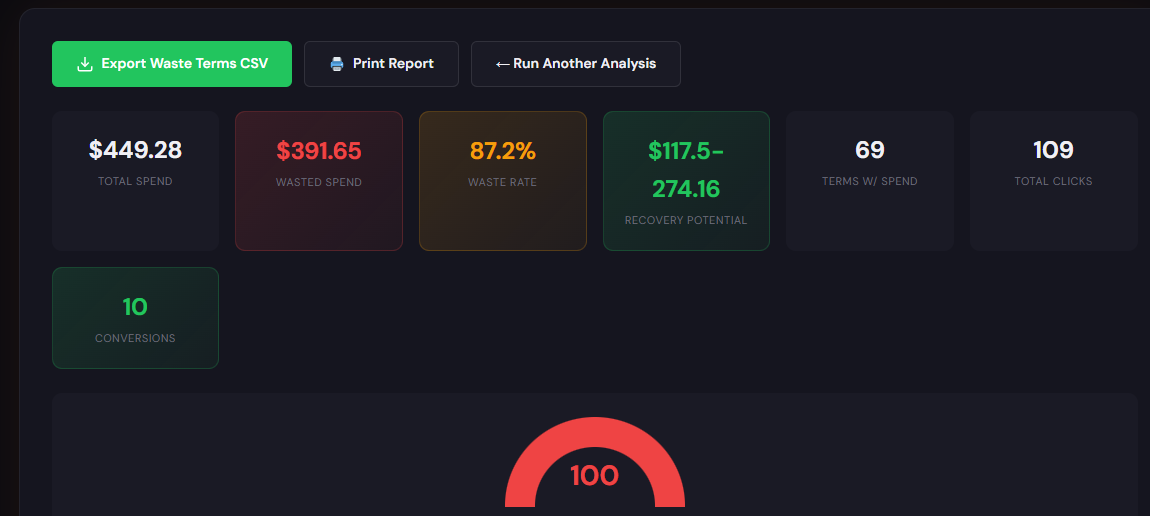
    Dashboard-style snapshot showing waste totals, top leakage areas, and a recovery plan summary

    What it outputs: an account-level snapshot showing total wasted spend, top leakage categories (search terms, placements, demographics), and a prioritized recovery plan.

    How to use it (3 steps)

    • Upload account data or connect via export and run the snapshot to get a waste total and breakdown.
    • Download the recovery plan: negative keyword suggestions, placement blocks, and budget reassignments.
    • Apply top-3 recovery actions this week and re-run snapshot after 7–14 days to measure reclaimed spend.
    Open Wastage Snapshot & Recovery

    Search Term Analyzer (Bid Adjustment by Search Term)

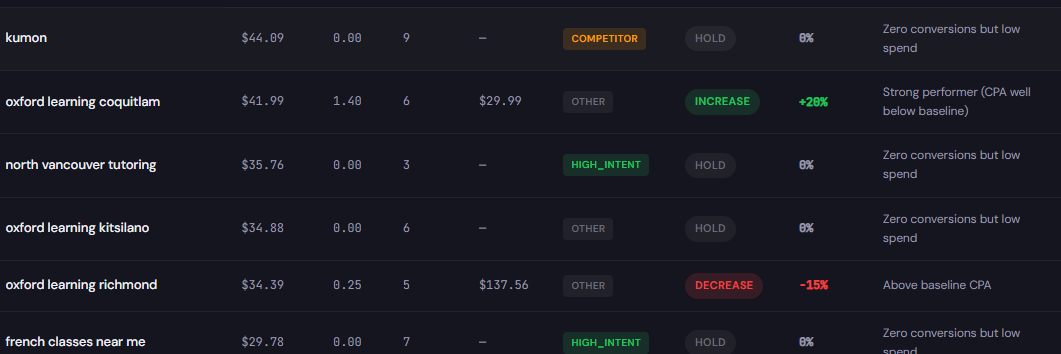
    Search term analyzer output table showing spend, conversions, tags, and recommended bid actions

    What it outputs: a table of search terms with spend, conversion metrics, intent tags, and suggested actions (negative, reduce bid, increase bid).

    How to use it (3 steps)

    • Feed your search-terms export into the tool and tag rules (e.g., CPA thresholds, intent keywords).
    • Review suggested actions; bulk-generate a negative keyword list and a CSV of bid adjustments for Google Ads Editor.
    • Apply negatives and upload the bid adjustments; monitor the impact on CPA within a week.

    Open Search Term Analyzer

    90-minute account triage playbook

    Run this in a single focused block to capture quick wins and create an action queue.

    1. 0–10 min: Pull account snapshot—monthly spend, top campaigns, and conversion trends.
    2. 10–30 min: Run Wastage Snapshot to get leakage categories and a recovery plan (export results).
    3. 30–60 min: Export search terms (last 30–90 days) and run Search Term Analyzer to get negatives and bid recommendations.
    4. 60–75 min: Apply top negatives and upload bid adjustments via Google Ads Editor for the most wasteful campaigns.
    5. 75–90 min: Align top 5 ad headlines with landing pages (quick edits) and schedule a 7-day recheck to measure improvement.
    Start the 90-minute triage

    Use ExecWrite to automate the snapshot and search-term analysis so your 90-minute run produces action-ready files and recovery steps.

    Run your triage at ExecWrite

    FAQ

    Q: How much waste can I expect to find?

    Typical initial audits show 5–20% recoverable spend depending on account hygiene. The exact amount depends on match-type usage, negative keyword history, and automated bid behavior.

    Q: Will adding negatives hurt reach?

    Not if you apply negatives based on performance thresholds. Targeted negatives remove low-intent traffic and usually improve conversion rate and ROAS.

    Q: How often should I run these audits?

    Weekly lightweight hygiene checks for negatives and placements, with a full snapshot monthly or after major campaign changes.

    Q: Can automated bidding coexist with these fixes?

    Yes—these fixes provide cleaner data signals so automated bidding can perform better. Treat automation as a consumer of clean signals, not a substitute for account hygiene.

    Sources

  • Why is my Google Ads (PPC) account wasting budget?

    PPCGoogle AdsMarketing Ops

    If your Google Ads account feels like it’s bleeding budget with little to show, this guide gives a straight, testable triage routine and quick fixes. Use these steps with ExecWrite tools to find waste fast and make bids and keyword lists actionable — start at ExecWrite.

    TL;DR
    • Wasted spend usually comes from keyword mismatch, bad bid timing, and poor ad-to-page relevance.
    • Run a 90-minute triage, fix the top 3 leak sources, then use a repeatable tool-backed workflow.
    • ExecWrite’s Wastage Snapshot and Search Term Analyzer make audits and bid fixes fast and export-ready.

    Why PPC feels harder now

    Paid media managers face higher CPCs, more automation black boxes, and vaguer signals from platforms. That combination means small structural problems magnify: a few poorly matched keywords, wrong time-of-day bids, or low relevance landing pages can turn profitable accounts into budget sinks.

    This article focuses on reliable, repeatable fixes — not broad strategy debates. Use the checklist and the two ExecWrite tools introduced below to convert audit findings into actions.

    The 5 biggest PPC problems marketers face

    1) Keyword-level waste (poor intent match)

    Symptoms

    • High spend on queries with low conversion rate.
    • Many one-off search terms with wasted cost.
    • Broad-match keywords pulling irrelevant traffic.

    Why it happens

    Accounts often scale with broad match or large keyword sets without prescriptive negatives or intent buckets. Over time the signal-to-noise ratio collapses and spend flows to unrelated searches.

    Fix this week

    • Export search term report for last 30 days; sort by cost and conversion rate.
    • Tag top wasted terms as negatives and add high-intent modifiers to winners.
    • Pause or tighten the match type on keywords with high CPA and no conversions.

    2) Timing and dayparting errors

    Symptoms

    • CPA spikes at specific hours or days.
    • Conversions cluster in a narrow window but bids stay flat.

    Why it happens

    Many accounts never test hour-of-day adjustments or rely on automated bidding without providing time signals. That lets wasted clicks accumulate when conversion likelihood is low.

    Fix this week

    • Pull hourly performance and identify high-CPA hours.
    • Apply -20% to -50% bid adjustments for proven low-conversion hours (test conservative first).
    • Increase bids only in top-converting time windows.

    3) Landing page mismatch (low Quality Score)

    Symptoms

    • Low CTR and low conversion rate despite decent traffic.
    • High impression share lost to rank, not budget.

    Why it happens

    Ad copy that promises one thing and landing pages that deliver another cause both poor QS and wasted traffic. Automated bidding then amplifies the cost of those mismatches.

    Fix this week

    • Audit top-performing keywords and confirm headline + offer parity on landing pages.
    • Test one landing page headline and CTA rewrite for the worst-performing ad group.
    • Use structured experiment (A/B) on the highest-traffic ad group first.

    4) Overbidding on low-value conversion paths

    Symptoms

    • High conversion counts but low downstream revenue or high return rates.
    • Automated bidding optimizes for actions that don’t equal business value.

    Why it happens

    Conversion tracking often captures micro-conversions (downloads, sign-ups) that don’t map to revenue. Bids rise around these signals unless value-based bidding is implemented.

    Fix this week

    • Segment conversions by revenue impact and deprioritize low-value actions in bidding strategy.
    • Adjust target CPA/ROAS to include only valuable conversions where possible.
    • Set up offline conversion imports for sales-qualified leads.

    5) Fragmented account structure and poor naming

    Symptoms

    • Hard to run filters or create scripts; repeated mistakes across campaigns.
    • Reports require heavy cleanup before you can act.

    Why it happens

    Rapid scaling, multiple handoffs, and inconsistent conventions make routine audits slow and error-prone.

    Fix this week

    • Standardize naming for campaigns/ad groups/labels for one product line.
    • Apply account-level labels for tests and control groups.
    • Create a one-page naming and tagging cheat sheet for your team.

    Fixes you can apply this week

    • Run a search-term-driven negative keyword pass on the last 30 days.
    • Export hourly performance and set conservative daypart bid adjustments.
    • Identify top 3 ad groups by spend and test landing-page headline parity.
    • Map conversions to revenue and deprioritize non-revenue micro-actions in bidding.
    • Standardize names and labels for easy filtering and automation.
    Run an automated audit and get a recovery plan

    Use ExecWrite’s Wastage Snapshot to identify top leakage areas and a prioritized recovery plan in minutes.

    Start at ExecWrite

    Tool-based workflow

    This section maps the biggest problems above to two focused ExecWrite tools. Each tool output and a 3-step usage pattern to convert findings into changes.

    Wastage Snapshot & Recovery — find budget leaks fast

    Dashboard-style snapshot showing waste totals, top leakage areas, and a recovery plan summary

    What it outputs: Account-wide waste totals, top leakage categories (search terms, audiences, device/time), and a prioritized recovery checklist.

    How to use (3 steps)

    • Upload or connect your account and generate the snapshot to get a ranked list of leakage items.
    • Apply the tool’s suggested negatives, budget shifts, and quick landing-page fixes to the top 5 leakage items.
    • Export a recovery plan CSV for batch updates via Google Ads Editor or your manager.

    Open Wastage Snapshot

    Search Term Analyzer — keyword-level fixes and bid actions

    Search term analyzer output table showing spend, conversions, tags, and recommended bid actions

    What it outputs: A table of search terms with spend, conversions, recommended tag (negative/keep), and suggested bid actions.

    How to use (3 steps)

    • Export your Search Terms report and feed it to the tool; it tags terms by intent and spend impact.
    • Apply recommended negatives and conservative bid adjustments (hourly or keyword-level) for the top-waste terms.
    • Re-run weekly and export the update list for Google Ads Editor upload.

    Open Search Term Analyzer


    90-minute account triage playbook

    Use this focused, timed routine to find and fix the biggest leaks in one session.

    • Minute 0–10: Connect account and run a Wastage Snapshot. Note the top 5 leakage categories.
    • Minute 10–25: Export search term and hour-of-day reports for the last 30 days.
    • Minute 25–40: Apply immediate negatives for the top 10 wasteful search terms (pause in account; log changes).
    • Minute 40–55: Use the Hourly Bid Adjuster (within the bid tool family) to set conservative -20% to -40% during low-conversion hours identified in your report.
    • Minute 55–75: Open the Quality Score Optimizer or manually check top ad groups for headline/landing page mismatch; draft one headline/CTA rewrite per ad group.
    • Minute 75–90: Export CSVs for Editor and schedule batch updates. Document the changes and set a 7-day review to measure impact.

    Next steps and automation

    After the triage, create a weekly snapshot cadence and automate exports into your reporting tool. Use small, repeatable experiments (10–15% traffic) when testing landing pages or major bid-cap changes.

    Run a guided recovery plan

    Try the Wastage Snapshot plus Search Term Analyzer together to get prioritized negatives, bid adjustments, and an exportable recovery CSV.

    Open the Wastage Snapshot

    FAQ

    How quickly will I see improvements after applying negatives?

    Expect to see CTR improve and wasted clicks fall within 3–7 days. Conversion and CPA improvements depend on traffic volume; use a 7–14 day window to properly measure impact.

    Can automated bidding undo my manual fixes?

    Automated bidding will react to the new signals, which is why conservative changes and a testing window matter. Use value-based targets where possible and feed cleaner conversion data after fixes.

    What’s the minimum data needed to use these tools?

    Tools work with as little as 30 days of account-level data. Higher-volume accounts will get faster statistical confidence, but the audit patterns are useful even for lower-volume accounts.

    Should I pause low-performing keywords immediately?

    Pause only the worst offenders. Prefer tagging and moving into a negatives list for review. Use conservative pauses and track impact — sudden removals can reduce impressions and costs but also limit learning for automated bids.

    Sources

    Ready to reclaim budget and turn audits into action? Start a recovery snapshot and search-term clean-up at ExecWrite.

  • Why is my Google Ads account losing ROI? Practical PPC fixes

    PPCGoogle AdsMarketing Ops

    If your Google Ads account feels like it’s getting more expensive for less return, this guide gives a practical triage, quick fixes you can run this week, and a tool-based workflow using ExecWrite to reclaim wasted spend and scale sustainably. Try a fast snapshot at ExecWrite to baseline your account.

    TL;DR
    • Most performance drops come from leakage: wasted keywords, time-of-day swings, and landing-page mismatch.
    • Fix these in one week with targeted negative keywords, ad schedule tweaks, and a landing-page quality check.
    • Use ExecWrite’s Wastage Snapshot and Free AI Keyword Generator to find waste and rebuild campaigns faster.

    Why PPC feels harder now

    Competition, automated bidding, and noisy data make execution riskier. Advertisers see the same metrics—CPC, CPA, ROAS—but fewer clear levers that consistently move them. That raises three operational stresses: diagnosis takes too long, fixes are partial, and automation hides root causes.

    Diagnosis needs to be fast and repeatable. This article focuses on repeatable checks, what to fix quickly, and how to use two ExecWrite tools to shorten the feedback loop.

    The 5 biggest PPC problems marketers face

    1) Wasted spend on low-intent search terms

    Symptoms

    • High spend with few conversions from many search terms.
    • Low click-through rates on broad modifier queries.
    • Conversion rates drop when account-level volumes increase.

    Why it happens

    Broad match and loose keyword structuring capture irrelevant queries. Without frequent search-term audits, negative keywords lag, and spend flows to low-intent queries.

    Fix this week

    • Run a 30-day search-term export and flag terms with spend > X and conversions = 0.
    • Add high-frequency negatives to exact match exclusions and campaign negatives.
    • Temporarily pause or reduce bids for query patterns that are low intent (e.g., “free”, “cheap”, unrelated brand names).

    2) Hourly/daypart performance swings

    Symptoms

    • CPA or ROAS varies dramatically by hour of day or day of week.
    • Automated bidding cycles amplify swings instead of smoothing them.
    • Conservative ad schedules were never rebuilt after market shifts.

    Why it happens

    Bidding algorithms react to recent signals; if conversion windows change by hour, the algorithm chases noise. No hour-level analysis means missed bid adjustments and poor dayparting.

    Fix this week

    • Pull hour-of-day performance for the last 30–90 days and identify the top/bottom 3 hours by CPA.
    • Set +/− bid modifiers for clear high-value hours and cut bids for low-performing hours.
    • Freeze auto-bids while hour modifiers ramp to avoid compounded adjustments.

    3) Landing-page mismatch / Quality Score drops

    Symptoms

    • Impression share drops without major bid changes.
    • Quality Score components—expected CTR, ad relevance, landing page—are low.
    • Landing pages that previously converted now have lower conversion rates.

    Why it happens

    Creative drift and messaging mismatch between ad copy and landing pages erode Quality Score. Even small discrepancies (CTA wording, headline) can reduce relevance.

    Fix this week

    • Map top-performing keywords to the landing pages they send traffic to.
    • Align headlines and primary CTAs to the keyword intent for high-volume groups.
    • Run an A/B test focusing on headline and above-the-fold CTA alignment for the worst-performing ads.

    4) Poor keyword structure and account drift

    Symptoms

    • Campaigns with mixed intent across ad groups.
    • Excessive single broad-match keywords covering many intents.
    • High overlap and internal competition between campaigns.

    Why it happens

    Quick fixes and incremental edits over time create structural debt. Without periodic restructuring, performance degrades and attribution blurs.

    Fix this week

    • Group keywords by intent and create tight ad groups (3–10 keywords each).
    • Change top offending broad-match keywords to phrase/exact and add negatives to prevent overlap.
    • Export a simple campaign CSV for cleanup and future bulk edits.

    5) Automation mask: algorithms hide root causes

    Symptoms

    • Automated bidding makes a sudden bid change and performance drops, but the reason isn’t reported.
    • Performance recovers or deteriorates randomly, dependent on bid strategy.

    Why it happens

    Automation optimizes for the metric you set, not for structural health. It can cover symptoms while the underlying issues persist.

    Fix this week

    • Switch a test subset of high-volume campaigns to manual or enhanced CPC for 7–14 days to observe direct effects.
    • Document changes and rollback windows so you can attribute effects to the right levers.
    • Use conservative automation with clear guardrails (max CPC/CPA caps).

    Fixes you can apply this week

    • Run a search-term waste audit: add negatives for high-spend zero-conversion queries.
    • Pull hour-of-day data and add bid modifiers for top/bottom hours.
    • Map ads-to-landing pages for top 20% of spend and align headlines + CTAs.
    • Group keywords by intent and export cleaned campaign structures for bulk edits.
    • Temporarily test manual bidding on a controlled sample to reveal automation side-effects.
    Run a fast waste snapshot

    Use a fast account snapshot to find wasted spend and get a prioritized recovery plan in minutes.

    Start a snapshot at ExecWrite

    Tool-based workflow: map problems to ExecWrite tools

    Below are two high-impact tools from ExecWrite that map directly to the problems above. Each section shows what the tool outputs and how to use it in three pragmatic steps.

    Wastage Snapshot & Recovery

    Wastage snapshot output showing waste totals and leakage areas

    What it outputs

    • Dashboard-style snapshot with total wasted spend, top leakage areas, and a recovery plan summary.
    • Quick list of negative keyword recommendations and budget reallocation suggestions.

    How to use it (3 steps)

    1. Connect or upload a search-term and performance export to the Wastage Snapshot.
    2. Review the top 5 leakage areas and apply the recommended negative-sets and budget reallocations.
    3. Export the recovery plan and run the recommended changes in a controlled rollout (10–20% traffic first).

    Open the Wastage Snapshot & Recovery tool

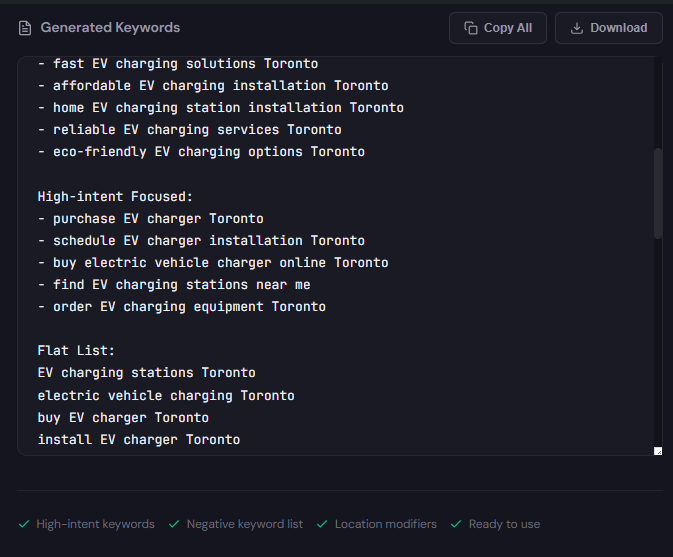
    Free AI Keyword Generator

    Keyword generator output list

    What it outputs

    • Structured keyword sections: high-intent keywords, long-tail modifiers, and negative keyword suggestions.
    • Campaign-ready grouping suggestions and CSV export for Google Ads Editor.

    How to use it (3 steps)

    1. Paste your seed keywords or landing page URL into the generator.
    2. Review grouped outputs and accept high-intent lists; add suggested negatives.
    3. Export the campaign-ready CSV and import to Google Ads Editor to rebuild tightly themed ad groups.

    Try the Free AI Keyword Generator

    90-minute account triage playbook

    Follow this time-boxed playbook to get a clear diagnosis and actions within 90 minutes.

    1. 0–10 min: Pull top-line metrics (last 30 days vs previous 30). Identify the worst KPIs (CPA, ROAS, impressions).
    2. 10–30 min: Run a search-term export and sort by spend with conversions = 0. Flag top 10 terms to add as negatives.
    3. 30–50 min: Pull hour-of-day report. Mark top 3 high-value and bottom 3 low-value hours for bid modifiers.
    4. 50–70 min: Map the top 20% of spend to landing pages. Note headline/CTA mismatches.
    5. 70–85 min: Implement negatives, schedule hour modifiers, and pause the top low-intent terms. Document changes.
    6. 85–90 min: Run the ExecWrite Wastage Snapshot for a validation report and export the recovery plan.

    FAQ

    How fast will I see results after adding negatives?

    You should see CTR and conversion-rate improvements within 24–72 hours, but allow 7–14 days for stable statistical effects as automation and attribution align.

    Can I trust automated bidding after fixes?

    Yes, but only after structural issues (negatives, ad/landing alignment, hour modifiers) are fixed. Reintroduce automated bids on a test subset first.

    How often should I run a wastage snapshot?

    Monthly for active accounts, bi-weekly for high-spend or rapidly changing campaigns.

    Will the keyword generator replace my keyword research?

    No. Use the Free AI Keyword Generator to accelerate structured lists and negative ideas, then validate with your account data and search-term history.

    Start reclaiming wasted spend

    Run a snapshot and get an actionable recovery plan in minutes. Use the results to feed the keyword generator and rebuild clean campaigns.

    Run an ExecWrite snapshot

    Sources

  • Why is my Google Ads (PPC) account underperforming?

    PPC Google Ads Marketing Ops

    If your account feels noisy — spending more without commensurate leads — start with an operational audit and targeted fixes. This article outlines a repeatable triage, week-one fixes, and how two ExecWrite tools can turn audit findings into immediate bid and recovery actions. Learn more at ExecWrite.

    TL;DR — What to do this week
    • Run a wastage snapshot to find top leak sources and recover budget fast.
    • Use search-term bid adjustments to stop bidding on low-value queries and raise bids where intent is high.
    • Follow a 90-minute triage playbook to create prioritized fixes and capture quick ROI wins.

    Why PPC feels harder now

    Expectations are higher, automation is ubiquitous, and account complexity has exploded. Advertisers juggle automated bidding, inconsistent search intent, and multiple landing experiences — while leadership still expects predictable CPA/ROAS. The result: more spend, more variance, and less signal where you need it most.

    The 5 biggest PPC problems marketers face

    1. Wasted spend and budget leakage

    • Symptoms: rising CPC with flat or falling conversions, unexplained daily spend spikes, or many low-intent conversions.

    Why it happens — Campaigns inherit historical targeting and bids that no longer match business goals. Automation masks leakage by smoothing spend without handling intent or negative match needs.

    Fix this week

    • Pull a 30-day wasted spend snapshot (top campaigns, keywords, and placements).
    • Pause or reduce budgets on top leakage sources and add negative keywords.
    • Redirect recovered budget to high-converting ad groups for controlled experiments.

    2. Poor search-term control

    • Symptoms: irrelevant query clicks, low click-to-conversion rate, and frequent “close variants” wasting higher CPC.

    Why it happens — Broad match and loosely structured ad groups expose accounts to noisy queries. Without systematic search-term analysis, negative keywords and bid posture lag far behind.

    Fix this week

    • Export last 30 days of search terms, tag by intent, and add top negatives immediately.
    • Move high-intent terms into Exact/Phrase ad groups with tailored ads and landing pages.
    • Apply search-term-level bid adjustments for high-value queries.

    3. Hourly and dayparting swings

    • Symptoms: predictable hour-of-day CPA spikes, wasted impression share at low-intent times, or missed peaks.

    Why it happens — Generic ad scheduling and global bidding policies ignore local buying rhythms. Automated bidding can be slow to react to intra-day trends.

    Fix this week

    • Analyze performance by hour and tighten schedules for low-performing windows.
    • Apply conservative bid multipliers during low-conversion hours; increase during high-value hours.
    • Monitor for 3–5 days and revert if automation rebalances incorrectly.

    4. Quality Score and landing-page mismatch

    • Symptoms: low quality scores, high CPC for keywords that should be cheap, low landing-page conversion despite good CTR.

    Why it happens — Messaging drift between ad copy and landing pages reduces perceived relevance. Quality Score penalties cascade into higher costs across the account.

    Fix this week

    • Audit top ad groups for headline/landing-page alignment and mismatched CTAs.
    • Deploy targeted landing page copy tweaks and run A/B tests on one high-traffic ad group.
    • Report Quality Score impact weekly and prioritize pages that move the needle.

    5. Broken account structure and keyword cannibalization

    • Symptoms: duplicate keywords across ad groups, poor ad relevance, and automated bidding bouncing between conflicting signals.

    Why it happens — Over time multiple managers, quick fixes, and automation generate structural entropy. Conflicting keywords and overlapping audiences confuse learning systems.

    Fix this week

    • Consolidate duplicate keywords and enforce one-topic-per-ad-group discipline for top traffic areas.
    • Use campaign-level negatives to prevent cross-campaign cannibalization.
    • Document a structure baseline and freeze structural changes during experiments.

    Fixes you can apply this week

    • Run a rapid wastage audit (30–90 days) and list top 10 leakage items by spend.
    • Apply immediate negatives for top 20 irrelevant queries and pause non-performing placements.
    • Promote high-intent search terms to tighter match types with tailored ads and 10–20% bid increases.
    • Implement hour-of-day bid multipliers for clear peaks and push conservative caps for low-value hours.
    • Align ad headlines and landing pages for the top 5 converting ad groups and measure Quality Score changes.
    Recover wasted spend fast

    Run a Wastage Snapshot to find the highest-impact leak points and generate a prioritized recovery plan you can action in hours.

    Run Wastage Snapshot


    Tool-based workflow: map problems to ExecWrite tools

    Wastage Snapshot & Recovery — what it outputs

    Wastage snapshot dashboard showing waste totals and recovery plan

    Outputs a dashboard-style snapshot listing total wasted spend, top leakage dimensions (queries, placements, campaigns), and an actionable recovery plan with prioritized fixes.

    How to use it in 3 steps

    1. Upload a 30–90 day export or connect your account; run the snapshot to get leakage totals.
    2. Review the top 5 leak sources and apply recommended negative keywords and campaign pauses.
    3. Download the recovery checklist and assign actions to owners; re-run weekly to measure recovered budget.

    Open the Wastage Snapshot


    Search Term Analyzer — what it outputs

    Search term analyzer output table showing spend, conversions, tags, and recommended bid actions

    Generates a table of search terms with spend, conversions, suggested tags (intent), and recommended bid actions at the search-term level.

    How to use it in 3 steps

    1. Export search-term report and import into the Search Term Analyzer.
    2. Tag queries by intent and accept recommended bid adjustments for high-intent winners and negatives for losers.
    3. Export bid adjustments and apply via Google Ads Editor or the API for faster rollouts.

    Open the Search Term Analyzer

    90-minute account triage playbook

    Use this timed agenda to convert auditing into prioritized actions.

    • 0–10 min: Pull top-level KPIs (cost, conv., CPA, CRO) and spot obvious spend spikes.
    • 10–30 min: Run Wastage Snapshot to identify top 5 leakage areas.
    • 30–50 min: Export top search terms and load into Search Term Analyzer; tag top negatives and winners.
    • 50–70 min: Apply immediate fixes — top negatives, pause worst placements, and adjust budgets.
    • 70–90 min: Set up monitoring (hourly checks for 48–72 hrs) and create a prioritized task list: landing page tweaks, QC on Quality Score, and structure fixes.
    Start a rapid audit

    Begin with a Wastage Snapshot and a Search Term Analyzer pass to create a prioritized recovery plan and bid adjustments you can apply in hours.

    Start at ExecWrite


    FAQ

    How fast will I see improvements after applying these fixes?

    You should see reduced wasted spend and improved CPA within 48–72 hours for immediate negatives and budget pauses. Quality Score and conversion-rate improvements typically take 1–3 weeks to stabilize.

    Can automated bidding undo manual adjustments?

    Yes. Apply conservative caps and monitor for 3–7 days. If automation rebalances too aggressively, switch to a more constrained bidding strategy while you stabilize signals (quality, conversions, and structured keywords).

    Which tool should I run first?

    Start with the Wastage Snapshot to identify top leak points, then use the Search Term Analyzer to act on query-level fixes and bid adjustments.

    Do these tools work with Google Ads Editor or the API?

    Yes. Outputs are export-ready for Google Ads Editor and formatted for quick API or bulk upload. Use the Search Term Analyzer export for direct bid adjustment uploads.


    Sources

  • Is my PPC wasting budget? How can I fix Google Ads performance fast?

    PPCGoogle AdsMarketing Ops

    Is my PPC wasting budget — and what can I do about it this week?

    If your account shows rising costs, unstable ROAS, or strange conversion patterns, this article gives a practical triage, weekly fixes, and a tool-led workflow you can run with ExecWrite to recover wasted spend fast. Learn how to find leaks, stop low-value traffic, and tune bids with repeatable steps. Visit ExecWrite for the tools discussed below.

    TL;DR
    • Three immediate checks: waste snapshot, search-term review, and hour-of-day bid swings.
    • Run the Wastage Snapshot, then the Search Term Analyzer to build negatives and bid rules.
    • 90-minute triage script included—prioritize fixes that recover budget in days.

    Why PPC feels harder now

    Automation and data privacy changed the inputs; margins are thinner and human oversight is still required. Algorithms move budgets quickly, platform defaults can inflate spend, and signals you relied on (cookies, click-level attribution) are noisier. That means routine maintenance—search-term hygiene, dayparting, quality-score fixes—matters more than ever.

    The 5 biggest PPC problems marketers face

    1) Wasted spend from low-value queries

    Symptoms:

    • High click volume from queries with zero conversions.
    • High cost on broad or discovery queries that never lead to sales.
    • Spikes in spend after campaign or keyword additions.

    Why it happens

    Broad match and automated match types expand reach quickly. Without regular search-term reviews and negative lists, low-intent queries will siphon budget.

    Fix this week

    • Run a 30–90 day search-term export and sort by cost > 0 conversions.
    • Add negatives for clear non-buying intent and misaligned modifiers.
    • Move expensive broad-match winners into phrase/exact or dedicated campaigns for control.

    2) Poor ad-to-landing relevance (Quality Score leaks)

    Symptoms:

    • High CPC but low impression share on key queries.
    • CTR under benchmark for your vertical despite matched keywords.
    • Landing page conversion rate falling while clicks rise.

    Why it happens

    Ad copy and landing pages drift apart as campaigns scale. Quality Score penalties raise costs and lower eligibility.

    Fix this week

    • Audit top 20 keywords by spend for ad/landing page mismatch.
    • Rewrite headlines to mirror top-performing search terms.
    • Test a landing page variation that matches primary ad messaging.

    3) Time-of-day and dayparting inefficiencies

    Symptoms:

    • Hours with high spend and poor CPA/ROAS.
    • Conversions clustered in specific windows but default bids across all hours.
    • Manual bid changes chasing noisy hourly performance.

    Why it happens

    Accounts often use uniform ad schedules or conservative dayparting. Without hourly diagnostics, you’re bidding the same when conversion likelihood changes.

    Fix this week

    • Analyze hour-of-day CPA and conversion rates for the last 30 days.
    • Apply -20% to hours with CPA 30% worse than account average; +10–20% to top-performing windows.
    • Monitor for 7 days and iterate rather than making aggressive blanket changes.

    4) Poor keyword structure and cross-contamination

    Symptoms:

    • Ad groups with dozens of unrelated keywords.
    • High-cost keywords cannibalizing each other.
    • Low click-through and inconsistent KPIs across ad groups.

    Why it happens

    Rapid expansion without a clear structure creates mixed intent ad groups that confuse machine learning and reduce relevance.

    Fix this week

    • Segment broad themes into single-intent ad groups (3–5 keywords each).
    • Create negative keyword lists at campaign level to avoid overlap.
    • Use a campaign generator to rebuild a targeted structure when needed.

    5) Attribution noise and conversion tracking gaps

    Symptoms:

    • Conversion counts change after tag edits or platform updates.
    • ROAS fluctuates wildly after privacy or tracking changes.
    • Unclear which campaigns truly drive pipeline.

    Why it happens

    Server-side tagging, changes to third-party cookies, and mismatched conversions between platforms create inconsistent signals that automation misreads.

    Fix this week

    • Validate primary conversion events and create a backup goal-based conversion.
    • Compare platform conversions vs CRM closes for a sample period.
    • Flag campaigns for manual review if attribution shifts more than 20% week-over-week.

    Fixes you can apply this week

    • Run a Wastage Snapshot to identify top leakage areas by spend and impact.
    • Export search terms (30–90 days), tag the high-cost/zero-conversion rows, add negatives immediately.
    • Build an hourly bid adjustment table and apply conservative hour modifiers for the next 7 days.
    • Segment high-spend keywords into tightly themed ad groups and update ad copy to match.
    • Prioritize conversion-tracking validation for campaigns with >20% performance variance.
    Run a quick waste audit

    Use the Wastage Snapshot to find top budget leaks and a recovery checklist you can act on in under an hour.

    Run the Wastage Snapshot

    Tool-based workflow: map the fixes to ExecWrite tools

    Wastage Snapshot & Recovery

    Wastage snapshot dashboard showing waste totals and recovery plan

    What it outputs: a dashboard-style snapshot listing total wasted spend, top leakage categories (search terms, placements, campaigns), and a prioritized recovery plan.

    How to use it (3 steps)

    1. Run the snapshot against the last 30–90 days to get leakage by bucket.
    2. Export the recovery plan and apply the top 3 negative keyword and budget recommendations.
    3. Re-run after 7 days to measure recovered spend and iterate.

    Open Wastage Snapshot

    Search Term Analyzer (Bid Adjustment by Search Term)

    Search term analyzer output table showing spend, conversions, tags, and recommended bid actions

    What it outputs: a prioritized table of search terms with spend, conversions, and suggested actions (negative, bid down, bid up, move to exact).

    How to use it (3 steps)

    1. Upload keyword/search-term export; flag queries with cost and zero conversions.
    2. Apply suggested negatives and build a short-list of candidate exact-match moves.
    3. Create bid rules from the recommendation column for automation or manual adjustments.

    Open Search Term Analyzer


    90-minute account triage playbook

    Run this script live with a teammate. The goal: identify 3 actions that recover budget and 2 that improve conversion signal within 90 minutes.

    • 0–10 min: Open Wastage Snapshot to surface top 3 leakage areas.
    • 10–30 min: Export search terms for the top leakage campaign; run Search Term Analyzer and add immediate negatives (apply the top 10 now).
    • 30–50 min: Pull hour-of-day performance and set conservative bid modifiers for worst-performing hours (-20%) and best hours (+10%).
    • 50–70 min: Segment any ad groups with >20 unrelated keywords; write 1 new ad per high-spend keyword with matched headline.
    • 70–85 min: Validate primary conversion event and run a quick CRM match sample if available.
    • 85–90 min: Document the three immediate actions, assign owners, and schedule a 7-day check-in.
    Start a recovery run now

    Execute the triage playbook with ExecWrite’s Snapshot and Analyzer to recover budget quickly.

    Launch ExecWrite tools

    FAQ

    How fast will I see recovered budget?

    If you act on high-impact negatives and hour bids, you can see immediate reduction in wasted clicks within 48–72 hours. True ROAS recovery may take 7–14 days as automation stabilizes.

    Can I automate the bid adjustments?

    Yes. Use the bid recommendations from the Search Term Analyzer and the hourly bid table as rules in your bidding system or apply them via scripts. Start conservatively and monitor.

    Do these tools require account access?

    The tools accept exported reports (search terms, performance by hour) — you don’t need account-level API access for quick audits. For continuous automation, connector options are available on ExecWrite.

    Will fixing quality score really lower my CPC?

    Improving ad relevance and landing-page alignment typically reduces CPC and increases impression share. Fixes targeted at your top-spend keywords yield the fastest impact.

    Sources

  • Why is my Google Ads performance slipping and how do I fix it?

    PPCGoogle AdsMarketing Ops

    If Google Ads feels more expensive and less predictable than it used to, you need a focused, operational plan — not another theory doc. This post shows exactly what to audit, the quick fixes you can apply this week, and a tool-led workflow using ExecWrite to recover wasted spend and correct bid signals. Try the tools at ExecWrite as you follow these steps.

    TL;DR — What to do first
    • Run a wastage snapshot to find budget leaks and negative keyword opportunities within 30 minutes.
    • Audit search-term performance and apply targeted bid adjustments by term and hour to stop high-CPA bids.
    • Run a 90-minute triage: stop obvious waste, reallocate budget, fix poor landing relevance, and deploy quality-score fixes.

    Why PPC feels harder now

    Paid search used to be a predictable auction you could optimize with rules and structure. Today the auction is noisier: more competitors, more automated bidding layers, less clear third-party signal, and higher expectations for landing-page relevance. That mix amplifies normal account problems into performance crises.

    Key structural issues are not seasonal — they’re systemic. The right operational checks and the right lightweight tools get you back in control without guessing.

    The 5 biggest PPC problems marketers face

    1) Rising CPA and volatile CPCs

    Symptoms

    • Conversions cost is up week-over-week despite stable conversion rate.
    • CPC spikes at certain hours or on specific queries.
    • Automated bids chase cost without clear improvement.

    Why it happens

    Automatic bidding amplifies noisy or misleading signals when account structure is weak or when irrelevant search terms siphon spend. Time-of-day, device or query-level swings often hide behind averaged metrics, so you bid up for bad traffic.

    Fix this week

    • Segment cost by hour and pause hours with high CPA.
    • Audit top-spending search terms and apply bid overrides or negatives.
    • Set conservative portfolio bid caps while you investigate.

    2) Wasted spend and leakage

    Symptoms

    • High spend with few conversions from low-intent queries.
    • Search terms that should be negative are still active.
    • Budget exhausted early in the day without meaningful results.

    Why it happens

    Accounts accumulate keyword bloat, poorly scoped match types, and missing negative lists. Campaigns then cannibalize each other and drain daily budgets on low-value traffic.

    Fix this week

    • Export top 200 search terms by spend and tag clear negatives.
    • Convert single broad-match high-spend terms into exact or phrase with tighter bids.
    • Reallocate budgets from leaking campaigns to top-performing ones.

    3) Poor account structure and keyword bloat

    Symptoms

    • Ad groups with dozens or hundreds of unrelated keywords.
    • Low click-through rates and weak ad relevance.
    • High-quality-score variance across similar queries.

    Why it happens

    Accounts grown over time without pruning create overlap and confusing signals for automated bidding. That drives inefficient auctions and low ad relevance.

    Fix this week

    • Group keywords by intent and landing page, not by history.
    • Pause or move low-CTR keywords into a negative list for testing.
    • Create tight, landing-page-driven ad groups for high-value intent.

    4) Automation misfires and signal gaps

    Symptoms

    • Smart bidding campaigns swinging wildly after policy or feed changes.
    • Conversions drop after a tracking tweak or site update.
    • Bids are raised for low-intent queries.

    Why it happens

    Automated systems need steady, accurate signal. Broken conversion tags, recent conversion-window changes, or mismatched events create poor optimization feedback.

    Fix this week

    • Verify conversion tags and recent tag changes; revert or fix if conversions fall.
    • Use bid caps and conservative targets while signals are noisy.
    • Isolate experiments to smaller budgets until data normalizes.

    5) Landing page relevance and Quality Score drops

    Symptoms

    • Click-through rates and conversion rates fall without CPC changes.
    • High impression share but poor conversion performance.
    • Ads show but landing pages have different messaging than ad copy.

    Why it happens

    Search engines reward tight ad-to-landing-page relevance. Messaging mismatches, slow pages, or weakened CTAs reduce Quality Score and raise costs.

    Fix this week

    • Align headlines and landing page H1s for top ad groups.
    • Run a quick A/B with a tuned landing headline and CTA.
    • Fix slow elements and remove intrusive interstitials.

    Fixes you can apply this week

    • 30-minute wastage snapshot: find top leakage and negatives.
    • 30-minute search-term audit: tag negatives, lower bids on wastey terms.
    • 15-minute hour-of-day review: pause high-CPA hours or apply negative hour adjustments.
    • 10-minute landing-page check: match top ad headlines to page H1 and CTA.
    • 5-minute bidding guardrails: apply bid caps to automated campaigns during triage.
    Run a quick wastage audit now

    Use a snapshot tool to find where your budget is leaking and get a prioritized recovery plan.

    Start a free snapshot at ExecWrite

    Tool-based workflow (map each pain point to ExecWrite tools)

    Wastage Snapshot & Recovery (best for waste & leakage)

    Wastage snapshot showing waste totals and recovery plan

    What it outputs: A dashboard-style snapshot that quantifies wasted spend, lists top leakage areas (search terms, campaigns, match types), and gives a prioritized recovery checklist.

    How to use it in 3 steps

    • Upload your account data and run the snapshot (30 minutes).
    • Review the top leakage items and export the negative keyword list.
    • Apply the recovery plan: pause leaking campaigns, add negatives, and reallocate budgets.

    Tool link: Wastage Snapshot & Recovery

    Bid Adjustment by Search Term — Search Term Analyzer (best for CPC swings and keyword fixes)

    Search term analyzer output table showing spend, conversions, tags, and recommended bid actions

    What it outputs: A table of search-term-level metrics with spend, conversions, CPA/ROAS, tags, and recommended bid actions that you can export to apply overrides or create negative lists.

    How to use it in 3 steps

    • Run the analyzer for your top-spending campaigns and filter by CPA and spend.
    • Tag high-CPA terms as negatives or set bid-reduction recommendations.
    • Export recommendations and apply via editor or automation rules.

    Tool link: Search Term Analyzer

    These two tools cover the majority of short-term fixes: the wastage snapshot finds where budgets leak, and the search-term analyzer turns noisy queries into explicit actions.

    90-minute account triage playbook

    1. 0–10 minutes: Lock down budgets: lower portfolio bids and add conservative caps.
    2. 10–40 minutes: Run the Wastage Snapshot. Export the top negative candidates and the recovery checklist.
    3. 40–60 minutes: Run the Search Term Analyzer on top-spending campaigns. Apply negative keywords and bid reductions for poor terms.
    4. 60–75 minutes: Fix landing-page relevance for your top 3 losing ad groups (headline alignment and CTA).
    5. 75–90 minutes: Reallocate freed budget to your top 2 performing campaigns and monitor hourly performance.

    Get the tools and start the triage

    Run the two-step workflow now and download actionable lists to apply in Google Ads Editor.

    Open ExecWrite and run your snapshot

    FAQ

    How fast can I see impact?

    Small wins (pausing leaks, applying negatives) can reduce wasted spend within a day. Meaningful CPA recovery typically appears within 3–7 days as bidding normalizes.

    Will automation undo my fixes?

    Automation can adapt. Use bid caps and conservative targets while you stabilize signals; once you’ve removed noise, automated bids perform better.

    What if conversions drop after changes?

    Rollback to the previous state, isolate the change in a test campaign, and verify conversion tracking. Most drops are tag or event misconfigurations.

    Are ExecWrite tools safe to use on live accounts?

    Yes. Tools produce exportable lists and recommendations you apply manually or via Editor. Start with a snapshot on a subset before full-scale changes.

    Sources

    Ready to run a recovery and stop wasting budget? Start the triage with ExecWrite: https://execwrite.com

  • Why is my Google Ads account underperforming?

    PPC
    Google Ads
    Marketing Ops

    If your account is losing efficiency, this is a hands-on operator’s guide. We map the five most common causes of underperformance and give checklist fixes you can run in a week. Try the tools at ExecWrite to speed audits and recover wasted spend.

    TL;DR
    • Most underperformance traces to wasted spend, bid misalignment, sloppy keyword structure, landing-page mismatch, or tracking gaps.
    • Run a focused 90-minute triage, apply three tactical fixes this week, and use two ExecWrite tools to automate audits and hourly bid adjustments.
    • Use the playbook below to recover budget, lift conversion rate, and stabilize bids within one audit cycle.

    Why PPC feels harder now

    Competition, automated bidding opacity, and shifting user intent have made performance less predictable. Platforms push automation but give less surface-level insight into where budget leaks occur. That means operators must be surgical: find waste, restore relevance, and control bids at times and queries that matter.

    The 5 biggest PPC problems marketers face

    Problem 1 — Wasted spend (budget leakage)

    Symptoms

    • High impressions and clicks with near-zero conversions on specific campaigns.
    • Large spend on broad-match or untagged search terms.
    • Conversion rate drops while CPCs remain steady or climb.

    Why it happens

    Broad targeting, missing negatives, and outdated match-type strategies let low-intent queries eat budget. Automation can amplify the problem by scaling spend to signals that don’t convert.

    Fix this week

    • Export search terms for the last 30 days and tag low-intent queries for negative keywords.
    • Pause underperforming broad-match ad groups; move high-potential queries into exact or phrase ad groups.
    • Implement device and location bid modifiers where CPA is worse than target.

    Problem 2 — Bid volatility and poorly timed bids

    Symptoms

    • CPA or ROAS swings hour-to-hour or day-to-day.
    • Automated strategies oscillate between aggressive and conservative without business input.
    • Ad schedule doesn’t reflect conversion timing (e.g., high spend overnight with no conversions).

    Why it happens

    Auto-bidding interprets noisy signals and can overreact to short-term trends. Without granular hourly adjustments or dayparting, you either overpay during low-value hours or miss volume during peak windows.

    Fix this week

    • Run an hour-of-day performance extract and flag hours with CPA > 2x target.
    • Apply negative bid adjustments for low-value hours and raise bids on proven hours by +10–30% incrementally.
    • Lock target ROAS/CPA ranges to avoid wide swings from a single day’s data.

    Problem 3 — Keyword and ad group structure leaks

    Symptoms

    • Ad groups with dozens or hundreds of unrelated keywords.
    • Low ad relevance scores and poor click-to-conversion rates.
    • High cost-per-conversion for long-tail queries buried in broad groups.

    Why it happens

    Quick account builds and bulk uploads create mixed-intent groups that dilute relevance. That drives down Quality Score and inflates CPCs.

    Fix this week

    • Split ad groups by intent clusters (commercial, navigational, informational).
    • Create tightly themed ad copy and landing pages per cluster.
    • Add negatives at campaign level for common mismatches found in your search terms export.

    Problem 4 — Landing page mismatch (Quality Score and CVR drops)

    Symptoms

    • High impression share but low conversion rate on specific ads or keywords.
    • High bounce rates from paid traffic with short session times.

    Why it happens

    Ads promise one thing and landing pages deliver another. Even small headline or CTA misalignments cause relevance penalties and conversion friction.

    Fix this week

    • Match headline language and the primary CTA between ad copy and landing page.
    • Run quick A/Bs on one high-traffic landing page element (headline or hero CTA).
    • Implement session recordings or funnel event tracking for pages with highest paid traffic.

    Problem 5 — Tracking and attribution blindspots

    Symptoms

    • Conversions are missing or show a sudden drop after platform updates.
    • Offline conversions and CRM events aren’t linked to campaigns.

    Why it happens

    Broken tags, changes in tracking scripts, and unconnected CRM imports produce bad signals. Bidding systems then optimize to incomplete data.

    Fix this week

    • Validate conversion tags and test with real events.
    • Reconcile CRM leads to Google conversions for a recent 14–30 day window.
    • Set up distinct conversion actions for online and offline funnels.

    Fixes you can apply this week

    • Export search terms + tag negatives (30–60 minutes).
    • Run hour-of-day CPA split, apply conservative bid adjustments for the worst 3 hours (20–40 minutes).
    • Split 2–3 mixed ad groups into tighter intent clusters and update 1 ad per new group (60–90 minutes).
    • Validate top 3 conversion actions and reconcile CRM data for sample leads (30–60 minutes).
    • Run a landing-page headline alignment test on the top paid landing page (set hypothesis and launch A/B in one afternoon).
    Run an automated waste and bid check now

    Use a snapshot audit to find wasted spend and an hourly bid table to fix dayparting quickly.

    Start at ExecWrite

    Tool-based workflow — map problems to ExecWrite tools

    Tool: Wastage Snapshot & Recovery

    Wastage snapshot dashboard showing waste totals and recovery plan

    What it outputs: A dashboard-style snapshot that quantifies wasted spend, identifies top leakage areas (search terms, campaigns, devices), and produces a prioritized recovery plan.

    How to use it — 3 steps

    • 1) Upload or connect your account data to generate the snapshot. The tool highlights top wasted queries and campaigns.
    • 2) Export the recovery checklist (negatives, pauses, budget reallocations) and assign actions to owners.
    • 3) Re-run after 7–14 days to measure recovered budget and incremental conversion lift.

    Open the Wastage Snapshot


    Tool: Hourly Bid Adjuster (Bid Adjustment by Search Term)

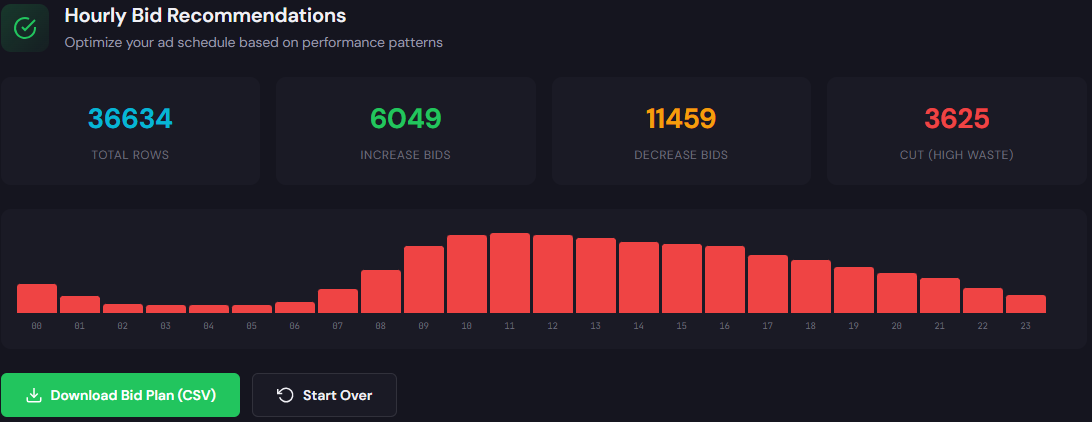
    Table showing hour-of-day rows with cost, conversions, CPA, and bid adjustment recommendations

    What it outputs: An hour-of-day performance table with CPA/ROAS by hour and recommended bid multipliers so you can apply precise dayparting adjustments.

    How to use it — 3 steps

    • 1) Pull the last 30–90 days of campaign data into the tool to calculate hour-level CPA and conversion volume.
    • 2) Review flagged hours where CPA exceeds threshold and accept suggested bid down adjustments or raise bids for high-performing hours.
    • 3) Export the adjustment plan and apply in Google Ads (or via Editor) as incremental bid changes, then monitor for 7 days.

    Open the Hourly Bid Adjuster

    90-minute account triage playbook

    Follow this timed checklist to triage an account and prioritize fixes.

    • 0–10 minutes: Quick health check — note impressions, click trends, and conversion dips.
    • 10–30 minutes: Run the Wastage Snapshot to identify top leakage (queries, campaigns, devices).
    • 30–50 minutes: Export search terms; mark top 20 low-intent queries as negatives and move high-potential terms into focused ad groups.
    • 50–70 minutes: Run the Hourly Bid Adjuster; apply bid adjustments for the worst and best performing hours.
    • 70–90 minutes: Validate top conversion tags and set a 7-day monitoring plan. Assign owners for negatives, ad group splits, and landing-page test.

    FAQ

    Q: How much budget can I realistically recover?

    Concrete recovery varies, but snapshot audits commonly identify 10–30% of monthly spend as misapplied. The quick wins (negatives + ad group fixes) typically recover the low-hanging portion within 1–2 weeks.

    Q: Will bid adjustments conflict with automated bidding?

    They can. Use hourly adjustments as guardrails: small, incremental modifiers that nudge automated strategies rather than replace them. If you run fully manual bidding, adjustments are applied directly; if automated, treat them as constraints.

    Q: Which tool should I run first?

    Start with the Wastage Snapshot to quantify leakage, then run the Hourly Bid Adjuster to stabilize time-based volatility. The snapshot tells you where money is wasted; the bid tool shows when.

    Q: Can I automate these checks?

    Yes. Set a weekly snapshot export and a daily hour-of-day check to trigger alerts when CPA thresholds are breached. The tools at ExecWrite support recurring exports and checklist outputs for handoffs.

    Run the audit and stop bleeding budget

    Execute the 90-minute triage with tools that produce action checklists and exportable recovery plans.

    Start the Wastage Snapshot

    Sources

    Want faster audits and exportable recovery plans? Get started at ExecWrite.

  • Why is my PPC (Google Ads) performance slipping — how do I fix it?

    PPC Google Ads Marketing Ops

    If your paid media numbers are trending down, this is the triage playbook you need. Read fast, act faster, and use tools from ExecWrite to automate the busy work so you can focus on strategy and recovery.


    TL;DR
    • Most PPC slippage comes from wasted spend, keyword noise, and poor bid timing—not mysterious algorithm changes.
    • Apply five quick checks this week (waste audit, search term pruning, landing page alignment, dayparting, and manual bid nudges).
    • Use two ExecWrite tools to speed recovery: the Wastage Snapshot for fast audits and the Search Term Analyzer for automated bid & keyword actions.

    Why PPC feels harder now

    In a world of automated bidding, privacy changes, and rising CPCs, the margin for sloppy setup is smaller. Automation hides problems until waste compounds. Teams without fast diagnostics and repeatable playbooks are firefighting instead of fixing root causes.

    The 5 biggest PPC problems marketers face

    Pain 1: Silent wasted spend

    Symptoms

    • High impressions with low conversion rates across broad match keywords.
    • Budget burns with no clear conversion lift after bid changes.
    • Reports show cost growing but ROAS falling month-over-month.

    Why it happens

    Automation and broad match expand reach, but without continual pruning and negative keywords, spend slips into low-intent queries fast.

    Fix this week

    • Run a waste snapshot to surface top leaking queries and spend buckets.
    • Pause or add negatives to the worst 20 search terms by spend.
    • Reduce budget caps on high-spend, low-conversion campaigns while you triage.

    Pain 2: Search term chaos (wrong intent showing)

    Symptoms

    • Conversions come from a tiny slice of queries; most clicks are irrelevant.
    • Manual negatives are duplicated and inconsistent across accounts.
    • Ad groups contain too many distinct intents.

    Why it happens

    Broad match + loose ad group structure lets every variation surface. Without a process to tag and action search terms, bids and keywords diverge from intent.

    Fix this week

    • Export the last 30 days of search terms, tag them (convertible, ambiguous, irrelevant).
    • Move high-intent queries into dedicated ad groups and tighten match types.
    • Centralize negative keyword lists and apply shared negatives to stop repeat leaks.

    Pain 3: Poor landing page relevance and Quality Score drops

    Symptoms

    • Low CTR paired with rising CPCs for previously stable keywords.
    • Landing page sessions show high bounce and low form completions.
    • Quality Score has dropped without major bid or budget changes.

    Why it happens

    Small messaging mismatches (headline vs. ad promise) and slow or irrelevant landing pages hurt expected CTR and conversion rate—both feed into Quality Score.

    Fix this week

    • Audit top-converting ad groups and check ad-to-page message alignment.
    • Run a headline and CTA refresh on the worst-performing pages.
    • Temporarily shift traffic to higher-converting pages while you iterate.

    Pain 4: Bid timing and dayparting mistakes

    Symptoms

    • Cost per conversion spikes during certain hours or days.
    • Bids are uniform across time despite known traffic patterns.
    • Automated bid strategies oscillate and never converge.

    Why it happens

    Accounts often treat time as uniform. Without hour-of-day diagnostics, opportunities to bid up on peak windows and throttle during noise are missed.

    Fix this week

    • Slice performance by hour/day and flag windows with CPA/ROAS divergence.
    • Apply conservative bid multipliers for high-value hours and negative adjustments for waste windows.
    • Monitor 48–72 hours and revert if automation over-corrects.

    Pain 5: Data gaps and conversion tracking inconsistency

    Symptoms

    • Conversion counts differ between GA and Google Ads.
    • Attribution windows change month to month, hiding trends.
    • Cross-domain or multi-step lead flows aren’t tracked end-to-end.

    Why it happens

    Tracking setups degrade as landing pages, forms, and tag managers change. Missing events make bids and automation work on faulty signals.

    Fix this week

    • Validate primary conversions in both Google Ads and your analytics tool for the last 30 days.
    • Implement server-side or fallback tracking for critical events.
    • Lock conversion windows and document attribution rules for the team.

    Fixes you can apply this week

    • Run a waste snapshot to get top leakage areas (search terms, placements, devices).
    • Prune the worst 20 search terms and add them to shared negatives.
    • Isolate high-intent queries into tight ad groups and switch to phrase/exact for testing.
    • Adjust bids by hour for the top 20% of traffic windows showing CPA variance.
    • Refresh landing page headlines to match ad copy and re-measure Quality Score.
    • Validate and freeze conversion definitions for 14 days while you stabilize bids.
    Run a fast audit with one click

    Use the Wastage Snapshot to identify wasted spend and a prioritized recovery plan in minutes.

    Run a wastage snapshot

    Tool-based workflow: map problems to ExecWrite tools

    Below are two focused tools that remove the busy work and convert analysis into action. Each includes what it outputs and a three-step usage workflow. Preview images are shown to the left of each tool description.

    Wastage snapshot preview

    Wastage Snapshot & Recovery

    What it outputs: a dashboard snapshot of total wasted spend, the top leakage sources (search terms, placements, devices), and a prioritized recovery plan you can act on immediately.

    How to use it (3 steps)

    1. Upload your Google Ads export or connect the account and run the snapshot to get a ranked waste summary.
    2. Review the top 5 leakage buckets and export negative keyword suggestions and campaign-level adjustments.
    3. Apply quick fixes: add the negative list, reduce budgets on leaking campaigns, and schedule a follow-up audit in 7 days.

    Open the Wastage Snapshot


    Search term analyzer output table showing spend, conversions, tags, and recommended bid actions

    Search Term Analyzer (Bid & Keyword Actions)

    What it outputs: a tagged table of search terms with spend, conversions, intent tags, and recommended bid actions or negative suggestions.

    How to use it (3 steps)

    1. Import the last 30 days of search term data and let the analyzer tag queries into convertible, ambiguous, and irrelevant.
    2. Review recommended actions: move convertible terms to new ad groups, apply negatives for irrelevant queries, and accept bid adjustments for ambiguous items.
    3. Export changes as a Google Ads Editor CSV or apply via the UI to execute fast, repeatable hygiene.

    Open the Search Term Analyzer

    90-minute account triage playbook

    Follow this timed checklist to stabilize an account in 90 minutes.

    • 0–10 min: Snapshot — run the Wastage Snapshot to surface top leakage.
    • 10–30 min: Pause — reduce budgets on the worst 2–3 campaigns flagged and set temporary caps.
    • 30–50 min: Search-term cleanup — run the Search Term Analyzer, export the top 20 negatives, and apply shared negatives.
    • 50–70 min: Quick landing page check — open top landing pages for worst-performing ad groups and verify headline/ad alignment; implement headline swap or canonical redirect.
    • 70–85 min: Dayparting — apply conservative hour-of-day bid adjustments for the most divergent hours.
    • 85–90 min: Document — write a 1-page summary of changes, expected metrics to monitor, and the 48-hour validation window.
    Start the recovery now

    Use ExecWrite to run the snapshot and search-term analyzer so you can triage in minutes, not days.

    Start a recovery snapshot

    FAQ

    Do automated bid strategies cause waste?

    Automated bidding can increase efficiency, but if conversion data or signals are noisy it will optimize toward bad outcomes. Use audits and temporary manual controls while stabilizing your conversion tracking.

    How often should I run a wastage audit?

    For active accounts, run a full wastage snapshot weekly and lightweight checks daily for top leakage areas. Use the weekly report to feed structural fixes.

    Will pruning search terms hurt scale?

    Pruning noisy, irrelevant queries improves ROAS immediately. Maintain a controlled expansion process (phrase/exact tests) to regain scale deliberately.

    How do I prioritize fixes if I only have one hour?

    Run a wastage snapshot and apply the top 3 negative keyword/ budget caps it recommends. That typically recovers the largest chunks of wasted spend fast.

    Sources

  • Why is my Google Ads budget wasting away, and how do I fix PPC performance fast?

    PPC
    Google Ads
    Marketing Ops

    If your Google Ads account is burning budget with little ROI, this post gives an operator-level triage: what to check, exact fixes you can apply this week, and a tool-based workflow using ExecWrite to recover wasted spend quickly. Consider this a playbook—paired with fast audits from ExecWrite.

    TL;DR
    • Wasted spend usually comes from mismatched intent, poor keyword coverage, and ad schedule leaks—stop high-cost losers first.
    • Quick fixes: negative keywords, ad schedule/bid adjustments, and landing-page alignment—implementable in a week.
    • Use the ExecWrite Wastage Snapshot to find leaks and the AI Keyword Generator to rebuild intent-driven keyword lists fast.

    Why PPC feels harder now

    Costs and competition have risen, automation masks root causes, and attribution frictions make optimizations risky. Two structural facts make modern PPC friction-heavy:

    • Automation increases velocity but hides which queries and hours are profitable.
    • Broader match behavior and auction complexity mean you inherit low-intent queries unless you audit them.

    The 5 biggest PPC problems marketers face

    Pain 1: Wasted spend on irrelevant search queries

    Symptoms

    • High impressions and clicks from long-tail queries with zero conversions.
    • High cost with low conversion rate in Search Terms report.

    Why it happens

    Mismatched match types and insufficient negative keywords let broad and modified queries enter auctions at scale. Automation can amplify the problem by bidding on volume, not intent.

    Fix this week

    • Export Search Terms for the last 30–90 days, sort by cost and zero conversions—add top offenders as negatives.
    • Collapse overly-broad keywords into phrase/exact or split by intent.
    • Pause high-cost, low-intent automated bidding rules until you add intent signals.

    Pain 2: Budget leaks by time-of-day or day-of-week

    Symptoms

    • Spikes of spend in specific hours with poor CPA/ROAS.
    • High daily spend but flat conversions—sawtooth performance across hours.

    Why it happens

    Ad schedules are often set-and-forgotten. Shifts in user behavior or seasonality make previously profitable hours wasteful.

    Fix this week

    • Pull hour-of-day performance and identify hours with CPA > 2x the account average—reduce bids or exclude those hours.
    • Implement conservative bid adjustments (-20% to -50%) on suspect hours and monitor for 7 days.
    • Use ad scheduling only where conversion density supports bids.

    Pain 3: Poor ad-to-landing page relevance

    Symptoms

    • Low conversion rate despite good CTRs.
    • High bounce rates on ad landing pages and low Quality Score.

    Why it happens

    Ads that overpromise or use different messaging than landing pages create drop-offs. Quality Score penalties increase CPCs and reduce visibility.

    Fix this week

    • Match headlines and CTAs between top-performing ads and their landing pages.
    • Create 1–2 tailored landing page variants for highest-volume ad groups.
    • Check load speed and remove distracting elements that block conversion paths.

    Pain 4: Cannibalized or poorly-structured campaigns

    Symptoms

    • Multiple campaigns bidding on similar keywords; internal auctions inflate CPA.
    • Unclear account structure prevents precise bidding and tracking.

    Why it happens

    Accounts often grow organically without governance—broad match, duplicates, and overlapping audiences create self-competition.

    Fix this week

    • Identify duplicate keywords across campaigns and consolidate where appropriate.
    • Use campaign-level priorities and negative lists to stop internal auctions.
    • Standardize naming and structure for future scaling.

    Pain 5: Measurement and attribution blind spots

    Symptoms

    • Conversions drop suddenly after tracking changes; inconsistent cross-channel signals.
    • High last-click CPA but downstream value isn’t visible.

    Why it happens

    Attribution mismatches, broken tags, or recent site changes can break conversion reporting, making good traffic look bad or vice versa.

    Fix this week

    • Validate conversion tags, server-side events, and GA4 import; compare events to server logs where possible.
    • Run a short split-test or liquidity check to confirm true conversion rates.
    • Apply conservative bid caps until measurement is confirmed.

    Fixes you can apply this week

    • Run a Search Terms export; add negatives for high-cost, zero-conversion queries.
    • Identify worst-performing hours and add hour-of-day bid reductions.
    • Pause or tighten broad match keywords; move volume into phrase/exact and tightly themed ad groups.
    • Audit top ad-to-landing-page pairs and implement headline/CTA parity.
    • Confirm conversion tracking and set temporary bid caps for volatile campaigns.
    Run a one-click waste audit

    Use ExecWrite’s Wastage Snapshot to find top leakage areas and get a prioritized recovery plan you can action this week.

    Run an audit at ExecWrite

    Tool-based workflow: map problems to ExecWrite tools

    We recommend using two focused tools to triage and rebuild: the Wastage Snapshot for leakage identification and the Free AI Keyword Generator for rebuilding intent-safe keyword lists.

    Wastage Snapshot & Recovery

    Dashboard-style snapshot showing waste totals, top leakage areas, and a recovery plan summary

    What it outputs: A dashboard-style snapshot showing total wasted spend, top leakage areas (search terms, hours, campaigns), and a prioritized recovery plan with negative keyword and pause recommendations.

    How to use (3 steps)

    1. Upload a Search Terms + hourly performance export into the Wastage Snapshot.
    2. Review the top leakage list and apply the suggested negatives and campaign pauses for the quickest wins.
    3. Download the recovery checklist and implement the top 3 actions in your account today.

    Open the Wastage Snapshot

    Free AI Keyword Generator

    Preview showing generated keyword list sections (high intent, negatives, modifiers) with copy/download controls

    What it outputs: Structured keyword lists (high-intent, informational, negative keywords, and modifiers) organized by ad-group and intent—export-ready for Google Ads Editor.

    How to use (3 steps)

    1. Enter your landing page or primary offer to seed intent-based keyword generation.
    2. Review the grouped output, mark which sections map to existing campaigns, and accept negatives automatically suggested.
    3. Export CSV for Google Ads Editor and upload as new tightly themed ad groups.

    Try the AI Keyword Generator (free)

    90-minute account triage playbook

    Run this live with your account open. Target: 90 minutes to pause the worst leaks and leave with a 7-day action plan.

    1. 0–10 min: Open Search Terms and Hourly reports; note total spend last 30 days.
    2. 10–30 min: Sort Search Terms by cost with zero conversions—add top 10 as negatives and document recurring patterns.
    3. 30–50 min: Load the Wastage Snapshot and confirm the top leakage areas; accept the top 3 recovery recommendations.
    4. 50–70 min: Run hour-of-day analysis; apply bid reductions on hours with CPA > 2x account average or exclude them.
    5. 70–85 min: Use the AI Keyword Generator to create focused ad group keyword lists for your top-converting landing pages.
    6. 85–90 min: Deploy immediate changes (negatives, bid adjustments, campaign pauses) and set a 7-day monitoring report to watch CPA/ROAS trends.
    Start recovering wasted spend now

    Get a prioritized recovery plan and export-ready fixes from ExecWrite. Fast audits reduce the noise so you can restore profitable traffic.

    Get started at ExecWrite

    FAQ

    How fast will I see results after applying negatives and hour bids?

    Expect initial spend reductions immediately; conversion rate improvements usually show within 3–7 days as Google re-learns. Watch conversion volume—if it drops too far, back off adjustments slightly.

    Won’t negative keywords reduce my reach?

    Negatives remove low-intent or irrelevant queries. The goal is higher-quality traffic, not raw reach. Proper negatives typically improve ROI by eliminating low-value clicks.

    Should I stop automation while triaging?

    Don’t disable all automation. Pause or limit automated bidding strategies on the worst-performing campaigns until you fix intent and measurement. Keep safe, conservative rules where needed.

    How do I know the Wastage Snapshot findings are accurate?

    The Snapshot uses your account exports to surface high-cost/zero-conversion queries and hourly leakage. Cross-check recommendations against raw Search Term and hourly reports before bulk applying changes.

    Sources

  • Why is my Google Ads PPC performance stalling?

    PPC Google Ads Marketing Ops

    If ROAS is flat or CPA is creeping up, this is for you. Below are operator-level diagnostics and week-one fixes plus a tool-driven workflow using ExecWrite to recover wasted spend and adjust bids by search term and hour. Try the tools at ExecWrite for fast, repeatable results.

    TL;DR
    • Major causes: wasted spend, poor query-level bidding, ad/landing mismatch, time-of-day swings, and automation gaps.
    • Week-one fixes: run a wastage snapshot, tag bad queries, apply negative keywords, and implement hourly bid adjustments.
    • Use ExecWrite’s Wastage Snapshot and Search Term Analyzer to map issues to action in under 90 minutes.

    Why PPC feels harder now

    Competition, privacy changes, and platform automation make predictable performance rare. Bidding signals are noisier, audiences fragment, and small budget leaks compound. The result: accounts that once scaled now show volatility and wasted spend.

    The 5 biggest PPC problems marketers face

    Pain 1 — Wasted spend and budget leakage

    • Symptoms: High impressions on low-converting queries, low conversion rate, rising CPA without higher volume.

    Why it happens: Poor query control, missing negatives, and legacy keyword lists let low-intent traffic absorb budget.

    • Fix this week: Run a spend-by-query audit, flag top spenders with zero/low conversions, and add negatives on low-intent terms.

    Pain 2 — Search-term level bid mismatch

    • Symptoms: High CPA on certain queries inside otherwise healthy ad groups; inconsistent conversion rates by phrase.

    Why it happens: Broad match + automated bidding hides query-level performance; account-level bids don’t reflect individual intent.

    • Fix this week: Identify high-spend, low-conversion queries and set explicit bid adjustments or move them into exact/phrase ad groups with tailored ads.

    Pain 3 — Poor ad-to-landing relevance (Quality Score drain)

    • Symptoms: High CPCs, low CTR, declining conversion rate after a landing page change.

    Why it happens: Messaging mismatch between search intent, ad copy, and landing page content reduces Quality Score and raises cost per click.

    • Fix this week: Run headline and landing page alignment audits; test ad copy variants that match top-performing queries.

    Pain 4 — Time-of-day and dayparting volatility

    • Symptoms: Strong performance for a few hours and sudden drop-offs; nightly spends that never convert.

    Why it happens: Uniform schedules assume steady intent. Many businesses have clear time windows for buyer activity—others are leaking bids into low-intent hours.

    • Fix this week: Pull hour-of-day conversion metrics, reduce bids or pause low-performing hours, and re-allocate budget to peak windows.

    Pain 5 — Automation that masks problems

    • Symptoms: Smart bidding keeps conversions but ROAS slides, little clarity on which queries or creatives failed.

    Why it happens: Automated strategies optimize for the metric you set but can’t fix bad inputs—bad keywords, landing pages, or creative still drive waste.

    • Fix this week: Backtest campaigns with manual rules, audit top contributing queries, and lock in negatives before trusting automation to scale.

    Fixes you can apply this week

    • Run a quick wastage snapshot to quantify leakage by campaign, ad group, and query.
    • Export top-spend search terms; tag high-spend/low-conversion queries for negatives or bid cuts.
    • Implement hour-of-day bid adjustments for the worst-performing hours.
    • Match top queries to tailored ads and landing pages to protect Quality Score.
    • Set a 7-day hold on broad automation changes—apply conservative manual adjustments first.
    Run a quick recovery scan

    Scan for wasted spend and get a recovery plan in minutes with ExecWrite’s Wastage Snapshot.

    Start a scan at ExecWrite


    Tool-based workflow: map pain points to ExecWrite tools

    ExecWrite — Wastage Snapshot & Recovery

    Dashboard-style snapshot showing waste totals, top leakage areas, and a recovery plan summary

    What it outputs: A prioritized dashboard showing wasted spend, top leakage channels (queries, campaigns), and an action-first recovery plan.

    How to use it (3 steps):

    • 1) Connect your account and run the snapshot to surface leakage by spend and conversion rate.
    • 2) Review the top 10 leakage items the tool recommends—negatives, paused placements, and low-intent queries.
    • 3) Export the recovery plan and apply negative lists, budget reallocations, and quick ad swaps. Re-run in 7 days to measure improvement.

    Use for: recovering wasted budget, building a tactical recovery plan, and educating stakeholders with a clear summary.

    Open Wastage Snapshot & Recovery

    ExecWrite — Search Term Analyzer (Bid Adjustment by Search Term)

    Search term analyzer output table showing spend, conversions, tags, and recommended bid actions

    What it outputs: Query-level table with spend, conv., CPA/ROAS, tags and recommended bid actions (increase, reduce, negative).

    How to use it (3 steps):

    • 1) Upload your search term report or link the account to get query-level performance across date ranges.
    • 2) Apply the tool’s suggested bid adjustments and tag queries you want to move into new ad groups or add as negatives.
    • 3) Export the bid action list as a Google Ads Editor CSV or use the recommendations to set hourly and query-level rules.

    Use for: immediate bid corrections, removing low-intent traffic, and precise recovery from query-level waste.

    Open Search Term Analyzer


    90-minute account triage playbook

    Follow this sequence with a focused analyst and access to ExecWrite tools.

    • 0–10 min: Scope and KPI alignment. Confirm target CPA/ROAS and recent change events (landing page, bids, budget).
    • 10–30 min: Run Wastage Snapshot. Export top 20 leakage items and total wasted spend by campaign.
    • 30–50 min: Run Search Term Analyzer on the same date range. Tag the top 15 high-spend/low-conversion queries.
    • 50–70 min: Apply immediate actions—add negatives, reduce bids on flagged queries, pause worst-performing hours.
    • 70–85 min: Fix quick ad/landing mismatches for top queries (swap headlines or route to better pages).
    • 85–90 min: Document changes, set a 7-day measurement window, schedule a quick re-scan in ExecWrite.
    Run these checks now

    Use ExecWrite to export recovery actions and implement bid adjustments without guesswork.

    Open ExecWrite tools

    FAQ

    Do I need a full account audit to start?

    No. Start with a Wastage Snapshot to quantify leakage and then use the Search Term Analyzer on top spend queries. You’ll get prioritized actions in minutes.

    Will automation undo my manual fixes?

    Not if you apply manual negatives and bid rules first. Treat automation as scaling only after you’ve fixed input quality (keywords, landing pages, negative lists).

    How often should I run these tools?

    Every 7–14 days during optimization phases, and monthly in steady state. Run a quick snapshot after any major site or campaign change.

    Can these tools export to Google Ads Editor?

    Yes. The Search Term Analyzer provides export-ready CSVs for Editor and the Wastage Snapshot exports recovery action lists for fast application.

    Sources