If Google Ads feels more expensive and less predictable than it used to, you need a focused, operational plan — not another theory doc. This post shows exactly what to audit, the quick fixes you can apply this week, and a tool-led workflow using ExecWrite to recover wasted spend and correct bid signals. Try the tools at ExecWrite as you follow these steps.
- Run a wastage snapshot to find budget leaks and negative keyword opportunities within 30 minutes.
- Audit search-term performance and apply targeted bid adjustments by term and hour to stop high-CPA bids.
- Run a 90-minute triage: stop obvious waste, reallocate budget, fix poor landing relevance, and deploy quality-score fixes.
Table of Contents
Why PPC feels harder now
Paid search used to be a predictable auction you could optimize with rules and structure. Today the auction is noisier: more competitors, more automated bidding layers, less clear third-party signal, and higher expectations for landing-page relevance. That mix amplifies normal account problems into performance crises.
Key structural issues are not seasonal — they’re systemic. The right operational checks and the right lightweight tools get you back in control without guessing.
The 5 biggest PPC problems marketers face
1) Rising CPA and volatile CPCs
Symptoms
- Conversions cost is up week-over-week despite stable conversion rate.
- CPC spikes at certain hours or on specific queries.
- Automated bids chase cost without clear improvement.
Why it happens
Automatic bidding amplifies noisy or misleading signals when account structure is weak or when irrelevant search terms siphon spend. Time-of-day, device or query-level swings often hide behind averaged metrics, so you bid up for bad traffic.
Fix this week
- Segment cost by hour and pause hours with high CPA.
- Audit top-spending search terms and apply bid overrides or negatives.
- Set conservative portfolio bid caps while you investigate.
2) Wasted spend and leakage
Symptoms
- High spend with few conversions from low-intent queries.
- Search terms that should be negative are still active.
- Budget exhausted early in the day without meaningful results.
Why it happens
Accounts accumulate keyword bloat, poorly scoped match types, and missing negative lists. Campaigns then cannibalize each other and drain daily budgets on low-value traffic.
Fix this week
- Export top 200 search terms by spend and tag clear negatives.
- Convert single broad-match high-spend terms into exact or phrase with tighter bids.
- Reallocate budgets from leaking campaigns to top-performing ones.
3) Poor account structure and keyword bloat
Symptoms
- Ad groups with dozens or hundreds of unrelated keywords.
- Low click-through rates and weak ad relevance.
- High-quality-score variance across similar queries.
Why it happens
Accounts grown over time without pruning create overlap and confusing signals for automated bidding. That drives inefficient auctions and low ad relevance.
Fix this week
- Group keywords by intent and landing page, not by history.
- Pause or move low-CTR keywords into a negative list for testing.
- Create tight, landing-page-driven ad groups for high-value intent.
4) Automation misfires and signal gaps
Symptoms
- Smart bidding campaigns swinging wildly after policy or feed changes.
- Conversions drop after a tracking tweak or site update.
- Bids are raised for low-intent queries.
Why it happens
Automated systems need steady, accurate signal. Broken conversion tags, recent conversion-window changes, or mismatched events create poor optimization feedback.
Fix this week
- Verify conversion tags and recent tag changes; revert or fix if conversions fall.
- Use bid caps and conservative targets while signals are noisy.
- Isolate experiments to smaller budgets until data normalizes.
5) Landing page relevance and Quality Score drops
Symptoms
- Click-through rates and conversion rates fall without CPC changes.
- High impression share but poor conversion performance.
- Ads show but landing pages have different messaging than ad copy.
Why it happens
Search engines reward tight ad-to-landing-page relevance. Messaging mismatches, slow pages, or weakened CTAs reduce Quality Score and raise costs.
Fix this week
- Align headlines and landing page H1s for top ad groups.
- Run a quick A/B with a tuned landing headline and CTA.
- Fix slow elements and remove intrusive interstitials.
Fixes you can apply this week
- 30-minute wastage snapshot: find top leakage and negatives.
- 30-minute search-term audit: tag negatives, lower bids on wastey terms.
- 15-minute hour-of-day review: pause high-CPA hours or apply negative hour adjustments.
- 10-minute landing-page check: match top ad headlines to page H1 and CTA.
- 5-minute bidding guardrails: apply bid caps to automated campaigns during triage.
Use a snapshot tool to find where your budget is leaking and get a prioritized recovery plan.
Tool-based workflow (map each pain point to ExecWrite tools)
Wastage Snapshot & Recovery (best for waste & leakage)
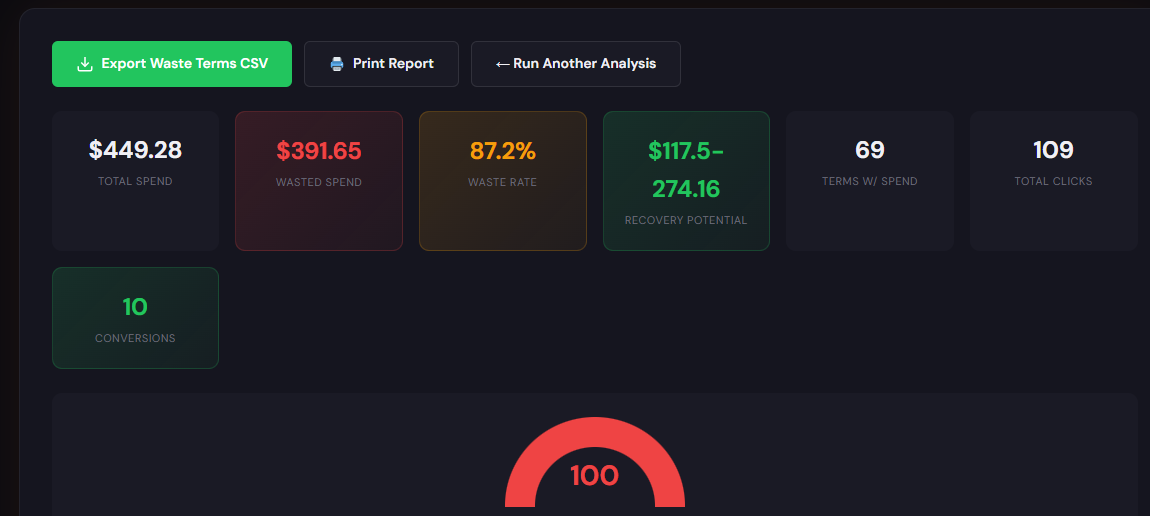
What it outputs: A dashboard-style snapshot that quantifies wasted spend, lists top leakage areas (search terms, campaigns, match types), and gives a prioritized recovery checklist.
How to use it in 3 steps
- Upload your account data and run the snapshot (30 minutes).
- Review the top leakage items and export the negative keyword list.
- Apply the recovery plan: pause leaking campaigns, add negatives, and reallocate budgets.
Tool link: Wastage Snapshot & Recovery
Bid Adjustment by Search Term — Search Term Analyzer (best for CPC swings and keyword fixes)
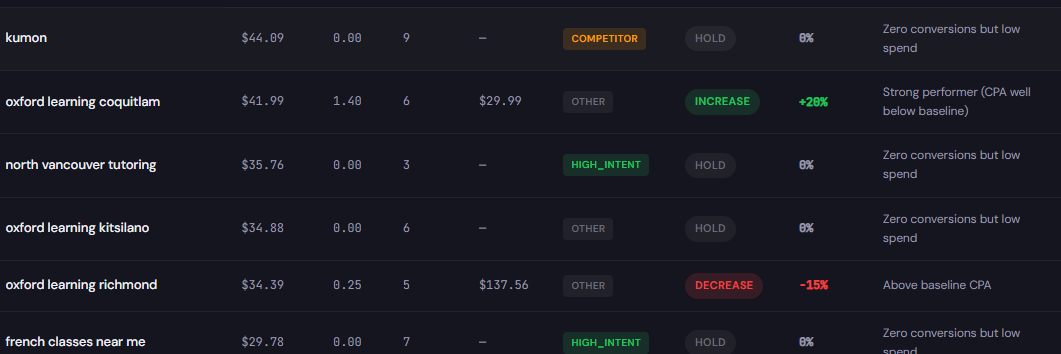
What it outputs: A table of search-term-level metrics with spend, conversions, CPA/ROAS, tags, and recommended bid actions that you can export to apply overrides or create negative lists.
How to use it in 3 steps
- Run the analyzer for your top-spending campaigns and filter by CPA and spend.
- Tag high-CPA terms as negatives or set bid-reduction recommendations.
- Export recommendations and apply via editor or automation rules.
Tool link: Search Term Analyzer
These two tools cover the majority of short-term fixes: the wastage snapshot finds where budgets leak, and the search-term analyzer turns noisy queries into explicit actions.
90-minute account triage playbook
- 0–10 minutes: Lock down budgets: lower portfolio bids and add conservative caps.
- 10–40 minutes: Run the Wastage Snapshot. Export the top negative candidates and the recovery checklist.
- 40–60 minutes: Run the Search Term Analyzer on top-spending campaigns. Apply negative keywords and bid reductions for poor terms.
- 60–75 minutes: Fix landing-page relevance for your top 3 losing ad groups (headline alignment and CTA).
- 75–90 minutes: Reallocate freed budget to your top 2 performing campaigns and monitor hourly performance.
Run the two-step workflow now and download actionable lists to apply in Google Ads Editor.
FAQ
Small wins (pausing leaks, applying negatives) can reduce wasted spend within a day. Meaningful CPA recovery typically appears within 3–7 days as bidding normalizes.
Automation can adapt. Use bid caps and conservative targets while you stabilize signals; once you’ve removed noise, automated bids perform better.
Rollback to the previous state, isolate the change in a test campaign, and verify conversion tracking. Most drops are tag or event misconfigurations.
Yes. Tools produce exportable lists and recommendations you apply manually or via Editor. Start with a snapshot on a subset before full-scale changes.
Sources
- Search Engine Land — analysis of PPC signal challenges
- WordStream — common causes of wasted Google Ads spend
- Google Ads Help — About Quality Score
Ready to run a recovery and stop wasting budget? Start the triage with ExecWrite: https://execwrite.com
Leave a Reply