If your Google Ads account feels like it’s bleeding budget with little to show, this guide gives a straight, testable triage routine and quick fixes. Use these steps with ExecWrite tools to find waste fast and make bids and keyword lists actionable — start at ExecWrite.
- Wasted spend usually comes from keyword mismatch, bad bid timing, and poor ad-to-page relevance.
- Run a 90-minute triage, fix the top 3 leak sources, then use a repeatable tool-backed workflow.
- ExecWrite’s Wastage Snapshot and Search Term Analyzer make audits and bid fixes fast and export-ready.
Table of Contents
Why PPC feels harder now
Paid media managers face higher CPCs, more automation black boxes, and vaguer signals from platforms. That combination means small structural problems magnify: a few poorly matched keywords, wrong time-of-day bids, or low relevance landing pages can turn profitable accounts into budget sinks.
This article focuses on reliable, repeatable fixes — not broad strategy debates. Use the checklist and the two ExecWrite tools introduced below to convert audit findings into actions.
The 5 biggest PPC problems marketers face
1) Keyword-level waste (poor intent match)
Symptoms
- High spend on queries with low conversion rate.
- Many one-off search terms with wasted cost.
- Broad-match keywords pulling irrelevant traffic.
Why it happens
Accounts often scale with broad match or large keyword sets without prescriptive negatives or intent buckets. Over time the signal-to-noise ratio collapses and spend flows to unrelated searches.
Fix this week
- Export search term report for last 30 days; sort by cost and conversion rate.
- Tag top wasted terms as negatives and add high-intent modifiers to winners.
- Pause or tighten the match type on keywords with high CPA and no conversions.
2) Timing and dayparting errors
Symptoms
- CPA spikes at specific hours or days.
- Conversions cluster in a narrow window but bids stay flat.
Why it happens
Many accounts never test hour-of-day adjustments or rely on automated bidding without providing time signals. That lets wasted clicks accumulate when conversion likelihood is low.
Fix this week
- Pull hourly performance and identify high-CPA hours.
- Apply -20% to -50% bid adjustments for proven low-conversion hours (test conservative first).
- Increase bids only in top-converting time windows.
3) Landing page mismatch (low Quality Score)
Symptoms
- Low CTR and low conversion rate despite decent traffic.
- High impression share lost to rank, not budget.
Why it happens
Ad copy that promises one thing and landing pages that deliver another cause both poor QS and wasted traffic. Automated bidding then amplifies the cost of those mismatches.
Fix this week
- Audit top-performing keywords and confirm headline + offer parity on landing pages.
- Test one landing page headline and CTA rewrite for the worst-performing ad group.
- Use structured experiment (A/B) on the highest-traffic ad group first.
4) Overbidding on low-value conversion paths
Symptoms
- High conversion counts but low downstream revenue or high return rates.
- Automated bidding optimizes for actions that don’t equal business value.
Why it happens
Conversion tracking often captures micro-conversions (downloads, sign-ups) that don’t map to revenue. Bids rise around these signals unless value-based bidding is implemented.
Fix this week
- Segment conversions by revenue impact and deprioritize low-value actions in bidding strategy.
- Adjust target CPA/ROAS to include only valuable conversions where possible.
- Set up offline conversion imports for sales-qualified leads.
5) Fragmented account structure and poor naming
Symptoms
- Hard to run filters or create scripts; repeated mistakes across campaigns.
- Reports require heavy cleanup before you can act.
Why it happens
Rapid scaling, multiple handoffs, and inconsistent conventions make routine audits slow and error-prone.
Fix this week
- Standardize naming for campaigns/ad groups/labels for one product line.
- Apply account-level labels for tests and control groups.
- Create a one-page naming and tagging cheat sheet for your team.
Fixes you can apply this week
- Run a search-term-driven negative keyword pass on the last 30 days.
- Export hourly performance and set conservative daypart bid adjustments.
- Identify top 3 ad groups by spend and test landing-page headline parity.
- Map conversions to revenue and deprioritize non-revenue micro-actions in bidding.
- Standardize names and labels for easy filtering and automation.
Use ExecWrite’s Wastage Snapshot to identify top leakage areas and a prioritized recovery plan in minutes.
Tool-based workflow
This section maps the biggest problems above to two focused ExecWrite tools. Each tool output and a 3-step usage pattern to convert findings into changes.
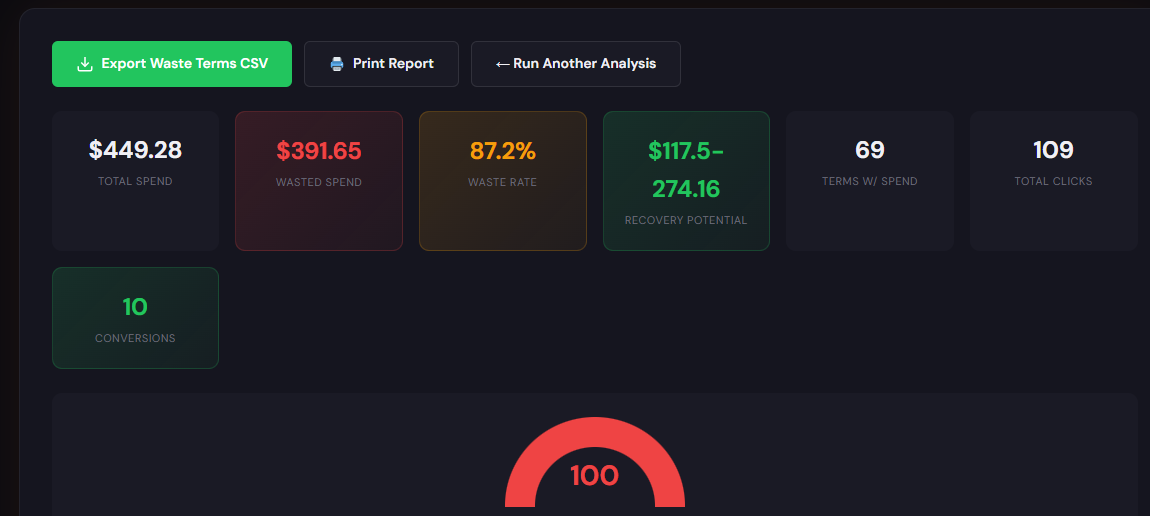
What it outputs: Account-wide waste totals, top leakage categories (search terms, audiences, device/time), and a prioritized recovery checklist.
How to use (3 steps)
- Upload or connect your account and generate the snapshot to get a ranked list of leakage items.
- Apply the tool’s suggested negatives, budget shifts, and quick landing-page fixes to the top 5 leakage items.
- Export a recovery plan CSV for batch updates via Google Ads Editor or your manager.
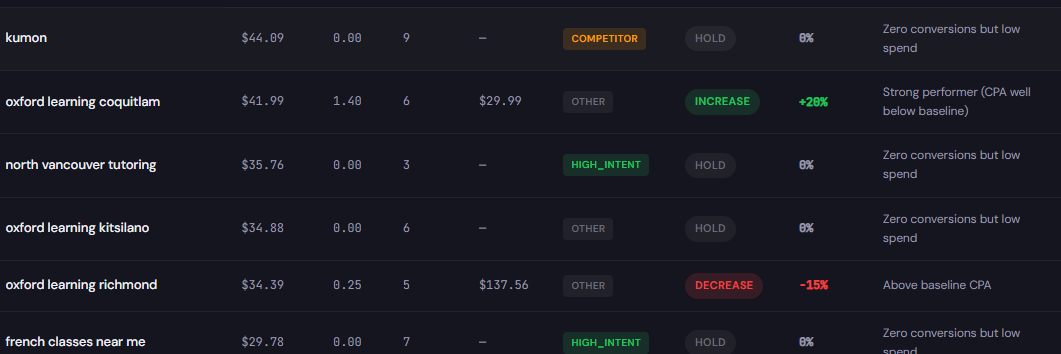
What it outputs: A table of search terms with spend, conversions, recommended tag (negative/keep), and suggested bid actions.
How to use (3 steps)
- Export your Search Terms report and feed it to the tool; it tags terms by intent and spend impact.
- Apply recommended negatives and conservative bid adjustments (hourly or keyword-level) for the top-waste terms.
- Re-run weekly and export the update list for Google Ads Editor upload.
90-minute account triage playbook
Use this focused, timed routine to find and fix the biggest leaks in one session.
- Minute 0–10: Connect account and run a Wastage Snapshot. Note the top 5 leakage categories.
- Minute 10–25: Export search term and hour-of-day reports for the last 30 days.
- Minute 25–40: Apply immediate negatives for the top 10 wasteful search terms (pause in account; log changes).
- Minute 40–55: Use the Hourly Bid Adjuster (within the bid tool family) to set conservative -20% to -40% during low-conversion hours identified in your report.
- Minute 55–75: Open the Quality Score Optimizer or manually check top ad groups for headline/landing page mismatch; draft one headline/CTA rewrite per ad group.
- Minute 75–90: Export CSVs for Editor and schedule batch updates. Document the changes and set a 7-day review to measure impact.
Next steps and automation
After the triage, create a weekly snapshot cadence and automate exports into your reporting tool. Use small, repeatable experiments (10–15% traffic) when testing landing pages or major bid-cap changes.
Try the Wastage Snapshot plus Search Term Analyzer together to get prioritized negatives, bid adjustments, and an exportable recovery CSV.
FAQ
Expect to see CTR improve and wasted clicks fall within 3–7 days. Conversion and CPA improvements depend on traffic volume; use a 7–14 day window to properly measure impact.
Automated bidding will react to the new signals, which is why conservative changes and a testing window matter. Use value-based targets where possible and feed cleaner conversion data after fixes.
Tools work with as little as 30 days of account-level data. Higher-volume accounts will get faster statistical confidence, but the audit patterns are useful even for lower-volume accounts.
Pause only the worst offenders. Prefer tagging and moving into a negatives list for review. Use conservative pauses and track impact — sudden removals can reduce impressions and costs but also limit learning for automated bids.
Sources
- Google Ads: About Quality Score — Google Ads Help
- How to Reduce Wasted Ad Spend — WordStream
- Automation limitations for PPC — Search Engine Land
Ready to reclaim budget and turn audits into action? Start a recovery snapshot and search-term clean-up at ExecWrite.
Leave a Reply