If your account feels expensive but doesn’t convert, this guide gives a pragmatic triage, three quick fixes, and a tool-based workflow you can run in a day. Try a quick snapshot at ExecWrite to see how much is recoverable.
- Run a fast wastage snapshot to find top leakage (search term noise, redundant spend, bad CPCs).
- Use a search-term bid analyzer to tag things to keep, pause, or bid up, and fix ad scheduling swings.
- Execute a 90-minute triage: triage spend, prioritize fixes, and apply 2–3 high-impact actions.
Why PPC feels harder now
Competition, automation opacity, and noisy intent make managing Google Ads operational work, not just strategy. You can’t rely on set-and-forget automated bidding because bad inputs (irrelevant queries, mismatched landing pages, time-of-day swings) still create wasted spend. The side effect: small leaks compound into significant monthly loss unless you have tooling and a repeatable process.
The 5 biggest PPC problems marketers face
1) Search-term leakage
Irrelevant queries or broad matches consuming budget
Symptoms
- High clicks from long-tail queries that never convert.
- Unexpected low-intent terms in high-volume campaigns.
- Cost-per-conversion spikes despite steady CPCs.
Why it happens
Broad match and loose keyword structure let variants and unrelated modifiers slip in. Without systematic search-term reviews, negatives never build and automation optimizes on noisy signals.
Fix this week
- Export last 30 days search terms and sort by cost and zero conversions.
- Tag recurring irrelevant terms as negatives and add to account-level negative lists.
- Promote high-intent search terms into exact or phrase keywords with dedicated ad copy.
2) Wasted budget from low-quality clicks
Clicks that cost money but never reach a meaningful funnel action
Symptoms
- High click volumes on informational queries, low conversions.
- Large spend in campaigns with poor landing-page relevance.
- Unexplained spikes in bounce rate and cost per session.
Why it happens
Imperfect keyword intent mapping and ad-to-landing-page mismatch cause irrelevant clicks. Quality Score and conversion rates suffer when messaging and landing pages aren’t aligned.
Fix this week
- Pause high-spend, low-conversion queries until you can test a tighter match type or new ad copy.
- Run a headline/landing alignment test for the worst-performing ad groups.
- Add negative keywords for top informational queries consuming clicks.
3) Poor ad scheduling and hourly performance swings
Time-of-day or day-of-week performance differences not reflected in bids
Symptoms
- High CPA during specific hours or days.
- Ad groups that convert only during business hours but still spend at night.
- Manual bid changes that don’t address hourly variance.
Why it happens
Campaigns need granular dayparting data. Without hourly analysis, automated bidding can perpetuate waste in hours with poor performance.
Fix this week
- Segment last 14–30 day performance by hour and identify windows with CPA 2x baseline.
- Apply ad schedule bid modifiers to reduce bids in poor hours.
- Test running limited budgets only during high-conversion windows.
4) Duplicate keywords and cannibalized ad groups
Internal competition inflates CPCs and confuses optimization
Symptoms
- Multiple ad groups bidding on the same keyword themes.
- Campaigns fighting each other for impressions and clicks.
- Lower win-rate on auctions than expected for top keywords.
Why it happens
As accounts grow, inconsistent naming and legacy campaigns create overlap. That overlap pushes up CPCs and dilutes signals to bidding algorithms.
Fix this week
- Run a keyword overlap report and merge or exclude conflicting ad groups.
- Standardize naming conventions and match types for core themes.
- Lock core commercial keywords into single ad group with optimized ads.
5) Landing-page relevance and Quality Score drag
Ad clicks arrive on pages that don’t convert
Symptoms
- Low CTR and low conversion rate despite high intent keywords.
- Quality Score stuck 1–4 for important keywords.
- High cost per click with poor impression share on valuable queries.
Why it happens
Disconnected messaging between ads and landing pages reduces perceived relevance. Quality Score responds to that signal and raises CPCs for poor matches.
Fix this week
- Audit top 10 landing pages and align headline, offer, and CTA to the ad group intent.
- Run a focused landing-page headline swap for the worst-performing 3 pages.
- Measure lift in CTR and conversion rate before and after changes.
Fixes you can apply this week
- Run a 7–30 day search terms export and tag the top 20 cost-no-conversion queries as negatives.
- Spin high-intent queries into their own exact-match ad groups with tailored ads and landing pages.
- Apply ad schedule modifiers where CPA exceeds 1.5x baseline for specific hours.
- Consolidate duplicate keywords and harmonize match types to stop cannibalization.
- Swap landing page headlines to match ad promises and measure immediate CTR/CR changes.
Use ExecWrite’s Wastage Snapshot to find top leakage areas and a prioritized recovery plan in minutes.
Tool-based workflow — map problems to ExecWrite tools
Wastage Snapshot & Recovery
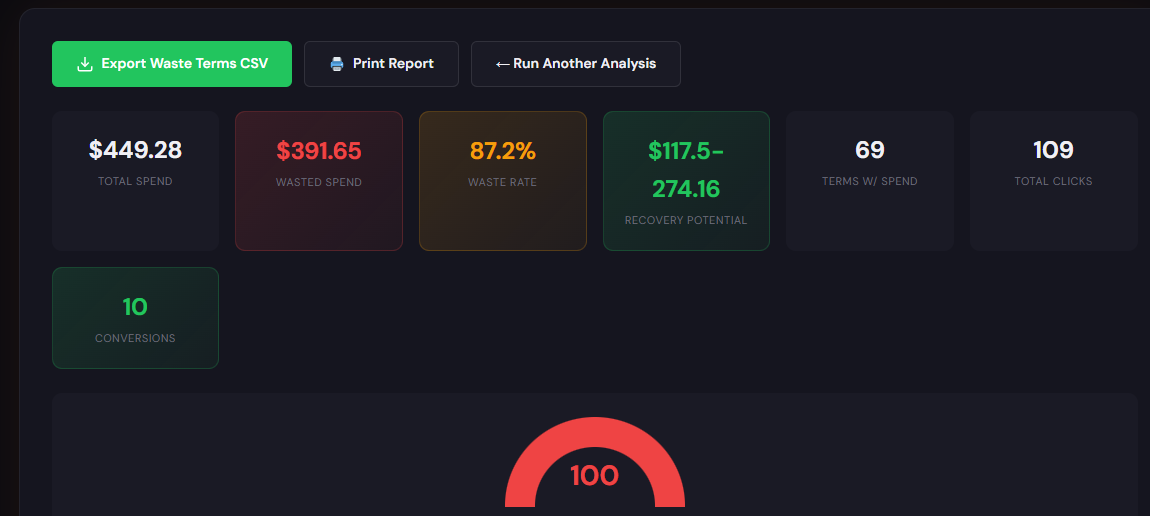
What it outputs: A dashboard-style snapshot that totals wasted spend, highlights top leakage areas (search terms, campaigns, ad groups), and gives a short recovery plan with immediate actions.
How to use it in 3 steps:
- Connect the account and run the snapshot for a 30-day window to surface spend and conversion gaps.
- Review the top 5 leakage recommendations (negatives, paused campaigns, budget reassignments).
- Apply the prioritized recovery actions and re-run the snapshot in 7 days to measure recovery.
Bid Adjustment by Search Term (Search Term Analyzer)
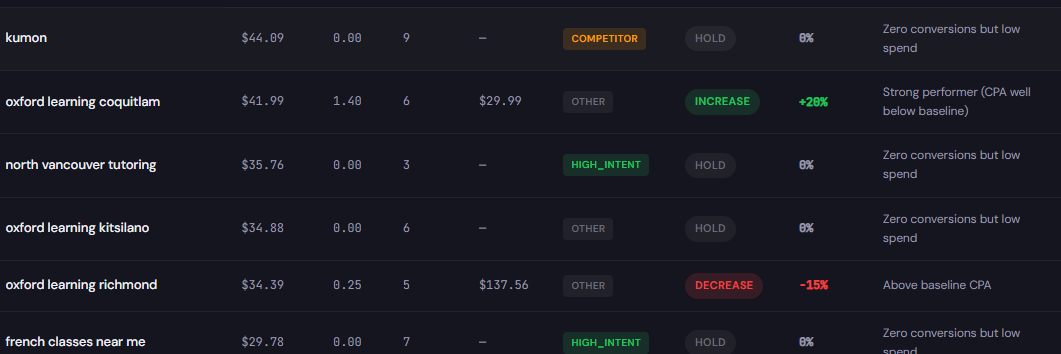
What it outputs: A table that tags search terms as keep, negative, or bid-change and recommends bid adjustments by term and hour-of-day patterns for dayparting.
How to use it in 3 steps:
- Upload or pull your search-term report into the tool and let it score terms by cost and conversion rate.
- Approve suggested negatives and export a CSV of recommended bid actions (including hourly modifiers).
- Import CSV into Google Ads Editor or apply changes via the UI; monitor CTR and CPA over the next 7–14 days.
Use the two tools together: Snapshot finds the leaks, Analyzer fixes the terms and bids. Both speed up the steps in the 90-minute playbook below.
90-minute account triage playbook
Run this on a live account with one screen and one analyst. The goal: identify three highest-impact fixes and start applying them.
- Minutes 0–10: Run the Wastage Snapshot for the last 30 days and scan the top leakage areas.
- Minutes 10–30: Export the search terms for the top 3 leaking campaigns and load into the Search Term Analyzer.
- Minutes 30–50: Approve negatives and export bid adjustments for high-cost, low-conversion terms; identify 2–3 ad groups to spin into exact-match tests.
- Minutes 50–70: Apply quick landing-page headline swaps for the two worst pages and push ad schedule modifiers for hours with 2x CPA.
- Minutes 70–90: Create an action list — negatives applied, bids changed, landing tests launched — and set 7-day check-in reminders to measure impact.
Use ExecWrite to automate the snapshot and search-term analysis steps, so you can focus on decisions, not exports.
FAQ
Most accounts see measurable reduction in wasted spend within 7–14 days after applying negatives, bid adjustments, and ad schedule changes. The Wastage Snapshot quantifies expected recoverable spend up front.
Automated bidding can re-learn after you change inputs. That’s why you must fix the inputs first (search terms, landing relevance, scheduling). Treat automation as the optimizer, not the root cause.
No — ExecWrite tools export CSVs and provide UI-ready suggestions. You can apply changes via Google Ads Editor or the Google Ads UI without engineering.
Targeted negatives remove low-value traffic; if volume drops, you’ll get cleaner clicks with better conversion signals. Monitor impression share on high-value terms and reallocate budgets if needed.
Leave a Reply