Google Ads feels more complex than it did five years ago. If your account leaks budget, produces inconsistent CPAs, or your keyword lists are a mess, you can use diagnostics and tool-driven workflows from ExecWrite to recover spend and restore control.
- Short-term: stop waste with a targeted wastage snapshot and negative keywords.
- Mid-term: rebuild intent-based keyword groups using an AI keyword generator.
- Operational: run a 90-minute triage playbook weekly to keep ROI stable.
Why PPC feels harder now
Platforms have automated more decisions, auction dynamics are noisier, and measurement has become fuzzier (attribution, cookieless changes). That makes simple rules less reliable and increases the operational workload: more audits, more segment testing, and constant cleanup. Add rising CPCs and more competition for intent terms, and manual ad ops becomes a treadmill.
The 5 biggest PPC problems marketers face
1) Invisible wasted spend
Symptoms
- High impressions with zero conversions on key campaigns
- Large spend on long-tail or irrelevant search terms
- Sudden CPA drift without clear bid changes
Why it happens
Negative keywords and query-level auditing are often deprioritized. Automation and broad match variants can inflate irrelevant traffic if not constantly monitored.
Fix this week
- Run a search-term-level spend audit for the last 30 days.
- Add top irrelevant queries as negatives at campaign level.
- Pause high-spend, zero-conversion keywords until reviewed.
2) Keyword structure chaos
Symptoms
- Ad groups mixing intent levels (brand, product, feature)
- High duplicate keywords across multiple ad groups
- Ad relevance and QS suffer
Why it happens
Campaigns grew organically: new keywords were dropped into existing groups, and there was no ongoing pruning or reclassification.
Fix this week
- Export keyword lists and dedupe duplicates.
- Tag keywords by intent and rebuild 10 priority ad groups.
- Set up a weekly cleanup task for new keywords.
3) Poor ad-to-landing relevance (Quality Score leaks)
Symptoms
- Low click-through rate despite competitive bids
- High bounce rate on paid landing pages
- Quality Score below account average on core keywords
Why it happens
Ads and landing pages diverge as messaging evolves. Teams change creative without aligning landing page headlines and offers to ad copy.
Fix this week
- Map top 20 converting keywords to their landing pages.
- Align headlines and primary offer copy within 48 hours.
- Use a headline/landing rewrite to close messaging gaps.
4) Time-of-day volatility (missed dayparting wins)
Symptoms
- Strong performance in narrow hour windows and poor elsewhere
- Manual schedules that don’t match conversion patterns
- ROAS swings by hour that can’t be explained by volume
Why it happens
Most accounts set broad schedules and ignore hourly performance; that leaves budget on the table during peak hours and wastes it during low-return windows.
Fix this week
- Run an hour-of-day performance report for the last 60 days.
- Set conservative bids during low-conversion hours, increase during peaks.
- Monitor hourly CPA for three business cycles before locking schedule.
5) Attribution and measurement drift
Symptoms
- Reported conversions change after analytics updates
- Different teams see different conversion counts
- Hard to reconcile ROAS across platforms
Why it happens
Multiple pixels, mismatched lookback windows, and changing attribution models cause inconsistent data. That uncertainty leads to wrong optimization decisions.
Fix this week
- Standardize conversion windows and document the model.
- Reconcile Google Ads conversions with backend KPIs for top campaigns.
- Use a wastage snapshot to surface measurement inconsistencies tied to spend.
Fixes you can apply this week
- Run a wastage snapshot on high-spend campaigns and add negatives for obvious leakage.
- Export and tag keywords by intent; rebuild 5 ad groups that drive most conversions.
- Audit top 50 search terms and pause/negate irrelevant ones.
- Use hourly performance data to implement daypart bid adjustments.
- Document conversion definitions and reconcile top 3 campaigns to backend conversions.
Run a wastage snapshot to see where budget leaks in minutes. The report gives specific negative keyword and recovery recommendations.
Tool-based workflow: map problems to ExecWrite tools
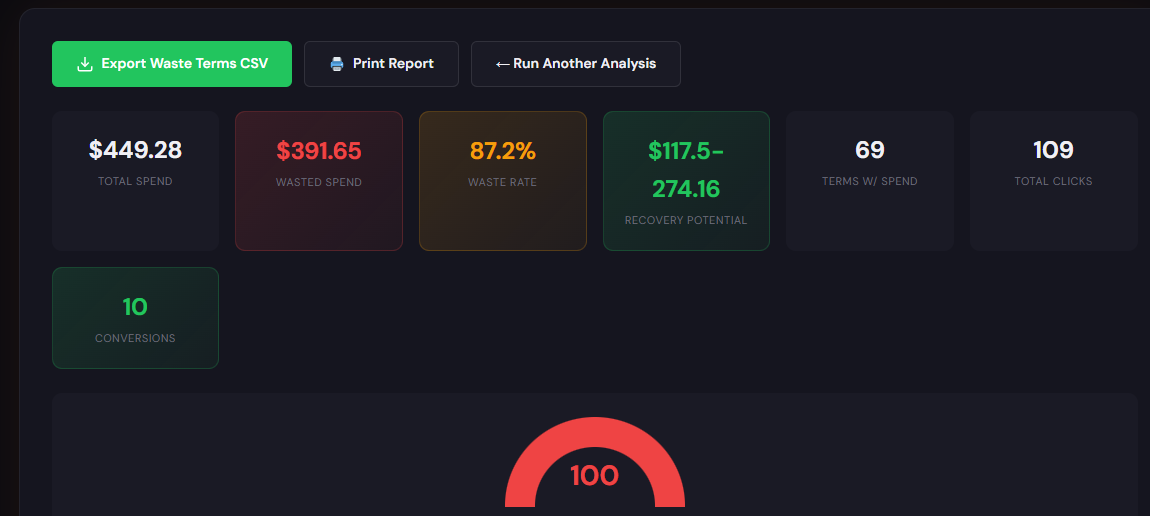
What it outputs: Dashboard snapshot with total wasted spend, top leakage categories (search terms, placements, match types), and a prioritized recovery plan you can action in under an hour.
How to use it in 3 steps
- Connect the account and select 30–90 day window to capture recent trends.
- Review the top leakage list; export search terms flagged as high-spend, low-conversion.
- Apply negative keywords and suggested campaign pauses, then re-run after 7 days.
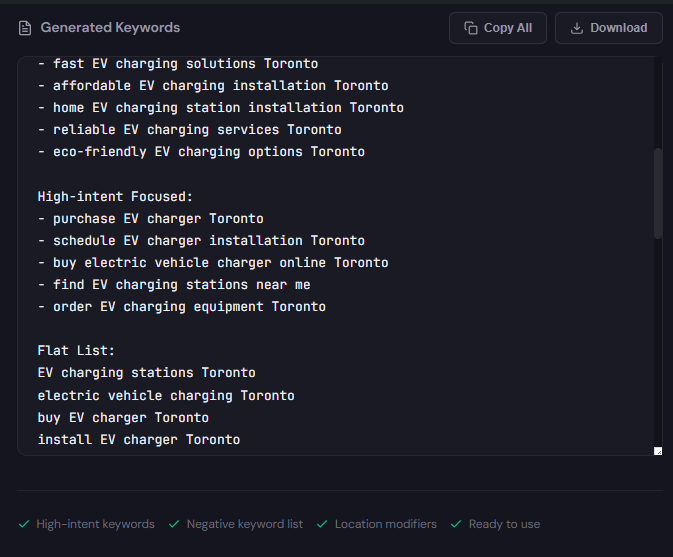
What it outputs: Intent-tiered keyword lists (high intent, informational, negatives), suggested ad group structure, and exportable CSVs ready for Google Ads Editor.
How to use it in 3 steps
- Enter your seed keywords and top converting landing pages to capture offer language.
- Choose intent buckets and generate a list; review and tag by performance priority.
- Export as CSV and import into the rebuilt campaign structure; keep negatives suggested by the tool.
Using both tools together: run the wastage snapshot first to remove leakage, then rebuild clean keyword/ad-group structure with the AI generator to restore Quality Score and scale efficiently.
90-minute account triage playbook
Follow this time-boxed checklist to stabilize performance fast.
- 0–10 min: Open account overview. Identify top 3 campaigns by spend.
- 10–30 min: Run a search-term export for those campaigns. Flag top 20 irrelevant queries.
- 30–50 min: Run the Wastage Snapshot tool on the same campaigns; apply immediate negatives it recommends.
- 50–70 min: Export keyword lists; run the AI Keyword Generator for the highest-converting campaign to restructure 3 ad groups.
- 70–85 min: Implement paused changes: add negatives, upload CSVs to Ads Editor, adjust ad schedules per hourly data.
- 85–90 min: Document changes and set a 7-day check to compare CPA/ROAS vs baseline.
Start the triage with the Wastage Snapshot and follow with the AI Keyword Generator to rebuild campaign structure quickly.
FAQ
Expect CTR and CPA improvements within 48–72 hours, but measure over a 7–14 day window to control for seasonality and bid learning.
Yes—tools surface high-confidence candidates, but always review recommendations against business context before applying them account-wide.
Moving keywords between ad groups can reset some historical signals. Prioritize high-impact ad groups first and keep a snapshot of baseline metrics.
Weekly for high-spend accounts, biweekly for mid-size accounts. Run a full snapshot monthly.
Leave a Reply