If conversions are flat or CPA is creeping up, this guide gives a tactical recovery playbook you can run this week. It maps practical fixes to free and premium tools on ExecWrite so you stop guessing and start recovering wasted spend.
- Wasted spend usually comes from poor match between intent, bids, and creative — diagnose with a quick wastage snapshot.
- Five root problems cover ~90% of account leaks: wasted search terms, poor bidding by hour, messy keywords/ad group architecture, low relevance (Quality Score), and automated bidding gone wrong.
- 90-minute triage + focused fixes + using the Wastage Snapshot and Search Term Analyzer from ExecWrite gets you immediate recoveries and a repeatable workflow.
Why PPC feels harder now
Fewer signals, more automation, and rising CPCs mean traditional rule-of-thumb tactics fail faster. The result: teams get reactive — pausing campaigns, cutting budgets, and missing structural fixes that recover spend.
The 5 biggest PPC problems marketers face
1. Wasted search terms eating your budget
- Symptoms: High spend on low-converting queries, long tail of singleton conversions, negative keywords missing.
Why it happens: Broad or phrase match expands into irrelevant long-tail queries; teams don’t review search terms frequently enough to add negatives.
- Fix this week: Export search terms last 30 days, surface top spend/no-conversion terms, add negatives and move high-intent queries into exact/ad group level.
2. Hour-of-day and dayparting blind spots
- Symptoms: CPA swings wildly by hour, conversion volume concentrated in narrow windows, wasted budget at low-performing hours.
Why it happens: Default ad schedules and campaign settings don’t match user behavior; manual checks are time-consuming so many teams never normalize by hour.
- Fix this week: Pull hour-of-day performance, reduce bids 20–40% for consistently high-CPA hours, increase bids on peak conversion hours, add ad schedule overrides.
3. Keyword/ad group structure chaos
- Symptoms: One ad group has 100+ keywords, ads are generic, Quality Score variance across keywords is high.
Why it happens: Rushed campaign builds and copy-first approaches leave keywords loosely grouped, which dilutes relevance and pushes CPC up.
- Fix this week: Break out top-spend keyword themes into separate ad groups, align 1–2 tightly-focused ads per ad group, and apply keyword-level negatives to reduce overlap.
4. Low ad-to-landing-page relevance (Quality Score leaks)
- Symptoms: Low CTR, rising CPC, conversion rate drops despite stable traffic.
Why it happens: Messaging mismatch between ad and landing page, poor headline alignment, or generic landing pages that don’t match intent.
- Fix this week: Match ad headlines to landing page H1s, create 1-2 landing page variants for top ad groups, A/B test headline and CTA relevance.
5. Automated bidding that’s misaligned with business goals
- Symptoms: Sudden volatility after switching to Smart Bidding, target CPA not met, limited conversion volume.
Why it happens: Smart bidding needs stable conversion data and accurate conversion values; when signals change or conversions are noisy, automated bids amplify the problem.
- Fix this week: Pause new broad experiments, switch to maximize conversions with a CPA cap, segment campaigns by conversion certainty, and use short-term manual bid overrides on high-variance groups.
Fixes you can apply this week
- Run a one-day search-term export and tag top spend/no-conversion queries for negatives.
- Pull hour-of-day report; reduce bids on worst 3 non-peak hours and increase on the top 2 performing hours.
- Split the top 20% of keywords by spend into dedicated ad groups with bespoke ads and landing pages.
- Audit Quality Score drivers: CTR, ad relevance, and landing page experience — fix the lowest-scoring keywords first.
- Temporarily cap automated bidding where conversion events are noisy; use conservative manual bids for testing.
Run a quick wastage audit to find the biggest leaks fast. Use the snapshot to prioritize negatives, bid fixes, and landing page mismatches.
Tool-based workflow (map each pain point to ExecWrite tools)
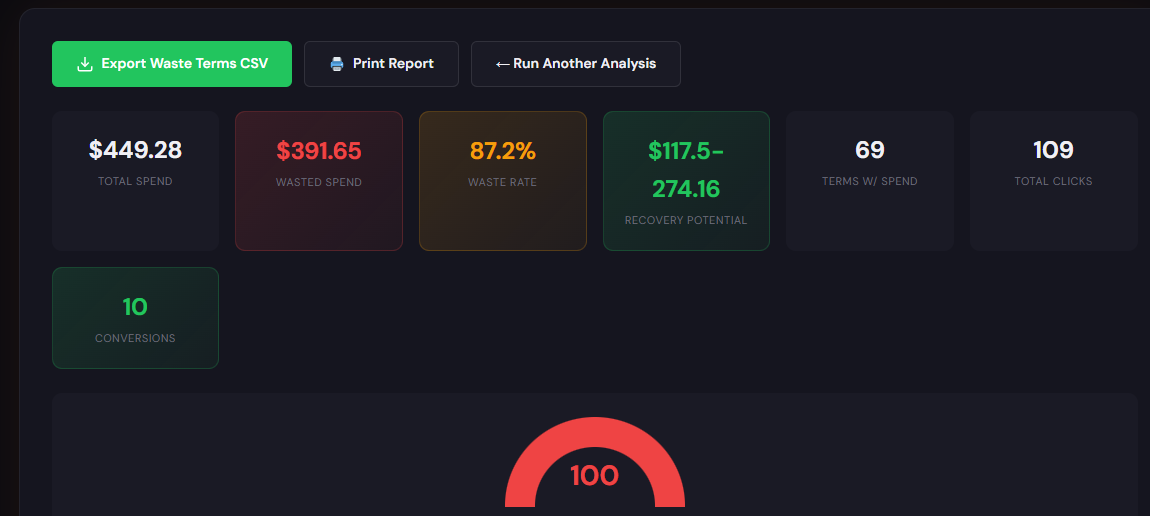
Google Ads Wastage Recovery Snapshot
What it outputs: A dashboard-style snapshot showing waste totals, top leakage areas (search terms, budgets, audiences), and a prioritized recovery plan.
How to use it (3 steps):
- Upload account data to the Wastage Snapshot at ExecWrite Wastage Recovery.
- Review the top 3 leakage categories it flags — prioritize negatives, budget shifts, and ad schedule fixes.
- Export the recovery plan and apply immediate negatives and bid caps; re-run snapshot weekly until waste drops.
Use when you need a fast, evidence-driven list of where your dollars leak.
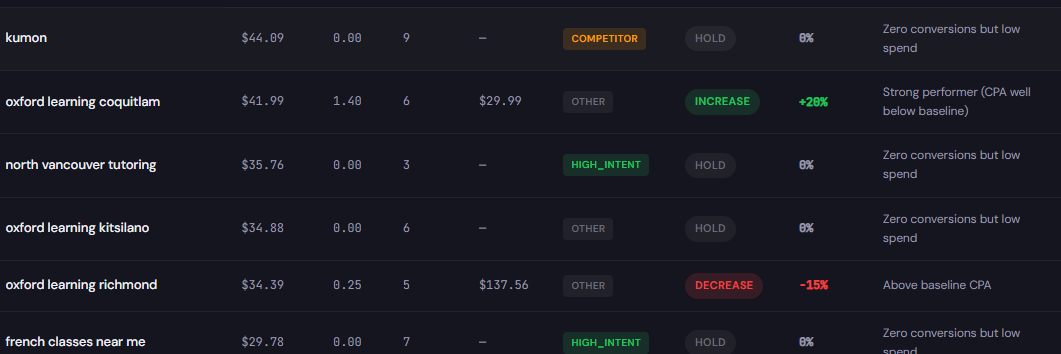
Bid Adjustment by Search Term (Search Term Analyzer)
What it outputs: A table of search terms with spend, conversions, CPA, and recommended bid actions or negatives.
How to use it (3 steps):
- Paste your search term report into the analyzer at Search Term Analyzer.
- Filter for high spend/no conversion and high CPA terms; tag terms for negative, move, or bid-change actions.
- Apply negatives and bid adjustments in the Google Ads UI or Editor; re-run the analyzer next week to measure lift.
Best for cleaning the tail and converting that work into specific account edits fast.
90-minute account triage playbook
- 0–10 min: Open account overview. Note last 14-day CPA, conversion volume, and any large budget shifts.
- 10–25 min: Run the ExecWrite Wastage Snapshot or scan campaign-level spend to identify top 3 leak categories.
- 25–45 min: Export search terms for top-spend campaigns and run the Search Term Analyzer. Tag negatives and move high-intent queries.
- 45–60 min: Pull hour-of-day report; apply temporary bid adjustments for worst-performing hours and boost peak hours.
- 60–75 min: Audit top ad groups for relevance: update headlines to match landing page H1, pause poorly performing ads.
- 75–90 min: Apply immediate negatives and bid changes in bulk via Google Ads Editor. Schedule a 1-week recheck and a deeper landing page/QA review.
Start your 90-minute triage with tools and templates from ExecWrite — get a prioritized recovery plan and actionable search-term fixes.
FAQ
You should see reduced wasted spend immediately; meaningful CPA improvement typically appears after 7–14 days as bids and automation stabilize.
Yes — when conversion signals are accurate and stable. If your conversions are noisy or low-volume, use conservative manual controls while you clean data and structure.
Search terms and hour-of-day reports. They reveal direct, high-impact actions: negatives and daypart bid changes.
No — tools are designed for operators. Export CSVs from Google Ads, paste into the tool, and follow the prioritized actions it returns.
Leave a Reply