If your Google Ads account is burning budget without predictable results, you don’t need theory — you need a fast, repeatable triage and a couple of tools that produce actions. ExecWrite has workflow-driven tools that produce recovery plans and bid actions you can implement today. Visit ExecWrite for the tools and templates referenced below.
- Most wasted PPC spend comes from unmanaged search terms, poor bid timing, and ads/landing-page mismatch.
- Fixes this week: stop bad search terms, restore ad-to-landing relevance, and apply hour-of-day bid adjustments.
- Use ExecWrite’s Wastage Snapshot and Search Term Analyzer to generate prioritized actions and recover budget in hours.
Why PPC feels harder now
Automation and broader match types increased scale — and with scale comes noise. Privacy changes and fluctuating CPCs mean conversion volume can swing while costs stay high. Teams are under pressure to show efficiency with fewer signals, so manual guesses don’t cut it. You need deterministic audits and exportable actions (negative keywords, bid changes, landing updates) not hypotheses.
The 5 biggest PPC problems marketers face
1. Uncontrolled search term waste
- Symptoms: high impressions on low-intent queries, clicks with zero conversions, frequent irrelevant search term spikes.
Why it happens — Broad and smart match increase reach but surface unrelated queries. Without a fast search-term audit you accumulate low-quality clicks and miss negative keyword opportunities.
- Fix this week: export top non-converting search terms, add negatives, and move high-intent terms into single-term exact ad groups.
2. Ad-to-landing-page relevance (Quality Score leaks)
- Symptoms: rising CPCs, low click-through rate vs historical, conversion rate drop after campaign changes.
Why it happens — Ads that promise something different than the landing page confuse users and reduce Quality Score, increasing CPCs.
- Fix this week: align headlines to landing-page value props, add focused ad groups, and run a quick headline-to-LP audit.
3. Time-of-day and dayparting losses
- Symptoms: wildly different CPA by hour, peak spend during low-converting hours, inconsistent ROAS across weekdays.
Why it happens — Accounts often inherit a flat ad schedule. Without granular hourly analysis you bid identically for high- and low-intent hours.
- Fix this week: analyze hour-of-day CPAs, reduce bids on poor-performing hours, and reallocate budget to peak hours.
4. Unrecovered wasted budgets (leaky campaigns)
- Symptoms: recurring low-quality spend, manual fixes that don’t stick, no consolidated recovery plan.
Why it happens — Teams act on individual finds but lack a prioritized recovery roadmap, so the same waste returns next month.
- Fix this week: run a snapshot audit to quantify waste, prioritize top three leakage areas, and apply high-impact quick wins.
5. Poor campaign structure & keyword cannibalization
- Symptoms: keywords competing in the same account, duplicated ads, inconsistent match types across groups.
Why it happens — Rapid scaling and ad-hoc additions create overlap. When similar keywords live in different ad groups you waste impressions and drive up CPCs.
- Fix this week: map intent (high, mid, low), consolidate duplicates, and export a clean campaign structure for Google Ads Editor.
Fixes you can apply this week
- Run a top-100 search-term export, add negatives for irrelevant terms, and promote clear converting queries to exact-match ad groups.
- Quick Quality Score patch: align ad headlines to landing page H1 and CTA; pause ads that underperform by CTR for 7 days.
- Hour-of-day triage: lower bids by 20–40% on hours with CPA > 1.5x account average; raise bids on hours with CPA < 0.8x average.
- Snapshot & prioritize: quantify absolute waste ($) and top 3 leak types, make a recovery checklist, and assign owners with deadlines.
- Structural clean-up: remove keyword overlap, standardize match types, and export CSV for Editor to redeploy in bulk.
Run a prioritized audit and get implementable actions. ExecWrite’s Wastage Snapshot produces a recovery plan you can act on in hours, not weeks.
Tool-based workflow: map problems to ExecWrite tools
Wastage Snapshot & Recovery — what it outputs
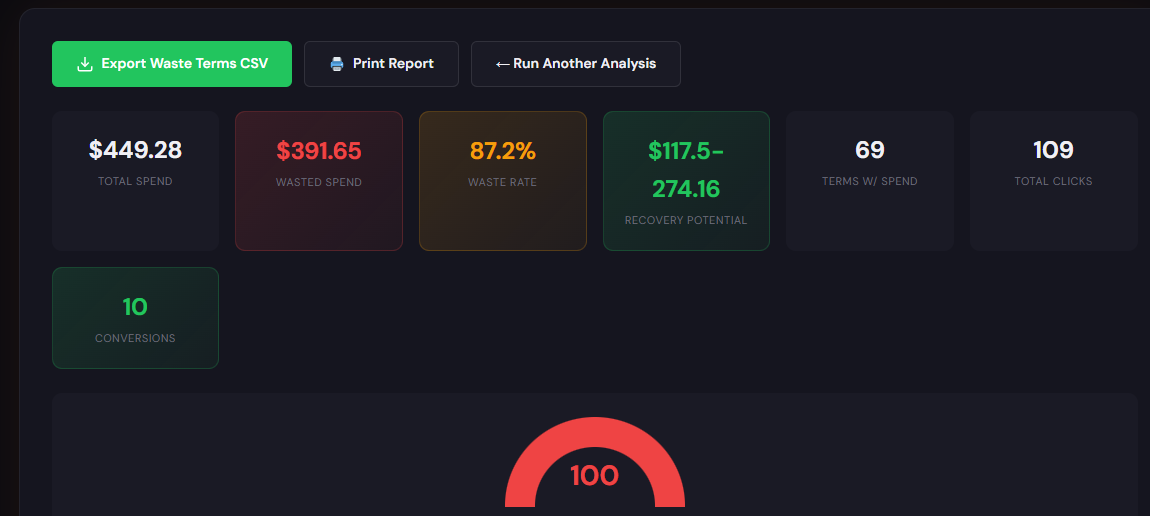
The Wastage Snapshot (https://execwrite.com/google-ads-wastage-recovery-snapshot/) produces a dashboard-style audit: total wasted spend, top leakage sources (search terms, campaigns, devices), and a prioritized recovery plan with line-item actions you can implement or export.
How to use it in 3 steps
- 1) Upload account exports (cost, conversions, search terms) and run the snapshot.
- 2) Review the prioritized leak list — the tool quantifies $ waste and ranks fixes by ROI.
- 3) Export action items (negatives, campaign pauses, reallocation suggestions) and apply them in Google Ads or Editor.
- 1) Paste the search-term report into the tool and choose intent tagging thresholds.
- 2) Review auto-tagged rows (Low intent, Brand, High intent) and accept suggested negatives and promotions to exact-match ad groups.
- 3) Export negative lists and bid-adjustment CSVs for Google Ads Editor or API pushes.
- Minutes 0–10: Pull last 30 days — cost, conversions, search terms, hour-of-day, device, campaign labels.
- Minutes 10–30: Run Wastage Snapshot. Flag top 3 leakage areas by $ and list required actions.
- Minutes 30–50: Paste search-term report into Search Term Analyzer. Export negatives and high-intent candidates.
- Minutes 50–70: Apply quick changes: add negative lists, pause lowest-performing campaigns, implement hour-of-day bid adjustments.
- Minutes 70–90: Create a 7-day monitoring plan. Schedule a re-evaluation and lock in who applies permanent structure fixes.
- Google Ads Quality Score help
- WordStream guide to negative keywords
- HubSpot: Common PPC mistakes and how to fix them
Tool URL: Wastage Snapshot & Recovery
Search Term Analyzer — what it outputs
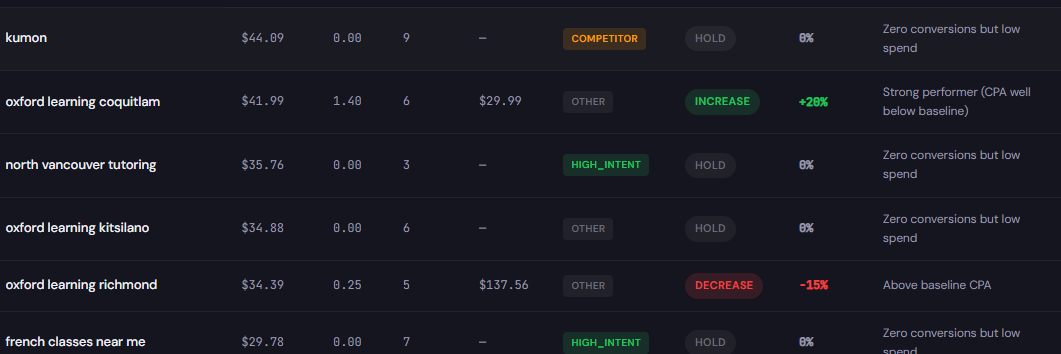
The Bid Adjustment by Search Term / Search Term Analyzer (https://execwrite.com/bid-adjustment-by-search-term/) turns raw search-term reports into tagged tables with spend, conversions, suggested negatives, and recommended bid actions. It’s built to create negative keyword lists and prioritized bid changes quickly.
How to use it in 3 steps
Tool URL: Search Term Analyzer
90-minute account triage playbook
These steps create measurable change within 90 minutes and a roadmap for work that needs longer-term fixes.
Use ExecWrite tools to turn exports into negative lists, bid adjustments, and a prioritized recovery plan. Implement fast and stop repeating the same fixes.
FAQ
You should see CTR/CPA movement within 48–72 hours if you apply negatives and hour-of-day bids. Full Quality Score improvements can take 2–4 weeks.
Yes. Both the Wastage Snapshot and the Search Term Analyzer export CSVs formatted for Google Ads Editor or bulk uploads.
Treat automated negatives as recommendations. Use the Search Term Analyzer to review and approve suggested negatives before bulk application.
Yes. Wastage Snapshot accepts consolidated exports so you can prioritize cross-account recovery plans.
Sources
Ready to stop wasting budget? Run a Wastage Snapshot and a Search Term Analyzer to get immediate, exportable actions: https://execwrite.com.
Leave a Reply