If your account has rising CPA, falling conversion rates, or spotty ROAS, this post gives a battle-tested triage path, quick fixes you can implement this week, and two ExecWrite tools to automate the heavy lifting. For hands-on remediation try ExecWrite’s tools at ExecWrite.
- Run a wastage snapshot to find budget leaks and low-intent traffic.
- Audit high-spend search terms and apply bid adjustments or negatives.
- Fix ad-to-landing-page relevance and dayparting within a single 90-minute triage.
Why PPC feels harder now
Markets, tracking, and automation have added layers of variance: less deterministic data, more signal noise, and automated bidding that amplifies unfiltered inputs. That combination makes small structural problems—poor asset relevance, wasted keywords, or wrong dayparting—scale into larger performance degradation.
The 5 biggest PPC problems marketers face
1. Invisible wasted spend
Symptoms
- High impression/click volume with near-zero conversions in specific campaigns.
- Budget burned early in the day without ROAS to justify it.
- Reports look OK at account level but performance deteriorates by campaign or keyword.
Why it happens
Accounts accumulate low-quality queries and mismatched audiences. Automated bidding optimizes what it sees; if the inputs include junk traffic, the system spends on it until you intervene.
Fix this week
- Generate a wastage snapshot to identify top leakage areas.
- Pause or reduce budget on mid-funnel display and broad-match campaigns until cleaned.
- Add high-confidence negatives from recent search-term data.
2. Poor search-term hygiene
Symptoms
- Irrelevant or low-intent queries driving clicks and spend.
- Multiple unrelated queries grouped under one phrase match or broad match.
- Negative keyword lists haven’t been updated in months.
Why it happens
Search-term reports are noisy and time-consuming; teams deprioritize cleanup and rely on broad-match coverage, which magnifies waste over time.
Fix this week
- Export last 90 days of search terms and tag by intent: high, research, irrelevant.
- Apply negatives for clear negatives and move high-intent terms into exact/ad-group appropriate bids.
- Set rules to auto-tag new low-intent terms for weekly review.
3. Quality Score leaks (ad/landing mismatch)
Symptoms
- High clicks but falling conversion rate after a rewrite or site change.
- Low ad relevance and expected CTR components in Quality Score diagnostics.
- Discrepancy between ad promises and landing page messaging.
Why it happens
Landing pages and ads drift apart—new creative or CMS updates break tight ad-to-page messaging. Google penalizes relevance which raises CPCs and reduces visibility.
Fix this week
- Run a focused QS audit on top-spend keywords; identify headline/landing gaps.
- Align headlines and CTAs on landing pages to the ad copy in the top ad groups.
- Set an experiment with a landing page version targeted to top keywords.
4. Time-of-day swings (bad dayparting)
Symptoms
- Huge CPA variance by hour or day.
- Campaigns spend during low-conversion hours because schedules are too broad.
- No measurement of hour-level ROAS or CPA trends.
Why it happens
Default ad schedules and automated bidding assume uniform intent; they don’t account for business-specific hour-by-hour demand patterns.
Fix this week
- Pull hour-of-day performance for last 90 days and identify profitable windows.
- Create ad schedule adjustments: bid up during profitable hours, down during loss-making hours.
- Test a conservative dayparting policy on a single campaign before scaling.
5. Over-automated campaigns with bad inputs
Symptoms
- Automated bidding amplifies sudden drops in conversion rates.
- Smart campaigns spend more after site changes or tracking issues.
- Low transparency into what signals the algorithm used.
Why it happens
Automation is strong when inputs are clean. If conversion tracking, audience signals, or creatives are broken, automation optimizes the wrong goal.
Fix this week
- Pause or switch to manual CPC on problem campaigns until tracking is validated.
- Verify conversion tags, audience definitions, and recent site changes.
- Use short experiments to confirm signal fixes before re-enabling automated bidding.
Fixes you can apply this week
- Run a quick wastage audit and prioritize the top 3 leak areas by daily spend impact.
- Extract recent search-term data, tag for intent, and add negatives for clear mismatches.
- Compare top ad headlines with landing-page H1s; make the copy consistent.
- Pull hour-of-day CPA/ROAS and apply conservative bid adjustments for worst hours.
- Pause automated strategies on campaigns with tracking or creative instability.
Use a wastage snapshot to find and quantify leaks in minutes. It surfaces top negative keyword candidates, wasted budgets, and recovery steps.
Tool-based workflow — map pain points to ExecWrite tools
Tool: Wastage Snapshot & Recovery
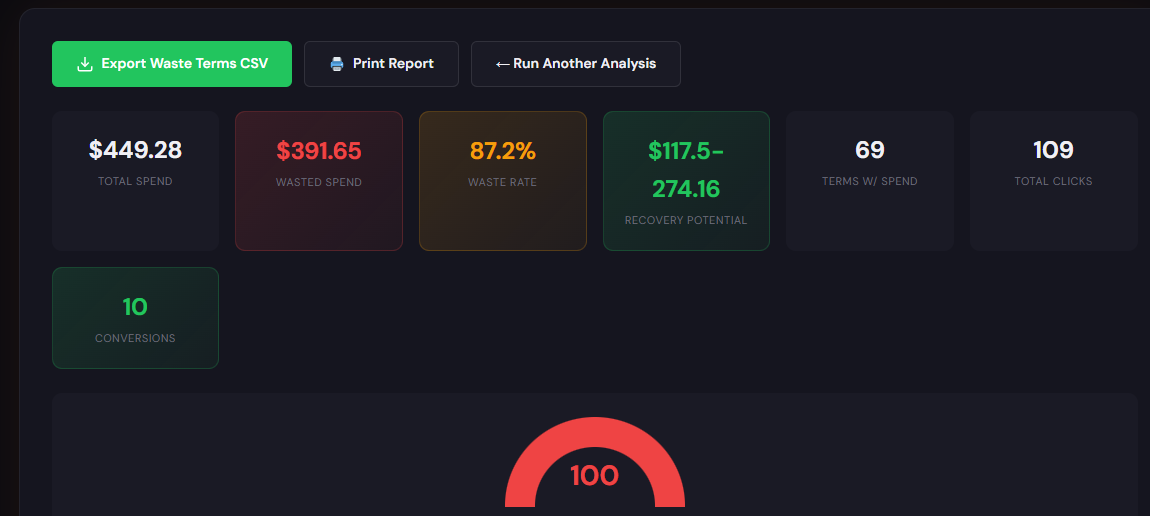
What it outputs: A dashboard summary of wasted spend, top leakage sources, negative keyword suggestions, and a staged recovery plan.
How to use it — 3 steps
- Upload your account export or connect via the tool to generate the snapshot.
- Review the top 5 leakage areas the snapshot lists (by spend and low-intent clicks).
- Apply the suggested negatives and budget pauses; export the recovery checklist for your team.
Open Wastage Snapshot & Recovery
Tool: Bid Adjustment by Search Term (Search Term Analyzer)
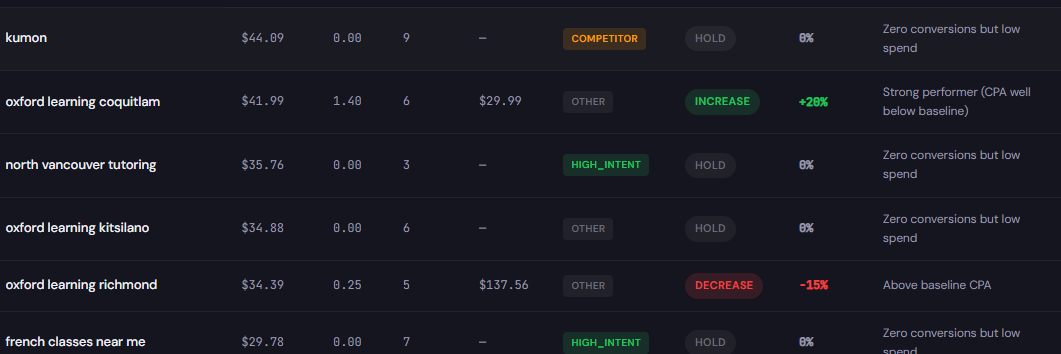
What it outputs: A tagged search-term table with spend, conversion metrics, intent labels, and recommended bid or negative actions.
How to use it — 3 steps
- Feed your recent search-term export into the analyzer.
- Use the intent tags to move high-intent terms into tighter match types and apply negatives for low-intent queries.
- Export bid-adjustment recommendations and implement via Google Ads Editor or scripts.
90-minute account triage playbook
- Minutes 0–10: Snapshot. Run the Wastage Snapshot to get an immediate prioritized list of leak areas.
- Minutes 10–30: Search-term triage. Load top 5 campaigns into the Search Term Analyzer; tag and apply top negatives.
- Minutes 30–50: Dayparting check. Pull hour-of-day CPA/ROAS and apply conservative ad schedule changes to stop loss-making hours.
- Minutes 50–70: Quality quick-fix. Match headlines to landing-page H1s for 3 top ad groups; set an experiment if possible.
- Minutes 70–90: Stabilize. Pause automated bidding on broken campaigns, save exports for the team, and assign follow-ups (detailed negative list, landing page rewrites, and schedule tests).
Run the wastage snapshot and search-term analyzer back-to-back to convert the triage steps into action items your team can deploy immediately.
FAQ
Some fixes—negatives, pausing bad campaigns, and dayparting—can reduce wasted spend within 24–72 hours. Quality-score and landing experiments typically take 2–4 weeks to show stable impact.
No. You can upload CSV exports for diagnostics or connect directly for a live snapshot. Exports are sufficient for immediate triage.
Automation will adjust given signals. After manual fixes, monitor automated campaigns closely and re-enable gradual bid automation only after you validate conversion tracking and creative stability.
Start with the Wastage Snapshot to quantify the problem at account-level, then use the Search Term Analyzer to clean the biggest sources of waste.
Leave a Reply