If your Google Ads numbers feel unstable—rising CPA, falling CVR, or weird spend spikes—you need a surgical, time-boxed triage approach, not another vague strategy doc. This article lays out exact symptoms, fast fixes, and a tool-backed workflow (useful with free tools at ExecWrite) to stop waste and restore performance.
- Run a wasted-spend snapshot and search-term analyzer to map leaks (30 minutes).
- Apply dayparting/bid adjustments and kill top wasting queries (30 minutes).
- Follow a 90-minute triage playbook to prioritize recovery actions and reallocate budget.
Why PPC feels harder now
Advertisers face more automation, less query visibility, and rising CPCs. Machine learning helps—but also masks root causes. Teams get pulled into reactive tweaks instead of focused recovery work. You need deterministic checks and tool outputs that convert into one-click fixes.
The 5 biggest PPC problems marketers face
1. Rising CPA with no clear origin
Symptoms
- Conversions flatten while cost increases.
- ROAS drops across campaigns simultaneously.
- Reports show more clicks but lower conversion rate.
Why it happens
Shifted user intent, budget drift into low-value queries, or automated bids chasing volume without conversion signals can all lift CPA. Often the root is leakage into low-intent search terms or ad/landing mismatch.
Fix this week
- Export top-spend search terms and tag by intent.
- Pause or add negatives for low-intent/high-cost queries.
- Restrict broad-match expansion until you verify intent.
2. Wasted spend in long-tail queries
Symptoms
- Hundreds of low-volume queries consume a disproportionate share of budget.
- Search terms with clicks but zero conversions stack up.
- Negative keyword lists aren’t reducing wasted clicks.
Why it happens
Broad or smart match settings and aggressive phrase expansion surface irrelevant long-tail queries. Without a systematic analyzer, these leaks compound slowly.
Fix this week
- Run a search-term analyzer and export high-cost, zero-conversion terms.
- Add those as negatives at campaign or account level.
- Convert repeat-waste terms into blocked lists for automation rules.
3. Poor ad-to-landing-page relevance (low conversion rate)
Symptoms
- High CTR but low CVR on specific ad groups.
- Quality Score drops or fluctuates.
- Landing page bounce rate spikes after changes.
Why it happens
Creative or landing-page changes can desynchronize messaging. Ads attract clicks but the landing page fails to deliver the expected intent or offer.
Fix this week
- Audit top ad groups for headline and offer mismatch.
- Use a landing-page rewriting checklist to align headlines and CTAs.
- Run A/B tests on the highest-traffic ad group first.
4. Hourly/daily performance swings
Symptoms
- CPA significantly better or worse at certain hours.
- Automated bidding underperforms during peak hours.
- Ad schedule cannot be easily tuned at scale.
Why it happens
Performance often follows predictable daily patterns. Without granular hour-of-day analysis you either miss opportunity windows or overspend when conversions are scarce.
Fix this week
- Pull hour-of-day metrics for cost and conversions.
- Apply conservative bid adjustments for low-performance hours.
- Increase bids in conversion-rich windows and monitor for 48 hours.
5. Tracking and attribution gaps
Symptoms
- Discrepancies between Analytics and Ads conversion numbers.
- Offline conversions not flowing back into Ads.
- Conversion value attribution seems inconsistent.
Why it happens
Broken tags, misconfigured conversion actions, or differences in lookback windows create noisy signals that break bidding and reporting.
Fix this week
- Verify gtag/GA4 events and Ads conversion actions.
- Reconcile a single conversion metric across platforms for 7 days.
- Pause automated bid strategies if conversions are undercounted until fixed.
Fixes you can apply this week
- Step 1: Run a wastage snapshot to quantify leaked spend by campaign and query.
- Step 2: Export search-term detail and tag by intent using a search-term analyzer.
- Step 3: Add negatives, pause poor-performing queries, and adjust ad schedule by hour.
- Step 4: Align top ad headlines to landing pages and run targeted A/B tests.
- Step 5: Reconcile conversion tracking and hold bidding strategies until signals are reliable.
Start with a quick snapshot to identify the top 10 leakage points and a prioritized recovery plan.
Tool-based workflow: map problems to ExecWrite tools
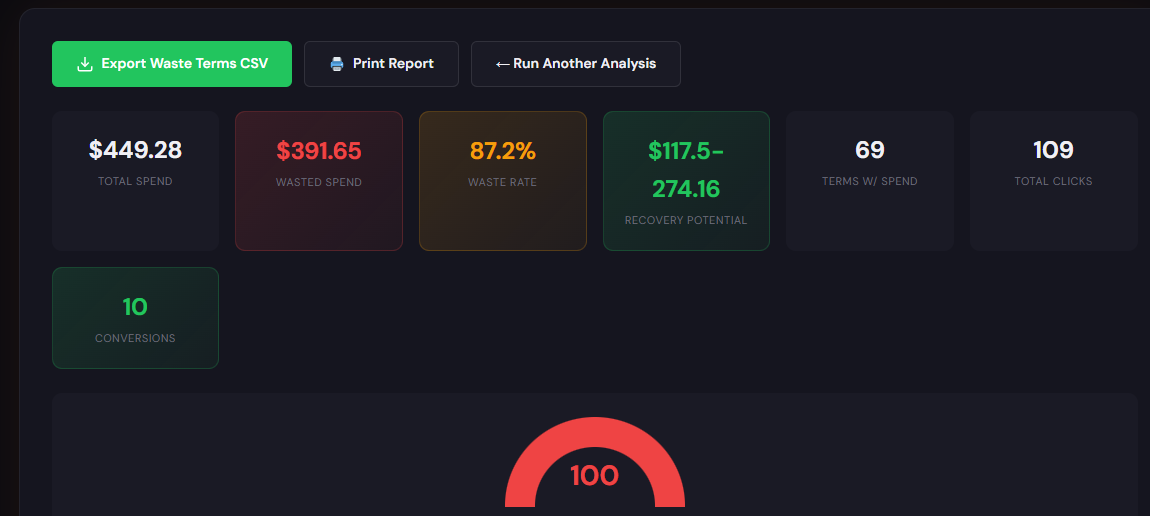
Outputs a dashboard-style snapshot showing wasted spend totals, top leakage campaigns, and a recovery plan with recommended actions.
How to use (3 steps)
- Upload or connect account-level spend and conversion data to generate the waste snapshot.
- Review the top 10 leakage areas and export the recovery checklist.
- Apply quick wins: pause waste campaigns, add negative keywords, and reallocate budget to efficient campaigns.
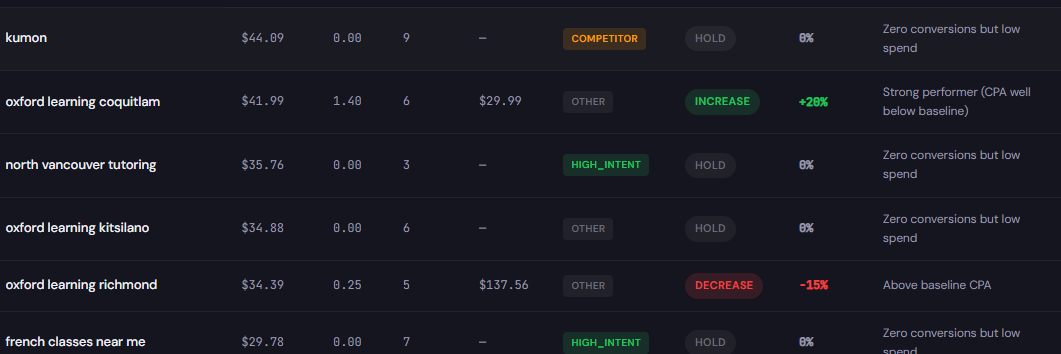
Produces a tagged table of search terms with spend, conversions, intent labels, and recommended bid actions or negative keyword suggestions.
How to use (3 steps)
- Load your search-term export into the analyzer and let it auto-tag intent (commercial, research, irrelevant).
- Export recommended actions: negatives, bid-downs, and terms to monitor.
- Push negatives into campaigns and set bid adjustments for low-intent matches.
Both tools create actionable exports you can apply in Google Ads Editor or via scripts—no manual row-by-row guessing.
90-minute account triage playbook
- 0–10 min: Generate a wastage snapshot and a top-100 search-term export.
- 10–30 min: Identify top 5 wasting campaigns and top 20 high-cost zero-conversion terms.
- 30–50 min: Apply negatives and pause worst-performing ad groups or campaigns.
- 50–70 min: Run hour-of-day analysis and apply conservative bid adjustments for low-value hours.
- 70–80 min: Align ad headlines to landing pages for the top 3 traffic-generating ad groups.
- 80–90 min: Reconcile tracking metrics and document changes for next 48-hour monitoring window.
Use the two tools above to audit, prioritize, and execute recovery actions. Fast audits identify quick budget wins and negative-keyword lists you can deploy immediately.
FAQ
If conversion data is unreliable, pause automated strategies for 48 hours. Run a waste audit and restore bidding once conversion signals are fixed.
You should see measurable reductions in wasted clicks within 24–72 hours after applying negative lists, depending on traffic volume.
Yes. ExecWrite tools provide export-ready lists and recommended bid actions compatible with Google Ads Editor and bulk uploads.
Properly tagging intent ensures you only block irrelevant low-intent queries. You should re-evaluate expansion periodically and whitelist high-potential long-tail terms.
Leave a Reply