If your Google Ads account feels like a money drain, you’re not alone. This post walks through why paid media gets harder, the five core problems that cause budget leakage, and an operator-grade recovery workflow. Use the guidance below alongside the free tools at ExecWrite to triage and fix waste in hours, not weeks.
- Wasted spend usually comes from poor match/type controls, broken intent signals, time-of-day and device swings, and low relevance across ad → landing page.
- Quick wins: pause high-cost non-converting queries, add negatives, reduce bids by hour/device where CPA spikes, and fix top landing-page mismatches.
- Use two focused ExecWrite tools—the Wastage Snapshot & Recovery and the Search Term Analyzer—to find leak points, then apply a 90-minute triage playbook.
Why PPC feels harder now
Performance marketing used to be a predictable auction—signal to conversion. Today you’re battling broader match types, AI-driven bidding, cross-device journeys, and noisier query sets. Those changes increase volume but reduce visibility into which clicks actually drive value. The result: more spend, less insight, and slower troubleshooting cycles.
The 5 biggest PPC problems marketers face
1) Query-level wastage (bad search terms)
Symptoms
- High spend on long-tail queries with zero conversions.
- High CPA for broad/phrase match groups that previously performed.
- Large search term reports with dozens of low-intent hits.
Why it happens
Match-type expansion and broad match with smart bidding can amplify low-intent queries. Without systematic search-term tagging and negative lists, wasted clicks compound quickly.
Fix this week
- Export last 30–90 days of search terms; filter by cost > X and conversions = 0.
- Turn those queries into negatives or add to a low-priority diagnostic campaign.
- Create intent-based labels (branded, transactional, research) and segment reports by label.
2) Time-of-day and dayparting leaks
Symptoms
- CPA or ROAS swings wildly by hour.
- Top-converting hours have small impression share; low-converting hours consume budget.
- Manual bids unchanged despite clear hourly patterns.
Why it happens
Automated bidding models smooth to averages; hourly performance gets flattened. Without hour-level analysis, bids stay too high during poor-performing windows.
Fix this week
- Review hour-of-day performance for cost, conversions, CPA over 30 days.
- Apply -20% to bids on recurring low-performing hours and +10–20% to peak hours.
- Set an ad schedule to limit exposure during expensive, low-converting times.
3) Landing page relevance and Quality Score sinks
Symptoms
- Low CTR for keywords that should be high-intent.
- High bounce rates and falling conversion rates after recent copy or creative changes.
- Quality Score under 6 on priority keywords.
Why it happens
Messaging mismatch between ad and landing page, slow pages, or poorly aligned CTAs reduce ad relevance and increase CPC. Quality Score penalties compound wasted spend over time.
Fix this week
- Run a headline-to-landing-page alignment check for top keywords.
- Prioritize fixing headline, CTA, and above-the-fold messaging for the top 3 low-QS keywords.
- Use a landing-page rewrite or targeted A/B test for those pages.
4) Budget leaks from duplicate or overlapping audiences/campaigns
Symptoms
- Competing bids across campaigns for the same queries.
- Unexpected spend spikes when new audience layers are applied.
- CPA rising after broadening targeting.
Why it happens
Campaigns targeting the same intent can bid against each other; layered audiences with overlapping members reduce efficiency and increase CPCs.
Fix this week
- Audit campaign targeting overlaps; pause or consolidate duplicates.
- Prioritize single campaign funnels for identical intent groups.
- Use negative audience or bid adjustments to separate layers.
5) Automation masking performance shifts
Symptoms
- Automated bidding hides why CPA increased.
- Sudden CAC increases linked to algorithm changes.
- Metrics improve superficially but conversion quality drops.
Why it happens
Smart bidding optimizes to signals but can overfit to short-term noise. Without query and landing-page inspection, automation can steer budget to low-quality conversions.
Fix this week
- Set performance guardrails (target CPA bands, max bid caps) for critical campaigns.
- Run a short-term manual experiment on key campaigns to isolate changes.
- Use conversion value filters to ensure optimization aligns with business KPIs.
Fixes you can apply this week
- Export search-term data (30–90 days); add negatives for high-cost non-converting queries.
- Run an hour-of-day performance report and apply ad scheduling/bid modifiers.
- Audit top 10 keywords for Quality Score and align ad headlines with landing pages.
- Consolidate overlapping campaigns and freeze new audience layers until performance stabilizes.
- Apply bid caps or conservative targets on automated bids while troubleshooting.
Use a focused account snapshot to find top leakage areas and a prioritized recovery plan in minutes.
Tool-based workflow: map problems to ExecWrite tools
Below are two tools that produce actionable outputs. Use them in sequence: snapshot → search-term analysis → targeted fixes.
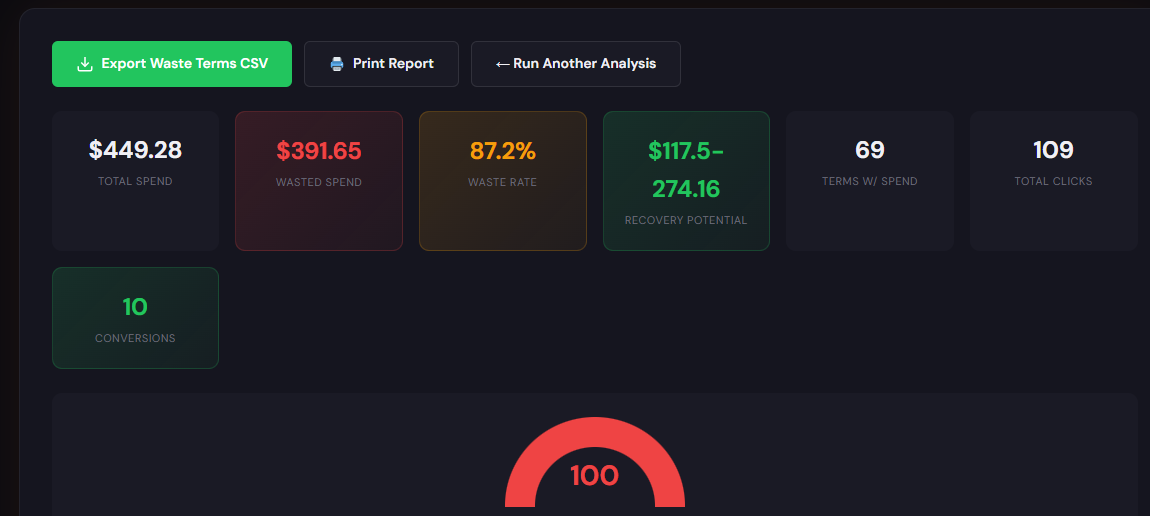
What it outputs
- Top leakage areas by campaign/ad group/keyword.
- Estimated wasted spend and quick-recovery checklist.
- Negative keyword and budget reallocation recommendations.
How to use it (3 steps)
- Upload your Google Ads account export or connect via the tool and run the snapshot for the last 30 days.
- Review the recovery plan: it highlights high-impact negatives, budget leaks, and campaigns to pause.
- Apply top-3 recommendations (negatives, budget shifts, quick landing fixes) and re-run in 7 days to measure lift.
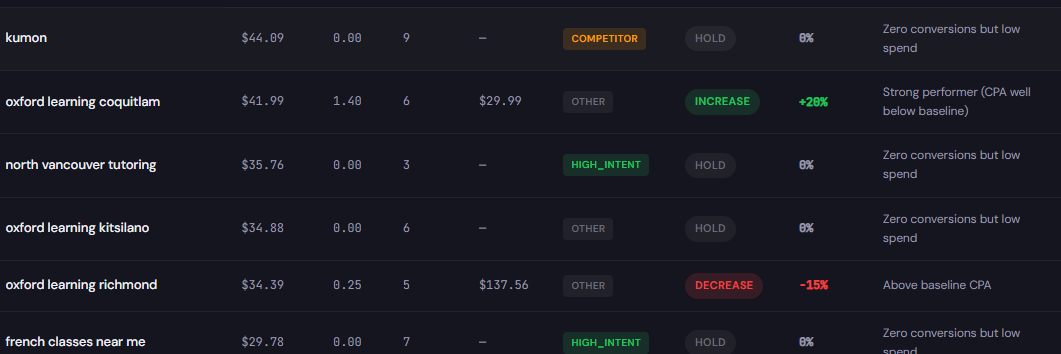
What it outputs
- Search-term table with spend, conversions, intent tags, and bid recommendations.
- Suggested negatives and bid adjustments for keywords and hours.
- CSV export ready for Google Ads Editor.
How to use it (3 steps)
- Run the analyzer on your last 90 days of search terms to surface costly, non-converting queries.
- Tag and export negatives and recommended bid adjustments by campaign/hour.
- Apply changes via Google Ads Editor or bulk uploads; monitor CPA for the next 7–14 days.
90-minute account triage playbook
- Minutes 0–10: Run the Wastage Snapshot & Recovery. Note the top 3 leakage causes.
- Minutes 10–30: Export search terms for high-spend campaigns and load into the Search Term Analyzer.
- Minutes 30–50: Apply immediate negatives for top high-cost no-conversion queries and pause clearly wasteful ad groups.
- Minutes 50–70: Check hour-of-day report; apply conservative ad schedule adjustments and -/+ bid modifiers for extreme hours.
- Minutes 70–90: Quick landing-page alignment — update headlines/CTAs for the top 3 low-QS keywords or flag them for a landing page rewrite. Document all changes and set a 7-day review.
Start with a snapshot, then run search-term analysis and deploy targeted negatives and bid adjustments. Get measurable recovery in days.
FAQ
A: You can see reduced wasted clicks within 24–48 hours; meaningful CPA improvements usually appear within 7–14 days as smart bidding stabilizes.
A: Not necessarily. Put conservative bid caps and tighter targets on critical campaigns while you troubleshoot to avoid runaway spend.
A: Start with the top 20–50 high-cost, zero-conversion queries. Track impact before expanding your negatives list.
A: Proper negatives and hour bidding preserve intent — they reduce noise, not demand. Once clean, scaling is more predictable and efficient.
A: Start with the Wastage Snapshot & Recovery to prioritize fixes, then use the Search Term Analyzer for query-level actions.
Leave a Reply