If your account spends but doesn’t convert, you need a practical triage—not theory. This guide walks through the exact faults that leak budget and gives a tight, tool-backed recovery path you can run this week. Start with a quick audit or visit ExecWrite for free snapshots and generators.
- Most wasted spend comes from poor match/keyword hygiene, ad-to-landing mismatch, and undiagnosed budget leaks.
- Run a 90-minute triage: waste snapshot, keyword surface, and targeted bid fixes to stop the bleeding.
- Use two ExecWrite tools (Wastage Snapshot & AI Keyword Generator) to recover spend and re-launch high-intent campaigns.
Why PPC feels harder now
Fewer cheap wins, more automation, and noisy signals make routine optimizations less effective. Cookies and targeting shifts increase ambiguity; smart bidding amplifies broken inputs. The result: accounts burn budget faster and yield fewer clear fixes. You need surgical diagnosis, not broad strategy sessions.
The 5 biggest PPC problems marketers face
Poor keyword hygiene and match-type leakage
Symptoms
- High spend on long-tail queries with zero conversions.
- Unexpected branded or irrelevant search terms triggering ads.
- CTR low but CPC high on broad-match-heavy campaigns.
Why it happens — Broad match and aggressive expansion without consistent search-term reviews create the biggest source of waste: irrelevant impressions and clicks.
Fix this week
- Export last 90 days of search terms; tag non-converting and irrelevant queries.
- Push top negatives into shared negative lists and pause offending keywords/ad groups.
- Convert high-volume irrelevant queries into negatives at account level.
Ad-to-landing-page mismatch (low relevance)
Symptoms
- High bounce rate and low conversion rate despite decent CTR.
- Low quality score on key keywords.
- Short session times and quick exits from paid landing pages.
Why it happens — Messaging drift: ads promise one thing, landing pages deliver another. Automated bidding magnifies the cost of this mismatch.
Fix this week
- Map top ad headlines to landing page headlines; fix the most mismatched pairs first.
- Add clear intent-driven CTAs and one-click conversion paths on landing pages.
- Use a simple A/B test: control vs. messaging-aligned variant for highest-spend ad groups.
Budget leaks and wasted spend pockets
Symptoms
- Spikes of spend that produce little or no conversions.
- High spend on low-intent campaigns or test variations nobody owns.
- Cross-campaign cannibalization where multiple campaigns target the same queries.
Why it happens — Complex account structures, overlapping targeting, and unmonitored experiments create places where spend runs unchecked.
Fix this week
- Run a waste snapshot to identify top leakage areas (by spend, by ad group).
- Pause or cap budget on experiments that exceed ROI thresholds.
- Consolidate overlapping campaigns or set negative audiences/keywords to reduce cannibalization.
Poor bid timing and dayparting
Symptoms
- Large hour-to-hour swings in CPA or conversion rate.
- Automatic bidding incorrectly prices low-converting hours the same as peak hours.
- Ad schedule is flat even when performance is not.
Why it happens — Many accounts never check hour-of-day performance; automated bidding can’t fix a flawed schedule without correct inputs.
Fix this week
- Pull hourly performance and apply -30% to hours with worst CPA, +20% to highest-performing hours.
- Set ad schedule caps for low-converting times rather than full pause if volume matters.
- Revisit after 7 days and adjust based on observed conversion windows.
Landing page conversion leaks (post-click)
Symptoms
- Good lead volume but poor lead quality or low demo requests.
- High drop-off on multi-step forms or gated content pages.
- Conversion rate declines while impressions/clicks stay steady.
Why it happens — UX frictions, slow pages, or poor qualification flows turn clicks into wasted budget.
Fix this week
- Strip forms to essentials on highest-volume pages and retest for conversion lift.
- Run page-speed checks and fix assets causing >1s load delays.
- Implement quick verification or qualification steps to improve lead quality without blocking conversion.
Fixes you can apply this week
- Run a one-click wastage audit on your top 3 campaigns to expose leakage areas.
- Export search terms, create shared negative lists, and apply at account level.
- Align top 10 ad headlines with landing-page H1s for your two highest-spend ad groups.
- Implement simple daypart bid adjustments for the worst and best 3 hours.
- Cap experimental budgets, and reassign budget to top-performing ad groups.
Run a wastage snapshot and a keyword generation pass to recover wasted spend and relaunch focused campaigns.
Tool-based workflow
Below are two lightweight ExecWrite tools that replace hours of manual triage. Each entry shows output and a 3-step usage plan with a preview.
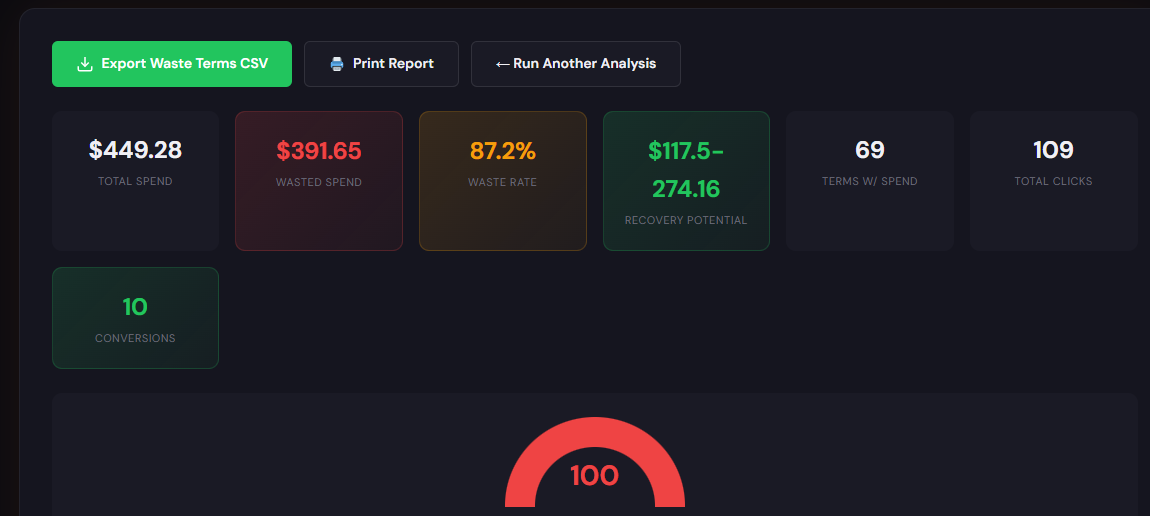
What it outputs: Dashboard-style snapshot with top leakage areas, waste totals, and a prioritized recovery plan you can act on immediately.
How to use (3 steps)
- Upload your Google Ads export for the last 90 days and let the tool identify top-leaking campaigns and ad groups.
- Review the prioritized recovery list and accept recommended pauses, negative keyword suggestions, and budget caps.
- Export the recovery plan and apply changes in Google Ads Editor or via the linked CSV to implement in under 30 minutes.
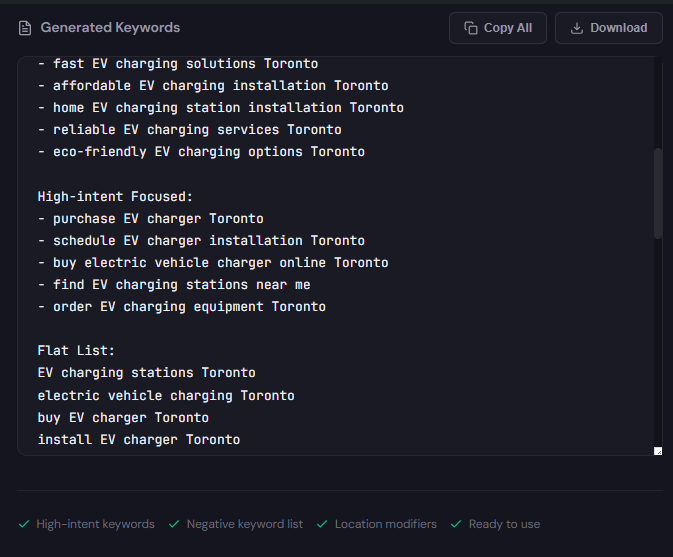
What it outputs: Structured keyword lists split by intent, negative keyword suggestions, and export-ready ad group structures.
How to use (3 steps)
- Enter your core product, landing page, or top-converting search terms.
- Generate intent-segmented lists and review suggested negatives to prevent match-type leakage.
- Export ad-group CSV or copy the lists into Google Ads Editor to rebuild focused campaigns quickly.
90-minute account triage playbook
Follow this timed checklist to stop budget leakage and create a prioritized recovery plan.
- 0–10 min: Run a Wastage Snapshot on your top 3 campaigns to get a leakage heatmap.
- 10–25 min: Export search terms for those campaigns; tag and compile negatives.
- 25–40 min: Apply immediate pauses/budget caps to top 3 leaking ad groups (per snapshot).
- 40–60 min: Use the AI Keyword Generator to create focused ad group lists for the two highest-value themes from your snapshot.
- 60–80 min: Align top ad headlines with landing-page H1s; create one messaging-aligned landing page variant per theme.
- 80–90 min: Deploy changes via Google Ads Editor, reassign saved budgets, and set a 7-day monitoring check.
Get the snapshot and keyword generator in the same workflow—recover spend and relaunch clean campaigns fast.
FAQ
You should see lower wasted spend immediately after pausing leaks; conversion-rate improvements typically appear within 7–14 days after aligning ads and landing pages.
ExecWrite provides recommended bid adjustments and export files. You retain control—apply changes manually or via Google Ads Editor to keep governance intact.
Properly scoped negatives reduce irrelevant clicks without blocking high-intent traffic. Use intent-segmented negatives so you remove noise but preserve scale.
Yes. Small accounts benefit most from quick waste discovery—recovering even 10–20% of spend can materially improve CPA and ROI.
Sources
- ExecWrite — Google Ads Wastage Snapshot & Recovery (tool used for audits)
- ExecWrite — Free AI Keyword Generator (tool used for keyword and ad-group generation)
- Google Ads Help — About Quality Score (why relevance and landing page alignment matter)
- Search Engine Journal — How to Reduce Waste in Google Ads (industry best practices on wasted spend)
Leave a Reply