If your account is burning budget with low conversions, this tactical guide isolates the common failure modes, prescribes fixes you can apply this week, and shows how ExecWrite tools speed recovery. Learn to triage an account in 90 minutes and lock in repeatable wins—see details at ExecWrite.
- Most wasted spend falls into a few repeatable buckets: irrelevant keywords, bad match types, poor ads-to-LP relevance, broken conversions, and wrong bid cadence.
- Apply four quick fixes this week: recover wasted queries, tighten match types, align ads and landing pages, and implement hourly/daypart bid edits.
- Use ExecWrite’s Wastage Snapshot to find high-leakage areas and the Bid Adjustment tool to act fast—follow the 90-minute triage playbook below.
Why PPC feels harder now
Paid media is more automated, more expensive, and more noisy. Automation masks the root cause of wasted clicks, privacy changes reduce signal, and auction dynamics push spend into underperforming placements. The result: normal optimization cycles no longer catch rapid leakage and you need fast, repeatable diagnostics to stop the bleeding.
The 5 biggest PPC problems marketers face
1) Irrelevant search queries generating clicks
Symptoms
- High spend, near-zero conversions on certain search terms
- CTR low or click volume spikes from long tail queries
- Negative keyword lists growing but not stopping leakage
Why it happens Automation + broad match expansion surfaces semantically distant queries. Without fast tooling, negative lists lag behind and waste compounds.
Fix this week
- Export top-spend search terms for the last 30 days and tag clearly irrelevant terms.
- Add high-frequency negatives as campaign-level negatives first.
- Switch the worst-performing ad groups from broad to phrase or exact for 7 days to test impact.
2) Mismatched ad creative and landing pages
Symptoms
- Good CTR but poor conversion rate
- High bounce rate on landing pages from paid clicks
- Quality Score slipping even as impressions rise
Why it happens Ad automation can serve high-performing headlines that don’t match landing-page messaging. That breaks the user journey and kills conversion rates.
Fix this week
- Pause responsive ads with mismatched headlines; test focused, single-message ads instead.
- Run a 3-variant landing page headline test that matches ad copy exactly.
- Check Quality Score components for top ad groups and fix landing-page relevance issues first.
3) Conversion tracking gaps
Symptoms
- Conversions drop suddenly without traffic changes
- Discrepancies between GA and Google Ads conversions
- Attribution windows show odd shifts
Why it happens Tagging, GTM triggers, or server-side changes often break conversion events. When conversions are missing, automation makes decisions on bad data and spends inefficiently.
Fix this week
- Verify conversion events in Google Ads and GA; check last deploys for changes.
- Run a test conversion and follow it through your stack (page > GTM > Google Ads).
- Temporarily switch automated bidding to manual or target impression share while tracking is fixed.
4) Wrong bid cadence and dayparting
Symptoms
- CPA/ROAS swings dramatically by hour of day
- Campaigns hit daily budget early with poor late-day performance
- Automated bidding ignores hourly patterns
Why it happens Most bidding strategies optimize on recent averages and miss granular hour-of-day patterns. That wastes budget in low-performing hours.
Fix this week
- Pull hourly performance for cost, conversions, and CPA for the last 14–30 days.
- Apply negative bid adjustments or ad schedule exclusions for consistently poor hours.
- Implement conservative bid increases for peak hours and monitor 48–72 hours.
5) Budget and structure drift
Symptoms
- High-performing campaigns capped by low budgets while low-performing ones spend freely
- Ad groups with mixed intent in the same budget
- Frequent changes by multiple users without a structure governance plan
Why it happens As accounts scale, teams add campaigns and audiences without rebalancing budget or consolidating structure. Result: wasted spend and missed opportunities.
Fix this week
- Run a budget reallocation: move 10–20% from low performers to high performers for a test window.
- Create a naming convention and tag authors/changes for auditability.
- Consolidate ad groups by clear intent buckets and set budgets per intent.
Fixes you can apply this week
- Run a quick wastage audit: top 100 search terms by spend → mark negatives → implement campaign-level negatives.
- Confirm conversions: fire test conversions, check GTM and Google Ads, switch bidding to manual if broken.
- Fix ad→landing-page relevance: 1-message ads, matching headlines, and a 3-variant headline test.
- Apply simple dayparting: pull hourly CPA and set -30% to -100% adjustments for poor hours.
- Reallocate budget for the next 7 days toward high-performing campaigns to validate capacity.
Run an automated audit to surface wasted spend, top leakage sources, and a prioritized recovery plan.
Tool-based workflow: map the problem to the ExecWrite tool
Wastage Snapshot & Recovery — audit and recovery plan
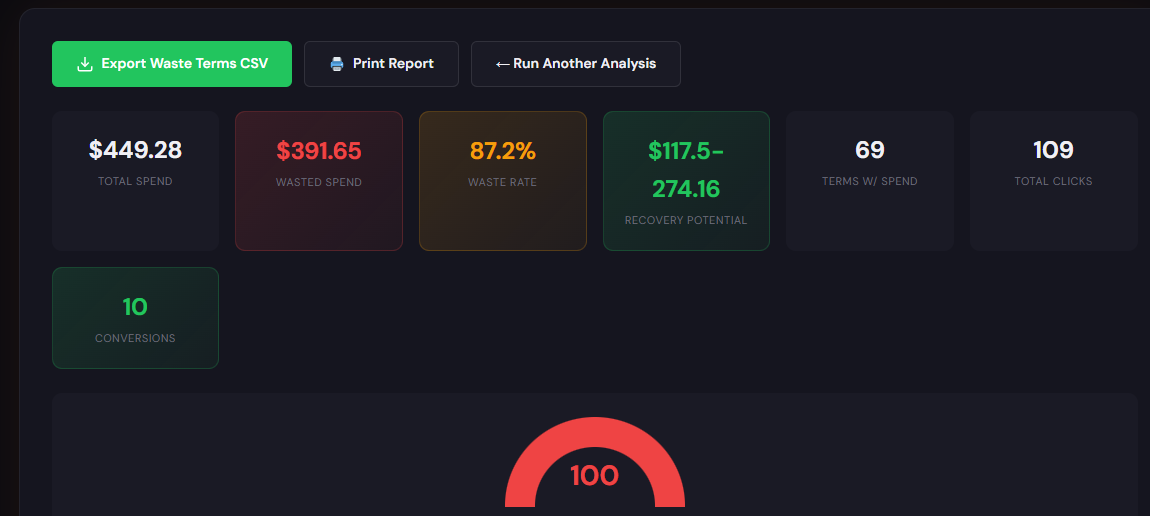
What it outputs: dashboard-style snapshot showing total wasted spend, top leak categories, prioritized negative keyword candidates, and an actionable recovery plan.
How to use it in 3 steps
- Upload your account or connect via the guided flow—run the snapshot for the last 30 days.
- Review the top 10 leak areas (search terms, audiences, placements) and accept suggested negatives or campaign edits.
- Export the recovery plan and apply the changes in Google Ads; monitor the 7-day impact and iterate.
Bid Adjustment by Search Term — fix daypart and search-term bid actions
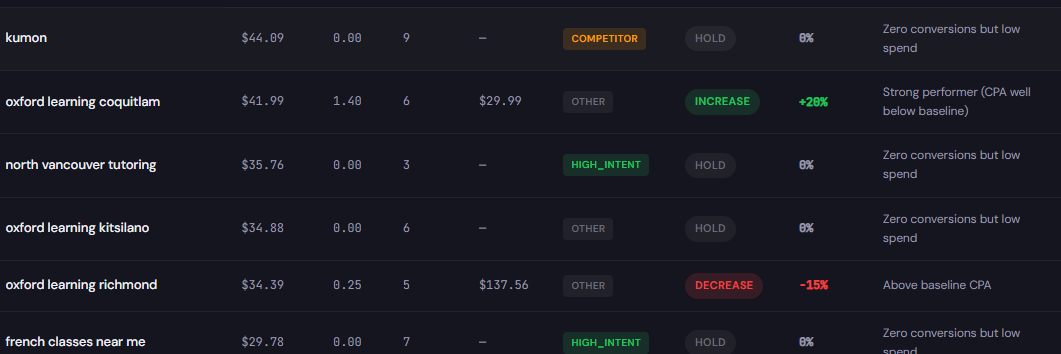
What it outputs: an exportable table with search-term-level spend, conversions, CPA/ROAS, tags, and recommended bid adjustments including hour-of-day suggestions.
How to use it in 3 steps
- Run the analyzer on the campaign/ad group set you want to fix and filter to high-spend, low-conversion terms.
- Accept recommended bid adjustments by term and hour-of-day, and export the CSV for Google Ads Editor.
- Upload changes in Google Ads Editor, monitor 48–72 hours, and roll back or scale based on CPA movement.
Both tools link back into a prioritized list of quick fixes; together they close the loop from diagnosis to action fast.
90-minute account triage playbook
- Minutes 0–10: Snapshot launch. Run Wastage Snapshot for 30 days and pull top 100 search terms by spend.
- Minutes 10–30: Negative triage. Apply campaign-level negatives for the top 20 irrelevant queries.
- Minutes 30–50: Conversion check. Fire test conversions, confirm GTM triggers, and ensure Google Ads receives events.
- Minutes 50–70: Bid cadence. Run Bid Adjustment by Search Term focused on top-spend ad groups and implement hour-of-day adjustments.
- Minutes 70–90: Quick ad/LP sweep. Pause worst responder ads, push 1-message variants, and schedule a 7-day landing page headline test.
- After 90 minutes: Set a 48–72 hour monitoring cadence, capture lessons, and document changes in a single audit spreadsheet.
Use ExecWrite to automate the audit and generate the fixes you can apply in under 90 minutes.
FAQ
No. Start by diagnosing the cause. If conversions are missing or severe mismatches exist, temporarily move to manual bidding while you fix tracking and landing-page relevance.
Expect initial improvement in 48–72 hours after applying negatives and bid adjustments. Structural fixes (landing pages, conversion tracking) may take longer but compound returns.
Start with the Wastage Snapshot to identify the largest leakage areas, then use the Bid Adjustment tool to act on search-term and hour-of-day patterns.
Yes. Both tools produce export-ready CSVs that you can upload through Google Ads Editor for fast, auditable changes.
Sources
- Google Ads Help – Support and documentation — reference for Quality Score, conversion tracking, and bidding basics.
- Search Engine Journal — articles and guides on reducing wasted spend and PPC best practices.
Leave a Reply