Why is my Google Ads PPC performance dropping — what can I fix this week?
If cost is up and leads are down, this is an operational playbook — not a manifesto. Use the checks below and the two ExecWrite tools linked to catch waste, fix keyword leaks, and get measurable bid and quality improvements fast. For hands-on tools, see ExecWrite.
- Most short-term Google Ads losses come from wasted spend, mis-tagged search terms, and bid timing—fixable in days.
- Run a quick wastage snapshot and a search-term bid audit to recover budget and reallocate to high-intent queries.
- Use the 90-minute triage below and ExecWrite tools to automate detection and deliver action lists managers can execute immediately.
Why PPC feels harder now
Every account has the same structural problems: data fragmentation, automated bidding opacity, and a higher cost-to-conversion in many verticals. Platforms push automation but don’t surface where it’s costing you money. That gap—where humans need to steer machine learning—creates the day-to-day grind: manual audits, confusing reports, and missed negative keyword opportunities. The rest of this article gives a short list of symptoms, quick fixes, and a tool-backed workflow to close the gap.
The 5 biggest PPC problems marketers face
1) Wasted spend hidden in low-intent search queries
Symptoms
- High impressions with zero conversions on many search terms.
- CPA drifting up while conversion rate drops.
- Large volume of clicks from irrelevant long-tail queries.
Why it happens
Auto-targeting, broad match and layered match types can surface irrelevant queries that bleed budget. Teams often lack a fast way to identify which exact terms to block or bid down.
Fix this week
- Export top 30 days of search terms by spend and sort by CPA.
- Tag terms with clear actions: negative, reduce bid, keep testing.
- Push high-volume negatives into a shared negative list and apply at campaign level.
2) Keyword and ad copy relevance / Quality Score leaks
Symptoms
- Declining click-through rate (CTR) and rising CPCs for core ad groups.
- Landing page conversion rate lower than expected despite steady traffic.
Why it happens
Mismatch between ad messaging, keyword intent, and landing page content reduces Quality Score and forces higher bids to sustain position.
Fix this week
- Audit top ad groups for headline-landing page alignment.
- Rewrite underperforming ad headlines to include the primary keyword and offer.
- Test a landing page headline tweak that mirrors the ad copy.
3) Bid timing and dayparting mismatches
Symptoms
- Huge CPA swings between hours or days of week.
- Conversion volume concentrated in narrow windows but budget evenly spread.
Why it happens
Default bid strategies often flatten time-of-day nuances. Without hour-level adjustments you either overspend in low-conversion hours or miss opportunities when buyers are active.
Fix this week
- Pull hour-of-day conversion and CPA report for last 30 days.
- Schedule bid modifiers: +X% on high-conversion hours, -Y% on low-performing hours.
- Monitor one week and roll adjustments into automated rules if stable.
4) Poor campaign structure and cross-contamination
Symptoms
- Search terms from different intents appear in the same ad group.
- Broad match causing important terms to be bidded at the same rate as generic traffic.
Why it happens
Rushed campaign builds or aggressive automation can lump mixed intent into single ad groups, limiting precise bidding and ad testing.
Fix this week
- Segment by intent: transactional vs informational vs navigational.
- Create new ad groups for high-intent clusters and move exact or phrase match terms there.
- Use separate budgets for testing vs scale campaigns.
5) Tracking gaps and mismatched conversions
Symptoms
- Google Ads conversions decrease but CRM leads remain steady.
- Conversion paths longer than the Ads attribution window.
Why it happens
Missing events, incorrect conversion windows, or broken tag setups create false negatives in Ads reporting, causing misguided optimization decisions.
Fix this week
- Validate tag fires and attribution windows in GA4 or server logs.
- Compare Ads conversions vs CRM lead counts for the last 30 days.
- Adjust conversion windows and import correct events if needed.
Fixes you can apply this week
- Run a fast wastage audit to identify the top 10 leak terms by spend.
- Apply negative lists and tag each term with the action (negative, bid down, keep).
- Optimize 3 headline-lp pairs for your highest-spend ad groups and A/B test.
- Set hour-of-day bid modifiers based on last 30 days of conversions.
- Validate conversion events end-to-end and correct attribution mismatches.
Use an automated audit to find the biggest drains and export actions you can apply right away.
Tool-based workflow: map problems to the ExecWrite tools that fix them
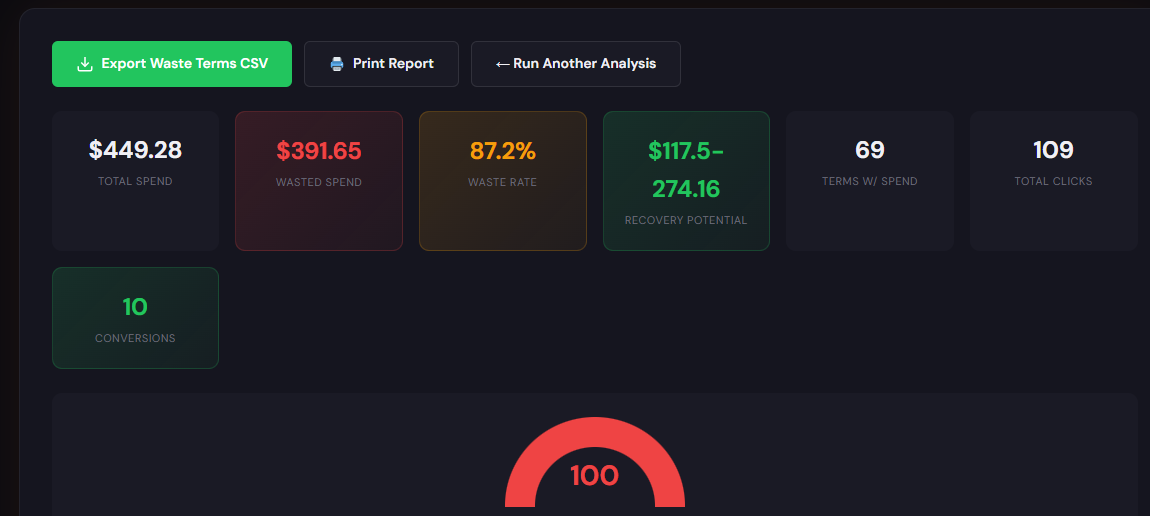
Dashboard-style snapshot with total wasted spend, top leakage categories, and an exportable recovery plan (negatives, budget moves, quick wins).
How to use it — 3 steps
- Upload last 30 days of Google Ads data to the snapshot tool: it surfaces top waste by campaign and search term.
- Review the recovery plan: the tool lists immediate negatives and budget reallocations you can apply.
- Export actions and apply them in Ads/Editor; re-run the snapshot after 7 days to confirm improvement.
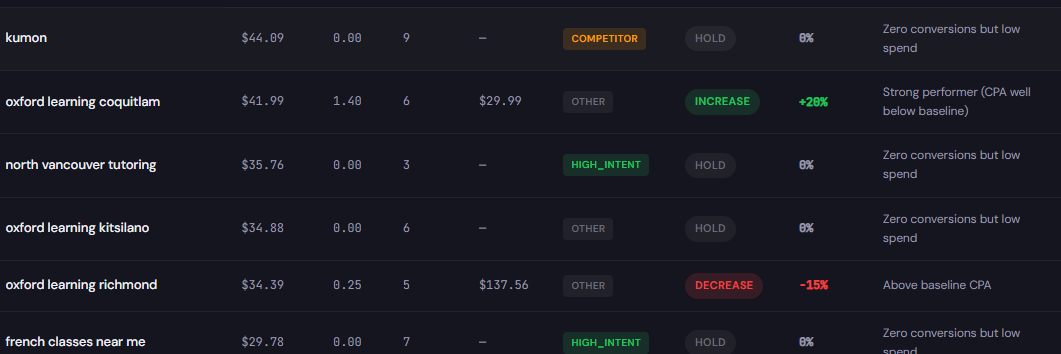
Term-level table with spend, conversions, CPA, recommended tag (negative/keep/bid), and suggested bid adjustments per term.
How to use it — 3 steps
- Load the account search-term export and let the tool classify each term by intent and performance.
- Apply the suggested tags and export a negative list or a CSV for Google Ads Editor to apply bid changes.
- Track results: the tool highlights which removals and bid edits produced immediate CPA reductions.
These two tools are designed to work together: the snapshot finds where budget is leaking at scale, and the search-term analyzer turns that signal into exact actions you can push to Ads or Editor.
90-minute account triage playbook
- 0–10 min: Pull account-level metrics (last 30 days vs prior 30). Note spend, convs, CPA, CTR.
- 10–30 min: Run Wastage Snapshot and identify top 5 leakage campaigns.
- 30–50 min: Run Search Term Analyzer on those campaigns; tag top 20 terms for action.
- 50–70 min: Apply negative lists and bid adjustments via Google Ads Editor (bulk CSV) and update ad schedules if needed.
- 70–90 min: Fix 3 headline/LP mismatches (quick copy tweaks) and deploy A/B tests. Schedule a 7-day check-in.
Automate the first two steps and get an exportable action plan you can apply immediately.
FAQ
Most accounts see measurable CPA improvement within 3–7 days; traffic will rebalance. Track conversions and CPA daily and re-run the wastage snapshot after one week.
Yes—bidding algorithms can reallocate if conversion signals change. Lock in negative lists and monitor automated bid strategies; use rules or portfolio bids only after you stabilize data.
Small accounts can use the Ads UI. For bulk negatives, bid edits, and campaign restructures, Google Ads Editor is faster and safer for rollbacks.
ExecWrite accepts exports and data uploads; it does not require account credentials. For privacy-sensitive environments, use CSV exports and local processing flows.
Leave a Reply