Wasted spend shows up as noise in reports and missed targets in board meetings. This post walks through the practical fixes you can apply this week, a 90-minute account triage playbook, and two ExecWrite tools that turn audits into action. See more at ExecWrite for hands-on utilities.
- Most waste comes from mismatched intent, untracked conversions, and poor bid timing — not just bidding algorithm failure.
- Run a waste snapshot and search-term bid audit to find immediate levers (negatives, bid cuts, ad-schedule changes).
- Use the ExecWrite Wastage Snapshot and Search Term Analyzer to produce prioritized, executable lists in minutes.
Why PPC feels harder now
Performance marketing has fewer obvious levers than it used to: privacy changes, automated bidding, and complex account structures hide the root cause. Marketers who rely on surface-level metrics (impressions, CTR) miss spikes in leakage and attribution gaps. The result: budgets climb while ROAS and pipeline decline.
Fixing this requires operator-level work: audit signals, validate conversions, prune low-intent queries, and apply time-based bid controls. Below are the recurring pain points and exact, short checklists you can run through this week.
The 5 biggest PPC problems marketers face
1) Wasted spend from low-intent search terms
Symptoms
- High spend on queries with no conversions
- Lots of clicks from broad or modified-match queries
- Surprising search terms in search-term reports
Why it happens
Automated match types and aggressive keyword match expansion can pull in queries with low purchase intent. Accounts that haven’t been pruned regularly accumulate negatives and low-performing search terms.
Fix this week
- Export last 30 days of search terms, sort by cost without conversions.
- Add top zero-conversion, high-cost queries as negatives by relevance bucket.
- Limit broad and phrase match spend with tighter bids or anchoring them to performance-focused match types.
2) Conversion tracking and attribution gaps
Symptoms
- Discrepancies between GA4 and Ads conversions
- High clicks, low recorded conversions after site changes
- Automatic rules and smart bidding losing signal
Why it happens
Tagging breaks from site updates, consent mode changes, or incorrect goal setup. When smart bidding loses conversion signal it optimizes on weaker proxies, wasting spend.
Fix this week
- Validate Ads conversion lines against server logs or CRM for a sample of recent conversions.
- Check global site tags, gtag.js presence, and consistent event names.
- Temporarily switch critical campaigns to manual bidding while you repair conversion signal.
3) Poor ad-to-landing relevance (Quality Score drains)
Symptoms
- Low Quality Scores in high-opportunity ad groups
- Declining CTRs and rising CPCs on previously stable keywords
- Landing pages with poor alignment to ad headlines
Why it happens
Copy and landing pages drift apart over time: promo pages change, creative rotates, and nobody updates headlines. Quality Score falls and costs rise.
Fix this week
- Identify ad groups with QS <= 6 and high volume.
- Align one ad headline and one landing page per ad group to match the top keyword intent.
- Test a landing-page headline swap or focused variant for 7–14 days.
4) Hourly/dayparting misses (wrong bids at wrong time)
Symptoms
- Strong conversion windows with low impression share or poor bids by hour
- Unexplained CPA swings by time of day
- Manual or automated bids that ignore local buying hours
Why it happens
Many accounts use blanket ad schedules or let automated bidding smooth across hours. When user intent is time-sensitive, you either underspend peak windows or overbid slow ones.
Fix this week
- Break performance by hour-of-day and identify top 3 converting hours.
- Apply positive multipliers for peak windows and reduce bids off-peak by a set percentage.
- Monitor for 7 days and adjust by small increments.
5) Overlapping audiences and campaign cannibalization
Symptoms
- Multiple campaigns competing for the same queries/audiences
- Lower ROAS when new campaigns launch
- Conversion credit split across similar funnels
Why it happens
Account sprawl and lack of negative targeting allow campaigns to compete, raising CPCs and reducing clarity on which creative or landing page performs best.
Fix this week
- Map campaign objectives and target overlaps in a spreadsheet.
- Add campaign-level negatives to enforce priority (brand vs. generic, geo splits).
- Pause overlapping low-volume campaigns and reassign high-value queries to a single, prioritized funnel.
Fixes you can apply this week
- Run a quick wastage snapshot to find top leakage buckets (search terms, auto-bids, budgets).
- Export the last 30 days of search terms; add negatives for zero-conversion high-cost queries.
- Validate conversion events for top 3 campaigns; fix tag/consent issues or pause smart bidding temporarily.
- Align one ad group per campaign: headline, keyword, landing page. Test a landing headline swap.
- Apply ad-schedule bid modifiers based on top converting hours.
Use the Wastage Snapshot to find leaks and the Search Term Analyzer to convert findings into negatives and bid actions fast.
Tool-based workflow (map each pain point to ExecWrite tools)
Below are two tools that replace hours of manual triage with prioritized outputs. Each tool shows what it produces and a 3-step way to use the output.
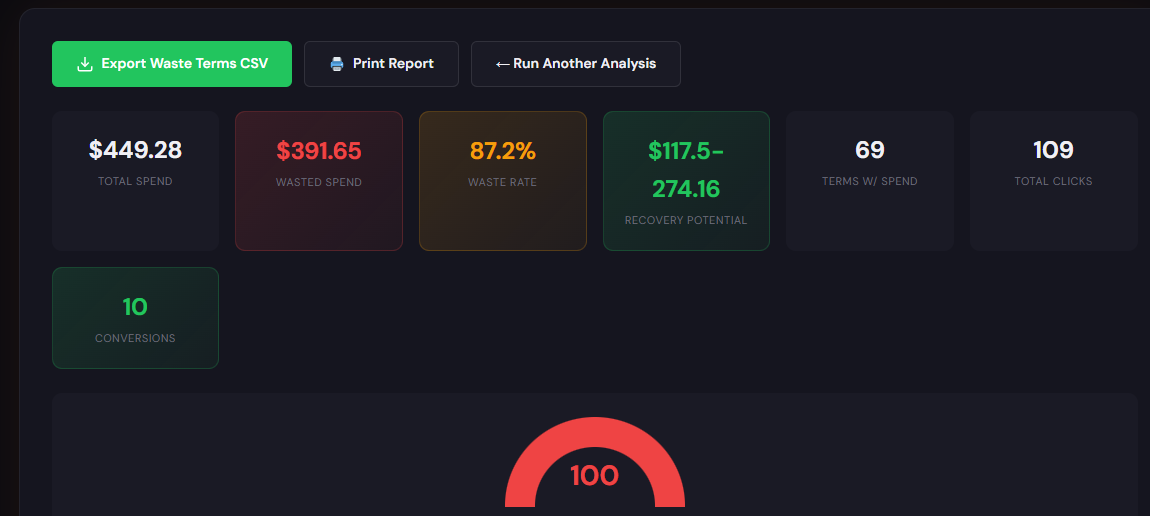
- Dashboard-style snapshot with total wasted spend and top leakage areas.
- Priority recovery plan: negatives, budget moves, and quick ad fixes.
- Exportable tasks you can push to an audit ticket list.
How to use it — 3 steps
- Upload or connect your account data and run the snapshot.
- Review the top 5 wasted areas the tool surfaces (search terms, budget leaks, poor-performing campaigns).
- Export the recovery plan and implement the top 1–3 actions this week.
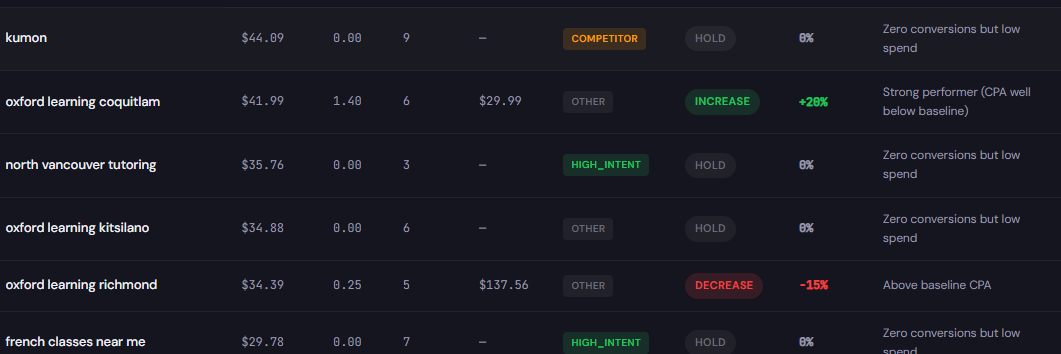
- Search-term table with spend, conversions, CPA, and recommended bid adjustments.
- Tagging and export features for negatives and bid-change CSVs.
- Hour-of-day aggregate views in the Hourly Bid Adjuster when you need dayparting.
How to use it — 3 steps
- Run the Search Term Analyzer over the past 30 days to get a sorted list of cost-without-conversion queries.
- Tag high-cost/no-conversion rows as negatives and export a negative list for upload.
- Use the recommended bid changes to generate a Google Ads Editor CSV or apply multipliers directly.
90-minute account triage playbook
Run this sequence with a single analyst. The goal: identify top 3 actionable fixes you can implement the same day.
- Minutes 0–10: Pull top-level KPIs (last 30/90 days) — cost, conv, CPA, conv rate; flag campaigns with +25% CPA or -20% conv rate vs baseline.
- Minutes 10–30: Run Wastage Snapshot for a leakage heatmap. Export top 10 leak items.
- Minutes 30–50: Run Search Term Analyzer for high-cost/no-conversion queries; tag and export negatives and bid actions.
- Minutes 50–70: Check conversion tracking for the top 3 campaigns flagged earlier — confirm event fires and look for GA/Ads mismatches.
- Minutes 70–90: Implement three quick actions: upload negatives, pause/adjust worst-performing campaign, and set ad-schedule modifiers for peak hours.
FAQ
Short answer: you can see visible CPA improvement in 7–14 days after implementing negatives and bid changes. Smart bidding needs stable conversion signal — if that’s broken, fixes may be immediate once tracking is restored.
Pause only for campaigns where conversion signal is unreliable. Otherwise use small manual overrides and leverage dayparting. If conversions are missing, pause smart bidding until you verify events.
Yes. The Search Term Analyzer and bid adjustment tool export Editor-ready CSVs for negatives and bid change bulk uploads.
Yes — start in read-only mode, review the proposed actions, and apply changes incrementally. The tools prioritize conservative fixes first.
Run a Wastage Snapshot and Search Term Analyzer to generate prioritized actions in minutes. Stop wasting budget and reclaim performance.
Sources
- Google Ads Help: About Quality Score — explanation of relevance signals and their impact on cost.
- Search Engine Journal: Google Ads Quality Score guide — practical breakdown of QS components and fixes.
- WordStream: How to stop wasting money on Google Ads — common causes of wasted spend and quick remedies.
Leave a Reply