If your Google Ads account leaks budget every month, this article gives an operator-level triage and practical fixes. Use the free and paid tools at ExecWrite to run fast audits, recover waste, and stop recurring leaks.
- Most wasted spend comes from mismatches (search terms, bids, times) and unmanaged automation—find it with a wastage snapshot.
- Quick stops: prune bad search terms, fix low-quality landing pages, and apply hour-of-day bid moves.
- Use ExecWrite’s Wastage Snapshot and Search Term Analyzer to find fixes, then run a 90-minute triage to lock in wins.
Why PPC feels harder now
Advertisers face more signals, less transparency, and more automation decisions. That creates three operational problems: invisible waste, over-optimization by rules/algorithms, and scale pressure to spend rather than to improve return. The result: accounts that grow cost but not revenue.
The 5 biggest PPC problems marketers face
Pain 1: Wasted spend from irrelevant search terms
- Symptoms: High impressions, low clicks-to-conversion, lots of unrelated search terms in the Search Terms report.
Why it happens: Broad match and loosely structured ad groups let low-intent queries trigger expensive clicks. Negative keywords aren’t maintained.
- Fix this week:
- Export the last 90 days of Search Terms and tag top irrelevant queries for negatives.
- Create refined exact/ad-group-specific match types for high-cost keywords.
- Set a weekly negative upkeep routine (10–20 mins).
Pain 2: Bid schedules and time-of-day CPA swings
- Symptoms: CPA varies wildly by hour; conversions cluster in specific windows; automated bidding overspends outside top hours.
Why it happens: Advertisers ignore dayparting signals or apply blanket bidding when conversion probability is time-dependent.
- Fix this week:
- Analyze hour-of-day conversion rates and cost-per-conversion by campaign.
- Apply ad schedule adjustments (bid modifiers) for low-performing windows.
- Test an hourly bid adjustment sheet for one campaign before scaling.
Pain 3: Landing page mismatch and Quality Score drops
- Symptoms: Declining CTR, rising CPC, low conversion rate despite steady traffic.
Why it happens: Ad copy and landing pages drift apart; audiences land on irrelevant pages and bounce, hurting Quality Score and price per click.
- Fix this week:
- Audit top-performing ad groups for headline/landing page relevance.
- Implement quick headline/CTA A/Bs and update landing headlines to match top queries.
- Measure conversion-rate lift and roll successful changes account-wide.
Pain 4: Unchecked automated bidding and rule conflicts
- Symptoms: Bids flip frequently, cost spikes after rule runs, automation fights human changes.
Why it happens: Multiple automations (smart bidding, rules, scripts) operate without a single source of truth, creating bid thrash.
- Fix this week:
- Document active automations and pause non-critical rules for 7 days.
- Run manual bid tests on a control campaign to observe behavior.
- Set guardrails: max CPC, ROAS floors, and conversion windows.
Pain 5: Slow keyword expansion and poor structure
- Symptoms: Overbroad ad groups, poor match-type strategy, and missed high-intent queries.
Why it happens: Teams rely on manual keyword lists or stale research instead of generating intent-segmented keyword sets quickly.
- Fix this week:
- Generate a targeted keyword set for one product using intent modifiers.
- Build ad groups around landing page themes and export to Google Ads Editor.
- Create a negative keyword list from search term negatives and add to shared library.
Fixes you can apply this week
- Run a wastage snapshot to identify top leakage areas (search terms, audiences, devices).
- Export Search Terms; add top 50 irrelevant queries to negatives and re-match exact vs broad.
- Analyze hour-of-day CPA and apply +/− bid mods for worst/best windows.
- Check top landing pages for headline mismatch; deploy three headline variations tied to query intent.
- Pause conflicting automation, document rules, and set a single bidding strategy per campaign type.
Start with a Wastage Snapshot to find where dollars leak. The tool highlights recovery opportunities and negative keyword suggestions.
Tool-based workflow
Below are two tools that map directly to the problems above. Use them in sequence: snapshot → search terms → hourly bid adjustments → landing page fixes.
Wastage Snapshot & Recovery
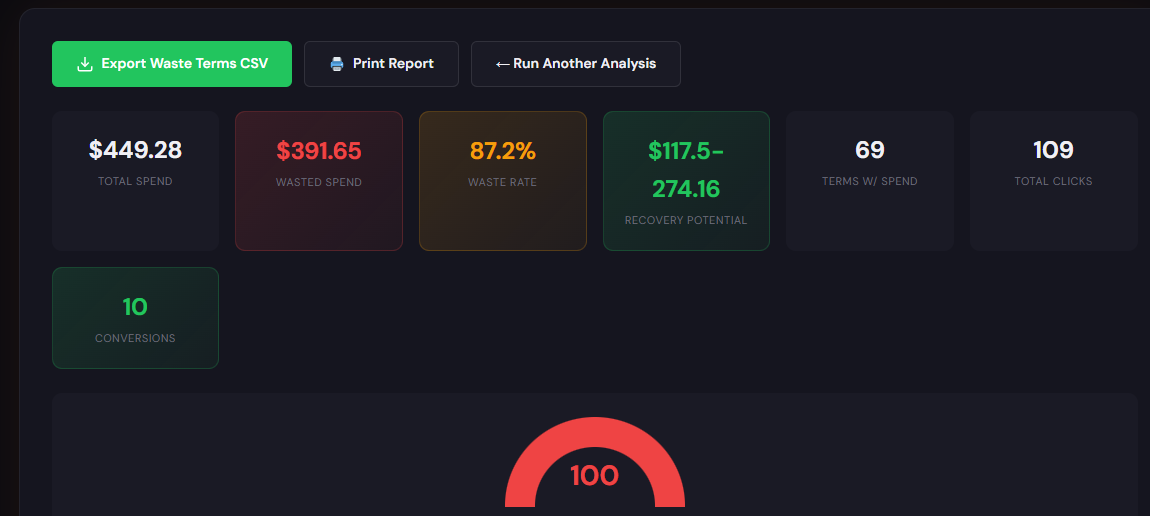
- Dashboard with total wasted spend, top leakage buckets (search terms, devices, campaigns), and a prioritized recovery plan.
- Negative keyword candidates and quick-line items you can action in minutes.
- Upload account data or connect your CSV export to the Snapshot tool.
- Review the top 10 leakage items and export the negative keyword list.
- Apply recoveries: add negatives, pause low-value campaigns, and track reclaimed spend over 14 days.
Tool link: Wastage Snapshot & Recovery
Search Term Analyzer (Bid Adjustment by Search Term)
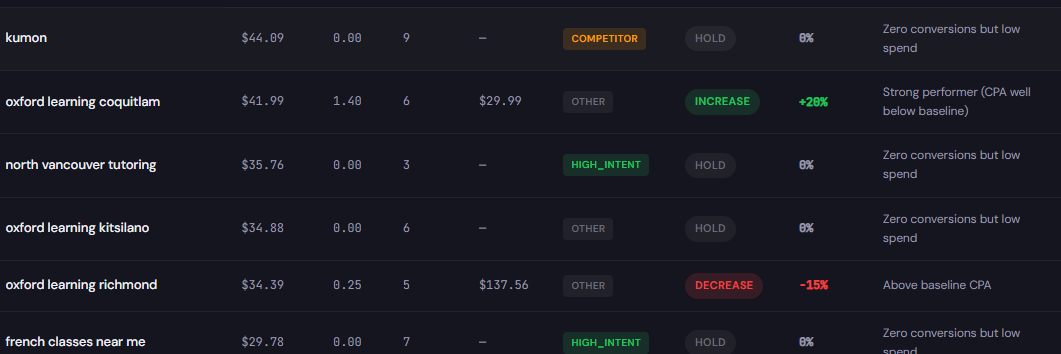
- Row-level search term metrics with spend, convs, CPA/ROAS and actionable tags (negative/add/keep).
- Recommended bid adjustments by search term and grouped export for Google Ads Editor.
- Upload your Search Terms report CSV for the chosen time window.
- Review tags and apply negatives or bid actions to the highest-cost low-conversion terms.
- Export the bid action CSV and import into Google Ads Editor for fast deployment.
Tool link: Search Term Analyzer
90-minute account triage playbook
Follow this timed playbook to convert findings into fixes in one block.
- 0–10 minutes: Pull account-level reports — search terms (90 days), campaign performance, hour-of-day, landing page URLs.
- 10–30 minutes: Run the Wastage Snapshot to get the top leakage buckets and recovery checklist.
- 30–50 minutes: Upload Search Terms to the Analyzer; tag and export negatives and bid moves.
- 50–70 minutes: Apply quick changes — negatives, ad schedule bid mods, pause worst spenders, and record changes.
- 70–90 minutes: Implement landing page headline fixes and set a 14-day measurement window with conversion tracking checks.
Use the tools above to run the 90-minute playbook and produce an actionable recovery plan. Get started at ExecWrite.
FAQ
Small fixes (negatives, pauses, ad schedule mods) typically show impact within 7–14 days. Structural fixes like landing page changes may take longer to validate.
Yes. Exports and CSV uploads are the primary workflows. For live API connections, a one-time setup by an admin is recommended.
No. Use the tools to produce recommended actions and create guardrails—pause conflicting rules first, then apply changes in a controlled manner.
Yes. Upload individual account exports or aggregate CSVs. The Snapshot highlights top leaks per account and combined recovery opportunities.
Sources
- Google Ads: About Quality Score — explains how landing page relevance and ad relevance affect cost and performance.
- Search Engine Journal: How to Use the Google Ads Search Terms Report — practical guidance on mining search terms for negatives and opportunities.
- Search Engine Land: How to Use Ad Scheduling (Dayparting) — dayparting strategies and performance impacts.
- HubSpot: How to Reduce Wasted Ad Spend — common sources of waste and operational fixes.
Leave a Reply