If your account feels like it’s bleeding budget while results slip, this playbook is for operators. We walk through core failure modes, quick fixes, a 90-minute triage, and a tool-first workflow using ExecWrite resources at execwrite.com to recover wasted spend fast.
- Stop daily budget leaks: audit wasted spend and negative keywords, then block the biggest offenders.
- Stabilize bids and schedules: use hour-of-day data and short-term bid rules to control volatility.
- Fix landing-page relevance and keywords: improve Quality Score and conversion rates with targeted rewrites.
Why PPC feels harder now
Paid media is more automated, more competitive, and more opaque than it was five years ago. Auction dynamics, broader match behavior, and algorithmic bidding amplify small data errors into big spend problems. Teams that treat Google Ads like a set-and-forget channel will see rising costs and falling returns; operators who run tight audits and apply surgical fixes win.
The 5 biggest PPC problems marketers face
1) Wasted spend and budget leakage
Common early warning sign of a losing account.
- Symptoms: high impressions but low conversions; many clicks from irrelevant queries; CTR drift without CVR.
Why it happens
Broad and phrase match combined with automated bidding push ads into tangential searches. Without regular negative keyword maintenance or a waste-focused snapshot, small losses compound quickly.
Fix this week
- Run a search-term audit and tag top irrelevant queries for negatives.
- Pause or lower bids for campaigns with high spend/low conversions.
- Apply quick negative lists at the account level for obvious junk traffic.
2) Keyword structure and intent mismatch
- Symptoms: high CPA in broad/ad group; ads that get clicks but drop off on landing page; low Search Impression Share for high-value terms.
Why it happens
Ad groups are too large, with mixed intent keywords and ads. That dilutes relevance and drives poor Quality Score and conversion rates.
Fix this week
- Split ad groups by intent (buy vs research). Create focused ad copy per group.
- Use an AI keyword generator to produce high-intent keyword variants and negatives.
- Export targeted ad groups to Editor for quick bulk updates.
3) Low Quality Score and landing-page mismatch
- Symptoms: high CPCs for keywords with good intent; ads drive traffic but landing pages don’t convert; high bounce rates.
Why it happens
Ad text, keywords, and landing pages diverge. Automation increases reliance on ad rank signals, so even small relevance gaps increase CPC and reduce visibility.
Fix this week
- Run a landing-page relevance check for your top 20 keywords.
- Rewrite headlines and CTAs to match keyword intent.
- Test a focused landing page for your highest-spend ad group.
4) Bidding volatility from automation
- Symptoms: sudden CPA spikes, inconsistent ROAS across hours or days, bids oscillating without clear cause.
Why it happens
Smart bidding reacts to signals; when inputs (conversion tracking, feed changes, seasonality) are noisy, bidding amplifies the noise and swings performance.
Fix this week
- Freeze major bid strategy changes and audit conversion tracking.
- Use hourly performance data to add temporary daypart bid adjustments.
- Set conservative bid caps or target adjustments while you triage.
5) Poor account hygiene and reporting blind spots
- Symptoms: disparate naming, missing UTM tracking, unclear conversion attribution, reports that don’t map to business outcomes.
Why it happens
Teams inherit messy accounts. Without a standard naming convention and hygiene checks, it’s hard to find root causes and apply surgical fixes.
Fix this week
- Standardize naming and document conversion events.
- Create a one-page report that ties campaign KPIs to business outcomes.
- Schedule a weekly 30-minute hygiene checkpoint.
Fixes you can apply this week
- Run a wasted-spend snapshot: identify top 10 queries and campaigns that drive low-value clicks.
- Apply immediate negative keywords for junk queries and pause worst-performing ad groups.
- Split high-spend ad groups by intent and refresh ad copy for exact/phrase matches.
- Check conversion tracking and set conservative bid caps while problems are resolved.
- Use hour-of-day performance to apply temporary bid modifiers for peak efficiency.
Run a targeted wastage snapshot and generate negative keyword lists automatically to stop the biggest leaks this week.
Tool-based workflow (map each pain point to ExecWrite tools)
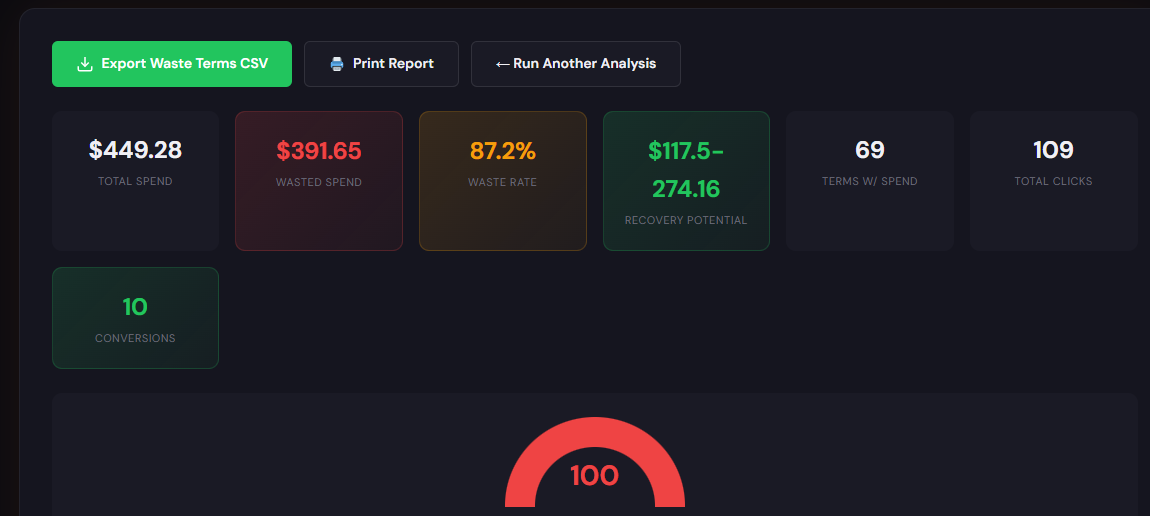
What it outputs: A dashboard-style snapshot showing total wasted spend, top leakage areas (search terms, campaigns), and a prioritized recovery plan with negative keyword suggestions.
How to use it (3 steps)
- 1) Upload a recent account spend and search-terms export to the Wastage Snapshot (Wastage Snapshot).
- 2) Review the top leakage areas and export suggested negatives and campaign-level pauses.
- 3) Implement negatives, pause the worst-performing ad groups, and rerun after 72 hours to measure impact.
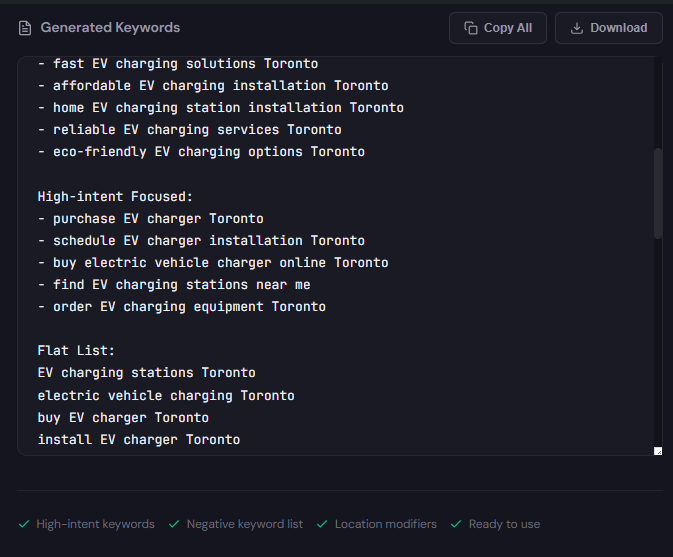
What it outputs: Structured keyword lists (high-intent, modifiers, negative candidates) and ad-group suggestions ready for export.
How to use it (3 steps)
- 1) Paste 5–10 core product/service phrases into the Free AI Keyword Generator (AI Keyword Generator).
- 2) Export high-intent keywords and map them to focused ad groups (exact/phrase first).
- 3) Use the output to create tighter ad copy and landing-page headlines that match intent.
Between these two tools: use the Wastage Snapshot to stop budget leaks and the AI Keyword Generator to rebuild structure and intent. Implement both within 48–72 hours for visible account stabilization.
90-minute account triage playbook
- 0–10m: Check account-level health — conversion count, tracking errors, and major bid changes.
- 10–30m: Run a Wastage Snapshot and export top 50 search terms by spend and zero/low conversions.
- 30–45m: Apply immediate negatives and pause the top 3 ad groups with worst spend-to-conversion ratios.
- 45–60m: Use the AI Keyword Generator to create focused ad groups for the top-performing landing pages.
- 60–80m: Implement conservative bid caps and hour-of-day bid modifiers for peak hours; document changes.
- 80–90m: Set a 72-hour monitoring window and schedule follow-up: measure spend reduction and conversion rate improvement.
Use the snapshot and keyword tools to stop waste and rebuild structure. Run a triage and get a prioritized recovery plan—fast.
FAQ
Expect meaningful spend reduction within 24–72 hours for the most obvious negatives. Conversion rate improvements depend on how many ad groups you split and whether you update landing pages.
Yes—if inputs are noisy. Poor conversion tracking, mixed-intent ad groups, or unchecked search terms feed bad signals. Freeze major changes, fix data quality, then let smart bidding resume.
Start with a Wastage Snapshot to stop bleeding spend, then use the AI Keyword Generator to rebuild structure and ad relevance.
ExecWrite offers both free and paid tools. The AI Keyword Generator is free to use; the Wastage Snapshot provides a prioritized recovery plan and may include paid upgrade options for deeper diagnostics.
Sources
- Google Ads: About Quality Score — official guidance on factors that influence Quality Score.
- Google Ads: Ad schedule (dayparting) — how ad scheduling and bid adjustments work.
- WordStream: Why You’re Wasting Google Ads Spend — practical examples of common waste vectors and fixes.
Leave a Reply