If your paid media numbers feel like they’re sliding, this is a tactical playbook. We walk through five root causes, quick fixes you can apply this week, and a tool-based workflow using ExecWrite to reclaim wasted budget and steady performance. For tool access and exports, visit ExecWrite.
- Most account problems are: wasted spend, automation mismatch, search-term noise, landing-page relevance, and slow testing.
- Quick wins: pause high-cost non-converting queries, set hour-level bids, map ads to landing pages, and run a 90-minute triage.
- Use two tools—Wastage Snapshot & Recovery and Bid Adjustment by Search Term—to generate prioritized actions and CSV-ready fixes.
Why PPC feels harder now
Platforms change fast: automation, privacy, and cost inflation mean historical rules don’t always work. That amplifies three predictable outcomes—less visibility at the query level, more wasted spend, and slower learning from tests. You can still act decisively; the fix is better data triage and targeted interventions, not wide-scale bidding panic.
The 5 biggest PPC problems marketers face
1) Wasted spend and budget leakage
Symptoms
- High cost but zero or very low conversions in a campaign or ad group.
- Large volume of low-intent search terms consuming budget.
- Spending clustered in few keywords with poor CTR or conversion rate.
Why it happens
Without frequent search-term audits and negative keyword hygiene, low-intent queries eat budget. Automation can amplify the problem by scaling performance signals linked to noise instead of business outcomes.
Fix this week
- Pull top 1,000 search terms by spend and tag non-converting queries.
- Apply negatives for broad-match leakage and known irrelevant modifiers.
- Reallocate budget away from campaigns with CPA > 2x target until remediated.
2) Automation misconfiguration
Symptoms
- Rapid swings in CPC/CPA after automated bid or portfolio strategy changes.
- Conversions drop despite stable traffic volume.
- Learning windows that never converge because goals/costs are inconsistent.
Why it happens
Automated strategies require clean signals and consistent goals. If conversion tagging, attribution windows, or campaign objectives shift, machine learning chases noise and inflates spend.
Fix this week
- Freeze automated bidding on the worst-performing campaigns for 48–72 hours.
- Confirm conversion and attribution settings match business goals.
- Run short manual bid tests on top keywords to re-establish baselines.
3) Poor search-term-level bidding
Symptoms
- Wide hour-to-hour CPA swings.
- Top queries that convert at dramatically different ROAS but have same bid.
- No clear dayparting or hour-level adjustments in place.
Why it happens
Most accounts treat keywords as static. Without search-term-level and hour-by-hour adjustments you miss when users are most likely to convert, so you either overbid for low-value times or underbid during peak intent.
Fix this week
- Export hourly performance for top campaigns and mark high/low CPA hours.
- Apply ad-schedule bid modifiers for expensive off-hours.
- Create a short list of search-terms that merit +10–30% bids by hour.
4) Landing page relevance and Quality Score decay
Symptoms
- High impressions but low CTR and poor conversion rate.
- Quality Score drops across keywords tied to a page.
- Ad messaging doesn’t match landing page headlines.
Why it happens
Ad-to-page mismatch reduces Quality Score and forces higher CPCs for the same traffic. Small copy and layout mismatches can create large conversion gaps.
Fix this week
- Map top ad variations to the exact landing page version they should send to.
- A/B test a headline and hero CTA aligned to the ad promise.
- Check tracking and form events for recent implementation issues.
5) Slow testing and poor experiment hygiene
Symptoms
- Tests run too long or without enough traffic to be decisive.
- Multiple experiments overlap with confounding variables.
- No clear success criteria for a test—decisions are subjective.
Why it happens
Teams skip upfront power calculations and proper segmentation, so tests consume time and budget without producing actionable outcomes.
Fix this week
- Define primary KPI and minimum detectable effect for each test.
- Run one clean test per audience or campaign pool at a time.
- Use short-duration tactical tests (7–14 days) for copy/landing tweaks.
Fixes you can apply this week
- Export last 30 days of search terms, sort by spend, and apply negatives to irrelevant, high-spend, non-converting queries.
- Run a quick conversion-tag audit: validate events, attribution windows, and duplicate conversions.
- Pause automated bidding where CPA is >2x target; run manual bids on top 20 keywords for calibration.
- Map ads to specific landing pages and align headlines; launch a 7–14 day headline A/B test.
- Apply hour-of-day bid modifiers based on observed CPA swings.
Run a quick wastage snapshot to find budget leakage and prioritized recovery steps—export negatives and recovery CSVs in minutes.
Tool-based workflow: map each pain point to ExecWrite tools
Wastage Snapshot & Recovery
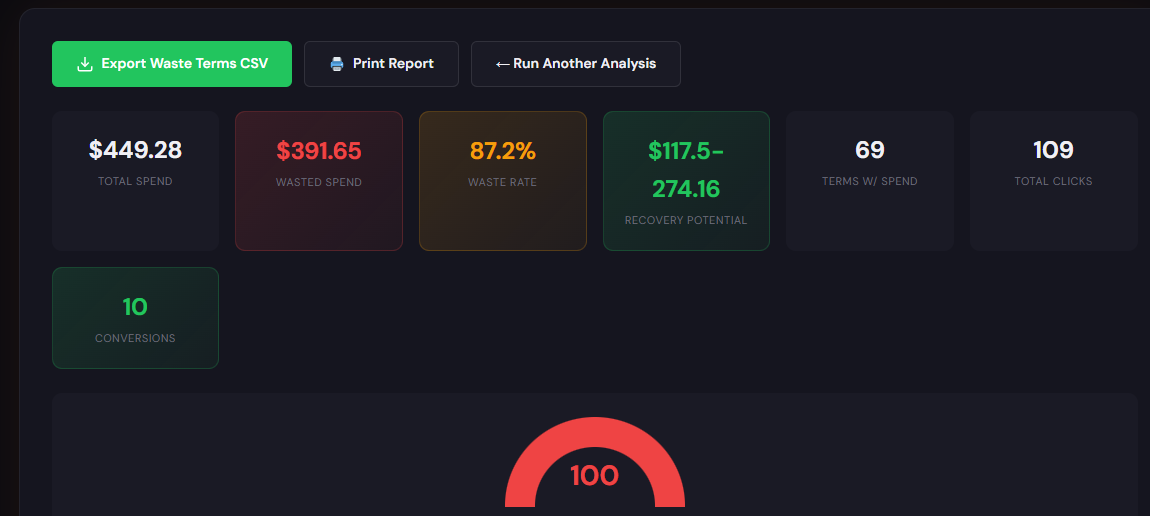
What it outputs: Dashboard snapshot of wasted spend, top leakage categories, prioritized negative keyword suggestions, and a recovery plan you can export as CSV.
How to use it (3 steps)
- Upload historical account data or connect via the UI and run the snapshot.
- Review the prioritized leakage list and select negatives to apply.
- Export recovery CSVs or download a recovery plan to implement changes in Google Ads Editor.
Why use it: it converts a time-consuming manual audit into an ordered action list so you can stop the biggest drains first. Tool: Wastage Snapshot & Recovery.
Bid Adjustment by Search Term (Search Term Analyzer + Hourly Bid Adjuster)
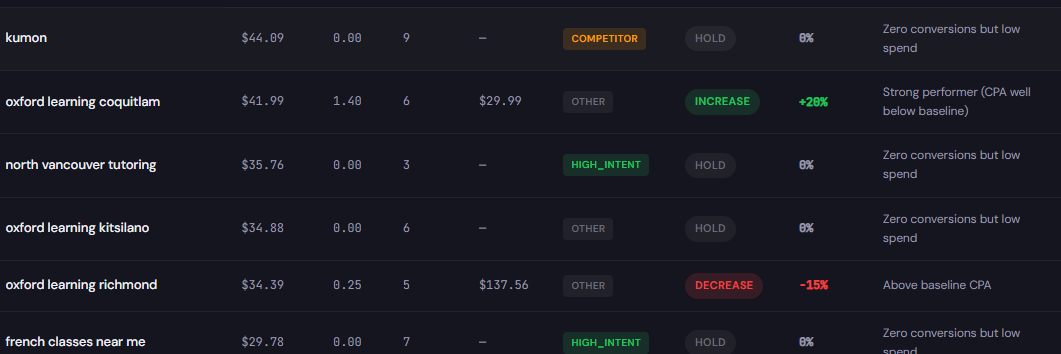
What it outputs: Search-term tables with spend, conversions, recommended bid changes, and hour-of-day adjustments for dayparting decisions.
How to use it (3 steps)
- Run the Search Term Analyzer on your campaign/ad group set to tag high-cost, low-conversion queries.
- Review recommended bid actions and export a bid-adjustment CSV for Google Ads Editor or your bidding platform.
- Use the Hourly Bid Adjuster report to set ad-schedule modifiers and capture hour-level ROAS swings.
Why use it: brings search-term granularity and time-based bidding into one workflow so you can stop broad-stroke bidding mistakes. Tools: Search Term Analyzer and Hourly Bid Adjuster.
90-minute account triage playbook
- 0–10 min: Top-level check—confirm conversions, budgets, and attribution settings.
- 10–30 min: Run Wastage Snapshot & Recovery and export the prioritized negatives list.
- 30–50 min: Export top 1,000 search terms by spend and run Search Term Analyzer on that list.
- 50–70 min: Apply immediate negatives and pause campaigns spending without conversions.
- 70–85 min: Use Hourly Bid Adjuster output to set ad-schedule modifiers for high CPA hours.
- 85–90 min: Document actions, schedule follow-up tests (7–14 days), and export change CSVs for Editor upload.
Run both the Wastage Snapshot and Search Term Analyzer to produce prioritized fixes and CSV-ready exports you can apply immediately.
FAQ
Not always. Pause or limit automation only where CPA diverges strongly from targets. Use short manual tests to re-establish reliable signals before re-enabling automated strategies.
Expect immediate traffic reduction from irrelevant queries; CPA improvement may take 7–14 days as learning stabilizes and conversions accumulate.
Yes. ExecWrite exports recovery and bid-adjustment CSVs formatted for bulk upload to Google Ads Editor or your preferred management tool.
Short-term: CPA (or cost per lead). Medium-term: ROAS and conversion rate. Use CPA to decide immediate pauses and negatives, then optimize for ROAS after recovery.
Leave a Reply