If your account feels chaotic—rising CPAs, budget leakage, or weird hour-by-hour swings—this guide gives an operator-first playbook and tool-driven workflow. Use the quick checks below, then run the exact ExecWrite tools that automate triage and recovery.
- Most wasted spend comes from mismatched intent, poor negative keyword coverage, and time-of-day misbids—find them fast with targeted audits.
- Use a short checklist to stop leaks this week, then run two ExecWrite tools to generate prioritized actions you can implement in Google Ads Editor.
- Follow the 90-minute account triage playbook to preserve budget, recover wasted spend, and stabilize performance quickly.
Why PPC feels harder now
Advertisers face three structural shifts: automation that hides granular signals, rising CPCs, and more noise from lower-quality queries. Smart Bidding helps, but it also amplifies noisy signals when the underlying account structure or negatives are weak. That combination magnifies waste—so you need faster audits and automated recommendations you can trust. For hands-on recovery, see tools at ExecWrite and the two tools we reference below.
The 5 biggest PPC problems marketers face
1) Wasted spend from low-intent search terms
Symptoms
- High volume of clicks with zero conversions.
- Search terms report shows many one-off or irrelevant queries.
- CPA jumps while conversions stay flat.
Why it happens
Broad match expansion, poorly structured ad groups, and incomplete negative lists let low-intent queries siphon budget. Smart Bidding learns from these bad clicks unless you remove or demote them.
Fix this week
- Export search terms for last 30 days sorted by spend and clicks.
- Tag and add high-volume irrelevant terms to negative lists immediately.
- Move high-converting search patterns into exact/ad-group specific campaigns to protect signal.
2) Hourly and daypart performance swings
Symptoms
- CPA or ROAS varies wildly by hour; same campaign performs well at 10am and poorly at 3pm.
- Ad schedules are default or absent despite clear hourly patterns.
Why it happens
Ad schedules are often left to automated bidding without a time-of-day layer. Bidding models optimize to averaged results and can be misled by small-time-window noise.
Fix this week
- Pull hourly performance by campaign for the last 14–30 days.
- Apply conservative bid adjustments (-20% to -50%) on hours with consistent poor CPA.
- Create separate campaigns or ad schedules for the funnels (e.g., prospecting vs. retargeting).
3) Landing page relevance and Quality Score drops
Symptoms
- Impressions fall, CPC rises, or Quality Score drops on top keywords.
- High CTR but low conversion rate—ad promises mismatch landing page.
Why it happens
When ads and landing pages diverge, Google reduces ad rank efficiency. Small messaging gaps compound into higher CPCs and lower conversion rates.
Fix this week
- Audit top 10 keywords by spend for ad-to-landing-page relevance.
- Align headlines and CTA language to match search intent.
- Run quick A/B headlines or headline swaps in responsive search ads to test alignment.
4) Poor negative keyword coverage and list hygiene
Symptoms
- Recurring irrelevant queries reappear even after manual negatives were added.
- Shared negatives block legitimate queries by mistake.
Why it happens
Negatives are managed inconsistently—added ad-hoc, copied incorrectly, or not exported/imported to synced campaigns—so leakage continues.
Fix this week
- Consolidate negatives into shared lists by funnel and intent.
- Use search-term clusters to generate negative lists rather than single-term edits.
- Test negative lists on a small campaign first to validate no overblocking.
5) Fragmented account structure and orphaned campaigns
Symptoms
- Duplicate keywords across campaigns, inconsistent naming, and ad groups with one keyword.
- Campaigns running without conversions for months.
Why it happens
Accounts grow organically. New launches, one-off experiments, and poor naming conventions create duplicates and block Smart Bidding from learning properly.
Fix this week
- Identify campaigns with zero conversions in 90 days and pause or reallocate budget.
- Standardize naming and merge duplicate keywords into single, intent-based campaigns.
- Use Editor CSVs to mass-fix structure—don’t edit live one-by-one.
Fixes you can apply this week
- Export: Search terms, hourly performance, landing page paths, and top keywords by spend.
- Immediate negatives: Add obvious irrelevant terms that cost >$X or >Y clicks.
- Hour locks: Reduce bids on consistently bad hours by 20–50% and monitor 72 hours.
- Landing quick-fix: Replace headline variants that promise features not present on the page.
- Pause-or-repair: Pause campaigns with no conversions in 90 days, then A/B a repaired campaign with clean structure.
Use an automated snapshot to find top leakage areas and a search-term analyzer to convert findings into negatives and bid actions in minutes.
Tool-based workflow: map problems to ExecWrite tools
Below are the two tools to run first. Each outputs actionable items you can implement in Google Ads or Editor. Previews are shown for quick context.
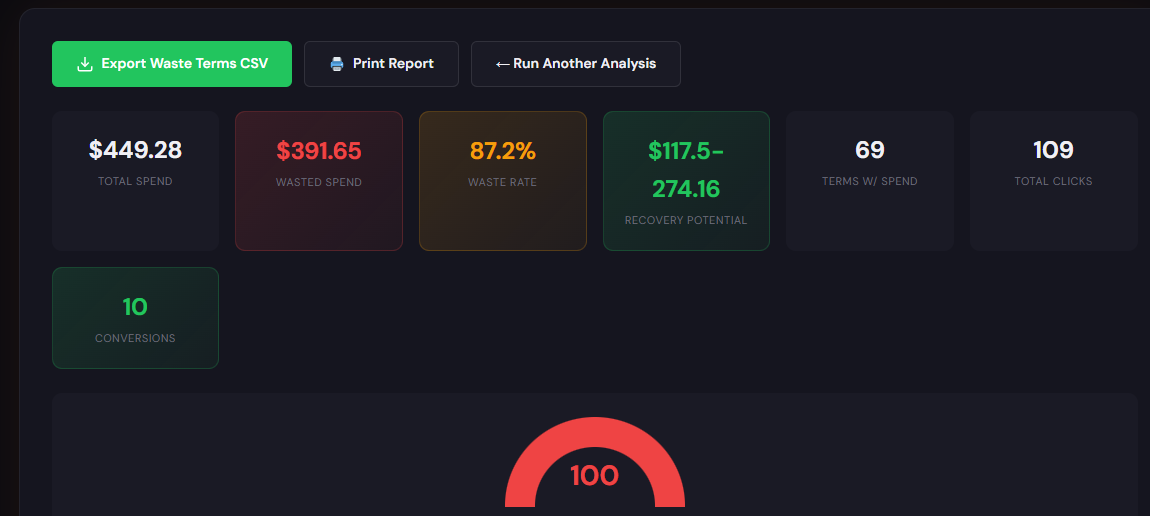
What it outputs: Dashboard-style waste totals, top leakage categories, prioritized recovery tasks, and a step-by-step recovery plan.
How to use (3 steps):
- Upload account spend/conversion CSV or connect your account to generate the snapshot.
- Review top leakage areas (e.g., irrelevant search terms, campaigns with zero conversions) and export the recovery checklist.
- Implement quick actions: pause low-performing campaigns, add shared negative lists, and assign budgets to performing funnels.
Preview images and export-ready lists let you push fixes into Google Ads Editor fast. Tool: Wastage Snapshot & Recovery.
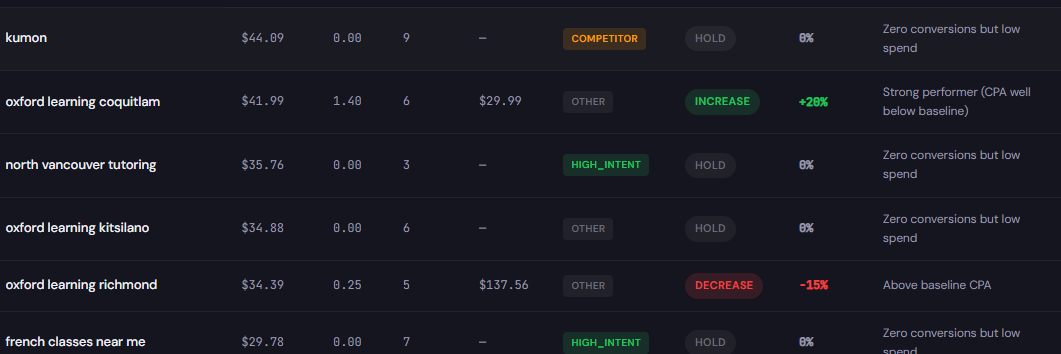
What it outputs: A ranked search-terms table with spend, conversions, tags (negative/keep), and recommended bid actions by term.
How to use (3 steps):
- Upload the Search Terms report CSV or connect directly and set the date range.
- Apply filters for spend and conversion thresholds; use tags to mark negatives and high-priority winners.
- Export recommended negatives and bid adjustments; import to Google Ads Editor or apply via scripts.
Quick wins: generate negative lists and minute bid adjustments by search term to stop waste immediately. Tool: Search Term Analyzer.
90-minute account triage playbook
Follow this timed sequence to triage an account and secure immediate savings.
- 0–10 mins: Pull reports—Search terms, campaign hourly performance, top 200 keywords by spend, and landing page mapping.
- 10–25 mins: Run the Wastage Snapshot & Recovery and review top three leakage buckets (export lists).
- 25–40 mins: Run the Search Term Analyzer; tag high-spend irrelevant terms and export negative list.
- 40–55 mins: Apply safety actions—pause campaigns with zero conversions in 90 days, import negatives, reduce bids on worst hours by 20–40%.
- 55–75 mins: Repair high-value paths—align headlines to landing pages for top 10 keywords and create temporary ad variants.
- 75–90 mins: Document actions, schedule automated checks (daily for 3 days), and plan a follow-up 7-day test to measure CPA/ROAS shifts.
Run the snapshot and search-term analyzer to generate export-ready negatives, bid adjustments, and a prioritized recovery plan you can implement in Google Ads Editor.
FAQ
Expect measurable reductions in wasted clicks within 24–72 hours. Smart Bidding models will need additional days to re-learn; monitor CPA/ROAS over a 7–14 day window.
Recommendations are export-ready but should be validated against your business rules. Use label-based staging or a small test campaign to validate before full import.
No—most tools provide CSV exports and step-by-step instructions for Google Ads Editor. API connectivity is optional for larger accounts.
Combine structural fixes (negatives, ad-to-landing alignment, scheduling) with conservative bid changes. That prevents Smart Bidding from learning from noisy, low-value clicks.
Start with the Wastage Snapshot & Recovery to prioritize issues, then run the Search Term Analyzer to convert the snapshot’s top leakage areas into immediate negatives and bid actions.
Sources
- Google Ads: About Quality Score — Official guidance on ad relevance and landing page experience.
- Search Engine Land: How Smart Bidding Works — Explanation of automated bidding behavior and common pitfalls.
- HubSpot: Negative Keywords Guide — Practical tips for building and managing negative keyword lists.
- WordStream: The Cost of Wasted Ad Spend — Data and context on common PPC waste areas.
Leave a Reply