PPC performance feels like it deteriorates year over year because small leaks compound fast. This post gives a concrete triage playbook and tool-led workflow (including ExecWrite’s Snapshot and Search Term Analyzer) so you can find recoverable spend and act within a week. Learn more at ExecWrite.
- Start with a 90-minute account triage that surfaces wasted spend, poor search-term fit, and timing issues.
- Use two specific tools: Wastage Snapshot (accounts-level leakage + recovery plan) and Search Term Analyzer (search-term bid & negative recommendations).
- Apply a 7-day checklist: kill obvious waste, add negatives, daypart bids, and test landing-page fixes.
Why PPC feels harder now
Scaling paid media has become more expensive and less predictable because ad platforms optimize toward long-term platform metrics, privacy signals mask intent, and account complexity grows as teams and automations pile up. The result: small issues (a bad search term list, an off-hour of spend, one poorly matched landing page) no longer look like single points of failure — they look like an account-wide performance tax.
The 5 biggest PPC problems marketers face
1) Wasted spend and budget leakage
- Symptoms: high impressions with low conversion rate, large spend on low-intent campaigns, sudden CPA spikes.
Why it happens: Campaigns, audience overlaps, and generic match types accumulate low-quality clicks. Without account-level visibility, leakage hides in dozens of ad groups and search terms.
- Fix this week: pause top 5 worst-performing ad groups by CPA or ROAS.
- Run an account-level waste snapshot (see tool workflow below).
- Add negatives from the top 100 low-value search terms.
2) Search-term noise and missing negatives
- Symptoms: clicks from unrelated queries, low conversion rate with surprisingly high spend on a few terms.
Why it happens: Broad and phrase match variants plus automated bidding expose accounts to long-tail, irrelevant queries unless someone actively harvests negatives.
- Fix this week: export search term report, tag high-spend/low-value queries, add them as negatives at campaign/account level.
- Move repeat low-intent terms to a shared negative list.
3) Poor Quality Score & landing page mismatch
- Symptoms: low CTR vs. peers, high CPCs, falling conversion rate after copy changes.
Why it happens: Ads point to landing pages with different messaging, slow load times, or mismatched offer. Quality Score drops and CPCs rise until you align creative and landing experience.
- Fix this week: audit top 10 low-QS ad groups and rewrite headlines/landing snippets to match keywords.
- Run an A/B of the landing page with a focused call-to-action for the highest-spend ad group.
4) Bad dayparting / time-of-day performance swings
- Symptoms: consistent hours with zero conversions but high spend; odd CPA peaks at night.
Why it happens: Default ad schedules and automated bidding ignore predictable hourly performance differences. You overbid during low-intent hours and underbid when buyers convert.
- Fix this week: segment performance by hour-of-day and add -50% bids during worst hours; increase bids during peak converting hours.
5) Campaign structure bloat & poor SKAG discipline
- Symptoms: many overlapping keywords, duplicated ad copy, and low control over bids per intent bucket.
Why it happens: teams add keywords and ad groups to win coverage quickly. Over time, control erodes, and automated bidding masks structural inefficiency.
- Fix this week: collapse duplicate ad groups, enforce 1–2 intent tiers per ad group, migrate mismatched keywords to separate campaigns.
Fixes you can apply this week
- Run a 30, 7, and 1-day spend review: find top 20 terms/ad groups by spend and sort by conversion value.
- Pause or lower bids on the worst 10% of spend (by CPA/ROAS).
- Add top negatives from search-term exports into shared lists.
- Daypart the account: reduce bids during consistently non-converting hours.
- Test one landing page change for the largest-conversion campaign.
Use an account-level Wastage Snapshot to surface the top leakage areas and get a prioritized recovery plan without manual digging.
Tool-based workflow (map pain points to ExecWrite tools)
Wastage Snapshot & Recovery — what it outputs
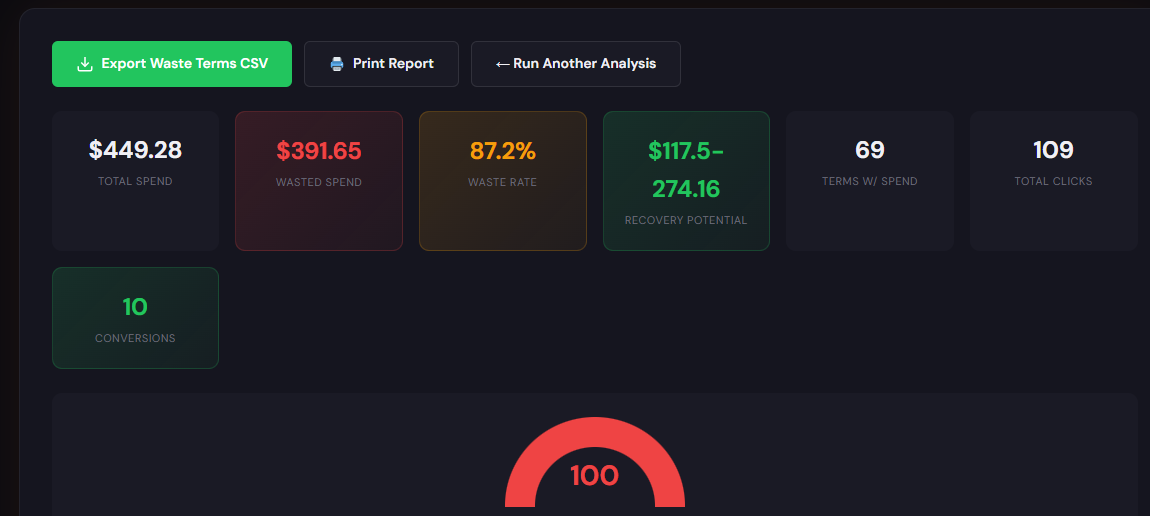
Outputs: account-level waste totals, top leakage areas (campaigns, ad groups, search terms), and a prioritized recovery checklist you can action in hours.
How to use (3 steps):
- 1) Upload or connect a 30-day account export into the Snapshot tool.
- 2) Review the highlighted leakage areas and recommended negative lists.
- 3) Export the recovery actions and apply them as shared negatives, pauses, and bid changes.
Search Term Analyzer (Bid Adjustment by Search Term) — what it outputs
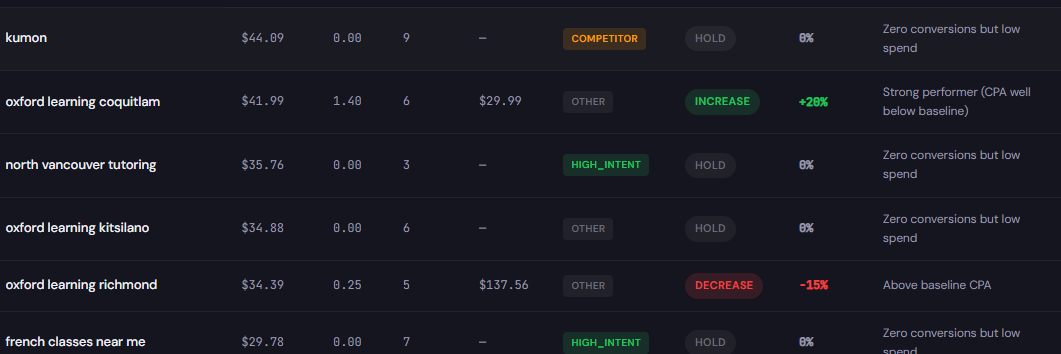
Outputs: per-search-term spend, conversions, tags for negative candidates, and recommended bid actions (raise/hold/lower) by term.
How to use (3 steps):
- 1) Paste your search term report into the Analyzer.
- 2) Tag low-intent and high-cost terms; review suggested bid adjustments for high-intent winners.
- 3) Export recommended negatives and bid adjustments; apply them to campaigns and ad groups.
Both tools work together: use Snapshots to prioritize where to run the Analyzer so you don’t waste time analyzing low-impact areas.
90-minute account triage playbook
- 0–10 min: Pull top-level metrics (30-day spend, CPA, conversions by campaign). Identify the 3 worst spend buckets.
- 10–30 min: Run Wastage Snapshot (or run a quick pivot) to get leakage areas—export top 50 low-value search terms.
- 30–50 min: Feed top leakage campaigns into the Search Term Analyzer and generate a negatives list + bid actions.
- 50–70 min: Apply immediate actions: add shared negatives, pause worst ad groups, reduce bids in non-converting hours.
- 70–90 min: Plan two experiments: a landing-page rewrite for the largest campaign and a controlled dayparting test for the next 7 days.
Get the Snapshot and Search Term Analyzer working on your account now — actionable outputs in under an hour.
FAQ
You should see measurable CPC/CPA improvements within 3–7 days after removing major negatives, pausing wasteful ad groups, and applying dayparting. Structural changes like landing page A/B tests take longer.
No — the Snapshot and Analyzer accept standard exports. API connections are available for automated workflows but aren’t required for initial triage.
Prioritize the metric tied to your business objective. For lead-gen, start with CPA; for ecommerce, optimize ROAS. The triage process is the same — isolate waste, then reallocate budget to high-value segments.
They identify Quality Score drivers (poor CTR, landing-page mismatch) and recommend headline/landing fixes and where to reallocate spend so you can prioritize pages to rewrite or ads to test.
Sources
- Google Ads: Quality Score — official guidance on factors that influence Quality Score.
- WordStream PPC Guide — practical tactics for reducing wasted ad spend and improving structure.
- Search Engine Land — coverage on bidding strategies and dayparting best practices.
Leave a Reply