PPC is noisier, more automated, and more expensive than it was five years ago. This post gives a tight, tactical playbook and shows how to use ExecWrite tools at execwrite.com to stop leakage and create predictable wins.
- Most wasted spend comes from relevance, bidding timing, and unfiltered search terms—fix those first.
- Run a 90-minute triage, then apply a 7-item checklist to capture quick wins this week.
- Use the Wastage Snapshot for a rapid audit and the Free AI Keyword Generator to rebuild intent-aligned ad groups.
Table of Contents
Why PPC feels harder now
Execution expectations are higher: automation is everywhere, auctions are more competitive, and measurement noise makes decisions riskier. Two structural shifts drive the pressure:
- Automation opacity: Smart bidding and automated targeting reduce manual levers and hide causal signals; you need better inputs to get reliable outputs (see Google’s Smart Bidding guidance).
- Attention fragmentation and rising CPCs: More advertisers chasing fewer high-intent queries increases CPCs and forces tighter ROI control.
The fixes below focus on what operators can actually control this week: relevance, waste audits, bids by time, and structure. Where automation is used, give it cleaner data and tighter constraints.
The 5 biggest PPC problems marketers face
Poor search-term hygiene
Symptoms
- High spend on irrelevant queries with no conversions.
- Large sets of low-intent search terms inflating CPA.
- Ad groups with mixed intent keywords and collapsing CTR/Conversions.
Why it happens
Search-term reports are large and tedious; teams delay cleaning. Without quick tagging and action, negative keywords lag and automation continues to bid on junk.
Fix this week
- Export last 30 days search terms, sort by spend and zero conversions.
- Add negatives for exact-match junk queries and pause low-intent keywords.
- Create tags for ‘review’/’negative’ to track changes.
Ad-to-landing-page mismatch (Quality Score leaks)
Symptoms
- Low CTR, high CPCs, and conversion rate drops after message changes.
- High impression share but low conversion rate compared to peers.
Why it happens
Disjointed creative or landing pages trigger lower Quality Scores. Automation assumes relevance; when messaging drifts, bid strategies optimize for the wrong outcome. Google’s Quality Score factors show relevance matters.
Fix this week
- Compare top-performing ad headlines to landing page H1s and CTAs—align them exactly.
- Run a 1-page relevance audit: headline, offer, CTA, and load speed.
- Temp reduce bids on ad groups with QS below account median until fixes are live.
Wasted budget from overlap and broad matches
Symptoms
- Multiple ad groups triggering for the same set of search terms.
- Broad match keywords generating irrelevant but high-cost traffic.
Why it happens
Broad match and Broad Match Modifier expose accounts to query drift. Without negative keyword lists and staged keyword expansion, overlap multiplies wasted spend.
Fix this week
- Identify top overlapping queries and pin them to a single tightly themed ad group.
- Add negatives to other groups and move aggressive expansion to a separate test campaign.
- Convert high-cost, irrelevant broad matches to phrase or exact for testing.
Wrong bid timing and inefficient dayparting
Symptoms
- Sharp hourly swings in CPA or ROAS with no bid adjustments.
- Campaigns exhausting budget during low-conversion hours.
Why it happens
Many teams rely on daily budgets alone. Hour-of-day performance patterns are predictable and actionable—ignoring them wastes daily spend.
Fix this week
- Segment last 14 days by hour-of-day and calculate CPA/ROAS per hour.
- Reduce bids or ad delivery during low-performance hours; increase during consistent high-performance hours.
- Use a conservative +-20% cap on adjustments to avoid throttling automation.
Poor campaign structure and orphan keywords
Symptoms
- Ad groups with 20+ unrelated keywords; low relevance and low CTR.
- Legacy keywords leaking impressions across campaigns.
Why it happens
Rapid scaling or handed-off accounts accumulate orphaned keywords. Poor structure stops learning signals from accumulating where they matter.
Fix this week
- Rebucket keywords into tighter ad groups (3–7 keywords each) by intent and landing page.
- Pause orphan keywords and re-import them into a structured CSV via Google Ads Editor.
- Document a naming convention and enforce it in new campaigns.
Fixes you can apply this week
- Run a 30-day wastage snapshot to find top leakage areas.
- Apply negative keywords for the top 20 irrelevant search terms.
- Stage broad-match tests in a separate campaign with strict budget control.
- Align top 3 ad headlines with landing page top-fold headline and CTA.
- Calculate hourly CPA/ROAS and set conservative daypart bid adjustments.
- Consolidate ad groups to 3–7 keywords and pause low-volume or duplicate keywords.
- Track all changes in a shared spreadsheet for 14-day outcome measurement.
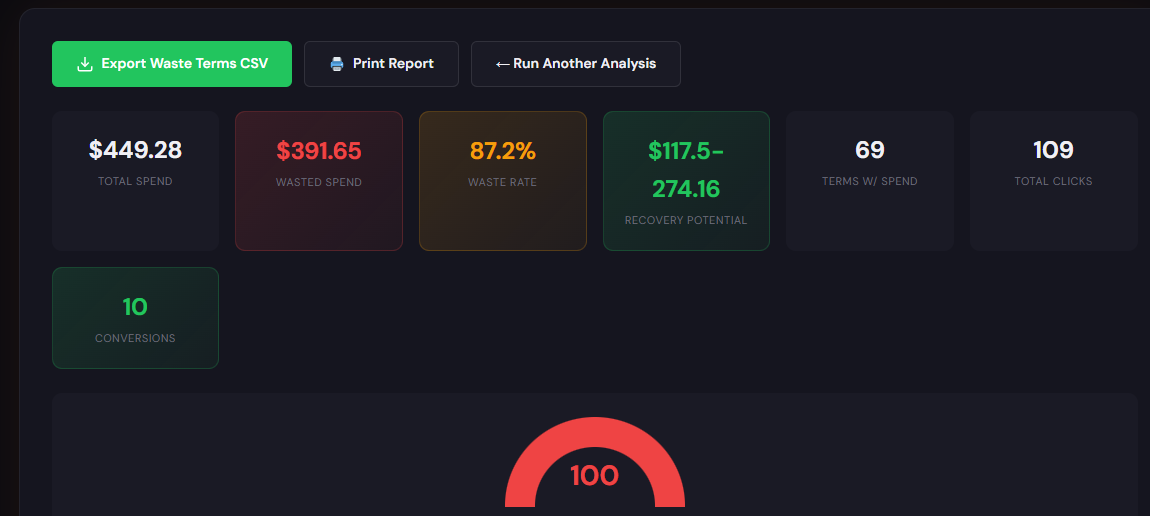
Use the Wastage Snapshot to find quick negative keywords, budget leaks, and recovery actions in minutes.
Tool-based workflow (map problems to ExecWrite tools)
What it outputs
- Dashboard showing total wasted spend, top leakage sources, and a prioritized recovery plan.
- Lists of high-spend, zero-conversion search terms and recommended negative additions.
How to use it (3 steps)
- Upload account spend & search term CSV for the last 30 days.
- Review the top leakage areas and export the negative keyword list.
- Apply negatives and export a step-by-step recovery plan to your ops doc.
What it outputs
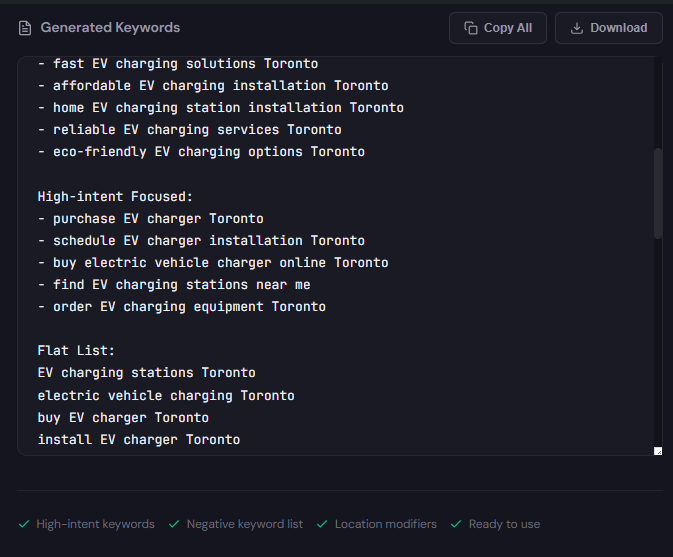
- Intent-segmented keyword lists (high intent, modifiers, negatives) and ad group suggestions ready for export.
- Structured CSVs suitable for Google Ads Editor.
How to use it (3 steps)
- Input your top-performing landing page or product description.
- Select intent buckets and generate keyword sets.
- Export grouped CSVs and upload to Editor or a staging campaign.
Mapping: use the Wastage Snapshot to fix search-term hygiene, overlap, and budget leaks. Use the AI Keyword Generator to rebuild structure and align ads to landing pages, improving Quality Score and CTR.
90-minute account triage playbook
- 0–10 min: Export account-level search terms, campaign performance, and top ad group stats (last 30 days).
- 10–25 min: Run the Wastage Snapshot and skim the top 10 leak items (spend with no conversions).
- 25–40 min: Apply immediate negatives for the top 10 irrelevant terms and pause 1–2 worst-performing broad matches.
- 40–55 min: Pull ad->landing page pairs for the top 5 ad groups by spend. Align headlines and CTAs; note edits to push live.
- 55–70 min: Calculate hour-of-day CPA/ROAS for top campaigns and add conservative bid adjustments for clear low/high hours.
- 70–85 min: Rebucket 5 orphan keywords into tighter ad groups using the AI Keyword Generator for suggested groupings.
- 85–90 min: Record every change in your ops doc and set a 14-day check-in to measure lift.
FAQ
Expect immediate reduction in irrelevant clicks within 24–72 hours. Performance improvements like lower CPA usually show within a week if you also align ads and bids.
Yes—automation amplifies both good and bad inputs. Treat smart bidding as an amplifier: cleaner structure and better negatives improve automated outcomes (see Google’s Smart Bidding documentation).
No. Use broad match in a controlled test campaign with strict budgets and negative lists. Scale only when it drives stable ROI.
Start with search-term negatives, then stop the top 1–2 leak campaigns. Next, align ads to landing pages for your top-spend ad groups. Those three moves return the fastest ROI.
Sources
- Google Ads: About Quality Score
- Google Ads: Smart Bidding
- WordStream: Wasted Ad Spend—How to Find It
Run a snapshot, export negatives, and rebuild a structured keyword set—all from ExecWrite. Fast audits, export-ready outputs, and playbooks for ops teams.
Leave a Reply