If your account feels like it leaks budget daily, this post gives an operator-level, prioritized plan to stop the bleeding. Try the quick checks below and try ExecWrite for fast audits and bid actions: execwrite.com.
- Most wasted PPC is process-driven: bad search term controls, weak bids, and landing-page mismatch.
- Run a 90-minute triage, recover low-hanging spend with a wastage snapshot, and apply search-term bid actions.
- Use the ExecWrite Wastage Snapshot and Search Term Analyzer to prioritize fixes and push corrective actions this week.
Table of Contents
Why PPC feels harder now
Costs and complexity rise as auction dynamics, audience signals, and automation overlap. Teams are stretched and tooling hasn’t caught up: more automation decisions happen upstream while human workflows still handle negatives, landing pages, and campaign structure. That mismatch creates persistent leakage and slow reaction cycles.
The 5 biggest PPC problems marketers face
1. Wasted spend and budget leakage
Symptoms
- High spend with low conversion volume.
- A lot of impressions and clicks from unexpected queries.
- Campaigns hit budget caps but conversions remain flat.
Why it happens: Lack of fast diagnostics and a centralized recovery plan. Teams can’t quickly find where budgets leak — broad keywords, irrelevant placements, or mis-tagged conversions.
Fix this week
- Run a wasted-spend snapshot to see top leakage buckets.
- Pause or reduce budget for poorly converting campaigns by 20% until triage completes.
- Export top spend rows by query and tag the worst offenders as negatives.
2. Search term garbage (and missing negatives)
Symptoms
- Conversions concentrated in a few terms; remaining queries are irrelevant.
- Broad-match or smart campaigns driving long-tail low-intent clicks.
- High click volume on informational queries that never convert.
Why it happens: Automation and broad match are useful but require active negative management and periodic pruning. Without a regular search-term review, costs balloon on low-intent demand.
Fix this week
- Pull last 30 days of search terms, sort by cost and conversion rate.
- Mark obvious non-converting phrases as negatives and add intent modifiers to high-value keywords.
- Convert repeat high-value search terms into exact/ad-group-level keywords.
3. Wrong bids by time of day (dayparting misses)
Symptoms
- Conversion rate swings dramatically by hour/day.
- Same campaign performs differently on weekdays vs weekends.
- Automated bidding overcorrects and amplifies hourly noise.
Why it happens: Many accounts rely on broad automated rules that ignore hour-of-day patterns. Without hour-level insight you bid up during poor-performing windows.
Fix this week
- Review hour-of-day performance for last 14–30 days for CPA/ROAS.
- Apply conservative bid adjustments: -20% for low-conversion hours, +10–25% for high-conversion windows.
- Monitor impact for 48–72 hours and iterate.
4. Low ad-to-landing-page relevance (Quality Score drag)
Symptoms
- High CPCs for keywords with weak ad CTRs.
- Landing page mismatch: traffic lands on generic pages with low conversion.
- Traffic with decent CTR but low conversion rate.
Why it happens: Ads and landing pages are built in silos. Copy changes or product updates leave ads out of sync with landing pages, reducing Quality Score and increasing costs.
Fix this week
- Identify top 10 high-cost keywords with low Quality Score.
- Align headlines and description copy to landing-page H1s or create dedicated landing pages.
- Test a single revised landing page per high-cost ad group.
5. Poor account structure and attribution mismatch
Symptoms
- Many keywords stuffed into one ad group; little control.
- Conversion tracking fires inconsistently across pages.
- Performance looks different in GA vs Ads.
Why it happens: Rapid scaling and piecemeal campaign builds create structural debt. Attribution differences hide true ROI and prevent correct bid decisions.
Fix this week
- Remap top-performing keywords into 1–2 focused ad groups.
- Audit conversion tags and confirm event counts match across platforms.
- Use first/last-click checks to reconcile obvious discrepancies.
Fixes you can apply this week
- Run a single wasted-spend snapshot across your account to identify the top 3 leakage buckets.
- Create a temporary budget lock: cut 10–30% from underperforming campaigns until triage.
- Export search terms (last 30 days), tag negatives, and promote high-intent queries to exact match.
- Apply conservative hour-of-day bid adjustments where CPA is 20%+ worse than daily average.
- Align 1 landing page per top ad group and measure lift for 7 days.
Run an automated wastage audit and get a prioritized recovery plan in minutes.
Tool-based workflow: map problems to ExecWrite tools
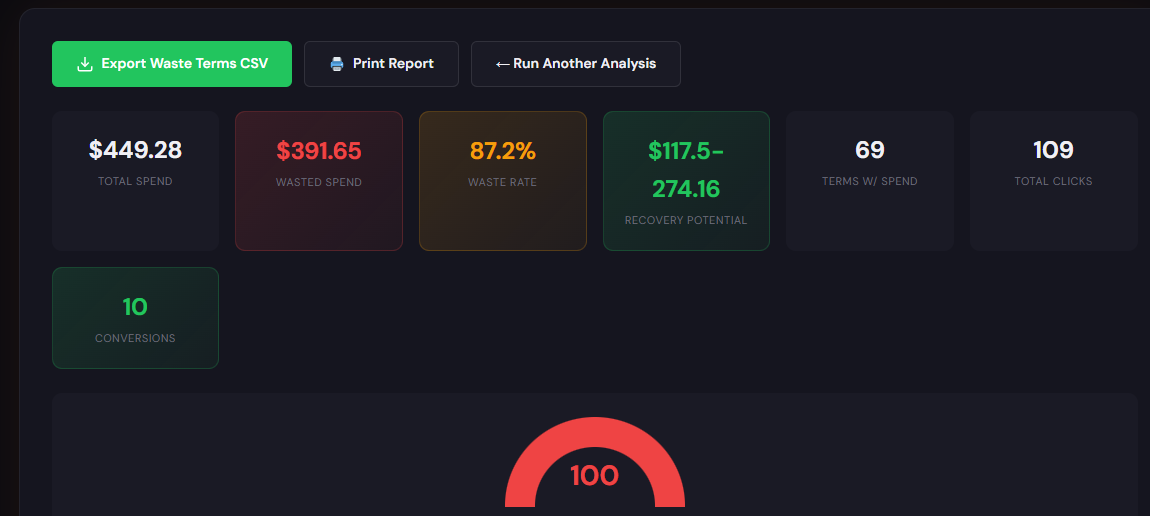
Wastage Snapshot & Recovery
What it outputs: A dashboard-style snapshot showing total wasted spend, top leakage areas, and a recovery plan with prioritized actions.
How to use it (3 steps)
- Upload your account spend data or connect via export and run the Wastage Snapshot: it finds budget leaks and negative keyword opportunities automatically.
- Review the top 5 leakage buckets and the recommended quick actions in the recovery plan.
- Apply the recommended changes: pause low-converting campaigns, add negatives, and reallocate budget to high-return campaigns.
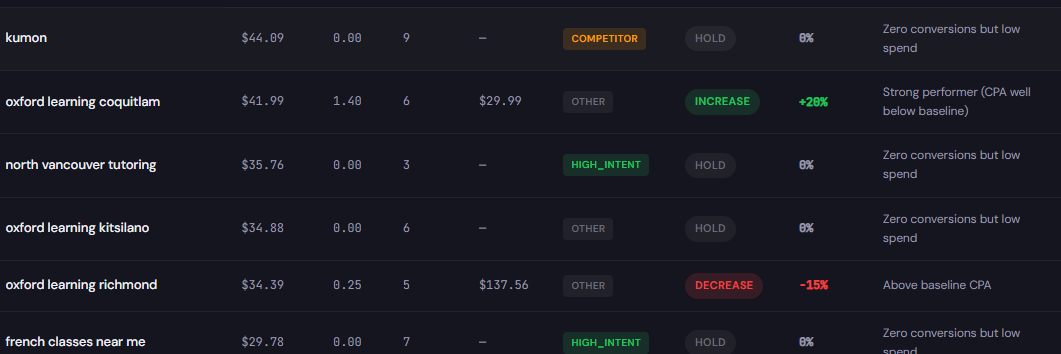
Bid Adjustment by Search Term (Search Term Analyzer)
What it outputs: A ranked table of search terms with spend, conversion rate, and recommended bid actions (increase, decrease, negative).
How to use it (3 steps)
- Export your search terms for the last 30 days and upload to the Search Term Analyzer.
- Filter by cost and low conversion rate to get immediate negative candidates and bid-adjust recommendations.
- Export recommended bid changes and upload to Google Ads Editor or apply via scripts for fast execution.
90-minute account triage playbook
- 0–10 min — Snapshot overview: run the Wastage Snapshot and skim the top 3 leak buckets.
- 10–30 min — Pause action: reduce budgets or pause the worst-performing campaigns identified.
- 30–50 min — Search-term clean sweep: upload search terms to the Search Term Analyzer, create negatives, and identify keywords to promote.
- 50–70 min — Bid tweaks: apply hour-of-day adjustments for identified poor windows and push conservative bid reductions where CPA is high.
- 70–90 min — Landing page check & tracking: confirm conversion tags and adjust 1 landing page copy or CTA for a high-cost ad group.
- Post-triage — Monitor for 48–72 hours and revert or iterate based on delta in CPA/ROAS.
Use ExecWrite to run the snapshot and export immediate bid and negative recommendations to execute your triage faster.
FAQ
Answer
Expect initial KPI movement in 48–72 hours for bid and negative changes. Landing-page and structural changes may take 7–14 days to stabilize.
Answer
Use automated recommendations as a prioritization layer, not an automatic deploy. Validate top changes in a low-risk environment (small budgets or Editor CSVs) before scaling.
Answer
Removing low-intent queries reduces volume but improves efficiency. Promote high-performing queries to exact match to preserve conversion volume while cutting waste.
Answer
Start weekly for accounts with >$10k/month spend until leakage is under control, then move to biweekly or monthly checks depending on volatility.
Leave a Reply