Underperforming accounts look messy at a glance—lots of clicks, few conversions, odd CPA swings. This guide walks operators through the exact checks, quick fixes, and a tool-based workflow using ExecWrite so you can stop wasting budget and steer campaigns back to profitable signals. Visit ExecWrite to run live audits and recovery tools.
- Audit fast: find the top 20% of leakage that creates 80% of wasted spend.
- Apply immediate controls: negatives, budget caps, and hour-based bid shifts.
- Use ExecWrite tools to generate recovery plans and search-term bid fixes in minutes.
Table of Contents
Why PPC feels harder now
Two trends make modern paid media unforgiving: rising CPCs and more noisy intent signals. Platforms push automated bidding and expanded match types while privacy changes reduce event fidelity. That means mistakes that used to be small (a single leaking search term, misaligned landing page) now compound faster and are harder to spot without tooling and a systematic triage.
The 5 biggest PPC problems marketers face
Problem 1: Wasted spend on low-intent search terms
Symptoms
- High impressions/clicks but low conversion rate in specific search-term reports.
- Large tail of terms with spend but zero or one conversion.
Why it happens
Broad match and liberal keyword match settings plus limited negative keyword lists allow irrelevant queries to win clicks. Over time these low-intent queries inflate spend and drag down overall CPA.
Fix this week
- Export search terms, filter by spend-to-conversion ratio, and add top offenders to negatives.
- Move high-spend, low-intent terms to passive match types and monitor for intent.
- Pause or reduce budgets on campaigns with disproportionate tail spend while you triage.
Problem 2: Budget leaks and misallocated spend
Symptoms
- Campaigns hitting daily budgets early with poor conversion efficiency.
- Manual budget moves result in unpredictable performance elsewhere.
Why it happens
Without a top-down view, teams over-allocate to legacy campaigns or high-impression buckets instead of anchoring on ROAS/CPA. Smart bidding can amplify the issue by spending to maximize conversions that aren’t valuable.
Fix this week
- Freeze new budget increases. Reassign only after identifying where conversions originate.
- Cap budgets on poor-performing campaigns and reallocate to proven winners.
- Set portfolio bid strategies only after cleaning the search-term and conversion data.
Problem 3: Hour-of-day and dayparting mismatch
Symptoms
- Large CPA swings by hour. Peak CPCs during non-converting hours.
- Flat schedules that don’t match user behavior.
Why it happens
Many accounts use default schedules or historical averages that no longer match current demand. Auto-bidding can push spend into hours that appear cheaper but convert poorly.
Fix this week
- Analyze hour-of-day conversion rates and set bid adjustments to dampen spend in poor hours.
- Test tighter ad schedules for 1–2 weeks and compare net CPA/ROAS.
- Apply conservative bid decreases for low-conversion hours and increases where conversion rate is strong.
Problem 4: Landing page mismatch and Quality Score drag
Symptoms
- Low click-to-conversion rates despite healthy CTRs.
- Costly keywords with low Quality Score and high CPCs.
Why it happens
Ad copy and landing pages drift apart from the search intent. Even small relevance gaps reduce Quality Score, raising CPC and lowering competitive position.
Fix this week
- Align top ad headlines to landing page headlines and value props.
- Run a short A/B test with a landing copy variation focused on the keyword intent.
- Prioritize Quality Score fixes on high-volume, high-cost keywords first.
Problem 5: Data noise from attribution and conversion tracking
Symptoms
- Conversion counts fluctuate with tag changes or platform updates.
- Performance looks good in clicks but bad in last-click conversions (or vice versa).
Why it happens
Partial event capture, inconsistent attribution windows, and cross-domain failures introduce measurement error. That noise confuses bidding algorithms and operator decisions alike.
Fix this week
- Verify tag firing on key pages and events using a tag debugger.
- Standardize attribution windows across reports used for bidding.
- Segment an A/B experiment with a stable conversion definition to validate changes.
Fixes you can apply this week
- Run a waste snapshot to identify top leakage sources (campaigns, keywords, hours).
- Export search-term reports, add top offenders to negatives, and label queries for follow-up.
- Implement temporary budget caps on poor-performing campaigns and reallocate to clean audiences.
- Apply hour-of-day bid adjustments based on last 30 days and watch CPA over 7 days.
- Align ads and landing pages for your 10 highest-spend keywords and monitor Quality Score.
- Confirm conversion tracking and freeze bidding changes during the cleanup window.
Run a fast audit with ExecWrite to surface the top leakage areas and a prioritized recovery plan you can act on this week.
Tool-based workflow: map problems to ExecWrite tools
Tool: Google Ads Wastage Snapshot & Recovery
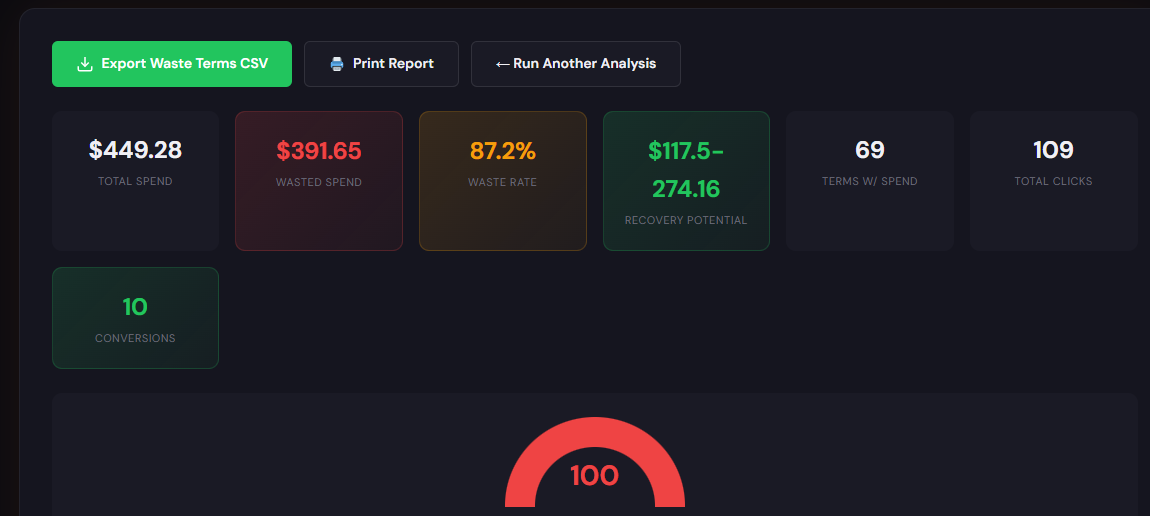
What it outputs: a dashboard-style snapshot that quantifies wasted spend, lists top leakage categories (search terms, campaigns, audiences), and proposes a step-by-step recovery plan.
How to use it — 3 steps
- Upload account data or connect your Google Ads view to generate the waste snapshot in minutes.
- Review the top 10 leakage items and apply the recommended negative keywords, budget caps, or pause suggestions.
- Export the recovery plan and assign actions to operators with deadlines; rerun the snapshot after 7 days to measure improvement.
Open the Wastage Snapshot & Recovery tool
Tool: Bid Adjustment by Search Term (Search Term Analyzer)
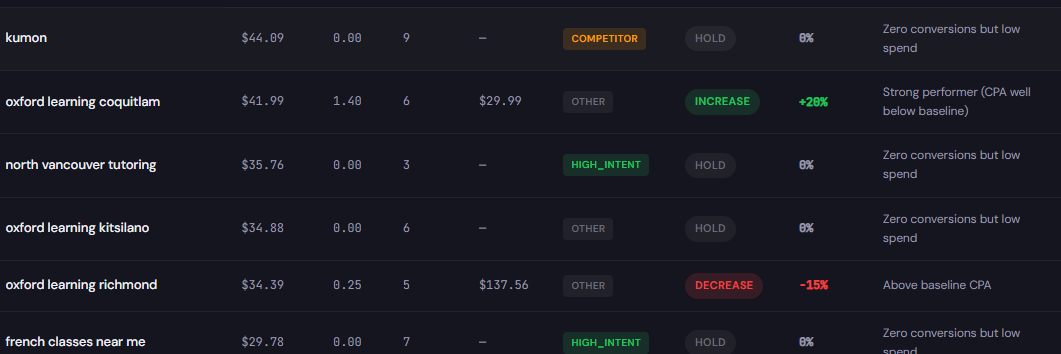
What it outputs: a per-search-term table that shows spend, conversion performance, recommended bid actions (up, down, neutral), and tags for quick bulk uploads.
How to use it — 3 steps
- Run the Search Term Analyzer to surface terms with poor spend-to-conversion ratios and recommended bid changes.
- Apply bid adjustments or add negatives directly from the report. Tag terms for follow-up testing or keyword expansion.
- Re-run weekly to keep the negative list and bid map current; export to bulk edit for Google Ads Editor.
Both tools work together: run the waste snapshot first to prioritize recovery areas, then use the Search Term Analyzer for surgical bid and negative keyword actions.
90-minute account triage playbook
- 0–10 min: Pull top-level metrics (last 30/7/1 day). Note CPA/ROAS swings and campaigns hitting budgets.
- 10–30 min: Run the Wastage Snapshot. Export top leakage items and top campaigns by wasted spend.
- 30–50 min: Run Search Term Analyzer for those campaigns. Mark top 20% of terms driving 80% of leakage.
- 50–70 min: Apply immediate fixes—add negatives, cap budgets, pause poor ad groups, set conservative bid adjustments for bad hours.
- 70–90 min: Align ads and landing pages on the 10 highest-spend keywords, confirm conversion tracking, and schedule a follow-up snapshot in 7 days.
Use the snapshot and search-term tools to get a prioritized recovery plan and export-ready fixes. Click below to start.
FAQ
You should see measurable lift in CPA/ROAS within 7–14 days for the fixes listed—unless major attribution issues hide true conversion performance.
Yes, but only after you clean search-term noise, fix conversion tracking, and stabilize budgets. Automation on noisy data amplifies mistakes.
You can’t retroactively reclaim clicks, but you can reallocate budget to higher-value queries and recover efficiency moving forward.
Start with the Wastage Snapshot to prioritize leakage, then use the Search Term Analyzer for surgical bid and negative moves.
Leave a Reply