If your account suddenly feels expensive, noisy, or unpredictable, you need a surgical approach: fast diagnosis, immediate fixes, and a repeatable recovery plan. ExecWrite has step-ready tools and templates to shorten the path from wasted spend to profitable scale — start at ExecWrite and use this playbook to act in hours, not weeks.
- Most performance drops come from noisy search terms, bid misalignment by hour, and landing page relevance — not just automation quirks.
- Run a 90-minute triage: wastage snapshot, search-term audit, and prioritized fixes (negatives, bids, landing messaging).
- Use ExecWrite’s Wastage Snapshot and Search Term Analyzer to identify leaks and apply high-confidence fixes this week.
Table of Contents
- 1 Why PPC feels harder now
- 2 The 5 biggest PPC problems marketers face
- 2.1 1) Wasted spend on irrelevant or low-intent search terms
- 2.2 2) Hourly/dayparting swings that misalign bids with conversion windows
- 2.3 3) Poor ad-to-landing-page relevance (Quality Score / conversion gaps)
- 2.4 4) Campaign structure entropy (keyword cannibalization & duplication)
- 2.5 5) Over-reliance on automation without human guardrails
- 3 Fixes you can apply this week
- 4 Tool-based workflow: map problems to ExecWrite tools
- 5 90-minute account triage playbook
- 6 FAQ
- 7 Sources
Why PPC feels harder now
Automation, audience signals, and expanding match types make campaign structure brittle. The data you used to rely on is noisier: impressions and clicks still flow, but relevance and conversion signals get blurred. That creates three practical effects: wasted budget, incorrect bid decisions, and slower iteration cycles.
The 5 biggest PPC problems marketers face
1) Wasted spend on irrelevant or low-intent search terms
Symptoms
- High spend with few conversions in Search Term reports
- Many new, unexpected queries driving clicks
- Search terms that look like support/FAQ queries or informational intent
Why it happens: Broad and phrase match plus query expansion by Google can surface low-intent queries. Without routine negative keyword hygiene, these queries consume budget before conversion intent shows up.
Fix this week
- Export last 30–90 days of Search Terms, sort by spend and CPA
- Tag and export the top 20% of queries by spend for negatives
- Apply negative keywords at campaign level and monitor CTR/CPAs for 72 hours
2) Hourly/dayparting swings that misalign bids with conversion windows
Symptoms
- CPA or ROAS swings strongly by hour of day
- Conversions cluster in narrow windows, but budget spends evenly
- Manual bid changes underperform due to timing lag
Why it happens: Many accounts never slice performance by hour. Campaign-level bid strategies assume uniform conversion rates across the day, so you overpay on low-value hours and miss volume when conversion probability is highest.
Fix this week
- Run an hour-of-day report for cost, conversions, and CPA
- Apply -30% to -100% bid adjustments on low-performing hours; +10–30% on peak hours
- Monitor for 7 days; adjust again with the next best-performing hours
3) Poor ad-to-landing-page relevance (Quality Score / conversion gaps)
Symptoms
- High impressions, low CTR on high-spend keywords
- Traffic that converts at much lower rate than landing page baseline
- Ads that promise different messaging than landing pages
Why it happens: Campaigns grow faster than creative and landing page updates. Ad extensions, headlines, and page copy drift apart—hurting Quality Score and increasing CPCs while conversion rate drops.
Fix this week
- Audit top 10 keywords by spend and map to headline + landing page
- Align headlines to page H1 and CTA for those high-spend terms
- Run an A/B test on the page with clearer headline and a single CTA
4) Campaign structure entropy (keyword cannibalization & duplication)
Symptoms
- Multiple ad groups bidding on overlapping keywords
- Confusing search attribution and inflated CPCs from internal competition
- Hard-to-interpret performance per keyword
Why it happens: Rapid scaling and inconsistent naming conventions create overlap. Without a disciplined group/ad-level mapping, match types and automated bids fight each other.
Fix this week
- Export keyword lists, deduplicate, and reassign core keywords to single ad groups
- Standardize match-type rules (exact for winners, phrase/broad for testing)
- Pause duplicated low-performing keywords and monitor net account CPC
5) Over-reliance on automation without human guardrails
Symptoms
- Smart bidding changes bids drastically and you can’t explain hourly shifts
- Automation increases conversions but drops margin
- Frequent strategy flips in response to short-term noise
Why it happens: Machine learning needs good inputs. If budgets, negative lists, or conversion tracking are noisy, automation makes the wrong optimization calls at speed.
Fix this week
- Set conservative bid caps or target ranges while you clean data
- Freeze major automation changes while you finish the 90-minute triage
- Implement guardrails: negative lists, hour/day adjustments, and conversion-value validation
Fixes you can apply this week
- Export top search terms (30–90 days) → tag & apply negatives for top spend leaks
- Run hour-of-day performance → apply bid modifiers to align spend with conversion windows
- Map top keywords to landing pages → fix headline/CTA mismatches for top spend terms
- Pause duplicated keywords and enforce match-type rules for a 7-day stabilization window
- Create a short negative-keyword list and apply at account level; update weekly
ExecWrite’s Wastage Snapshot identifies leakage areas and gives a prioritized recovery plan you can action in hours.
Tool-based workflow: map problems to ExecWrite tools
Wastage Snapshot & Recovery
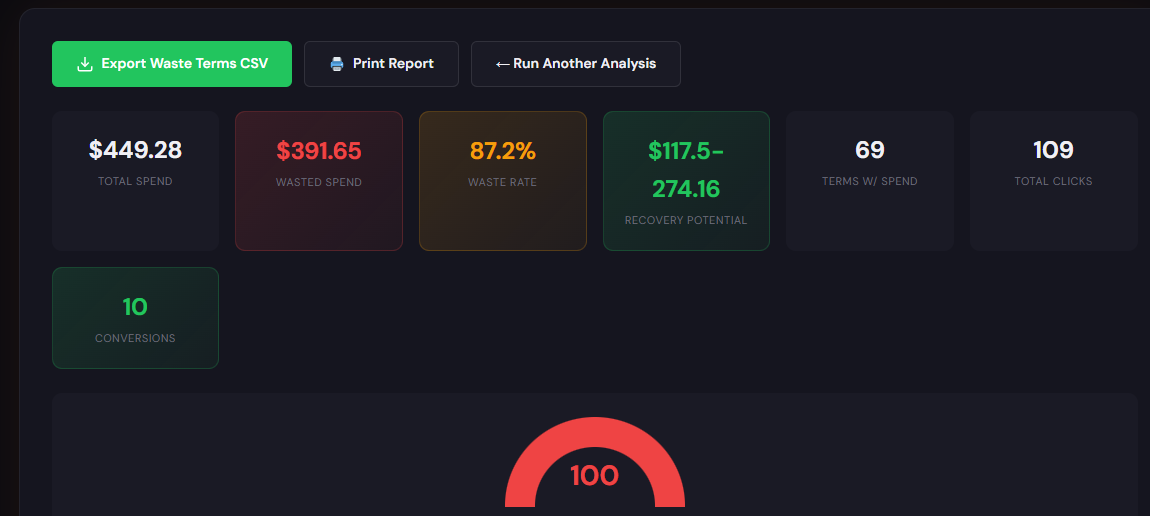
What it outputs: Quick dashboard showing total waste, top leakage sources, and a prioritized recovery playbook (negatives, budget shifts, and quick landing fixes).
How to use it — 3 steps
- Upload account data or connect your MCC to generate the snapshot (2–10 minutes).
- Review top 3 leakage areas the tool flags (search terms, budget leaks, low-quality campaigns).
- Export the recovery plan and apply the top 5 actions (negatives, pause, bid caps) in your account.
Search Term Analyzer (Bid Adjustment by Search Term)
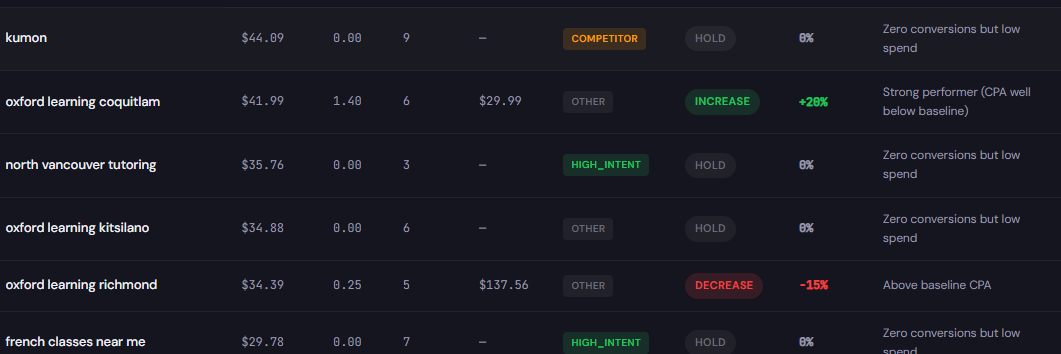
What it outputs: A ranked table of search terms with spend, conversions, CPA, suggested tags (negative/keep/test), and recommended bid actions.
How to use it — 3 steps
- Paste your Search Terms export and let the Analyzer tag high-spend, low-intent queries.
- Review suggested negatives and bid changes; accept and export the CSV for upload to Ads Editor.
- Re-run after 3–7 days to validate impact and refine the negative list.
Both tools are designed to shorten diagnosis and give prioritized, actionable outputs you can apply in the Google Ads UI or upload via Editor. Use the Wastage Snapshot for top-level triage, then the Search Term Analyzer for surgical negative and bid fixes.
90-minute account triage playbook
- 0–10 min: Quick snapshot — run Wastage Snapshot to get top 3 leakage areas.
- 10–30 min: Search term triage — export top 200 search terms; run Search Term Analyzer and accept top negatives.
- 30–50 min: Hour-of-day check — pull hourly performance; apply bid modifiers for worst/best hours.
- 50–70 min: Landing quick-fixes — map top 10 keywords to landing pages and align headlines/CTAs.
- 70–85 min: Structure cleanup — pause exact duplicate low-performers and enforce match-type rules.
- 85–90 min: Lock-in actions — upload negatives, apply bid changes, and document changes in a handoff note.
This triage prioritizes the highest-leverage items first: leakage (waste), then bid timing, then relevance. Repeat weekly until the account stabilizes.
Run the Wastage Snapshot and Search Term Analyzer to generate an action plan you can implement in the next 90 minutes.
FAQ
You should see immediate spend reduction on the excluded queries; CPA improvements typically appear within 3–7 days as traffic stabilizes.
Short-term bid modifiers are a guardrail. If you use Smart Bidding, set conservative caps and let the strategy learn after you clean the signals.
You can semi-automate it: run the Analyzer weekly and review suggested negatives. Full automation without review risks removing long-tail converting queries.
Track three KPIs over 14–30 days: Cost / Conversion, Conversion Rate, and Spend on top 20 search terms. The tools export ready-made reports to make this fast.
Leave a Reply