If your account feels like it’s leaking budget with little to show for it, this guide gives measurable checks, quick fixes, and a tool-based workflow you can run this week. For fast audits and data-backed bid actions, see execwrite.com for linked tools and previews below.
- Top causes: wasted keywords, poor ad-to-page relevance, wrong bids by hour, and campaign structure leaks.
- Weekly fixes: negative keywords, quick Quality Score checks, hourly bid adjustments, and a wastage snapshot.
- Use two fast tools: Wastage Snapshot to find leaks, and Search Term Analyzer to set exact bid actions.
Table of Contents
Why PPC feels harder now
Performance pressure, rising CPCs, and automation that hides decisions make PPC feel unpredictable. Marketers must reconcile machine decisions with strategic controls: automated bidding optimizes for signals but needs clean inputs (keywords, negatives, landing relevance). Without routine triage and tactical bid actions you see spend but not efficient outcomes.
The 5 biggest PPC problems marketers face
1) Wasted spend from low-value search terms
Symptoms
- High spend on search terms with few/no conversions.
- Lots of broad or unfiltered query matches in search query reports.
- Conversions only from a small subset of terms.
Why it happens
Broad match and automated match-type expansion let low-intent queries trigger ads. If you don’t tag, negative, and re-bid specifically by search term, automated bidding optimizes across noisy inputs.
Fix this week
- Export last 30 days of search terms and sort by spend-to-conversions ratio.
- Add top non-converting, high-cost queries as negatives.
- Tag mid-value terms for tailored bidding rather than blanket negatives.
2) Ad-to-landing-page mismatch killing Quality Score
Symptoms
- Low or falling Quality Scores, high CPCs.
- High CTR but low conversion rate (traffic that clicks but doesn’t convert).
- Message mismatch between ad headlines and landing content.
Why it happens
Ads promise one thing and landing pages deliver another. Automated systems penalize relevance; lower Quality Scores increase CPC and lower impression share.
Fix this week
- Run a headline-to-landing copy audit: ensure the top 1–2 headlines mirror landing H1 and CTA.
- Duplicate high-volume ad groups into landing-page-specific groups.
- Prioritize pages with best conversion rates for higher bids.
3) Wrong bids by hour (dayparting ignored)
Symptoms
- Large hourly CPA/ROAS swings across the day.
- Automated bid changes that don’t reflect peak conversion windows.
- High spend during low-conversion hours.
Why it happens
Accounts often have meaningful hourly patterns. If bidding or ad schedules aren’t adjusted, you overpay during off-hours or miss conversions during peaks.
Fix this week
- Pull hour-of-day performance for cost and CPA.
- Temporarily reduce bids or pause during consistently poor hours.
- Increase bids 10–30% on the best 2–3 peak hours to test lift.
4) Conversion tracking noise and attribution gaps
Symptoms
- Conversion count fluctuates wildly across the same period week-over-week.
- Conversions attributed to unexpected campaigns or channels.
- Offline conversions not feeding back to Google Ads.
Why it happens
Tracking mismatches (duplicate tags, inconsistent event fires, attribution model changes) create poor signals for bidding engines.
Fix this week
- Validate primary conversion fires with Tag Assistant and server-side logs.
- Set one primary conversion action for bidding and mark others as attribution-only.
- Reconcile GA/CRM data with Google Ads conversions for a 30-day window.
5) Campaign structure enabling cross-contamination
Symptoms
- Too many intents in a single ad group or campaign.
- High variance in keyword performance inside same ad group.
- Automated bidding can’t target the right CPA/ROAS because inputs are mixed.
Why it happens
Mixing awareness and bottom-funnel terms in the same group dilutes signals and confuses bidding algorithms that expect consistent intent and CPA goals.
Fix this week
- Split ad groups by intent or match type for top 20% of spend-driving keywords.
- Apply specific landing pages per intent cluster.
- Use separate bidding strategies for different intent buckets.
Fixes you can apply this week
- Run a 30-day search-term export; add top non-converting, high-cost queries to negatives.
- Identify top 3 high-spend hours and lower bids there; increase bids on the top 2 converting hours.
- Set a single conversion action for bidding and tag others as secondary.
- Audit the top 10 ads by spend for landing-page relevance; update headlines or page H1 as needed.
- Split mixed-intent ad groups for cleaner signals and targeted creatives.
Use a snapshot tool to identify top leakage areas and get prioritized recovery steps in under an hour.
Tool-based workflow (map each pain point to ExecWrite tools)
Below are two focused ExecWrite tools—what they output and how to use them in three steps. Use these tools together: Wastage Snapshot to find leaks, then Search Term Analyzer to apply bid/negative actions.
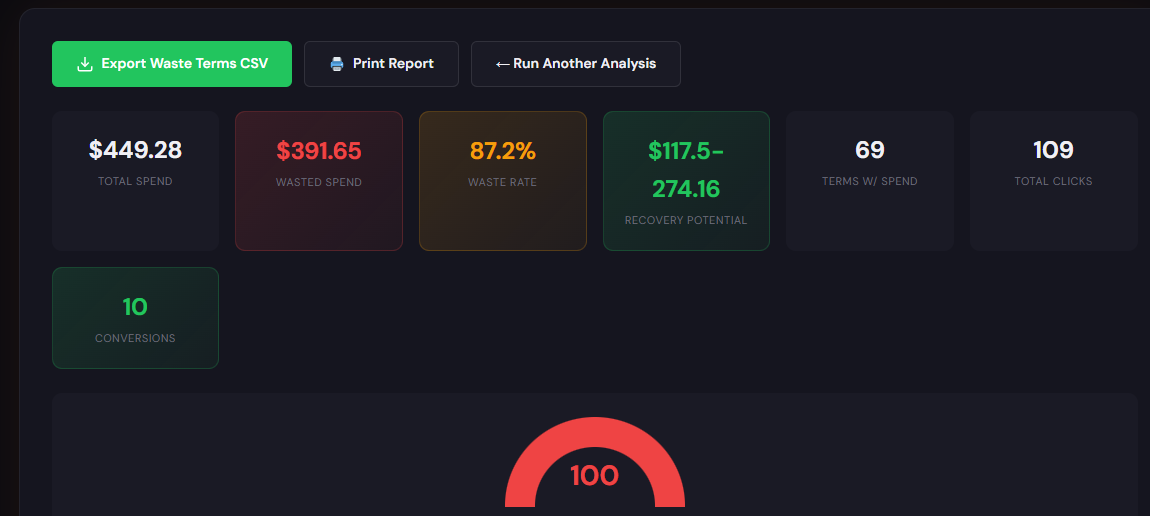
Outputs a dashboard-style snapshot: estimated wasted spend, top leakage areas (search terms, placements, audiences), and a short prioritized recovery plan you can action immediately.
How to use it — 3 steps
- Upload a 30–90 day export or connect your account to generate a snapshot.
- Review the top 3 leakage areas and download the recovery checklist.
- Apply the suggested negatives and budget reallocations, then monitor a 7‑day lift.
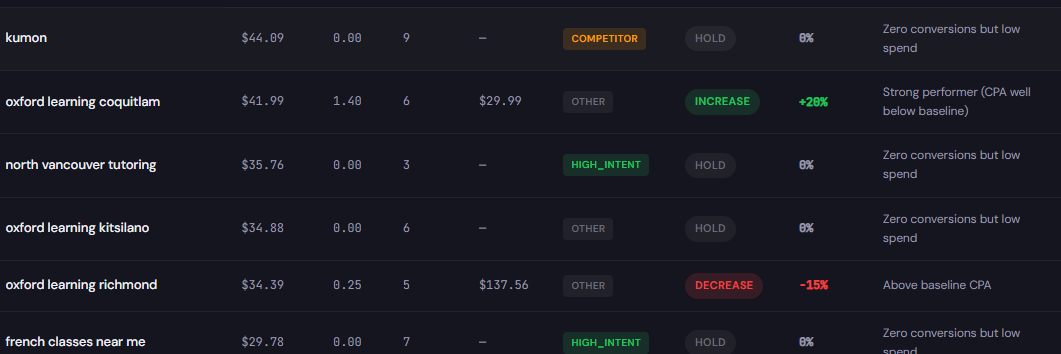
Outputs a table of search terms with spend, conversions, CPA/ROAS, and recommended bid actions (raise, hold, lower, negative), plus export-ready lists for Google Ads Editor.
How to use it — 3 steps
- Upload your search term report (30 days recommended).
- Filter by spend and conversion rate; tag groups as negative, re-bid, or test.
- Export actions to a CSV and push changes via Google Ads Editor or API.
90-minute account triage playbook
Run this sequence live with a screen-share or alone. Target: immediate spend recovery and prioritized tests.
- 0–15 min: Pull last 30 days — search terms, hour-of-day, campaign spend, top ads by impressions.
- 15–30 min: Run Wastage Snapshot for a prioritized leak list. Export the top 10 recovery actions.
- 30–50 min: Run Search Term Analyzer on the search-term export. Flag high-cost non-converters and top-converting terms.
- 50–70 min: Apply immediate defensive actions: add negatives, reduce bids by 10–30% on poor hours, pause low-value placements.
- 70–90 min: Implement three tests: increase bids on top 2 hours, update 3 ad headlines to match landing pages, and split one mixed-intent ad group. Schedule a 7-day performance check.
Run a Wastage Snapshot and Search Term Analyzer to get prioritized recovery actions you can apply this week.
FAQ
Negatives remove poor-fitting traffic and can temporarily reduce volume, but they increase efficiency. Add negatives based on data, not intuition.
Override when you have clear, consistent hourly or search-term patterns that automated bidding isn’t capturing. Use short-term manual bid shifts and then hand control back to automation once the signals are cleaner.
For mid-size accounts, weekly snapshots + monthly structural reviews. High-spend accounts need bi-weekly checks and daily monitoring during major campaigns.
Yes. The Search Term Analyzer outputs export-ready CSVs for bulk edits and Google Ads Editor workflows to apply bid and negative changes quickly.
Sources
- Google Ads Help — About automated bidding
- HubSpot — How to Avoid Wasting Money on Google Ads
- Search Engine Journal — Dayparting and ad scheduling for Google Ads
Need a practical snapshot and search-term bid plan you can run right now? Start with a Wastage Snapshot and Search Term Analyzer to recover wasted spend fast — visit ExecWrite.
Leave a Reply