If your account feels like a money-drain, this is a no-fluff, operator-focused playbook. Use the checklists below plus quick scans with ExecWrite (https://execwrite.com) tools to find budget leaks and fix bids without guesswork.
- Find where budget is leaking and recover wasted spend in the first 30–60 minutes.
- Use search-term bid actions to stop overbidding on low-intent queries and lift ROAS.
- Apply three fixes this week to stabilize CPA and create clean signals for automated bidding.
Table of Contents
Why PPC feels harder now
Advertising platforms matured ML—but they still need clean inputs. Two decades of automation plus noisy signals (privacy changes, broader match, generative search) mean your account needs tighter hygiene: better search-term control, clearer landing page relevance, and faster leak detection. Without those, machine learning optimizes the wrong things and you pay for the waste.
The 5 biggest PPC problems marketers face
1) Wasted spend and budget leakage
Symptoms
- High impressions and clicks with near-zero conversions from certain campaigns or keywords.
- Daily spend spikes with no corresponding lift in leads or revenue.
- High percentage of low-quality search terms in reporting.
Why it happens
Poor keyword hygiene, broad-match expansion and missing negatives create traffic that looks like volume but has zero ROI. Automation then ramps spend on that noise.
Fix this week
- Run a top-100 search-term audit and flag terms with clicks but zero conversions.
- Add the worst 20–50 terms as negatives immediately.
- Pause poorly performing broad-match ad groups until cleaned.
2) Wrong bids on actual converting search terms
Symptoms
- High CPA for some search terms and low CPA for others, inconsistently across hours or days.
- Conversions concentrated on a small set of search terms but bids don’t reflect that.
Why it happens
Aggregate bid strategies or campaign-level bid rules ignore term-level performance. The algorithm can’t raise or lower bids for individual search terms without clear guidance.
Fix this week
- Export search-term-level CPA and spend for the last 30 days.
- Increase bids for top-converting terms and reduce bids or add negatives for high-cost, no-convert terms.
- Group converting terms into tighter ad groups to improve signal quality.
3) Poor dayparting / ad scheduling
Symptoms
- Conversion rate or ROAS swings wildly by hour-of-day or day-of-week.
- Manual schedules that don’t reflect current conversion windows.
Why it happens
Historical schedules become stale. Without hourly-level insights, budgets are wasted during low-converting times and underutilized during peak windows.
Fix this week
- Pull hour-of-day performance and mark low-ROI hours for -20% or -50% bids.
- Raise bids during proven high-converting hours and monitor for three days.
- Limit ad delivery during weekends or nights if conversion rates fall below target.
4) Low Quality Score / landing-page mismatch
Symptoms
- High CPCs versus competitors, poor ad rank, and low ad relevance scores.
- Landing pages that don’t match ad messaging or search intent, causing high bounce rates.
Why it happens
QA gaps between ad copy and landing page erode expected click-through and conversion rates—both signals Google uses to set costs.
Fix this week
- Map top ad groups to focused landing pages (one dominant CTA per page).
- Refine headlines to match the top search-term intent for the ad group.
- A/B test one headline and one CTA to restore relevance within 7–14 days.
5) Slow testing and creative decay
Symptoms
- Same ad set running for months with declining CTR and conversions.
- Low volume of new headline or landing page variants being tested.
Why it happens
Teams deprioritize creative because ad ops are buried in reporting. Without a rapid creative supply, performance decays and automation starves for useful signals.
Fix this week
- Create three new headlines and two new CTAs for top ad groups and launch them in rotating tests.
- Set a 14-day evaluation window and automatically pause the worst performer.
- Standardize naming so winners are easy to export to other campaigns.
Fixes you can apply this week
- Run a 30–60 minute search-term sweep; add 20–50 immediate negatives.
- Export and sort search-term CPA; apply manual bid adjustments to top/worst terms.
- Pull hour-of-day performance and set ad schedule bid modifiers for low-conversion hours.
- Map high-volume ad groups to single-purpose landing pages; align headlines and CTAs.
- Ship at least 3 new creative variants to top ad groups and test for 14 days.
Use a focused audit to find budget leaks, then apply term-level bid fixes. ExecWrite has tools that automate both scans.
Tool-based workflow — map pain to ExecWrite tools
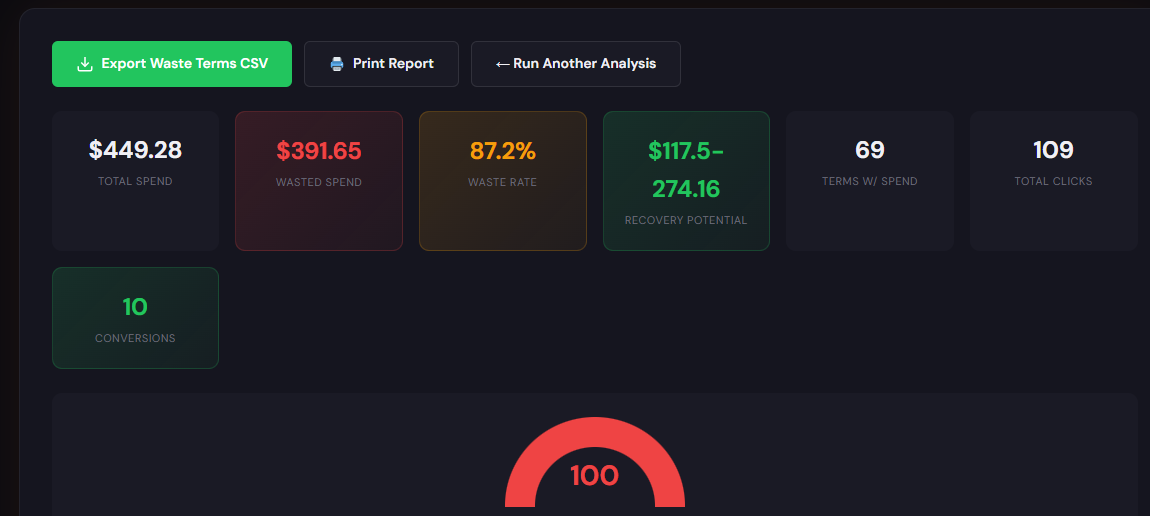
What it outputs: Dashboard-style snapshot of wasted spend, top leakage areas (terms, campaigns, match types), and an actionable recovery plan with prioritized negatives and budget shifts.
How to use it — 3 steps
- Upload a last-30/90-day report or connect the account to generate the snapshot.
- Review top leakage items (search-term, campaign, device) and accept suggested negatives.
- Export the recovery plan and deploy changes in Google Ads; monitor spend changes over 3 days.
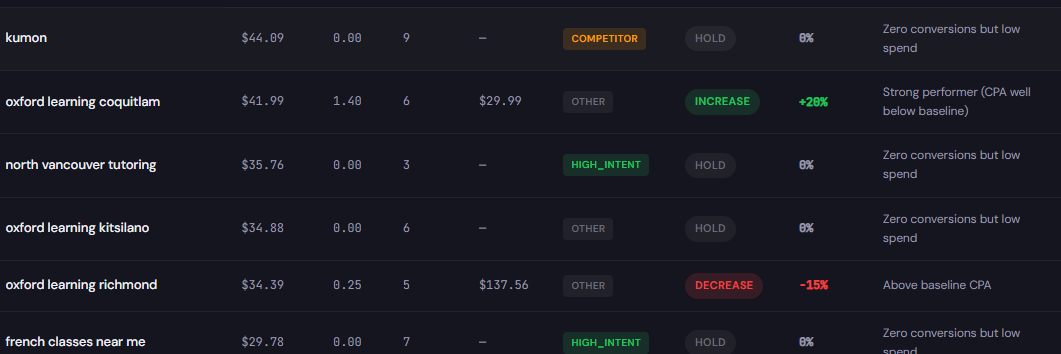
What it outputs: A search-term-level table with spend, conversions, CPA/ROAS, tags and recommended bid actions (raise / lower / negative) so you can make surgical changes quickly.
How to use it — 3 steps
- Upload search-term performance or pull directly from the account and set your CPA/ROAS targets.
- Review the tool’s recommended actions and accept or tweak the suggested adjustments.
- Export a CSV for Google Ads Editor or apply changes directly via the tool’s recommendation list.
Both tools are designed to be used together: Wastage Snapshot finds the leakiest areas; Search Term Analyzer turns that insight into precise bid actions.
90-minute account triage playbook
Follow this minute-by-minute triage to stabilize spend fast.
- 0–10 min: Global check — overall spend vs. target, CPA/ROAS deviation, campaigns running over budget.
- 10–30 min: Run Wastage Snapshot & Recovery to identify top leakage buckets (terms, campaigns, devices).
- 30–50 min: Run Search Term Analyzer on the leakiest campaigns; flag 20–50 negatives and export recommended bid changes.
- 50–70 min: Apply high-confidence negatives and bid cuts (worst 20% of terms). Pause any campaign spending >2x target CPA.
- 70–90 min: Set ad-schedule modifiers based on hour-of-day data; push 3 creative variants to top ad groups. Document changes and assign next 7-day monitoring owner.
Run the two tools together to turn audit insights into immediate actions. Fast scans + precise bid changes = recovered budget and cleaner signals for automated bidding.
FAQ
Expect CTR and CPA to stabilize within 24–72 hours. Performance improvements on ROAS can show within the first week as the algorithm re-learns on cleaner traffic.
Tools provide recommendations. Treat high-confidence suggestions (clear high-CPA, high-spend terms) as safe to apply; review edge cases manually. Exporting to Google Ads Editor is safest for bulk edits.
Proper negatives remove irrelevant or low-intent traffic and improve quality of signal. You may see lower volume but higher conversion efficiency—better for automated bidding.
Start with quick hygiene (negatives, bids) to stop waste, then prioritize landing page relevance fixes to improve Quality Score and sustainable performance.
Leave a Reply