If your account used to hit target ROAS and now misses regularly, this guide gives an operator-first playbook to diagnose and recover performance. We reference tooling and examples from ExecWrite to speed audits and fixes.
- Most shortfalls come from wasted spend, structure decay, and automation drift—fix these first.
- Run a 90-minute triage: waste snapshot, search-term adjustments, and quick bid/daypart changes.
- Use two focused tools (wastage snapshot + search-term bid adjuster) to recover low-effort wins fast.
Table of Contents
Why PPC feels harder now
Paid media is a moving target: auctions, privacy changes, and automated bidding have increased volatility. That means smaller structural issues (bad keywords, weak landing relevance, schedule mismatches) compound faster than they used to. Operators who rely on look-and-see reporting lose ground to accounts that run disciplined triage and automation checks.
The 5 biggest PPC problems marketers face
1) Wasted spend from low-value queries
- Symptoms: high impressions with zero conversions, large spend on bottom-of-funnel mismatch, conversion rate drops while clicks remain steady.
Why it happens: Keyword lists and match types drift over time; negative keyword hygiene falls behind, and broad/phrase match expansions pick up irrelevant queries.
- Fix this week: Run a top-100 search-term waste report, add negatives for irrelevant intent, pause high-spend zero-conversion queries.
2) Automation drift: bidding is optimized to the wrong signals
- Symptoms: stable CPA target but rising CPCs and falling conversion value, or volatile ROAS despite steady traffic.
Why it happens: Automated bidding learns from noisy conversion signals, conversion delays, or campaign mixing (one conversion tag used for different business units).
- Fix this week: Segment conversion actions by value, set conservative bid caps, and test switching to manual CPC for unstable campaigns for 7–14 days.
3) Ad-to-landing-page relevance problems (Quality Score leaks)
- Symptoms: low CTR relative to peers, high CPCs, low ad relevance scores inside the account diagnostics.
Why it happens: Messaging drift between ads and destination pages—creative or product changes left landing pages stale against ad copy.
- Fix this week: Sync headlines with top landing page H1s, test 1–2 headline swaps per ad group, and QA load times and tracking on top landing pages.
4) Poor campaign structure and bad keyword grouping
- Symptoms: same search terms triggering multiple ad groups, low relevance ad groups, and poor conversion distribution across ad groups.
Why it happens: Rapid edits, aggressive keyword expansions, and manual team handoffs create overlapping keyword coverage and cannibalization.
- Fix this week: Rebuild 2–3 worst-performing ad groups into tight, single-intent groups and export for Google Ads Editor to apply quickly.
5) Hour-of-day and dayparting mismatches
- Symptoms: consistent hourly CPA spikes, clear hours with conversions but low spend, or campaigns serving heavily in low-value windows.
Why it happens: Default ad schedules and automated bid strategies that don’t account for hourly user behavior cause wasted budget during off-hours.
- Fix this week: Inspect hour-of-day conversion performance, reduce bids for consistently weak hours, and increase bids for peak-conversion windows.
Fixes you can apply this week
- Run a wastage snapshot to identify top leakage (top campaigns, ad groups, and search terms).
- Export top 200 search terms by spend and add negatives for non-converting intent.
- Apply conservative bid adjustments by hour and pause non-performing hours.
- Audit 5 landing pages for headline alignment and tracking errors.
- Set bid caps / switch to manual CPC on unstable automated campaigns for 7–14 days.
Need a fast, actionable waste audit and prioritized recovery plan? ExecWrite’s snapshot surfaces top leaks and recovery actions so you can act in hours, not weeks.
Tool-based workflow: map each pain point to ExecWrite tools
Below are two targeted tools that map directly to the five problems above. Each tool shows what it outputs and a three-step operator workflow. Preview images are included left-aligned for quick recognition.
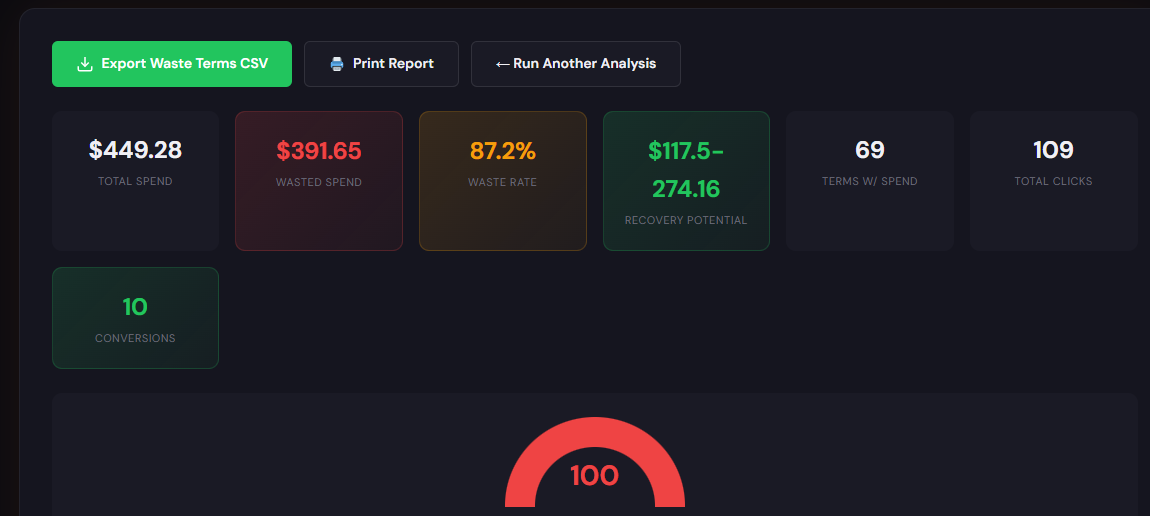
What it outputs: Dashboard-style snapshot listing total wasted spend, top leakage areas, negative keyword candidates, and a recovery plan prioritized by impact.
How to use it (3 steps):
- Upload or connect your account and run the snapshot to get a prioritized leakage report.
- Review the top 10 waste items—pause or reduce budgets on clear leaks and export negative keyword lists.
- Implement the recovery plan items across campaigns, then rerun the snapshot in 7 days to measure impact.
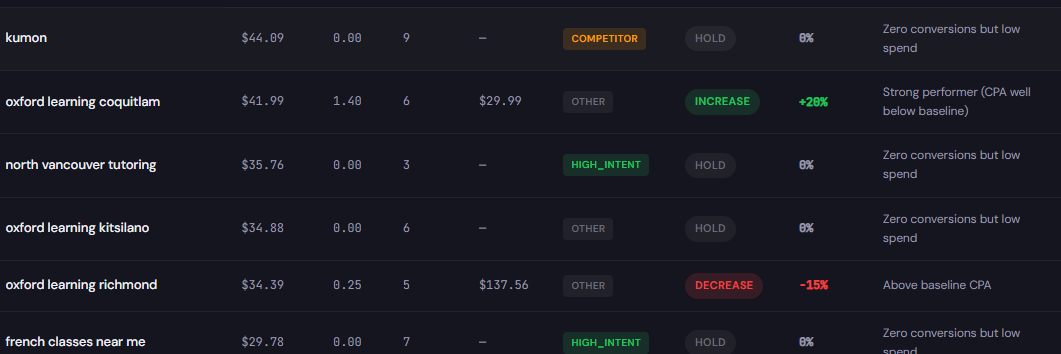
What it outputs: Table of search terms with spend, conversions, CPA/ROAS, tags (keep/negate/adjust), and suggested bid actions.
How to use it (3 steps):
- Export the top 200 search terms by spend into the analyzer.
- Review suggested tags: add negatives, mark high-value queries, and accept bid recommendations for marginal terms.
- Apply bid adjustments or negatives in bulk via Google Ads Editor or the interface; recheck performance after 7 days.
90-minute account triage playbook
Follow this timed sequence to stabilize an account in 90 minutes.
- 0–15 min: Run the ExecWrite Wastage Snapshot and export top leakage items.
- 15–35 min: Open Search Term Analyzer on the top-spend campaigns; tag negatives and high-value queries.
- 35–55 min: Apply immediate actions: add negatives, pause clear wasteful campaigns, reduce budgets on leaking ad groups.
- 55–75 min: Inspect hourly conversion table (top campaigns) and apply conservative daypart bid adjustments for low-performing hours.
- 75–90 min: QA the top landing pages (headlines, tracking) and schedule the next snapshot in 7 days to measure impact.
FAQ
A: You can expect lower wasted spend within days and measurable CPA/ROAS improvements within 7–14 days if you applied negatives, bid caps, and dayparting changes.
A: Not always. Apply conservative caps and segment conversion actions first. If volatility persists, switch key campaigns to manual CPC temporarily for diagnosis.
A: Start with a waste snapshot (spend vs. conversions by campaign/ad group/search term), search-term reports, and hour-of-day performance.
A: Yes—manually—but tools like ExecWrite’s snapshot and search-term analyzer save hours and surface prioritized actions so operators can act fast.
A: The same principles apply. On small budgets, waste compounds faster—so finding and killing high-spend non-converting queries is even more critical.
Want a prioritized recovery plan you can act on in hours? Run the Wastage Snapshot and Search Term Analyzer to get a step-by-step fix list.
Leave a Reply