If your account feels unstable—ROAS drifting, CPA spiking, or a sudden flood of irrelevant clicks—this post is a tactical recovery guide. Actionable checks, a 90-minute triage, and a tools-first workflow using ExecWrite to recover wasted spend and rebuild signal fast. Learn more at ExecWrite.
- First stop the bleeding: find wasted spend, kill leakage, add negatives.
- Fix quick wins this week: simplify segments, stabilize bids, align landing pages.
- Use the Wastage Snapshot + AI Keyword Generator to prioritize fixes and export recovery plans.
Table of Contents
Why PPC feels harder now
Automation, broad-match expansion, and privacy-driven signal loss mean the old rules for keyword hygiene and manual bid cuts no longer deliver consistent results. Systems find more users but return less predictable intent; budgets get drained by low-value queries or misaligned landing experiences. The result: more noise, fewer clean signals, and heavier reliance on fast, repeatable audits to detect waste.
The 5 biggest PPC problems marketers face
1) Wasted spend from low-intent queries
Symptoms
- High click volume on non-converting keywords or search terms
- High impressions but low conversion rate and rising CPA
- Conversions concentrated in a handful of queries
Why it happens
Broad match and automated targeting increase exposure to low-intent searches; missing negatives and poor search-term reviews let low-value traffic keep draining budget.
Fix this week
- Export top search-terms last 30 days, filter by conversions=0 and cost>$100
- Create negative keyword lists for clear leakages and apply at campaign level
- Pause or lower bids on high-cost/no-convert queries
2) Bid volatility by time-of-day
Symptoms
- CPA swings dramatically by hour
- Bids auto-adjust without predictable performance gains
Why it happens
Automated bidding reacts to thin or erratic signals; without hour-level analysis you can be overbidding when conversion probability is low.
Fix this week
- Pull hour-of-day performance and set conservative ad schedules
- Apply small bid multipliers for hours that consistently convert
3) Ad-to-landing mismatch (Quality Score drag)
Symptoms
- High CTR but low conversion rate
- Quality Score or expected CTR penalties
Why it happens
Ads that promise one value and landing pages that deliver another create friction and lost conversions; Quality Score falls when relevance gaps persist (see Google Ads guidance on Quality Score).
Fix this week
- Run headline-to-LP alignment checks for top 10 ad groups
- Test landing page variations that match primary ad message
4) Poor keyword structure and messy account hierarchy
Symptoms
- Large ad groups with mixed intent keywords
- Hard-to-isolate winners and losers
Why it happens
Poorly organized accounts prevent clean signal aggregation; automated systems can’t optimize effectively when ad groups mix awareness and purchase intent.
Fix this week
- Split top ad groups by intent (purchase vs. research)
- Create focused ad copy and landing page pairs for each group
5) Slow negative keyword hygiene
Symptoms
- Recurring irrelevant search trends cause repeated waste
- Negative lists out of date across campaigns
Why it happens
Teams review search terms irregularly; without automation or a quick generator, negative coverage lags and budgets leak.
Fix this week
- Automate weekly exports of zero-conversion high-cost queries
- Publish a centralized negative list and push changes across accounts
Fixes you can apply this week
- Stop spend on top 5 non-converting search terms—apply negatives now.
- Set conservative ad schedules for low-converting hours and test hour multipliers.
- Segment ad groups by intent; move high-intent keywords into dedicated ad groups.
- Match top 20 ad headlines to landing page H1 and CTAs; measure lift in conversion rate.
- Run a quick wastage snapshot to prioritize fixes by dollar impact.
Start with a one-click account snapshot to find leakage, negative keyword candidates, and recovery actions.
Tool-based workflow (map each pain point to ExecWrite tools)
We focus on two tools that deliver the fastest ROI: the Wastage Snapshot & Recovery and the Free AI Keyword Generator. Use them in tandem to find waste, extract negatives, and rebuild structured campaigns.
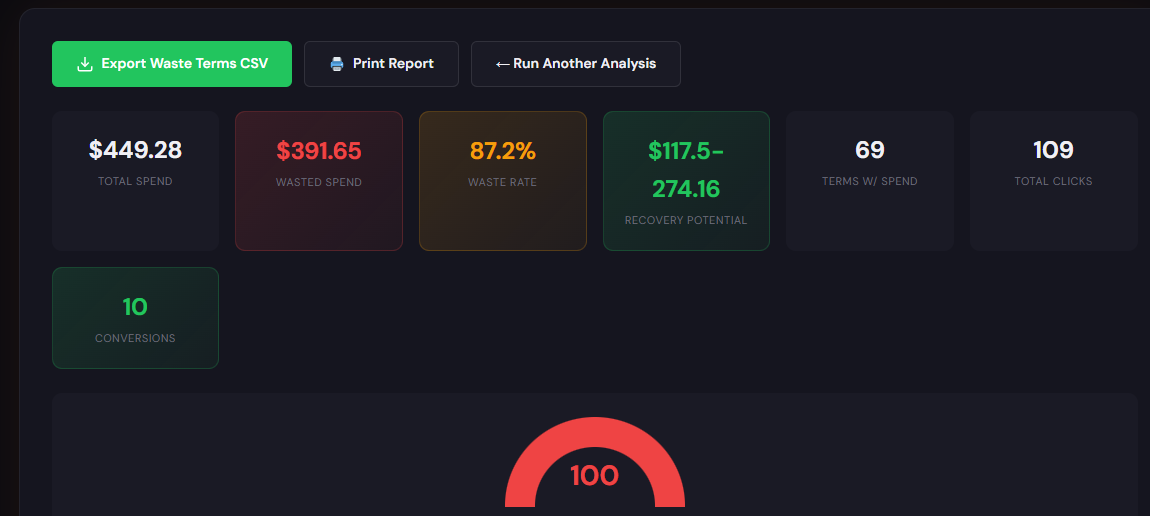
What it outputs: Dashboard snapshot of wasted spend, top leakage categories, negative keyword candidates, and a prioritized recovery plan.
How to use it (3 steps)
- 1) Upload or connect your account data and run the snapshot—get a one-page waste score and top leak list.
- 2) Review the prioritized recovery actions (negatives, paused keywords, ad schedule changes) and export the CSV.
- 3) Apply the exported negatives and bid adjustments in bulk via Google Ads Editor. Monitor 7-day performance impact.
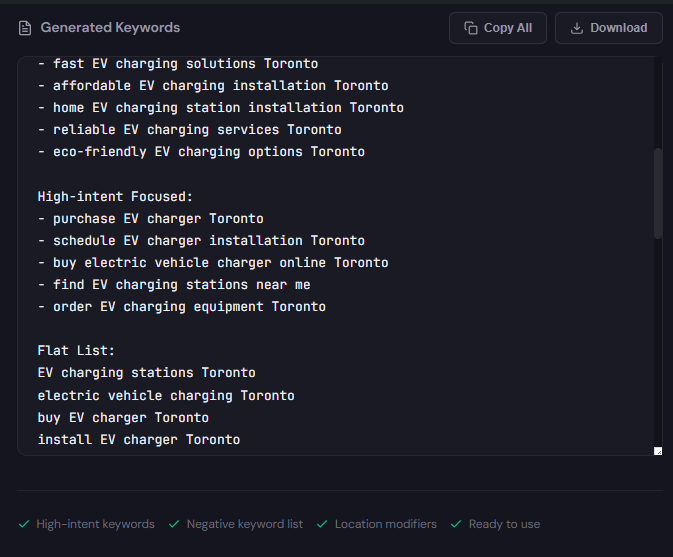
What it outputs: Structured keyword lists with high-intent groups, modifier suggestions, and negative keyword candidates—export-ready for campaign builds.
How to use it (3 steps)
- 1) Input your landing page or core product phrases and select desired intent buckets.
- 2) Generate keyword groups and review automated negatives—remove any false positives.
- 3) Export group CSV for Google Ads Editor or use the Campaign Generator to produce ad-group-level structure.
90-minute account triage playbook
Run this playbook live with an editor and 1 analyst. Aim: stop waste, stabilize CPA, and create a recovery backlog.
- 0–10 min: Snapshot. Run the Wastage Snapshot to get top leakage by cost and category.
- 10–30 min: Kill the top 3 bleeding items. Apply negatives and pause clearly irrelevant keywords/campaigns.
- 30–50 min: Hourly check. Pull hour-of-day performance; set ad schedule blocks for hours with CPA > 2x baseline.
- 50–70 min: Quality quick-fix. For top 10 ad groups, align ad headlines to landing pages and tag for A/B tests.
- 70–85 min: Structure cleanup. Use AI Keyword Generator to create focused ad groups for 2 worst-performing product areas.
- 85–90 min: Export & document. Export negatives and campaign CSVs; assign owners for 7-day monitoring and a 30-day recovery plan.
Use the snapshot to prioritize and the AI generator to rebuild structured campaigns. Fast exports, action items, and measurable wins.
FAQ
Small wins (negatives, paused waste) often show impact in 72 hours. Structural changes and A/B tests take 7–30 days to validate.
Automation helps but needs clean inputs. Run these audits to give algorithms better signals; otherwise automation can accelerate wasted spend.
The free generator scales for ideation and negative lists; export to Google Ads Editor for large-batch uploads and campaign builds.
Not always. Instead, pair broad match with aggressive negative hygiene and close monitoring. Use the snapshot to identify where broad match is bleeding budget.
Leave a Reply