If your Google Ads ROI is dropping, this post gives a tight, operator-level playbook to find leaks, stop waste, and stabilize CPA. Use the quick checks below and the ExecWrite tools linked for repeatable recovery. (Soft mention: try ExecWrite for fast diagnostic outputs that map to actions.)
- Run a 30-minute wastage snapshot to find budget leaks and negative keyword opportunities.
- Audit search terms and apply bid adjustments by search term and hour of day.
- Fix quality score and landing-page alignment for the top 20% of spend-driving keywords.
Table of Contents
Why PPC feels harder now
Google Ads is more automated, data-noisy, and expensive. Auction dynamics and privacy-driven signal loss make performance swings bigger: automated bidding reacts to fragmented signals, broad match/automation surfaces irrelevant queries, and inflated CPCs punish low-relevance assets. That combination turns small structural problems into rapid budget waste. Fix the structure first — then tune models.
The 5 biggest PPC problems marketers face
1) Silent wasted spend (you don’t notice bad queries quickly)
Symptoms
- High clicks with no conversions on mid-to-high CPAs
- Many low-quality search terms in broad match/ad groups
- Top-spend campaigns with large long-tail query lists
Why it happens — Automation + broad match expands into irrelevant queries and negative keyword hygiene lags. Without quick snapshots you keep funding queries that never convert.
Fix this week
- Run a quick wastage snapshot to surface top leakage areas.
- Add negative keywords for the top 30 non-converting terms.
- Pause broad-match ad groups responsible for most low-quality clicks.
2) Quality Score decay and messaging mismatch
Symptoms
- Click-through rate drops over 30–60 days
- High CPC relative to expected benchmarks
- Landing page and ad headlines that don’t match intent
Why it happens — Creative drift and landing page updates create relevance gaps. Automation penalizes relevance with higher CPCs and lower ad rank.
Fix this week
- Compare headlines and landing page messaging for the top 10 keywords by spend.
- Apply focused ad copy tests with exact-phrase calls-to-action that mirror landing pages.
- Use a Quality Score checklist and rewrite the worst-performing landing pages.
3) Hour-of-day and dayparting mismatches
Symptoms
- Huge CPA or ROAS swings by hour
- Same campaign performs differently weekdays vs weekends
- Bid strategies over/under-react to time-based volume
Why it happens — Aggregated bidding models smooth hourly signals; without explicit dayparting or hourly bid adjustments, you subsidize poor hours and lose efficiency.
Fix this week
- Pull hour-of-day performance and apply conservative bid reductions for losing hours.
- Test a small ad schedule restriction for worst-performing hours.
- Monitor conversion latency to ensure you’re not cutting off delayed conversions.
4) Campaign structure entropy (ad groups are noisy and unfocused)
Symptoms
- Many keywords in a single ad group with poor CTR variance
- Low ad relevance scores and messy negative lists
- Difficulty executing incremental experiments
Why it happens — Rapid scaling and automation push managers to lump keywords together. The result: diluted relevance, harder optimizations, poor QS.
Fix this week
- Split the top 10 poorest-performing ad groups into tighter intent buckets.
- Create ad copy that maps precisely to each new ad group.
- Export to Editor for bulk negative keyword and match-type fixes.
5) Measurement drift and attribution blind spots
Symptoms
- Conversions drop while leads or revenue don’t match expected patterns
- Inconsistent cross-channel metrics
- Conversion windows or tags misaligned after site changes
Why it happens — Tagging changes, conversion-action misconfigurations, and shifts in multi-touch attribution hide real performance, leading to mistaken optimizations.
Fix this week
- Verify conversion tags and event firing on the top two conversion pages.
- Check conversion windows and disable redundant conversion actions.
- Run a parallel-channel check (Analytics vs Ads) for the largest campaigns.
Fixes you can apply this week
- Run a wastage snapshot for top 10 campaigns and cut the worst 5% of queries by spend.
- Export search terms and add negatives at campaign level for immediate savings.
- Use hourly analysis to create conservative bid modifiers for expensive hours.
- Rewrite headlines and H1s for landing pages tied to high-spend keywords.
- Split noisy ad groups and push tight ad relevance into Editor CSVs for bulk upload.
Run a wastage snapshot and a search-term audit to get action items in minutes.
Tool-based workflow — map problems to ExecWrite tools
Below are two focused tools that produce action-ready outputs and how to use them in a tight workflow. Images show the actual output previews aligned left so you know what to expect.
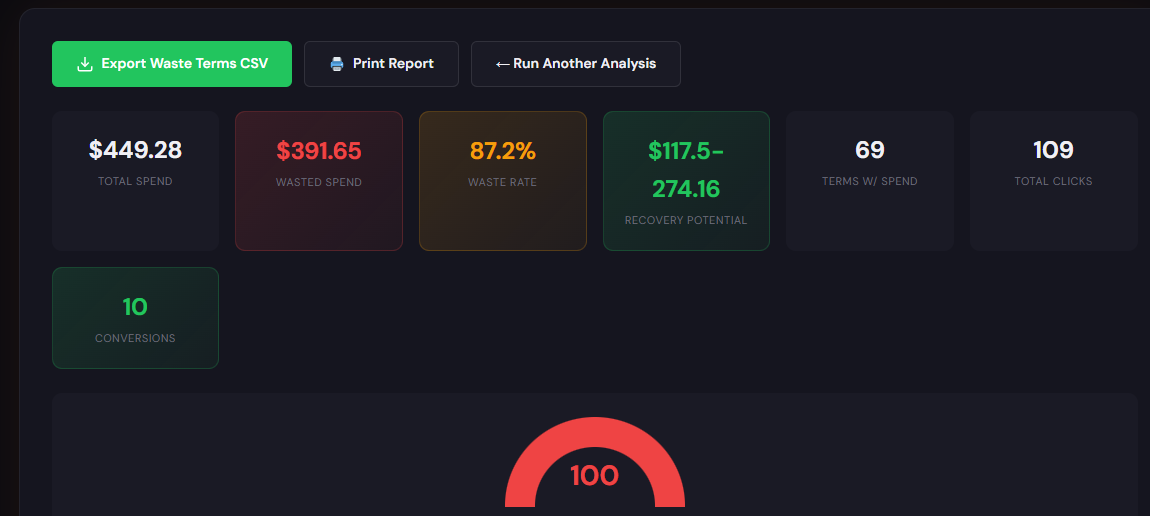
Wastage Snapshot & Recovery — find and recover wasted spend
What it outputs: A dashboard-style snapshot with total wasted spend, top leakage areas, negative keyword candidates, and a prioritized recovery plan.
How to use it — 3 steps
- Upload your last 30–90 days of account data to the snapshot tool (or connect via CSV).
- Review the top 5 leakage items and export the negative keyword list and pause recommendations.
- Implement high-confidence negatives and paused ad groups; re-run snapshot after 7–10 days to measure recovered ROI.
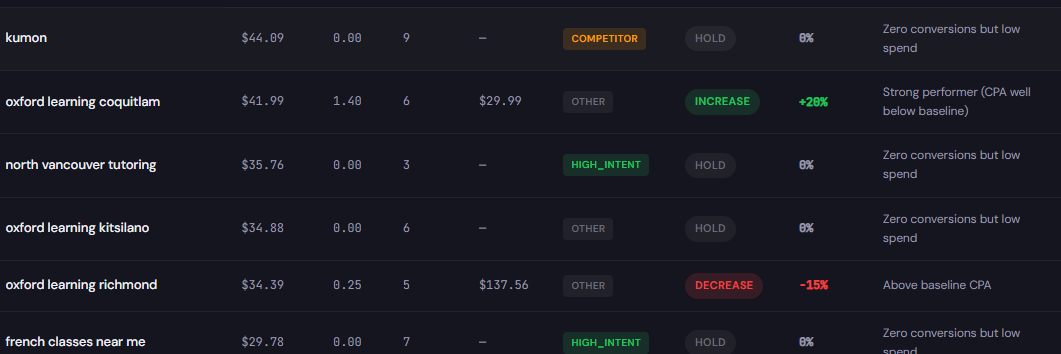
Bid Adjustment by Search Term (Search Term Analyzer)
What it outputs: A table showing search-term performance with spend, conversions, CPA, and recommended bid actions (up/down/neutral), plus tags for quick export.
How to use it — 3 steps
- Feed the tool your search term report. Set thresholds for minimum spend and conversion counts.
- Apply the recommended bid actions for high-spend, high-CPA terms and tentatively bid-up high-ROAS terms.
- Export the CSV for Google Ads Editor and push changes in a controlled batch (monitor 3–7 day impact).
90-minute account triage playbook
Follow this time-boxed sequence to get from bewilderment to action in 90 minutes.
- Minutes 0–10: High-level scan — top 10 campaigns by spend and MoM trend. Flag the worst three.
- Minutes 10–30: Run Wastage Snapshot on the account; export the negative keywords and leakage report.
- Minutes 30–50: Run Search Term Analyzer for the two worst campaigns; tag non-converting high-spend terms.
- Minutes 50–70: Implement immediate changes — add top negatives, pause worst ad groups, apply hourly bid cuts for worst hours.
- Minutes 70–80: Quick landing-page check for top 3 spend-driving keywords; tweak headlines to match intent.
- Minutes 80–90: Document changes, set 7-day monitoring alerts, schedule follow-up test (A/B ads or landing flows).
Use the two ExecWrite tools above to produce your triage outputs and a clear action list in under 90 minutes.
FAQ
Expect CPC and CPA improvements in 3–7 days for immediate negatives; broader quality score improvements take 2–6 weeks as ad systems re-learn.
Automation can counteract changes if signals differ. Protect critical changes with campaign-level exclusions and monitor algorithms for 7–14 days.
Yes. Use these tools to fix data quality and relevance before trusting Smart Bidding. Cleaner inputs yield better automated decisions.
At minimum: 30–90 days of search-term-level spend, conversions, and campaign/ad-group structure. More history improves signal for hourly and QS diagnostics.
Leave a Reply