If your account feels fragile—rising CPA, falling conversions, inconsistent ROAS—you need a structured triage, not marketing theory. This guide lays out the symptoms, quick fixes, and a tool-driven workflow using ExecWrite for fast remediation. Visit ExecWrite to access the tools referenced below.
- Most account drops come from waste, search-term mismatch, or bidding timing—fix those first.
- Run a 90-minute triage: wastage snapshot, search-term analyzer, and quick bid-hour check.
- Use ExecWrite’s Wastage Snapshot and Search Term Analyzer to find actionable negatives, bid actions, and landing-page gaps.
Table of Contents
Why PPC feels harder now
Three structural shifts make troubleshooting noisier: automated bidding masks underperformance, data aggregation hides hour-level swings, and broad-match/AI expands irrelevant queries faster than negative lists can keep up. That combination turns small leaks into material performance degraders.
The 5 biggest PPC problems marketers face
1. Rising wasted spend (leakage)
- Symptoms: Spend up, conversions flat or down; high click volume with low conversion rates.
Why it happens: Campaigns inherit broad-match expansions and automated bids increase exposure on low-intent queries unless negatives and structure keep pace.
- Run a wasted-spend snapshot to see top leakage categories.
- Apply the top 20 negative queries and pause poor-performing keywords.
- Reduce budgets on high-cost, zero-conversion campaigns for 72 hours while you audit.
2. Search-term mismatch (irrelevant queries converting poorly)
- Symptoms: High conversions from a narrow set of queries, many clicks with no intent.
Why it happens: Broad match + responsive search ads bring high query volume; relevance drops if ad copy, landing page, and keyword intent aren’t aligned.
- Download search terms for the last 30 days and tag negatives immediately.
- Group converting queries into exact/phrase ad groups to preserve signal.
- Create simple ad-copy variants aligned to the top 3 converting intents.
3. Bid timing and dayparting weaknesses
- Symptoms: Hourly CPA swings > 30%; peak spend at low-converting hours.
Why it happens: Automated bidding optimizes to mixed signals when you don’t feed it hourly patterns; cross-day aggregation hides when to bid up or down.
- Pull hour-of-day performance and apply conservative bid adjustments (+/-) where CPA deviation is largest.
- Schedule ads to turn off low-converting windows temporarily.
- Lock in baseline bid caps while you collect 7 days of new hourly data.
4. Quality Score and landing-page relevance drops
- Symptoms: Impression share falls despite stable bids; CTR and conversion rate drop.
Why it happens: Messaging mismatch between query, ad, and landing page reduces CTR and conversion rates, which then feeds back into Quality Score.
- Match headline copy to top converting query intents.
- Audit top 10 landing pages for speed and headline relevance.
- Run A/B headlines focused on intent alignment (run for 5–7 days).
5. Tracking and attribution noise
- Symptoms: Conversion counts differ across tags/analytics; offline conversions delayed.
Why it happens: Tagging drift, missing server-side events, and lookback window mismatches create inconsistent signals that automated systems interpret as volatility.
- Confirm conversion actions in Google Ads match your primary KPI (same type and value).
- Compare Google Ads and GA4 conversion volumes; tag any >20% gaps for priority fix.
- Temporarily extend ROAS/CPA targets while you stabilize the attribution data feed.
Fixes you can apply this week
- Run a quick wastage snapshot to find top negative opportunities and budget leaks.
- Export search terms, tag the top 50 irrelevant queries, and move high-intent queries into dedicated exact/phrase groups.
- Check hour-of-day CPA variance; apply conservative bid modifiers to top-variance hours.
- Audit 5 landing pages for headline/match and load speed; implement fastest copy swaps first.
- Stabilize conversion settings and pause aggressive automated bid experiments until data is consistent.
Use ExecWrite’s Wastage Snapshot and Search Term Analyzer to find negatives, recover wasted spend, and generate bid actions in minutes.
Tool-based workflow: map problems to ExecWrite tools
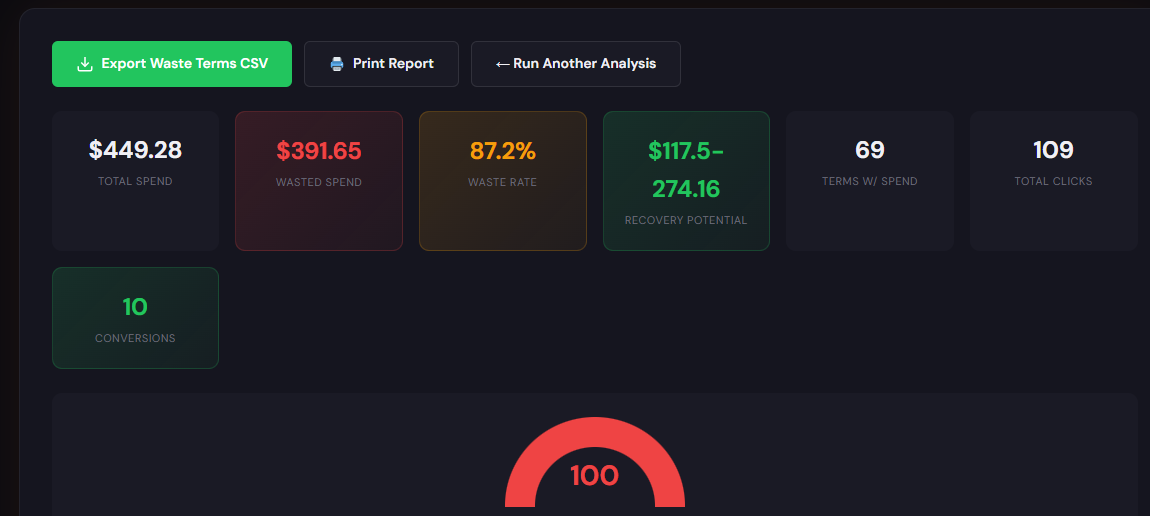
What it outputs: A dashboard-style snapshot that quantifies wasted spend, shows top leakage categories, and delivers a prioritized recovery plan (negative keywords, budget shifts, campaign pauses).
How to use it in 3 steps
- Upload a 30-day Google Ads export into the Wastage Snapshot (tool URL: Wastage Snapshot).
- Review the top 5 leakage buckets and export the recommended negatives and pause list.
- Apply negatives and pause actions, then re-run after 72 hours to measure recovered ROI.
Preview files: multiple snapshot visuals help prioritize fixes quickly.
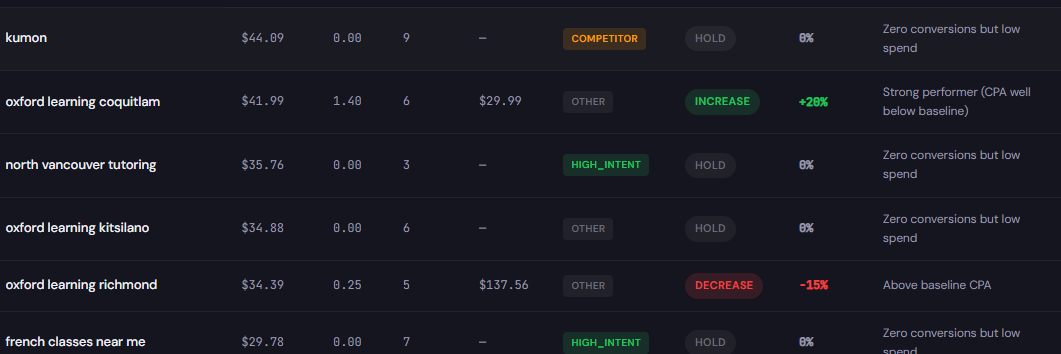
What it outputs: A search-term table showing spend, conversions, CPA/ROAS, and suggested bid actions or negative tagging at the search-term level (Search Term Analyzer).
How to use it in 3 steps
- Upload your search-terms report and filter by CPA/ROAS thresholds you care about.
- Tag terms as negative, move-to-exact, or bid-up based on the tool’s recommendations.
- Export the CSV for bulk edits in Google Ads Editor and schedule a re-check in 7 days.
Open the Search Term Analyzer to generate your actionable edit list.
90-minute account triage playbook
- 0–15 min: Snapshot — Run the Wastage Snapshot. Note top 3 leakage buckets and the estimated wasted spend.
- 15–35 min: Search-term sweep — Export search terms, feed them to the Search Term Analyzer, and tag the top 50 negatives.
- 35–50 min: Hourly check — Run an hour-of-day report and flag hours with >30% CPA variance for temporary bid modifiers.
- 50–70 min: Quick landing-page audit — Check headlines for top 3 converting queries and swap copy on the worst-matching page.
- 70–90 min: Apply & measure — Push negatives and paused campaigns. Lower budgets on noisy campaigns. Set calendar reminders to re-evaluate in 3 and 7 days.
Run both the Wastage Snapshot and Search Term Analyzer from ExecWrite to produce the exact negatives and edits you need to apply in the first 90 minutes.
FAQ
Expect measurable changes in 72 hours for immediate fixes (negatives, budget shifts). Bid/learning changes take 7–14 days to stabilize depending on traffic volume.
No—well-chosen negatives improve signal quality. Remove genuinely irrelevant queries; keep high-intent variants in market to preserve positive conversion signal.
Stabilize conversion definitions first (same action/value across accounts). Pause aggressive bid automation until tag issues are resolved to prevent bid noise.
Start with the Wastage Snapshot to quantify leaks, then use the Search Term Analyzer to create a prioritized negative and bid-action list.
Sources
- Common Google Ads mistakes, WordStream — common account-level troubleshooting and negative keyword guidance.
- About Smart Bidding, Google Ads Help — how automated bidding interprets signals and the importance of clean conversion data.
- Google Ads mistakes and fixes, HubSpot — practical checks for quality-score and landing-page mismatch.
Need a fast, operator-friendly workflow and tools that produce CSV-ready fixes? Start with ExecWrite: https://execwrite.com
Leave a Reply