Rising CPCs and flat conversions are symptoms, not destiny. This post shows operator-level diagnostics and fixes you can run this week — including tools on ExecWrite to automate the boring parts.
- Wasted spend, misaligned intent, and automation settings are the fastest levers to pull.
- Run a waste snapshot, prioritize negative keywords, and tune bids by hour and search term this week.
- Use targeted tools (waste recovery + search-term bid actions) to convert triage into measurable savings.
Table of Contents
Why PPC feels harder now
Paid media is doing more with less forgiving signals. Competition pushes CPCs up, privacy changes reduce conversion signal fidelity, and smart bidding can both help and hide problems. The result: higher spend, slower troubleshooting, and longer time-to-impact on fixes. Fixes must be surgical — not broad budget slashes.
The 5 biggest PPC problems marketers face
1) Wasted spend from irrelevant or low-intent queries
Symptoms
- High spend with low conversions for many search terms.
- Large number of clicks coming from queries that don’t match offer intent.
- Conversion rate that drops when impressions rise.
Why it happens
Search term growth, broad match expansion, and automated match types surface lots of irrelevant traffic. If negative keywords aren’t catching up, you pay for clicks that never convert.
Fix this week
- Export last 30–90 days of search terms and sort by spend and CPA.
- Identify top 10% of spend that produces zero conversions and add as negatives.
- Pause or reduce bids on broad-match heavy ad groups until negatives are applied.
2) Automation hiding core problems (smart bidding overconfidence)
Symptoms
- Performance drift after switching to a bid strategy.
- Bid strategy recommends higher spend into inefficient segments.
- Ad groups with volatile daily CPA/ROAS.
Why it happens
Automated bidding optimizes to the signals it sees. If signals are noisy or your account has leakage, the algorithm raises bids to chase volume that isn’t profitable.
Fix this week
- Temporarily switch high-variance ad groups to manual CPC with portfolio exclusions.
- Segment campaigns by intent so automation targets consistent buckets.
- Audit conversion actions and match types feeding smart bidding.
3) Hourly/dayparting inefficiencies
Symptoms
- Large CPA/ROAS swings by hour of day.
- Ad schedule set-and-forget from initial launch.
- Budget exhausted early in the day with no conversions later.
Why it happens
Performance patterns change by audience behavior and competitor activity. Without regular hour-level checks, you bid the same at 2am as at peak business hours.
Fix this week
- Pull hour-of-day performance for cost, convs, CPA, and ROAS.
- Reduce bids for consistently poor hours and reallocate budget to top-performing slots.
- Apply bid adjustments or ad schedule changes and monitor 48 hours for lift.
4) Landing page mismatch and Quality Score leaks
Symptoms
- Low Quality Scores on headline/landing page relevance.
- High impressions but low click-through or high bounce rate.
- Conversion rate falls after creative or landing page changes.
Why it happens
Ads promise something the landing page doesn’t deliver. Even small messaging mismatches cause QS drops and higher CPCs.
Fix this week
- Run a headline-to-landing-page relevance check for top 5 ad groups.
- Adjust headlines to reflect primary offer and ensure landing page has matching H1 and CTA.
- Test a high-intent landing page for worst-performing ad groups.
5) Poor keyword/ad group structure
Symptoms
- Noisy broad-match ad groups mixing intents.
- Single ad group with too many keywords and conflicting ads.
- Difficulty isolating what drives CPA increases.
Why it happens
Accounts grow without refactor. Granularity is sacrificed for convenience and the result: bad data and weak signals for bidding and creatives.
Fix this week
- Export keyword lists and group by intent; split high-spend buckets into dedicated ad groups.
- Create single-intent ad groups (exact/phrase) for top-converting keywords.
- Match creative to each ad group’s intent and measure for 7–14 days.
Fixes you can apply this week
- Run a spend-by-search-term audit and add negatives for top wasted queries.
- Run an hour-of-day bid review and apply ad schedule adjustments.
- Isolate problematic campaigns from automation and run manual CPC tests.
- Split broad ad groups by intent and align headlines to landing pages.
- Prioritize fixes that recover immediate spend (negatives, bid cuts, pause low-intent keywords).
Run an automated waste snapshot and turn the results into negative keywords and recovery actions.
Tool-based workflow: map problems to ExecWrite tools
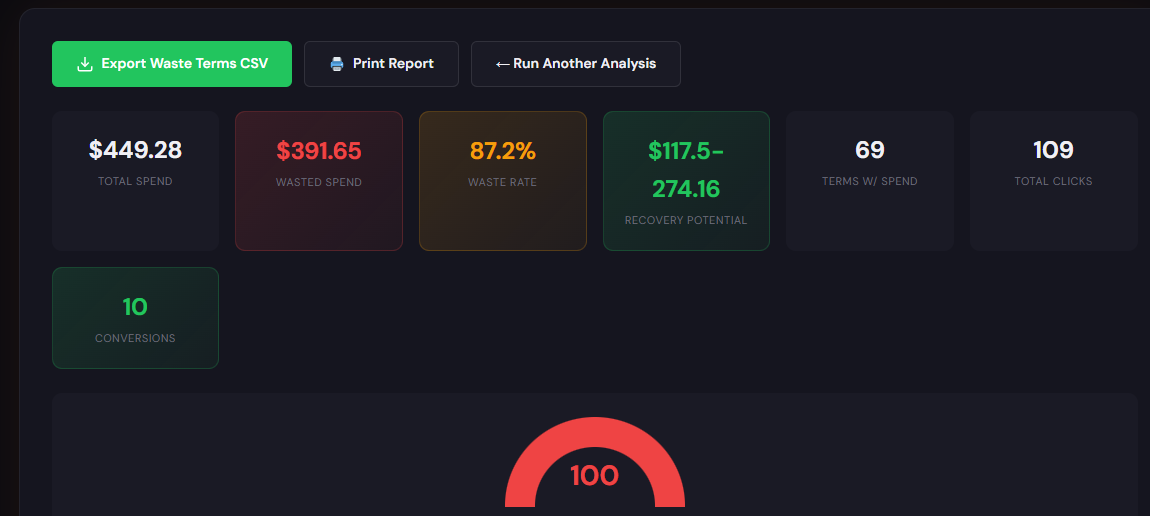
What it outputs
- Dashboard-style snapshot of top leakage areas, wasted spend totals, and prioritized recovery actions.
How to use it in 3 steps
- Run a snapshot for the last 30–90 days to surface top waste buckets.
- Export the suggested negative keyword list and recovery plan.
- Apply negatives and track spend reduction over the following 7 days.
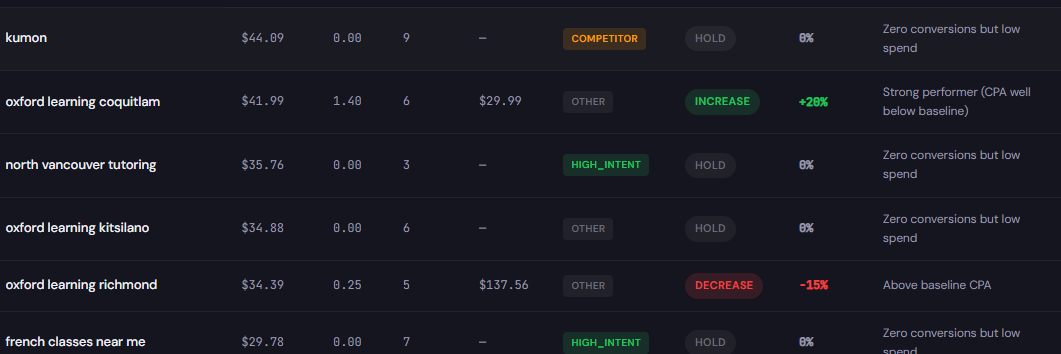
What it outputs
- A table of search terms with spend, conversions, CPA, and recommended bid actions (increase/decrease/pause).
How to use it in 3 steps
- Upload search term data or connect your account and filter to the last 30–90 days.
- Review recommended bid adjustments and tag terms as negative/low-bid/high-priority.
- Export the actions and push them to Google Ads or implement via Editor.
90-minute account triage playbook
- 0–15 min: Snapshot top-line metrics — cost, conversions, CPA by campaign. Flag campaigns up >20% cost with flat conversions.
- 15–35 min: Run a wastage snapshot and export top wasted terms. Add immediate negatives for top spend/no-conv terms.
- 35–60 min: Run search-term analyzer and apply bid reductions for high-CPA terms; tag high-intent winners.
- 60–75 min: Check hour-of-day performance and apply ad schedule edits for the worst hours.
- 75–90 min: Pause or isolate noisy automation-driven groups and set manual CPC for a 7–14 day test.
- Post-triage: Document actions, expected impacts, and schedule a 48–72 hour check for early signals.
Start a free snapshot, run the search-term analyzer, and convert outputs into account actions without the spreadsheet grind.
FAQ
Not always. Start by fixing signal quality (negatives, conversion accuracy) and isolating only the worst-performing campaigns. If automation continues to chase bad traffic, then test manual CPC on those groups.
Run a full snapshot monthly and quick scans weekly for high-spend campaigns. Use snapshots after any major match-type or campaign structure change.
Yes, but that’s the point: remove low-intent clicks that waste budget and improve conversion rates for remaining traffic, which in turn lowers CPA and improves bid strategy signals.
Bid changes can affect CPC and spend immediately; expect clearer conversion signal within 48–72 hours. Use short tests and monitor daily to avoid overreacting to noise.
Leave a Reply