Performance slides, budgets burn, and bidding feels random. This guide shows pragmatic diagnostics and fixes you can apply in a week, plus how ExecWrite tools speed the work. Try the tools at ExecWrite for instant, actionable outputs.
- Most underperformance traces to wasted spend, poor match between ads and landing pages, and bid timing—fix these first.
- Run a waste snapshot and search-term analysis to get prioritized fixes you can apply this week.
- Use the 90-minute triage playbook to stabilize CPA/ROAS and create quick wins before longer optimizations.
Table of Contents
Why PPC feels harder now
Three structural shifts make managing paid media more demanding: automated bidding obscures signals, audience overlap and keyword creep inflate costs, and cross-channel attribution hides where conversions actually come from. Those changes increase noise and make tactical wins feel temporary unless you pair diagnostics with surgical fixes.
The 5 biggest PPC problems marketers face
1) Wasted spend and low signal
Symptoms
- High impression volume but low conversion rate.
- Large spend on branded/irrelevant queries with zero conversions.
- Exploding cost per click (CPC) without corresponding lift in leads.
Why it happens
Broad match expansion, poor negative keyword lists, and unchecked query-level waste create noise that undermines automated bidding. The result: your bid strategy chases impressions instead of conversions.
Fix this week
- Run a waste snapshot to identify top leakage areas by spend and low-value queries.
- Pause or tighten broad match keywords showing high cost and zero conversions.
- Add top wasting queries to negatives and exclude low-intent placements.
2) Poor search-term hygiene (keyword cannibalization)
Symptoms
- One keyword group triggers for dozens of intent signals (informational vs. transactional).
- Multiple ad groups compete for the same queries, raising CPCs.
- High spend on queries that should be negative or in a separate funnel.
Why it happens
Loose keyword structures and lack of query-level review let the account fragment. That fragmentation confuses bidding and reporting and blocks precise audience targeting.
Fix this week
- Export last 90 days of search terms and flag high-spend, low-conversion queries.
- Reassign queries into intent-based ad groups; add negatives where necessary.
- Use a search-term analyzer to generate recommended bid actions and tags.
3) Timing and ad-schedule mismatches
Symptoms
- Huge hourly swings in CPA or ROAS.
- Conversions concentrate in narrow windows but bids stay flat.
- Budget burns during low-conversion hours.
Why it happens
Default ad schedules and daily budgets ignore hour-of-day performance. Without dayparting, you overbid when traffic is cheap but unproductive and underinvest when buyers convert.
Fix this week
- Run an hourly performance report and identify 3 best and 3 worst hours.
- Reduce bids during low-conversion hours and increase when conversion rate spikes.
- Set ad schedule modifiers or use an hourly bid adjuster for precise actions.
4) Landing page mismatch and declining conversion rate
Symptoms
- CTR is stable but conversion rate falls.
- High bounce rates on paid landing pages for specific ads or keywords.
- Quality Score drops tied to ad-to-LP relevance.
Why it happens
Ads promise something different than the landing page delivers. That mismatch kills conversion rates and pushes up CPA, even if clicks look healthy.
Fix this week
- Audit top-converting keywords and check ad headline/LP alignment.
- Run targeted landing copy tests focused on headline and CTA alignment.
- Use a quality-score optimizer to get prioritized headline and LP changes.
5) Over-reliance on automated bidding without clean inputs
Symptoms
- Bidding cycles produce unstable CPA/ROAS after small account changes.
- Simulated bid changes show little predicted improvement.
- Difficulty explaining performance to stakeholders.
Why it happens
Automated strategies require reliable signals. If your account has mixed-intent ad groups, noisy search terms, or unfiltered conversions, automation amplifies the problems instead of fixing them.
Fix this week
- Stabilize signals: clean conversions, fix tracking issues, and tidy ad groups.
- Switch problematic ad groups to manual or portfolio strategies while you clean inputs.
- Document changes and measure impact before re-enabling full automation.
Fixes you can apply this week
- Run a wasted-spend snapshot to get a prioritized leakage list and recovery steps.
- Export and tag search terms; promote high-intent queries, add low-intent negatives.
- Implement simple daypart bid adjustments for three worst and three best hours.
- Align top 10 ad headlines to landing-page headlines; launch two A/B tests.
- Stabilize conversions: verify tracking and remove low-value conversion events from bidding targets.
Get a prioritized waste audit and recovery plan in minutes — targeted at the exact leakages that increase CPA.
Tool-based workflow (map each pain point to ExecWrite tools)
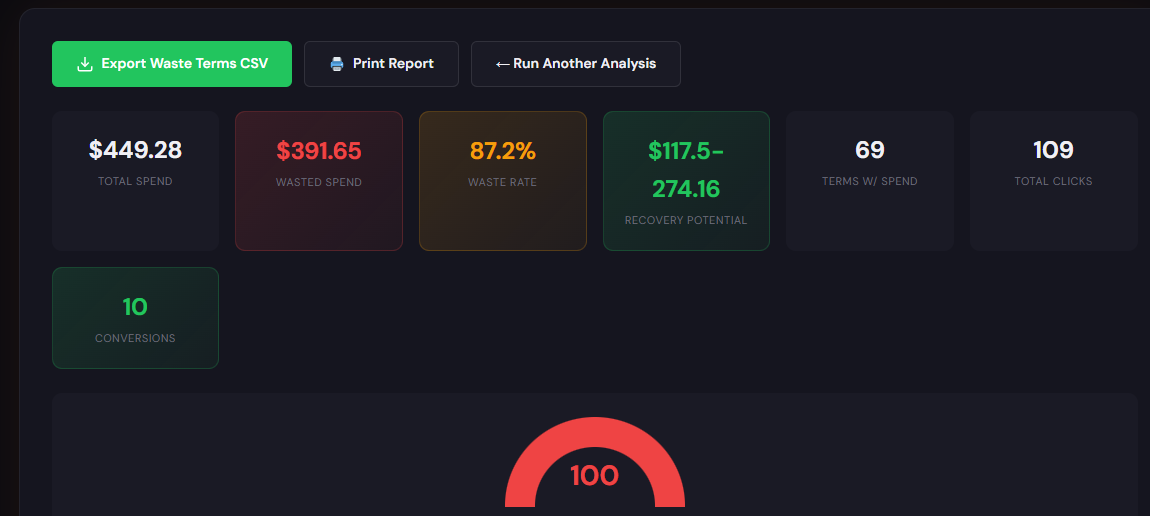
What it outputs: A dashboard-style snapshot showing total wasted spend, top leakage areas (search terms, campaigns, placements), and a prioritized recovery plan you can action immediately.
How to use it — 3 steps
- Upload your account CSV or connect via supported export and run the snapshot.
- Review top leakage items and apply the suggested negatives/pauses for instant savings.
- Export the recovery plan and implement changes in Google Ads; re-run snapshot after 7 days to measure impact.
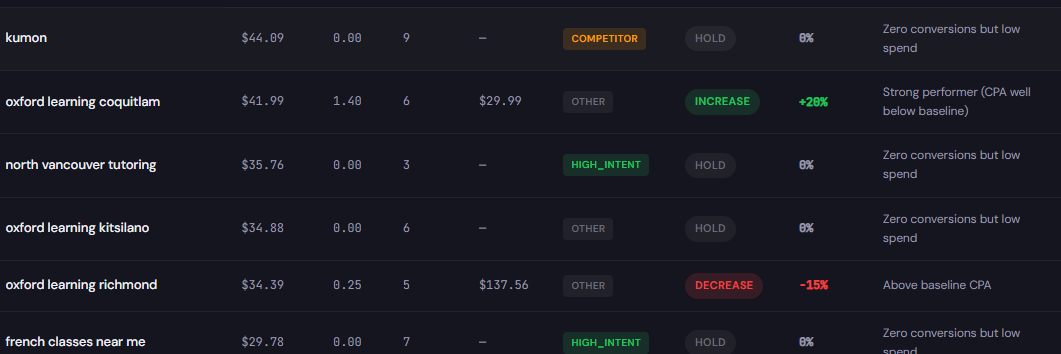
What it outputs: A query-level table that tags terms by intent, shows spend/conversion metrics, and recommends bid actions or negative keywords.
How to use it — 3 steps
- Feed the last 30–90 days of search-term data into the analyzer.
- Approve tag suggestions and apply recommended bid adjustments or negatives.
- Deploy changes and monitor hourly/weekly impact; iterate on newly uncovered queries.
Both tools work together: run the Wastage Snapshot first to prioritize where to focus, then use the Search Term Analyzer to execute precise query-level fixes and bid actions.
90-minute account triage playbook
- 0–10 min: Pull top-level KPIs (last 7/30/90 days): spend, conversions, CPA/ROAS, and top 20 spenders.
- 10–30 min: Run Wastage Snapshot to identify urgent leakage (top 10 waste items).
- 30–50 min: Export search terms for the top 5 leaking campaigns and run Search Term Analyzer.
- 50–70 min: Apply immediate actions—pause low-value keywords, add negatives, implement 3-hour bid modifiers for worst hours.
- 70–90 min: Fix tracking/Conversions: confirm conversion settings, remove low-value events, document changes and set a 7-day review.
- Deliverable: A one-page recovery plan with expected savings and next steps for A/B tests and larger structural fixes.
Run the two tools above to produce the exact lists and bid actions you need to stabilize performance now.
FAQ
Immediate savings from pausing wasteful queries can appear in 24–72 hours. Bid and landing-page changes typically take 7–14 days to stabilize so you can measure true impact.
Yes. Clean inputs make automated bidding effective. Use manual controls on problematic groups while you fix signal quality, then re-enable automation gradually.
ExecWrite accepts exports and direct account data depending on the tool. Use CSV exports if you prefer not to connect live accounts; the tools accept standard Google Ads reports.
No. Tools generate prioritized recommendations and export actions. You control which changes to implement in Google Ads; exported CSVs speed bulk uploads and Google Ads Editor workflows.
Sources
- Google Ads Help — About Quality Score
- Google Ads Help — Ad schedule and ad delivery
- Google Ads Help — Negative keywords
- WordStream — How to Reduce Wasted Ad Spend
Ready to stop guessing and start recovering wasted spend? Run the snapshot and search-term analyzer at ExecWrite to get prioritized, export-ready actions.
Leave a Reply