If your account feels like it’s slowly leaking ROI, this playbook gives operator-level steps to find and fix the three most common sources of decline — wasted spend, bid drift, and relevance gaps — and includes a tested tool workflow from ExecWrite to speed recovery.
- Quick audit: run a waste snapshot, check hour-of-day swings, and scan search term leakage.
- Three fixes this week: stop bad spend, tighten keyword/ad relevance, and apply time-based bid controls.
- Use two ExecWrite tools (Wastage Snapshot & Bid Adjuster) to produce an actionable recovery plan in one session.
Table of Contents
Why PPC feels harder now
Higher CPCs, more automation noise, and audience fragmentation mean the old fixes don’t scale. The symptoms are familiar: rising CPA, flat ROAS, and a messy account structure that feeds waste into automated bidding. This article focuses on the operational fixes that work now — tangible checks you can run in hours, not vague strategy shifts.
The 5 biggest PPC problems marketers face
Pain 1 — Wasted spend from irrelevant search terms
Symptoms
- High impressions on low-quality searches with zero conversions.
- Broad match campaigns driving most clicks instead of high-intent queries.
- Negative keyword lists are incomplete or unmanaged.
Why it happens
Automation and broad match expansion generate volume but also noise. Without regular search term audits, low-intent queries erode budgets and confuse bidding models.
Fix this week
- Export search terms for top-spending campaigns (90 days).
- Tag any term with 0 conversions and >X spend as immediate negative (define X by budget; typically 2–5% of total).
- Create a watchlist for near-converting terms to turn into exact/phrase keywords.
Pain 2 — Bid drift and hour-of-day swings
Symptoms
- CPA spikes at specific hours or weekdays.
- Automated bid strategies frequently target poor-performing windows.
- Ad scheduling is limited or not data-driven.
Why it happens
Many teams set broad ad schedules or rely solely on machine-learned bidding without feeding it clean hour-level signals. The result: bids rise when conversion probability is low.
Fix this week
- Pull hour-of-day performance for conversions and CPA for the last 60–90 days.
- Apply -30% to -50% bid modifiers to the worst-performing hours; +10–20% to the best.
- Monitor performance for 7 days and iterate.
Pain 3 — Landing page relevance and Quality Score decay
Symptoms
- CTR and conversion rate both falling despite constant traffic levels.
- Quality Score drops across several ad groups.
- High bounce rates coming from paid landing pages.
Why it happens
Creative and messaging drift — ads no longer match landing pages. Search intent changes faster than copy updates, and Quality Score takes the hit.
Fix this week
- A/B test headline and hero messaging to restore ad-to-page relevance.
- Align top 10 keywords per ad group with on-page H1/H2 and CTA text.
- Add a quick variant landing page for the worst-performing ad groups.
Pain 4 — Overbroad campaign structure
Symptoms
- Single campaigns with dozens of unrelated keywords and mixed intent.
- Poor ad relevance and confusing automated bidding signals.
- Difficulty tracing performance to a single driver.
Why it happens
To save time, teams lump keywords together. That convenience creates mixed signals for automation and hides the real winners.
Fix this week
- Split top-spending campaigns into narrower intent buckets (commercial vs. info).
- Create dedicated ad groups for top-converting terms with bespoke ads and landing pages.
- Export ad relevance and QS by ad group to validate splits.
Pain 5 — Attribution and conversion tracking noise
Symptoms
- Conversions jump or drop after tracking changes; ROAS looks unstable.
- Offline or cross-channel conversions aren’t stitched to paid clicks.
- Lead quality doesn’t match conversion counts.
Why it happens
Tracking changes, misconfigured goals, and incomplete data imports create a false picture. Bidding models optimize for flawed signals and perform poorly.
Fix this week
- Audit conversion actions: ensure consistent naming, values, and attribution windows.
- Map top revenue sources to conversions and disable ambiguous actions used by bids.
- Validate tag firing and server-side imports on a sample of leads.
Fixes you can apply this week
- Run a quick waste scan (search terms + negative additions) and remove the top 10 waste drivers.
- Apply hour-of-day bid adjustments based on 60–90 day data.
- Split high-spend mixed campaigns into focused buckets and rewrite ads to match intent.
- Run a landing page relevance check for top 20 ad groups and deploy quick headline variants.
- Validate conversion actions and attribution windows; pause any noisy goals used for bidding.
Use ExecWrite’s Wastage Snapshot to find top leakage areas and generate a recovery checklist you can act on in hours.
Tool-based workflow
Below are two lightweight tools from ExecWrite that let you turn the fixes above into repeatable outputs. Each tool block shows what it produces and a three-step use path.
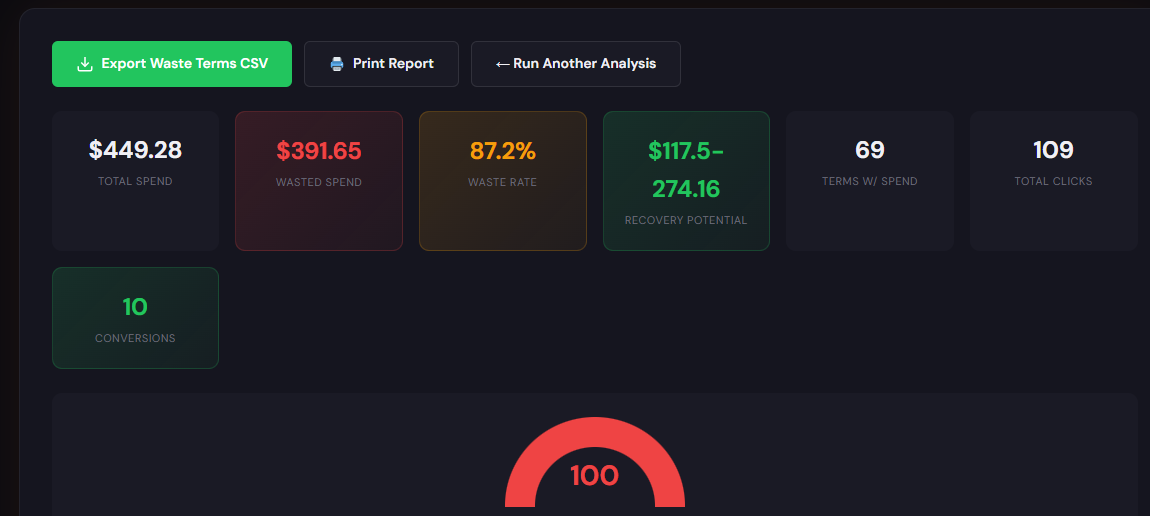
What it outputs: A dashboard-style snapshot listing total wasted spend, top leakage areas (search terms, budgets, campaigns), and a prioritized recovery plan with quick negative keyword exports.
How to use it — 3 steps
- Upload your account export (or connect via the guided workflow) and run the snapshot.
- Review the waste ranking and export the top negative keyword list and recovery tasks.
- Apply negatives, pause the worst campaigns, and schedule a 7-day monitoring sprint.
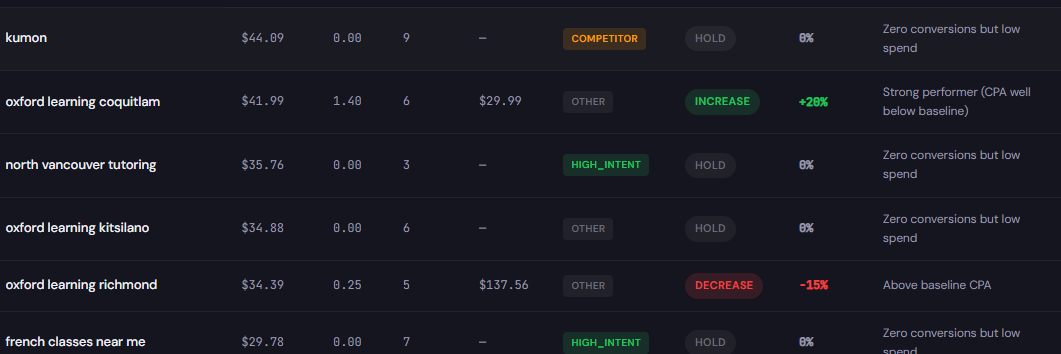
What it outputs: A ranked table of search-term performance with spend, conversions, tags (negative/keep/test), and recommended bid actions by term or group.
How to use it — 3 steps
- Export search terms for your high-spend campaigns (90 days) and upload to the analyzer.
- Apply the analyzer’s tags: negative for waste, keep/test for near-converters, and suggested bid adjustments for high-intent winners.
- Push negatives and bid recommendations back into the account (or via Editor) and monitor the delta in 7 days.
90-minute account triage playbook
A timed checklist to triage an underperforming account and produce an immediate recovery plan.
- 0–10 min: Pull account spend, conversions, top campaigns, and top search terms (last 60–90 days).
- 10–30 min: Run Wastage Snapshot and export the top 10 negative candidates and the recovery summary.
- 30–50 min: Upload search terms to Search Term Analyzer and tag the top 50 noisy terms.
- 50–70 min: Apply negatives, implement ad schedule bid modifiers (based on analyzer + hour data), and pause top waste campaigns.
- 70–90 min: Create a recovery action list with owners and a 7-day monitoring plan. Share results and next steps with stakeholders.
Use ExecWrite’s tools to automate the waste scan and bid recommendations — save hours of manual triage and get a prioritized plan.
FAQ
Expect initial efficiency gains within 3–7 days as the account stops spending on non-converting queries; full performance stabilization usually takes 2–4 weeks as bidding models re-learn.
Not necessarily. Apply changes in stages: negative/structure fixes first, then let automated bids run on cleaner signals. Pause bids only if you see extreme volatility or if tracking is broken.
Use 60–90 days to smooth weekly patterns but exclude major seasonality spikes. For new campaigns, use at least 30 days and supplement with daypart tests.
Yes. The Wastage Snapshot highlights relevance gaps and the Quality Score optimizer suggests headline and landing page changes to restore ad-to-page alignment.
Leave a Reply