If your account feels like it spends more than it converts, this article gives a technician-first roadmap: the five persistent problems you’ll find, quick fixes you can run this week, and a tool-driven workflow using ExecWrite to recover wasted budget and stabilize performance. For hands-on audits and recovery, start at ExecWrite.
- Most wasted spend comes from structural issues: mismatched intent, poor scheduling, and unmanaged search terms.
- Run a 90-minute triage that finds 3–5 high-impact fixes and reclaims budget fast.
- Use the ExecWrite Wastage Snapshot and the Search Term Analyzer to produce a recovery plan and prioritized bid actions.
Table of Contents
Why PPC feels harder now
Platforms change, but the real friction is internal: larger accounts, mixed funnels, and automation that hides the details. Advertisers lean on automated bidding and broad match without a repeatable audit routine. That produces two outcomes: invisible waste (spend that buys no incremental conversions) and fragile wins (improved CPA one week, crash the next).
This post assumes you want operator-level fixes — checks you can apply in a day and tools to automate the repetitive work. If you need a quick audit dashboard, ExecWrite has templates and tools that speed diagnosis and remediation.
The 5 biggest PPC problems marketers face
1. Wasted spend from irrelevant search terms
Symptoms
- High cost on search terms with zero conversions or negative intent queries showing high clicks.
- High impressions but low CTR on broad match campaigns.
- Slow negative keyword hygiene — repeats of the same bad queries over weeks.
Why it happens
Broad match + smart bidding without ongoing search-term management lets the engine explore expensive, irrelevant queries. Automation optimizes for conversion volume, not query relevance, unless you guard it with negatives.
Fix this week
- Export last 30–90 days of search terms, sort by spend, and tag non-converting high-cost terms as negatives.
- Add exact-match variants for high-intent converting terms and move them to tighter ad groups.
- Pause low-quality broad-match ad groups until negatives are applied.
2. Poor ad-to-landing-page relevance (Quality Score leaks)
Symptoms
- Low or falling Quality Scores on key ad groups.
- High CPCs or low ad rank despite healthy bids.
- Landing pages that don’t echo ad headlines or intent.
Why it happens
QS is an aggregate signal of expected CTR, ad relevance, and landing page experience. When messaging drifts between ad and landing page, conversion rates fall and costs rise.
Fix this week
- Map top-performing ads to their landing pages and update headlines to match the search intent.
- Run experiments: simple headline/CTA swaps with clear intent alignment.
- Prioritize pages with the highest traffic but lowest conversion rate for quick copy alignment.
3. Hour-of-day and dayparting mismatches
Symptoms
- Big CPA swings by hour or day, unexplained by seasonality.
- Budget drained during off-peak hours with poor conversion yield.
- Ad schedule set broadly with no data-driven adjustments.
Why it happens
Accounts often inherit a default ad schedule. Without granular hour and day analysis, you bid into hours that consistently underperform.
Fix this week
- Pull hour-of-day performance (cost, conv, CPA) for last 90 days and mark hours with CPA above target.
- Apply conservative bid adjustments or turn off ads during the worst hours.
- Monitor for a full week and iterate.
4. Duplicate or poorly structured campaigns
Symptoms
- Multiple campaigns competing for the same keywords or audiences.
- Confusing priority settings (brand vs nonbrand) causing bid conflicts.
- Difficulty attributing conversions to a single source.
Why it happens
Rapid scaling and multiple operators create overlapping campaigns. Overlap reduces control and increases CPCs because your campaigns bid against themselves.
Fix this week
- Run an overlap report between campaigns and pause redundant or legacy structures.
- Define clear naming conventions and priorities (brand/exact > nonbrand/broad).
- Move high-intent terms into single-purpose campaigns for better bidding.
5. Slow negative keyword and waste recovery processes
Symptoms
- Known negatives are not applied account-wide.
- Ad hoc fixes recur because there’s no reusable recovery plan.
- Time-to-fix is days or weeks, not hours.
Why it happens
Teams fix symptoms rather than codify fixes. Without a recovery snapshot and a playbook, wasted spend returns.
Fix this week
- Create a negative keyword list for common waste and apply it across relevant campaigns.
- Document a weekly search-term review slot and assign ownership.
- Use tooling to automate detection of repeat offenders.
Fixes you can apply this week
- Export last 90 days of search terms, sort by spend, and add the top 20 non-converting queries to negatives.
- Identify 3 landing pages with high traffic + low CR and align headlines to match the top 5 converting queries.
- Pull hour-of-day CPA and apply -30% to worst hours; monitor for seven days.
- Consolidate overlapping campaigns identified in your campaign overlap report.
- Create an account-wide negative list for recurring waste and publish it organizationally.
Run the ExecWrite Wastage Snapshot to get a prioritized leak list and recovery plan for your account. Use the Search Term Analyzer to convert the plan into negatives and bid actions.
Tool-based workflow: map problems to ExecWrite tools
We focus on two tools that give maximum reach: the Wastage Snapshot for fast recovery and the Search Term Analyzer for negative hygiene and bid actions.
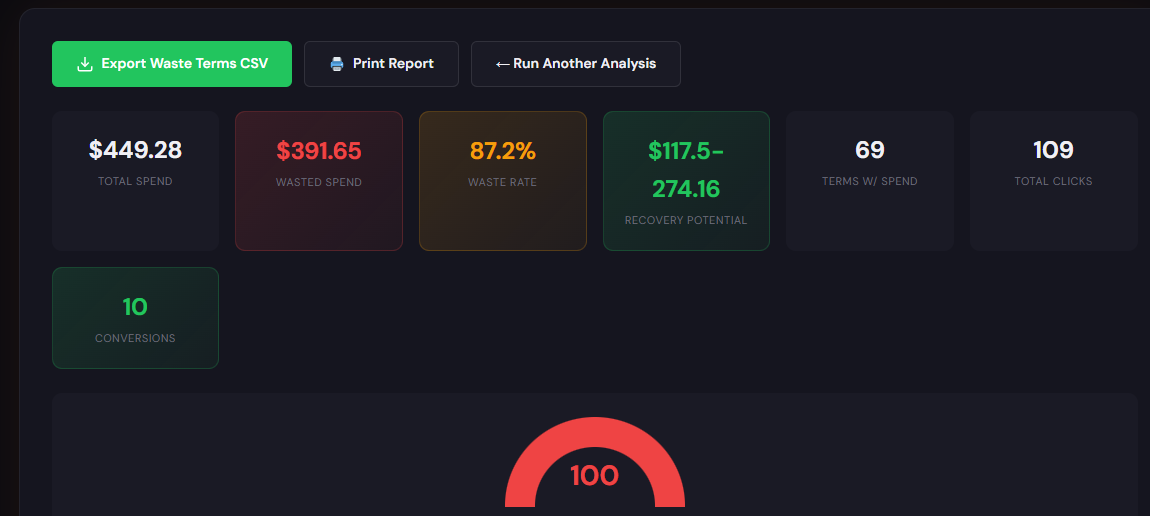
What it outputs: a dashboard-style snapshot of wasted spend, top leakage areas, and a prioritized recovery plan with recommended negatives and budget reallocation steps.
How to use it (3 steps):
- Upload your account data or connect via API to generate the snapshot.
- Review the top 5 leakage areas (search terms, campaigns, audiences) and export the recovery checklist.
- Apply the recommended negatives and budget moves; re-run the snapshot next week to validate impact.
Preview images show the waste totals and recovery plan that your team can assign and track. Use the snapshot to create a repeatable weekly audit.
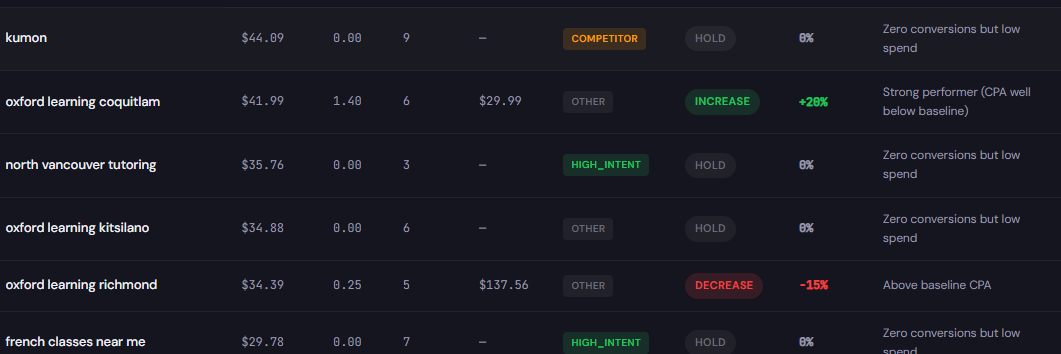
What it outputs: a search-term table with spend, conversions, tags (negative candidate vs convert), and recommended bid adjustments, plus CSVs for Editor upload.
How to use it (3 steps):
- Export search-term data from Google Ads and import to the Search Term Analyzer.
- Tag high-cost non-converting queries as negatives; tag high-intent converts as exact-match candidates.
- Export the CSV and push changes through Google Ads Editor or apply recommendations in bulk via the tool.
90-minute account triage playbook
Run this sequence with a single operator and one sheet. Aim for quick, irreversible wins.
- Minute 0–10: Snapshot. Run the ExecWrite Wastage Snapshot to get a prioritized list (waste totals, top leakage areas).
- Minute 10–30: Search-term triage. Export top 200 search terms by spend; tag top 20 non-converting queries as negatives using the Search Term Analyzer.
- Minute 30–45: Hour analysis. Pull hour-of-day report and apply bid adjustments or pause worst hours for the week.
- Minute 45–60: Landing page triage. Pick the top 3 high-traffic, low-CR pages. Update headlines to match the top queries and launch A/B tests.
- Minute 60–75: Campaign structure. Identify overlapping campaigns; pause or rename redundant ones and apply an account-wide negative list.
- Minute 75–90: Document actions and schedule a 7-day validation. Re-run the Wastage Snapshot to measure immediate impact and export changes for handoff.
FAQ
You can stop obvious waste in hours; measurable CPA improvements usually appear within 7–14 days after negatives and schedule changes are applied.
Properly applied negatives reduce irrelevant clicks without harming high-intent traffic. Start with high-cost, zero-conversion terms and monitor traffic shifts.
Automation helps but needs clean inputs. Use tooling to fix structural issues first; then allow automated strategies to operate on higher-quality signals.
ExecWrite accepts data uploads and exports. Run the Wastage Snapshot via CSV and use the Search Term Analyzer with exported search-term reports.
Start your triage with ExecWrite to produce a prioritized recovery plan and executable CSVs. Reclaim wasted spend and lock in quality improvements.
Sources
- Google Ads: About Quality Score — official explanation of Quality Score components and impact on CPC.
- WordStream: How Much Money Are You Wasting on Google Ads? — common causes of wasted spend and mitigation tactics.
- Search Engine Land: Dayparting strategies for PPC — best practices for hour-of-day and ad scheduling.
Leave a Reply