If your Google Ads account is losing efficiency—rising CPA, shrinking conversions, or odd swings in spend—this tactical guide tells you what to check this week. Use the playbooks below plus lightweight scans from ExecWrite to turn quick wins into sustained gains.
- Common causes: wasted spend, poor keyword intent, ad/landing mismatch, bid timing, and structure drift.
- Immediate actions: run a wastage snapshot, fix high-spend low-intent queries, re-align ad-to-landing copy, and apply daypart bid moves.
- Tools: use the Wastage Snapshot to prioritize recovery and the AI Keyword Generator to rebuild intent-driven ad groups.
Table of Contents
Why PPC feels harder now
Platforms evolve, competition increases, and attribution becomes noisier. A handful of structural shifts make managing paid media more operational and less intuitive:
- Auction complexity: more automated bidding, broader match behavior, and layered machine learning mean human signals get drowned unless data is clean.
- Audience and intent drift: queries that once converted now arrive with different intent or new competitors that undercut ROI.
- Measurement friction: cross-device and cross-channel attribution gaps conceal true conversion paths, so you see symptoms but not root causes.
The 5 biggest PPC problems marketers face
Pain 1 — Wasted spend: high cost, low return
Symptoms
- High spend spikes with flat or falling conversions.
- Large tail of search terms with spend but zero conversions.
- Frequent broad-match or smart-bidding surprises you with volume you didn’t expect.
Why it happens
Automation plus broad/modified match types can surface unrelated queries. Without regular negative keyword hygiene and leak checks, budgets flow to low-intent traffic.
Fix this week
- Run a search-term-level scan for last 30 days and tag high-spend/zero-conversion terms.
- Apply negatives for irrelevant modifiers and single-query leak sources.
- Pause or cap low-converting broad-match ad groups until you restructure them.
Pain 2 — Keyword intent mismatch
Symptoms
- High clicks but low conversion rate on specific queries.
- Landing pages that don’t answer the user’s question.
- Ad copy promises differ from destination content.
Why it happens
Over time, ad groups collect noisy keywords. Without intent labeling, you bid the same on researchers and buyers.
Fix this week
- Split keywords into intent buckets: high-intent (purchase/convert), mid-intent (compare), low-intent (research).
- Re-write ad headlines to match the bucket intent; point high-intent ads to conversion-optimized pages.
- Create negatives to keep research queries out of purchase-focused ad groups.
Pain 3 — Ad-to-landing misalignment (Quality Score drops)
Symptoms
- Quality Score or IS metrics slip while CPCs rise.
- CTR declines even when impressions are stable.
- Conversion rates drop despite similar traffic volume.
Why it happens
Search engines reward relevance. If the landing page or headlines don’t deliver on the ad’s promise, quality and conversion suffer.
Fix this week
- Audit top-performing and worst-performing ads for headline/landing mismatch.
- Deploy short A/B tests: headline swap and single-page CTA change.
- Prioritize page speed and key CTA above the fold for high-intent traffic.
Pain 4 — Bad structure and campaign drift
Symptoms
- Overlapping keywords and duplicated ads across campaigns.
- Conflicting bid strategies in similar audience windows.
- Hard to isolate which change moved performance metrics.
Why it happens
Accounts accumulate tactical changes. Without guardrails, structure collapses and the learning systems get noisy signals.
Fix this week
- Audit for overlap using a simple search-term vs. keyword map and consolidate duplicates.
- Standardize naming and tag campaigns by objective and funnel stage.
- Simplify bidding: one clear strategy per campaign.
Pain 5 — Time-of-day and daypart inefficiency
Symptoms
- Huge CPA variance by hour or day.
- Manual ad schedule changes that don’t move core KPIs.
- Reactive bid changes that confuse automated bidding models.
Why it happens
Different hours attract different intents or competitors. Without granular hour-level controls, bids can be too high during low-intent periods.
Fix this week
- Pull hour-of-day performance and set conservative bid adjustments for low-performing windows.
- Use shorter test windows (48–72 hours) for aggressive hour shifts, then revert or keep changes based on CPA.
- Coordinate schedule changes with your bidding windows to avoid conflicting signals.
Fixes you can apply this week
- Run a wastage snapshot to get prioritized leak areas (search terms, placements, match types).
- Apply negatives for top 5 irrelevant search terms immediately.
- Group keywords into 3 intent buckets and relaunch high-intent ad copy to matching landing pages.
- Audit ad headlines vs landing pages for the top 10 converting ad groups and align them.
- Pull hour-of-day CPA and set -20% to -50% bids for the worst-performing 3 hours; monitor impact over 72 hours.
- Document changes and roll back anything that worsens CPA in 7 days.
Start with a prioritized Wastage Snapshot to see where budget leaks. The scan surfaces top negative opportunities and a short recovery plan.
Tool-based workflow: map problems to ExecWrite tools
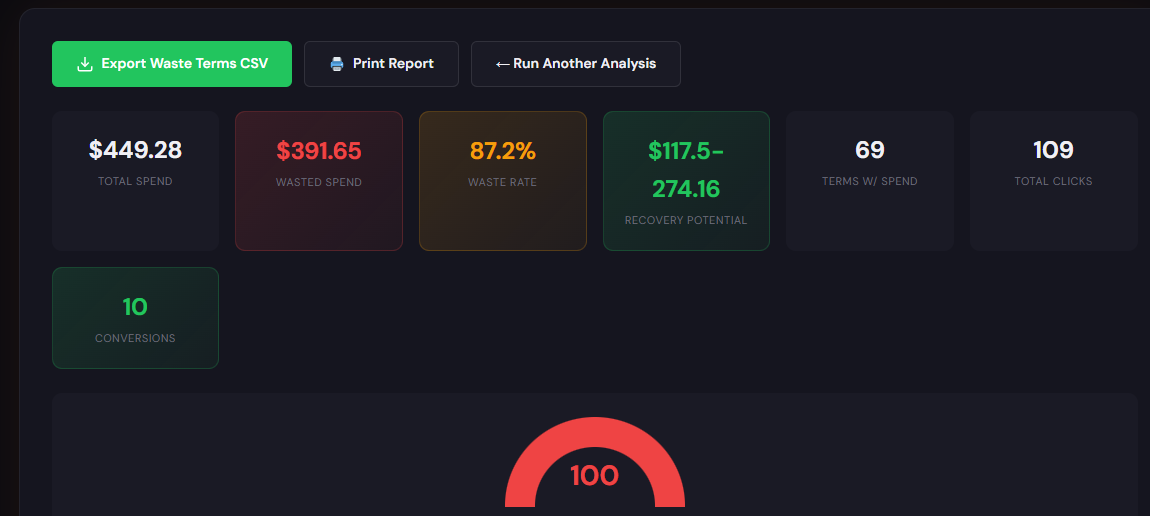
What it outputs: A dashboard-style snapshot with total wasted spend, top leakage areas (search terms, placements, devices), and a recovery plan with recommended negatives and budget moves.
How to use it (3 steps)
- Run the Wastage Snapshot for the last 30 days to surface high-spend zero-conversion queries.
- Export the top 10 leak items, apply negatives and pause the worst-performing placements/ad groups.
- Monitor CPA for 72 hours and apply the recommended recovery budget reallocation.
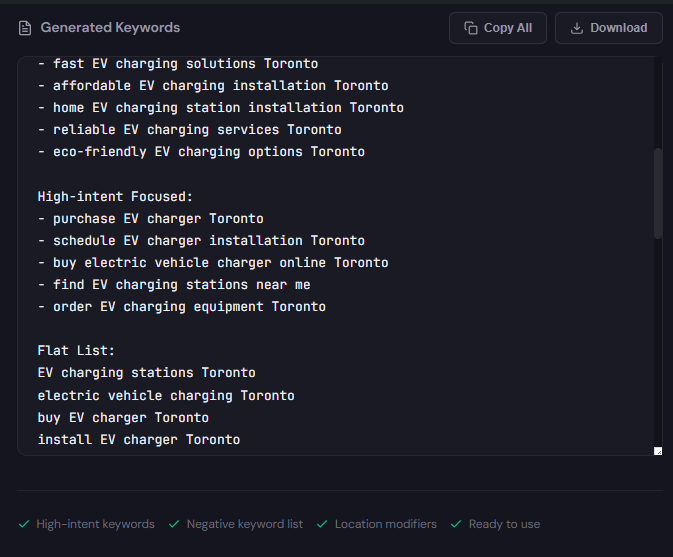
What it outputs: Intent-labeled keyword lists (high, mid, low intent), negative keyword suggestions, and ad group structure ready for export.
How to use it (3 steps)
- Paste a landing page or core product phrase into the AI Keyword Generator to get categorized keyword sets.
- Import high-intent keywords into new ad groups and attach matching headlines and landing pages.
- Download the campaign CSV for Google Ads Editor to apply structure and reduce overlap.
90-minute account triage playbook
Use this as a timed checklist to stabilize performance fast.
- 0–15 min: Run a Wastage Snapshot and export top 20 search terms by spend and zero conversions.
- 15–30 min: Apply immediate negatives for the top 5 irrelevant queries and pause any auto-bid ad groups with runaway spend.
- 30–45 min: Pull hour-of-day report; set conservative -30% bid adjustments for worst 3 hours.
- 45–60 min: Use the AI Keyword Generator on 3 high-volume landing pages; create focused high-intent ad groups.
- 60–75 min: Align ad headlines to landing pages for 10 priority ad groups and push a small A/B test.
- 75–90 min: Document every change, set 72-hour check-ins, and schedule a full structure audit next week.
Begin with a Wastage Snapshot and follow the 90-minute playbook. The tool shows exactly where to apply negatives and which campaigns to cut first.
FAQ
Usually within 24–72 hours. You’ll notice lower spend and clearer signal for bidding models; use 72 hours to validate before rolling out more changes.
Yes. Feed product categories or landing pages in batches to generate intent-labeled keyword sets and export-ready structures for Google Ads Editor.
Short-term pause reduces noise. Replace paused groups with tightly themed ad groups using generated high-intent keywords to retain scale with control.
Track CPA, conversion rate, and wasted spend delta from the snapshot. A successful recovery reduces wasted spend and improves conversion rate or lowers CPA within a 7–14 day window.
Sources
- Google Ads Help — official platform guidance on bidding, quality, and ad relevance.
- Search Engine Journal — industry coverage on dayparting and ad scheduling best practices.
- WordStream — insights on wasted ad spend and optimization tactics.
Leave a Reply