If your CPC, CPA, or ROAS slipped and you can’t point to seasonality, this guide gives a practical triage path, quick fixes you can run this week, and two focused ExecWrite tools to recover wasted spend and tighten bids. For fast exports and quick scans, see https://execwrite.com for the tools referenced below.
- Major leaks: wasted search terms, time-of-day swings, poor ad-to-LP relevance, and conversion/attribution gaps.
- Weekly fixes: negative keyword pushes, campaign structure cleanup, simple daypart rules, and a landing-page headline check.
- Tools: run the Wastage Snapshot to quantify waste, use Search Term Analyzer to set bid actions by term within an hour.
Table of Contents
Why PPC feels harder now
Platforms have matured: automated bidding, audience signals, and privacy changes shift control away from manual levers. That makes campaigns more efficient when configured correctly — and opaque when they aren’t. Small structural errors (bad keywords, poor funnels, wrong schedules) compound quickly, turning healthy accounts into money pits. The operators who win are the ones who map symptoms to surgical fixes and automate repeatable audits.
The 5 biggest PPC problems marketers face
1. Wasted spend on low-intent search terms
Symptoms:
- High impressions with zero conversions on many search queries.
- Spend concentrated in long tail queries that never convert.
- CTR or conversion rate falls while clicks remain stable.
Why it happens: Broad match + smart bidding expands to queries that match at keyword level but lack purchase intent. Without systematic search term pruning or negatives, you pay for irrelevant traffic.
Fix this week:
- Export last 30 days of search terms, sort by cost, and add top non-converting queries as negatives.
- Change broad-match + smart-bidding keywords with poor intent to phrase or exact, or pause them.
- Create a negative keyword list and apply it across campaigns; update weekly.
2. Poor ad-to-landing-page relevance (Quality Score leaks)
Symptoms:
- Low Quality Scores or high CPCs on specific ad groups.
- Low landing-page conversion rate relative to traffic quality.
- High bounce rates from ad clicks that used the same headlines as ads.
Why it happens: Ads promise one thing and landing pages deliver another. Even with automated bidding, low relevance forces higher bids to maintain position.
Fix this week:
- Audit top 10 ad groups by spend: align ad headlines with landing-page H1 and primary CTA.
- Run a basic A/B headline swap on the top-converting landing page for the worst QS ad group.
- Use a landing-page rewrite checklist: headline, offer clarity, and above-the-fold CTA.
3. Time-of-day and dayparting mismatches
Symptoms:
- Hourly CPA swings — cheap clicks at night with zero conversions.
- Campaigns spend evenly even though conversions cluster in working hours.
- Automated bid strategies ignore predictable hourly patterns.
Why it happens: Aggregated automated bidding often flattens hour-of-day signals when conversion volume is low, leading to wasted budget during low-intent hours.
Fix this week:
- Pull hour-of-day performance for the last 60 days and identify conversion peaks.
- Create simple ad schedule adjustments: reduce bids by 20–50% for low-conversion hours.
- Use hourly bid modifiers for campaigns with steady volume.
4. Broken or misaligned conversion tracking
Symptoms:
- Conversion count drops without traffic drops.
- Discrepancies between Analytics and Google Ads conversions.
- Bidding algorithms show poor learning or oscillation.
Why it happens: Tracking tags get removed, page events change, or cross-domain settings break. Automated bidding then optimizes to flawed signals.
Fix this week:
- Verify page-level conversion events for top funnels (form submit, thank-you page hits).
- Compare last 14 days between Analytics and Ads; document discrepancies.
- Set up a fallback event (e.g., clicks to thank-you page) to keep bidding stable.
5. Campaign structure that mixes intents
Symptoms:
- Same ad group contains both discovery and transactional keywords.
- Automated bidding can’t find a consistent CPA because intent is mixed.
- Reporting shows broad variance in conversion rates inside ad groups.
Why it happens: Rapid scaling, aggressive automation, or incomplete keyword mapping create mixed intent buckets. That confuses bidding algorithms and wastes budget on low-value searches.
Fix this week:
- Segment keywords into separate ad groups by intent (bottom-funnel, mid-funnel, research).
- Assign distinct landing pages or final URLs by intent segment.
- Apply different bidding strategies per segment: target CPA for bottom-funnel, maximize clicks for discovery.
Fixes you can apply this week
- Export search terms, tag top waste and negatives, and deploy a cross-campaign negative list.
- Run a 10-minute headline alignment check between top ads and landing pages; publish quick fixes.
- Pull last 60 days hour-of-day data and set three simple bid-mod rules (peak, shoulder, off-hours).
- Validate top conversion paths and set a fallback conversion to stabilize bidding.
- Split one mixed-intent ad group into two and watch performance for 7 days.
Quantify wasted spend, recover budget, and get a prioritized recovery plan in minutes with ExecWrite’s Wastage Snapshot.
Tool-based workflow: map problems to ExecWrite tools
Only two tools are required to get immediate, repeatable impact: the Wastage Snapshot & Recovery and the Search Term Analyzer. Use them together: one finds systemic leaks and the other turns waste into precise bid/negative actions.
Wastage Snapshot & Recovery
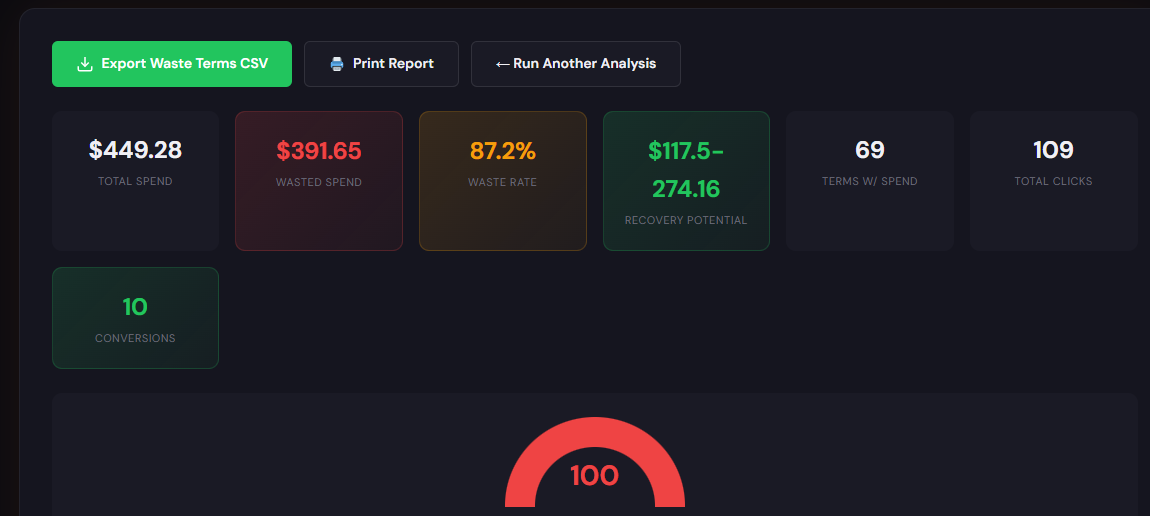
What it outputs: A dashboard that quantifies wasted spend, lists top leakage sources (search terms, campaigns, keywords), and a prioritized recovery plan with action items.
How to use it — 3 steps:
- Upload or connect your account and run the snapshot (5–15 minutes).
- Review the top 10 leakage areas the tool surfaces and export the recovery checklist.
- Apply the top recommended negatives, pause the worst-performing keywords, and reallocate budget to high-performing segments.
Search Term Analyzer (Bid Adjustment by Search Term)
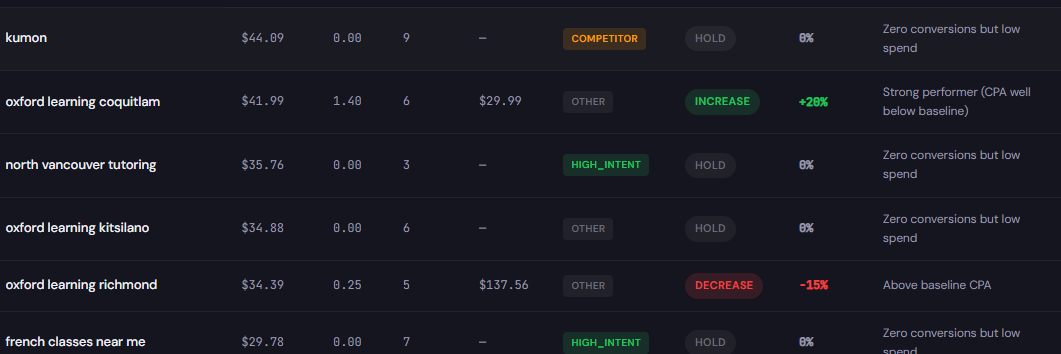
What it outputs: A term-level table with spend, conversions, CPA/ROAS, tags, and recommended bid actions (raise, lower, negative).
How to use it — 3 steps:
- Run the analyzer for the campaign or account and filter to the last 30–60 days.
- Tag terms: recoverable (raise bids), pause/negative (exclude), and reassign (move to separate ad groups).
- Export recommended bid adjustments and apply via Editor or API; schedule a follow-up run in 7 days.
90-minute account triage playbook
Run this exactly as written to find the fastest wins.
- Minutes 0–10: High-level metrics — compare last 7/30/90 days for CPA, ROAS, spend, and clicks. Note which metrics moved first.
- Minutes 10–30: Run the Wastage Snapshot & Recovery (connect and snapshot). Export top leakage report.
- Minutes 30–50: Pull top 200 search terms by spend and run the Search Term Analyzer on that list. Tag negatives and bid actions.
- Minutes 50–70: Fix quick hits — apply the top 20 negatives, pause the highest-cost no-conversion keywords, and set simple ad schedules from the hour-of-day findings.
- Minutes 70–90: Validate conversions and set a fallback event. Document changes and earmark tests (headline swap, landing-page rewrite) to measure next 7 days.
FAQ
Expect immediate spend reduction from negatives and pauses (within 24–48 hours). Bidding improvements and ROAS lift typically materialize in 7–14 days as automated strategies re-learn on cleaner signals.
Not usually. Use targeted fixes (negatives, structure, landing pages) first. If automated strategies oscillate, set a short learning pause or switch to portfolio strategies while you stabilize signals.
Prioritize conversion quality (value/conv) over raw conversion count. If low-quality conversions increase, your CPA and ROAS will look better but business outcomes suffer.
Yes. Both the Wastage Snapshot and Search Term Analyzer are designed for analysts and marketers; connections and exports are straightforward and include step-by-step prompts.
Yes — the goal is to turn one-off triage into a weekly cadence: run a wastage snapshot and term analysis, push negatives, and monitor changes. That process scales across accounts and teams.
Start a targeted recovery: run a Wastage Snapshot, apply the Search Term Analyzer recommendations, and lock in weekly audits. Get started at ExecWrite to automate these steps.
Sources
- Google Ads: About Quality Score — official guidance on Quality Score and relevance factors.
- WordStream: How to Fix Wasted Ad Spend — practical approaches to search term negatives and campaign structure.
- Search Engine Journal: Google Ads Account Audit Checklist — audit steps and common failure points.
- Google Ads: Conversion tracking overview — how tracking failures affect automated bidding.
Leave a Reply