Paid media teams are under pressure: rising CPCs, automation that hides problems, and budgets that leak. ExecWrite has tools and playbooks that let operators triage accounts and reclaim wasted spend — start with a free scan at execwrite.com to find the low-hanging fruit.
- Stop 10–30% of wasted spend by running a rapid wastage snapshot and applying negatives.
- Fix structure and intent leaks with a generated keyword set that separates high-intent modifiers.
- Use an hourly bid adjuster to stabilize CPA swings and prevent overspend during bad hours.
Table of Contents
Why PPC feels harder now
Automation and machine learning promised efficiency, but they also raise the bar for account hygiene. Automation optimizes within your setup — it won’t fix structural issues, incorrect match-type mixes, or untagged landing pages. That means many teams are paying for machine-scale errors: bid algorithms amplifying leakage, inefficient keywords scaled across campaigns, and time-of-day CPA spikes that go uncorrected.
The 5 biggest PPC problems marketers face
1) Wasted spend from irrelevant search queries
Symptoms
- High spend on many search queries with zero or one conversion.
- Broad match keywords pulling unrelated intent.
- Negative keyword lists that haven’t been updated in months.
Why it happens
Broad match + automated bidding yields volume — but not always quality. Without regular search-term analysis and negative hygiene, ad spend flows to low-intent or irrelevant queries that algorithms then bid up.
Fix this week
- Export last 30 days of Search Terms and tag top spend/no-conversion queries as negatives.
- Pause broad keywords where exacts outperform by CPA/ROAS.
- Create a temporary low-bid ‘test’ ad group to isolate questionable broad terms.
2) Poor ad-to-landing-page relevance (Quality Score leaks)
Symptoms
- High impressions but low CTR and lower conversion rate on specific ad groups.
- Quality Score gaps vs. competitors for top keywords.
Why it happens
Creative and landing pages drift from keyword intent. Ads promise something the landing page doesn’t deliver; Google responds by lowering expected CTR and raising CPCs.
Fix this week
- Audit top 10 keywords by spend for headline/landing mismatch; update headlines to match primary keyword.
- Push landing page copy that mirrors ad language and test one control change per page.
- Use dynamic keyword insertion cautiously — prefer explicit relevance.
3) Campaign structure that mixes intents
Symptoms
- Single campaign contains high-intent purchase terms and awareness keywords.
- Difficulty setting bids or budgets because performance varies widely within the campaign.
Why it happens
Ad groups or campaigns built over time become catchalls. Automation then optimizes at the wrong granularity and misallocates budgets across intents.
Fix this week
- Split campaigns by intent: purchase vs. research vs. brand-protect.
- Move high-spend, high-converting keywords into dedicated campaigns for stricter bid control.
4) Time-of-day and day-of-week CPA swings
Symptoms
- CPA doubles or more during certain hours or days.
- Automated bidding increases spend during poor-performing windows.
Why it happens
Bidding algorithms react to immediate signals and can amplify patterns. If you don’t constrain bids by hour, the system may scale into costly periods.
Fix this week
- Apply ad schedule bid modifiers to reduce bids during the worst hours.
- Monitor hourly CPA for 3–5 days to validate adjustments.
5) Keyword list fragmentation and missing negatives
Symptoms
- Many duplicate or overlapping keywords across ad groups.
- High impression share loss to irrelevant queries.
Why it happens
Growth over time without governance leads to duplication. Without a consistent structure, negatives and match types aren’t enforced across campaigns.
Fix this week
- Run a quick dedupe: export keywords across accounts and collapse overlaps into single controlled ad groups.
- Create a global negative list for known irrelevant modifiers.
Fixes you can apply this week
- Run a wastage scan to identify top leakage queries and wasted budgets.
- Apply immediate negatives for high-spend/no-conversion search terms.
- Split campaigns by intent and move top-converting keywords to controlled campaigns.
- Update headlines and landing pages for your top 20 keywords to improve Quality Score.
- Set ad schedule modifiers to cut bids during hours with poor CPA.
- Generate a structured keyword list (high intent, modifiers, negatives) to replace ad hoc keywords.
Start by finding the largest leaks in 15 minutes with an automated scan.
Tool-based workflow
Below are two practical ExecWrite tools chosen to fix the problems above: a Wastage Snapshot to stop leaks and a Free AI Keyword Generator to rebuild structure and negatives.
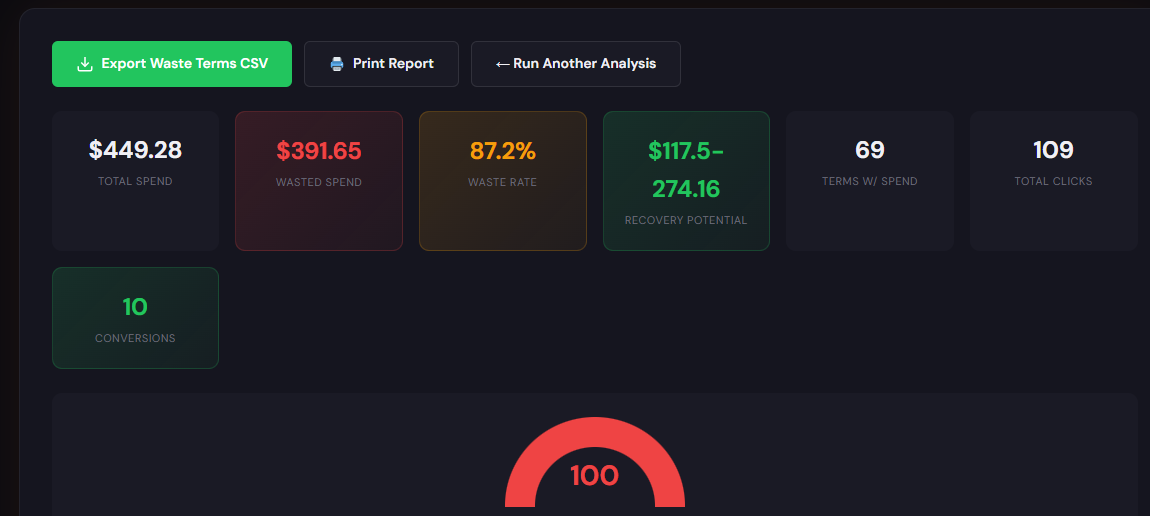
Outputs a dashboard-style snapshot showing wasted spend totals, top leakage areas (search queries, campaigns, devices), and a prioritized recovery plan with recommended negative keywords and immediate pausing candidates.
How to use it in 3 steps
- Upload your last 30 days of Search Terms and performance data to the snapshot tool: Wastage Snapshot.
- Review the top 10 leakage queries and apply the suggested negatives or pause offending keywords.
- Export the recovery plan and implement the high-impact changes in your account; re-run after 7 days to measure reclaimed spend.
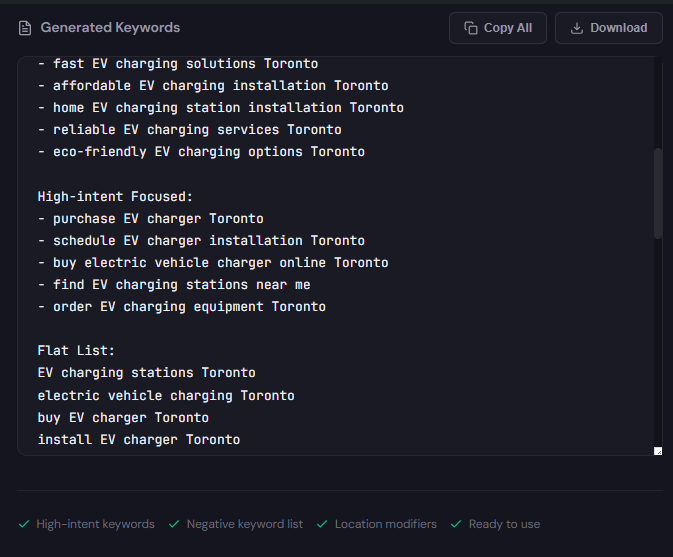
Generates structured keyword lists: grouped ad groups, high-intent variations, recommended negatives, and export-ready CSVs for Google Ads Editor.
How to use it in 3 steps
- Enter your top product/service focus and landing page URL into the generator: Free AI Keyword Generator.
- Review grouped outputs (purchase intent, research intent, modifiers) and accept the recommended negatives.
- Export the campaign CSV and upload via Google Ads Editor to replace fragmented keyword sets with structured campaigns.
90-minute account triage playbook
Follow this timed sequence to get meaningful wins in one session.
- 0–10 min: Pull top 30 search terms by spend (last 30 days).
- 10–30 min: Run a Wastage Snapshot; tag the top 15 waste terms as negatives or move them to a test group.
- 30–50 min: Export top 20 keywords by spend and conversions. Identify headline/landing mismatches and draft 2 headline swaps per ad group.
- 50–70 min: Run the AI Keyword Generator for your primary product pages and prepare grouped keyword CSVs for import.
- 70–85 min: Apply ad schedule modifiers reducing bids during worst hours and set a dashboard to watch CPA hourly.
- 85–90 min: Snapshot the account and save the recovery/export files. Schedule a 7-day recheck.
Use the Wastage Snapshot and free keyword generator together to stop leaks and rebuild campaigns. Start at ExecWrite.
FAQ
Most accounts see measurable reclaimed spend within 3–7 days after applying negatives and pausing the largest leakage queries. The Wastage Snapshot prioritizes these actions for immediate impact.
Automation optimizes within your configuration. These fixes change the configuration (negatives, structure, schedules), so automation will then operate on cleaner data and deliver better results.
Yes. Run the generator per landing page or product and merge outputs into separate campaigns by intent. Export-ready CSVs make uploads via Google Ads Editor straightforward.
The snapshot only analyzes your exported data to produce recommendations. It does not change your account; you control which recommendations to apply.
Leave a Reply