PPC doesn’t break overnight — it degrades. This guide gives an operator’s playbook to stop budget leaks, recover wasted spend, and restore predictable CPA using clear checks and two ExecWrite tools you can run in minutes at ExecWrite.
- Most account declines are avoidable: they’re poor intent, bad structure, or unchecked waste. Fixes are tactical, measurable, and repeatable.
- Run a wastage snapshot + search-term analysis to find the top 20% of leaks that cause 80% of lost spend.
- Follow the 90-minute triage playbook and use the two ExecWrite tools below to generate negative keywords, bid actions, and a recovery plan.
Table of Contents
Why PPC feels harder now
Platforms have more automation, more competition, and faster shifts in user behavior. That raises the bar for account hygiene — structure, intent matching, and frequent cleanups. If you treat campaigns as set-and-forget, performance drifts and algorithms optimize to the wrong signals.
The 5 biggest PPC problems marketers face
1. Wasted spend on low-intent queries
Symptoms
- High spend, low conversions on many search terms.
- CTR and conversion rate drop despite steady traffic.
- Many one-off search queries in reports without clear intent.
Why it happens
Broad match, broad SKAGs, and expanding audiences can bring traffic that looks relevant but converts poorly. Without regular search-term pruning, negative keyword lists never catch up.
Fix this week
- Export last 30 days search terms, sort by cost and conversion rate.
- Identify top 5% cost terms with zero conversions and add to negatives.
- Create intent buckets (high, mid, low) and pause low-intent, expensive terms.
2. Poor ad-to-landing-page relevance (low conversion rate)
Symptoms
- Click-throughs are fine but conversion rates fall after recent copy or landing changes.
- Quality Score drops on key keywords.
- High bounce rates on campaign-driven landing pages.
Why it happens
Message mismatch — the ad promises something the landing page doesn’t deliver. Automated bidding will still send traffic, but the end-user experience is broken.
Fix this week
- Spot-check your top 10 converting ad groups for headline + landing page alignment.
- Library of 3 variant headlines that match primary landing page value props.
- Run small A/B tests: keep the variant that raises conversion rate by >10%.
3. Bid & dayparting mismatches
Symptoms
- High CPA at specific times of day or days of week.
- Automated bidding oscillates — wide CPA swings hour-to-hour.
- Manual schedules don’t reflect recent performance trends.
Why it happens
Historical schedules become stale. Without hourly-level checks, you overbid during low-intent hours and underbid when conversions peak.
Fix this week
- Review last 14–30 days by hour: identify two high-performing windows and two low-performing windows.
- Apply conservative bid adjustments: -20% on bottom windows, +10–15% on top windows.
- Run for one week and reassess performance.
4. Structural mess: mixed intents in single ad groups
Symptoms
- Ad groups with dozens of heterogeneous keywords and low relevance.
- Low Quality Scores and weak ad copy performance.
- Confusing reporting where one ad group hides winning/losing queries.
Why it happens
Rapid scaling and ad-hoc additions create bloated groups. That prevents specific optimization and misleads automated bidding signals.
Fix this week
- Split the top 10% of ad groups by spend into tighter intent clusters (product vs. research vs. competitor).
- Duplicate winning ad copy into narrowed groups to test lift.
- Archive low-volume, low-intent keywords into a quarantine negative list.
5. No routine audit / recovery process
Symptoms
- Account problems reappear weeks after fixes.
- Changes are reactive rather than planned and tracked.
- Limited visibility into where previous fixes impacted metrics.
Why it happens
Most teams don’t bake a repeatable audit into their calendar. Fixes are one-off and lack measurable owners and rollbacks.
Fix this week
- Create a 90-minute triage template (steps below) and run weekly until stable.
- Track changes in a simple changelog: date, change, expected impact, owner.
- Automate snapshots for recurring checks (cost by search term, QS, hour-of-day).
Fixes you can apply this week
- Run a wastage snapshot to find top leakage channels and negative keyword candidates.
- Export top 1,000 search terms, tag by intent, and add negatives for repeat offenders.
- Apply conservative hour-of-day bid adjustments on the worst and best-performing windows.
- Group keywords into tighter ad group buckets and align 2–3 ad headlines per group.
- Document every change with a short note and expected KPI impact for 14 days.
Use a wastage snapshot to identify the top areas of lost spend and generate prioritized negative keyword lists in minutes.
Tool-based workflow: map problems to ExecWrite tools
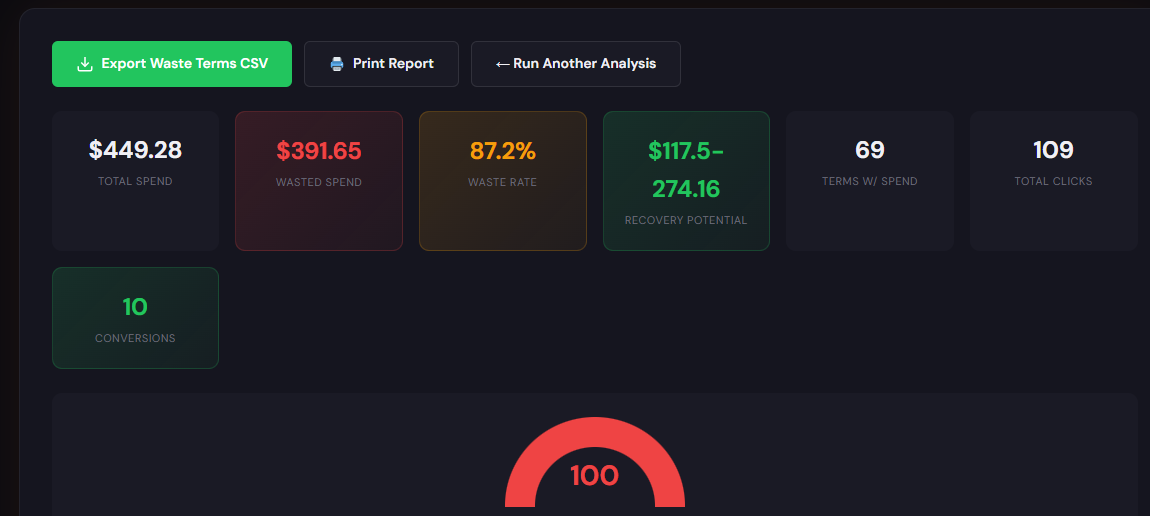
What it outputs: dashboard-style snapshot with total wasted spend, top leakage areas, and a prioritized recovery plan (negative keywords, budgets to cut, quick fixes).
How to use it (3 steps)
- Upload your last 30–90 days of Google Ads data into the snapshot tool.
- Review the top 5 leakage categories and export the recovery checklist.
- Apply the highest-impact negatives and budget cuts; rerun in 7 days and compare.
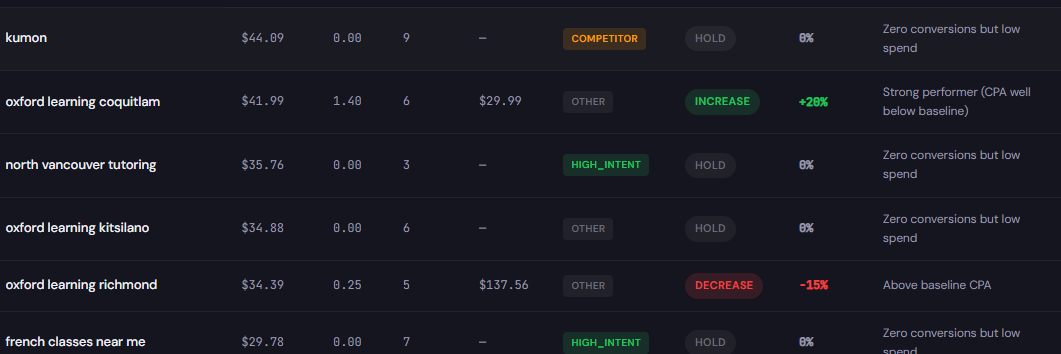
What it outputs: a search-term-level table with spend, conversions, CPA, intent tags, and recommended bid actions or negative flags.
How to use it (3 steps)
- Run the analyzer against your account to surface the high-cost, low-converting terms.
- Accept or edit the recommended actions: set negatives, reduce bids, or move queries to tighter ad groups.
- Export the action list and upload as bulk changes or apply via Google Ads Editor.
Note: these two tools cover the majority of immediate recovery work — find wasted spend, create negatives, and generate prioritized bid actions to protect your CPA. For ongoing maintenance, schedule weekly snapshots.
90-minute account triage playbook
- Minutes 0–10: Pull a 30–90 day account export (search terms, campaign/ad group performance, hour-of-day).
- Minutes 10–30: Run Wastage Snapshot & Recovery to identify top leakage areas and export the recovery checklist.
- Minutes 30–50: Run Search Term Analyzer, tag intent, and generate negatives and bid recommendations for top-cost terms.
- Minutes 50–70: Apply quick wins (top 10 negatives, 2–3 bid adjustments, pause worst ad groups). Log each change.
- Minutes 70–90: Set a 14-day check: monitor conversions, CPA, and QS. Prepare a changelog and schedule the next snapshot. Create owners for each action.
Run both the wastage snapshot and search-term analyzer now to produce an action list you can apply this week.
FAQ
Many accounts see measurable CPA improvement within 7–14 days after applying negatives and bid adjustments. Improvements compound as you iterate weekly.
Not if you pair fixes with clear structure changes: tighter ad groups, aligned landing pages, and documented bid rules. Snapshot-driven pauses and negatives guide automated systems to better signals.
Tools generate exportable action lists (negatives, bid adjustments, recommended ad group moves) that you apply via Google Ads Editor or UI — you control the final upload.
Start weekly for 4–6 weeks during recovery, then move to biweekly or monthly depending on volatility and spend level.
Sources
- Google Ads Help: About Quality Score — explanation of relevance factors that affect conversions and Quality Score.
- WordStream: Negative Keywords and Why They Matter — tips on preventing low-intent traffic via negatives.
- Search Engine Journal: Bid adjustments and dayparting strategies — practical approaches to hour-of-day bidding.
Leave a Reply