If your account feels like it drains budget without reliable returns, this guide gives an operator-focused audit and fixes you can apply this week. Use the checklist, then run targeted recoveries with ExecWrite to reclaim wasted spend and stabilize performance — start at ExecWrite for tools and exports.
- Most wasted spend falls into tracking gaps, irrelevant search terms, and improper bid schedules.
- Apply a 7-step triage this week: audit conversions, capture top leakage, add negatives, and stabilize bids.
- Use two ExecWrite tools—the Wastage Snapshot and the Search Term Analyzer—to find recovery actions and automated bid suggestions in minutes.
Table of Contents
Why PPC feels harder now
Paid media used to be a numbers game: traffic, bids, conversions. Today the levers are fragmented — privacy changes, more match-type complexity, automated bidding opacity, and platform-driven auctions that mask where budget truly went. That increases uncertainty and makes simple fixes less visible, turning small leaks into monthly waste.
The 5 biggest PPC problems marketers face
1) Measurement gaps
- Symptoms: conversions drop without traffic change; high clicks but low attributed conversions.
Why it happens: Tracking pixels, server-side tagging, and cross-domain setups are inconsistently implemented, causing conversions to be missed or double-counted.
- Validate primary conversion: test via real conversion flows and Tag Assistant or server logs.
- Check parallel conversions (GA4, server, CRM) for discrepancies and map a single source of truth.
- Pause or annotate campaigns while you resolve discrepancies so automated bidding doesn’t overreact.
2) Irrelevant search terms and wasted match-type traffic
- Symptoms: expensive clicks with zero intent, sudden spikes in low-quality keywords, high bounce/low conversion pages.
Why it happens: Broad match and even phrase match can surface tangential queries; negative keyword coverage is often incomplete and not maintained.
- Export last 30-90 days of search terms and tag obvious negatives.
- Add negatives at campaign level for systemic leaks and ad-group negatives for granular control.
- Use exact-match negatives for brand-unsafe or irrelevant modifiers.
3) Bid and budget misalignment (dayparting & CPA swings)
- Symptoms: hours/days with large CPA spikes, budgets exhausted early with no conversions late-day.
Why it happens: Automated bidding hides hour-of-day performance. Accounts often inherit bid strategies that assume uniform performance across time.
- Segment hourly performance for the last 30 days and identify +/− CPA swings.
- Apply conservative hour-of-day bid adjustments; test in 2-week windows.
- Move budget from unproductive hours to high-conversion windows.
4) Ad-to-landing-page mismatch (low Quality Score)
- Symptoms: good CTR but poor conversion rate; high CPC despite low impression share issues.
Why it happens: Messaging mismatch between ad copy, keywords, and landing pages lowers Quality Score and increases CPCs.
- Audit top-performing keywords and their landing pages for message alignment.
- Test headline and CTA parity (ad headline → landing page headline).
- Prioritize fixes on keywords that drive volume and cost.
5) Campaign structure entropy
- Symptoms: sprawling ad groups, mixed-intent ad groups, shared budgets masking performance.
Why it happens: Over time multiple editors, fast pivots, and campaign-level changes create structural drift that reduces control.
- Identify the top 10 cost-driving campaigns and freeze structural changes for a week.
- Split mixed-intent ad groups into focused, intent-aligned groups.
- Replace shared budgets with manual budgets on problem campaigns until stable.
Fixes you can apply this week
- Confirm a single conversion source of truth; pause auto-bidding if conversions are unreliable.
- Export search terms; apply negatives and group them into a negatives library.
- Run an hourly performance check and set conservative bid adjustments for worst-performing hours.
- Align top 20 keyword headlines to landing page headlines; deploy quick A/B tests for conversion lift.
- Freeze structural edits on your worst-performing campaigns; triage with a recovery playbook.
Use a single snapshot to see wasted spend, top leak areas, and an immediate recovery checklist.
Tool-based workflow — map problems to ExecWrite tools
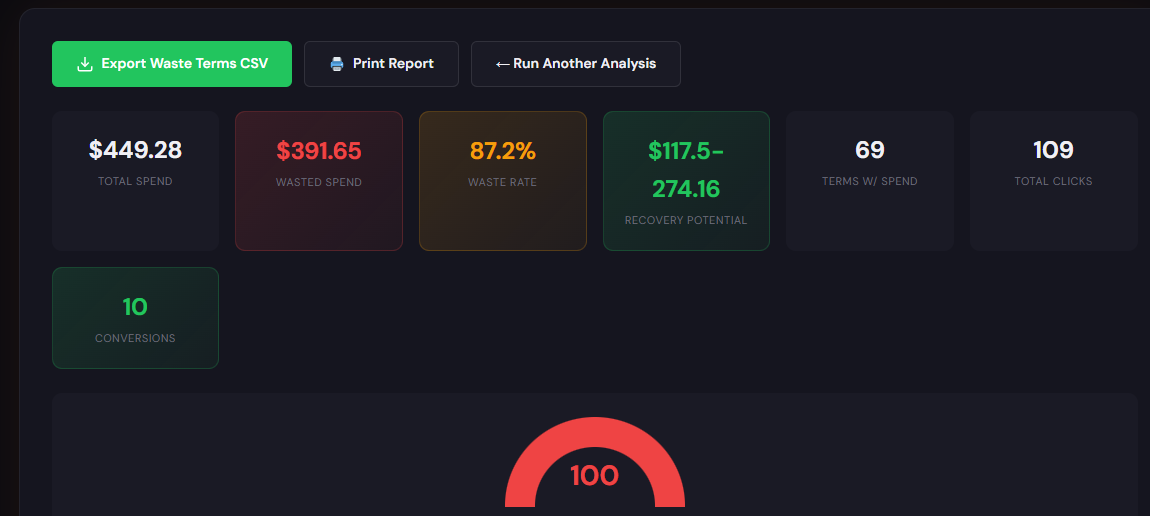
What it outputs: A dashboard-style snapshot showing total wasted spend, top leakage categories (search terms, low-converting campaigns, budget leaks), and a prioritized recovery plan.
How to use — 3 steps
- Upload or connect your account data to generate the snapshot (Wastage Snapshot).
- Review the top 3 leak areas in the recovery plan and export the negative keyword and pause lists.
- Apply the exported negatives/budget changes and re-run the snapshot after 7–14 days to measure recovered spend.
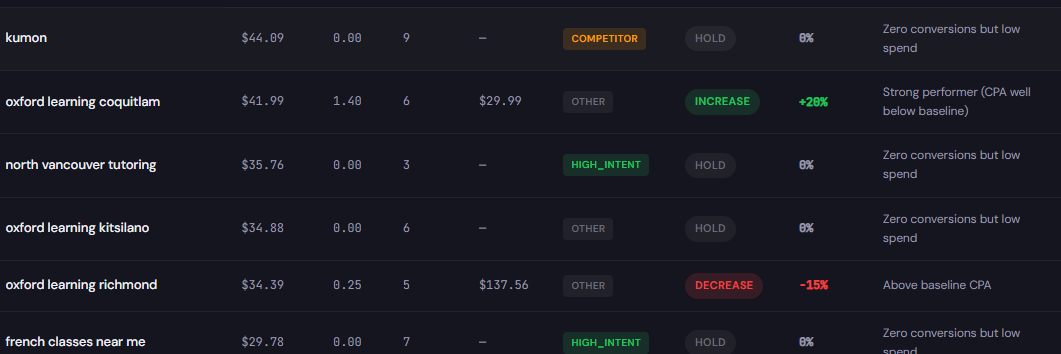
What it outputs: A table of search terms with spend, conversion metrics, tags (negative or priority), and recommended bid actions per term.
How to use — 3 steps
- Run the analyzer for the last 30–90 days to capture low-intent and high-intent queries (Search Term Analyzer).
- Tag and export recommended negatives, low-quality terms, and suggested bid adjustments.
- Push the exported lists into Google Ads Editor or the UI; monitor CPA over subsequent 2 weeks and iterate.
Both tools are designed to reduce hands-on time: snapshot cuts discovery from hours to minutes, search-term output gives actionable exports for Editor or scripts.
90-minute account triage playbook
Use this as a timed checklist. Focus on facts, not hypotheses.
- 0–10m: Collect data — last 30/90 days, top campaigns by spend, and conversion counts.
- 10–25m: Run Wastage Snapshot to get top leakage areas and export recommendations.
- 25–45m: Run Search Term Analyzer; tag top 50 low-quality terms and top 20 high-value terms.
- 45–60m: Apply immediate controls — add negatives, pause low-quality campaigns, reduce bids on worst-performing hours.
- 60–75m: Fix measurement — validate primary conversion, add annotations to paused changes.
- 75–90m: Document actions, set 14-day review, schedule follow-up snapshot and search-term run.
Start the 90-minute triage with tools and exports that make fixes operational. Recover budget without guesswork.
FAQ
You can see immediate CPC/traffic shifts within 24–48 hours; measurable CPA improvement typically appears within 7–14 days as bidding stabilizes and automated strategies adapt.
If your conversion tracking is unreliable, pause or switch to manual bidding temporarily. Automated bidding needs accurate signals; otherwise it can overspend while optimizing on bad data.
Start with the Wastage Snapshot for a high-level diagnosis, then run the Search Term Analyzer to get the actionable negative and bid lists.
Yes. ExecWrite tools export Editor-ready lists (negatives, paused campaign lists, bid recommendation CSVs) to speed application and reduce manual error.
Leave a Reply