If your Google Ads account feels like it’s burning cash, this post gives a pragmatic triage and repair plan you can run in 90 minutes — including targeted workflows that use tools from ExecWrite to recover wasted spend and lock in better bids.
- Most wasted spend comes from (1) irrelevant queries, (2) bad ad-to-landing relevance, and (3) time-of-day bid mismatches.
- Run a quick wastage snapshot and search-term analysis to identify leaks, then apply negatives and hourly bid adjustments.
- Use the ExecWrite Wastage Snapshot to prioritize fixes and the Search Term Analyzer to set bid/negative actions.
Table of Contents
Why PPC feels harder now
Higher CPCs, automation that hides signals, and privacy changes have made campaign diagnostics more manual. The bulk of wasted spend is not a single problem — it’s the intersection of noisy query volume, ad relevance gaps, and opaque automated bidding that reacts slowly to account structure issues.
The 5 biggest PPC problems marketers face
1. Wasted spend from irrelevant search queries
- Symptoms: high impressions with zero conversions, broad-match terms driving low-intent clicks, unfamiliar query strings in search terms.
Why it happens: Broad matches, poor negative keyword coverage, and unchecked query expansion from automation let low-intent traffic in.
- Fix this week: Export last 30 days of search terms, tag low-intent groups, and upload negatives in bulk.
2. Ad-to-landing page mismatch (Quality Score and conversion drops)
- Symptoms: high CTR but low conversions, rising CPA, low Quality Score on key keywords.
Why it happens: Ads promise different offers than landing pages or page load/UX issues kill conversions even with good click-throughs.
- Fix this week: Check top 10 conversion keywords, align headlines and CTAs, and apply quick landing page messaging tests.
3. Hour-of-day and dayparting bid inefficiencies
- Symptoms: conversion rate swings by hour, wasted spend during low-value hours, poor ROAS at specific times.
Why it happens: Default ad schedules and automated bids assume uniform performance; without granular data you overpay during dead hours and under-bid during peak conversion windows.
- Fix this week: Pull hour-of-day performance, add simple ad schedule modifiers, and test aggressive bids during top hours.
4. Campaign structure and keyword bloat
- Symptoms: overlapping keywords across ad groups, duplicated audiences, and automation cannibalizing internal auctions.
Why it happens: Fast scaling without guardrails creates conflicts that confuse smart bidding and inflate CPCs.
- Fix this week: Identify top overlapping keywords, consolidate/ad group reassign, and set negative match rules between campaigns.
5. Measurement gaps and false negatives
- Symptoms: conversion attribution doesn’t match backend, offline conversions missing, or server-side measurement not sending events.
Why it happens: Privacy changes and misconfigured tracking lead to underreported conversions — which in turn causes automated bidding to undervalue some channels.
- Fix this week: Reconcile conversions with CRM for last 30 days and verify conversion actions are receiving events.
Fixes you can apply this week
- Run a search-term export for the top 10 cost-driving campaigns; add negatives for irrelevant clusters.
- Audit top 20 keywords for Quality Score gaps and align ad headlines to landing-page headlines.
- Pull hour-of-day performance and create a simple ad schedule (increase bids +20–50% on peak hours, -30% on low hours).
- Remove duplicate keywords across campaigns and set campaign-level negatives to prevent self-competition.
- Compare reported conversions to CRM totals; flag missing conversion actions and re-tag pages or server events.
Run a Wastage Snapshot to see top leakage, then export recommended negatives and a staged recovery plan in minutes.
Tool-based workflow: map problems to ExecWrite tools
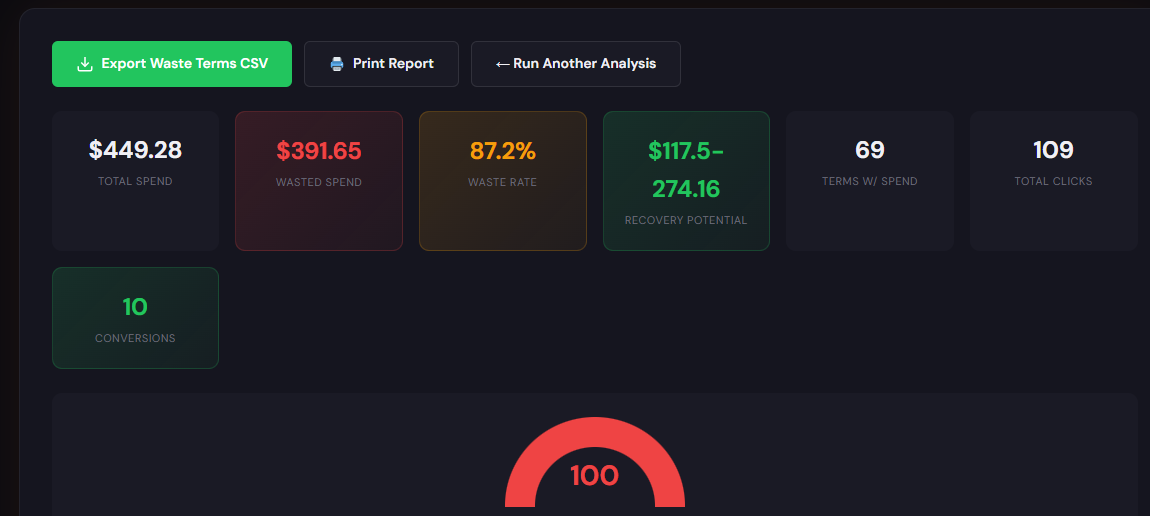
What it outputs: a dashboard-style snapshot of wasted spend, top leakage areas, and a prioritized recovery checklist you can action immediately.
How to use it (3 steps):
- Run the snapshot for the account or a campaign group — get a one-page waste summary and top leak drivers.
- Export the recovery plan: ranked negative keyword lists, budget reassignments, and campaign fixes.
- Apply the highest-impact negatives and budget shifts, then re-run the snapshot after 7 days to measure recovery.
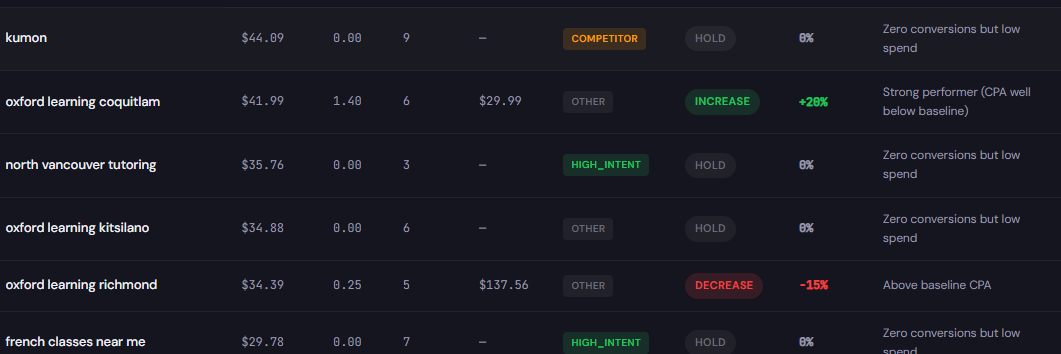
What it outputs: a search-term table with spend, convs, CPA/ROAS and recommended bid actions (raise, hold, lower) plus negative keyword suggestions.
How to use it (3 steps):
- Upload or connect your search-terms export for the target campaign and choose the performance window.
- Review the analyzer’s tags and recommended bid adjustments; approve or edit recommendations in bulk.
- Export the bid/negative CSV and apply changes through Google Ads Editor or API; monitor hourly performance.
90-minute account triage playbook
- 0–10 minutes: Pull top 10 cost campaigns, export search terms, conversions, and hour-of-day reports.
- 10–30 minutes: Run the ExecWrite Wastage Snapshot to generate a prioritized leakage list.
- 30–50 minutes: Run the Search Term Analyzer on the exported search terms and tag low-intent queries for negatives.
- 50–70 minutes: Apply highest-impact negatives and update ad schedules (hour-of-day bid modifiers).
- 70–90 minutes: Fix 2–3 landing page mismatch issues (headlines/CTAs), document changes, and schedule a 7-day follow-up snapshot.
- Post-triage: Hold bids stable for 48 hours to let changes propagate; track recovery via the snapshot.
Run both the Wastage Snapshot and Search Term Analyzer on the same account to prioritize fixes and export immediate action items.
FAQ
Not if you target low-intent clusters. Proper negatives reduce wasted clicks and improve your signal for smart bidding. Always export and review before mass applying.
Start weekly after major fixes, then move to monthly for steady-state accounts. Weekly during recovery helps confirm improvements.
Yes — use hour modifiers to guide an automated strategy. When automation is opaque, hour adjustments ensure campaigns respect known high- and low-value windows.
Target keywords with high spend and low QS first. Align ad headlines and landing-page content to close the relevance gap before adjusting bids.
Leave a Reply