Ad costs rising, conversions dropping, and your team is firefighting. This actionable guide shows why paid channels feel harder, gives a short triage playbook, and maps fixes to concrete tools at ExecWrite so you can recover wasted spend fast.
- Most wasted Google Ads spend comes from mismatched intent, poor negative keyword coverage, and un-tuned bidding windows.
- Apply five quick checks this week (search term audit, ad-to-LP relevance, hourly bid shifts, budget leakage, negative keywords).
- Use ExecWrite’s Wastage Snapshot and Search Term Analyzer to identify leaks and produce prioritized fixes in under 90 minutes.
Table of Contents
Why PPC feels harder now
Automation, privacy, and competition have converged: bid algorithms are opaque, keyword intent fragments, and CRO expectations are higher. That makes small account hygiene issues costlier and harder to spot without tools and a repeatable triage process.
The 5 biggest PPC problems marketers face
1) Wasted spend on low-intent search terms
Symptoms
- High spend, low conversion queries showing in search terms.
- Many clicks with high bounce rates and poor time-on-site.
- Negative keyword lists are small or unchanged for months.
Why it happens
Keyword lists grow by copying broad modifiers and letting automation match too widely. Without regular negative keyword sweeps, irrelevant queries eat budget.
Fix this week
- Export search terms for the last 30 days, sort by spend/conversion ratio.
- Add clear non-converting, irrelevant phrases to negatives (exact + phrase where needed).
- Pause or lower bids for ad groups showing consistent low-intent clicks.
2) Ad-to-landing-page mismatch (low Quality Score)
Symptoms
- Low CTR vs expected benchmarks for branded and non-branded ads.
- High CPCs without corresponding conversion lifts.
- Landing page bounce or low on-page conversion rates.
Why it happens
Ad copy promises a specific solution but the landing page fails to deliver that intent or has slow load/conversion friction. Quality Score drops and costs rise.
Fix this week
- Align top-performing ad headlines to clear landing page headlines and CTAs.
- Run a single A/B test: current page vs headline-matched page.
- Fix obvious UX blockers: form length, CTA visibility, load time.
3) Hourly/dayparting mismatch
Symptoms
- Conversion rate swings by hour with flat bids.
- High CPA at times when conversions are near zero.
- No ad schedule optimization in place.
Why it happens
Accounts often leave auto-bidding to handle all hours equally, but consumer behavior and competitive bids change by hour and day—so you overpay during low-value windows.
Fix this week
- Run an hourly performance export (cost, conversions, CPA by hour) for 90 days.
- Lower bids or exclude low-converting hours; increase bids on peak hours.
- Test a focused daypart bid modifier for top-performing campaigns.
4) Budget leakage between campaigns
Symptoms
- Low-priority campaigns consistently spend their full daily budgets.
- High-priority campaigns under-deliver despite adequate budgets.
Why it happens
Shared budgets, overlapping keywords, and poor priority settings let lower-value campaigns consume the daily spend before high-value campaigns can serve.
Fix this week
- Identify campaigns with full spend and low ROAS; reduce budgets or pause until fixed.
- Remove overlap by tightening match types or splitting campaigns by intent.
- Use shared budget caps carefully or move to individual budgets for priority campaigns.
5) Automation without guardrails
Symptoms
- Campaigns switch to expensive keywords or hours without human review.
- Performance drops after applying broad recommendation changes.
Why it happens
Auto-bidding and smart campaigns are powerful but react to inputs. If conversion tracking is noisy or account structure is weak, automation optimizes the wrong signals.
Fix this week
- Audit conversion tracking and remove low-quality micro-conversions from Smart Bidding targets.
- Set bid caps or target CPA ranges while tuning inputs.
- Run short manual experiments before full automation adoption.
Fixes you can apply this week
- Run a wastage snapshot to find top leak categories (search terms, budgets, audiences).
- Export search terms, build a prioritized negative keyword list, and deploy it account-wide.
- Align the top 3 ad headlines to landing-page headlines; run a headline-matched LP test.
- Pull hourly performance and set 3 core bid modifiers: reduce low-hour bids, boost peak hours, cap extremes.
- Freeze broad automation changes until tracking and account hygiene are verified.
- Document changes and measure week-over-week impact; revert if CPA worsens.
Run an ExecWrite Wastage Snapshot to identify leaks and get a prioritized recovery plan in minutes.
Tool-based workflow (map each pain point to ExecWrite tools)
ExecWrite: Wastage Snapshot & Recovery
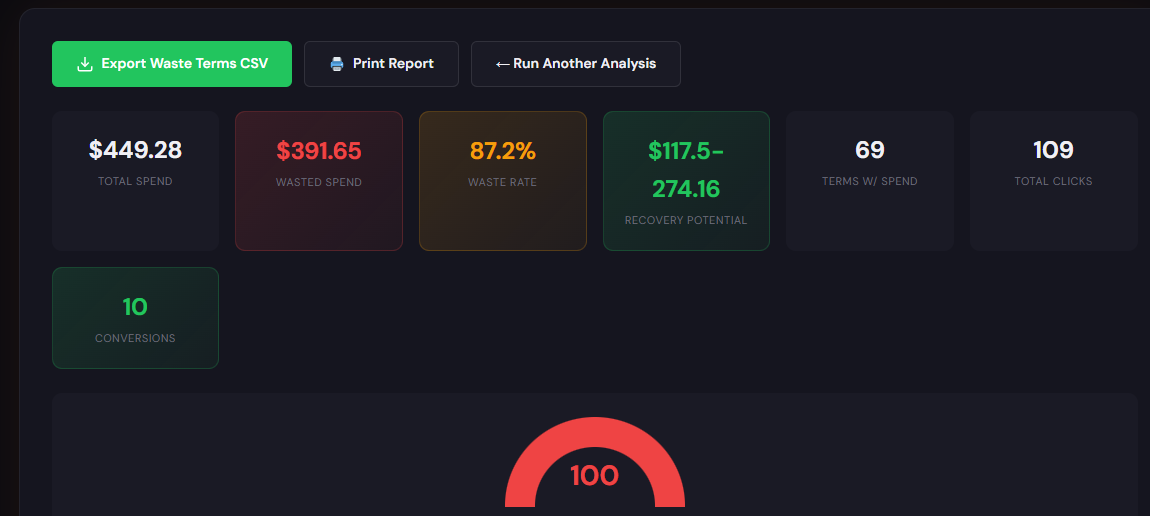
Outputs: Dashboard showing total wasted spend, top leakage categories (search terms, budgets, audiences), and a prioritized recovery checklist with suggested negatives and budget shifts.
How to use it — 3 steps
- Upload account CSV or connect via supported export and run the snapshot.
- Review the top 5 leak drivers in the dashboard and export the recovery plan.
- Deploy suggested negative lists and budget recommendations; re-run snapshot after 7 days to measure gains.
Link: ExecWrite Wastage Snapshot & Recovery
ExecWrite: Bid Adjustment by Search Term (Search Term Analyzer)
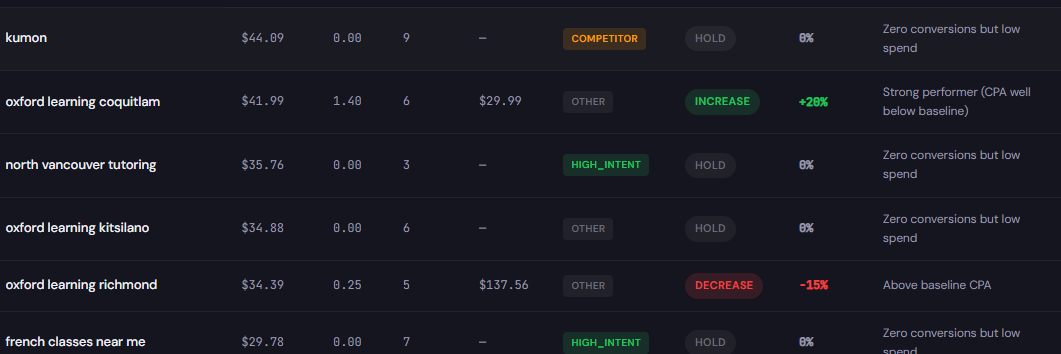
Outputs: Search-term-level table with spend, conversions, CPA, tags (negative/review/keep) and recommended bid actions per term and ad group.
How to use it — 3 steps
- Export search terms and performance metrics, then import to the analyzer tool.
- Use the tags to generate a negative keyword list and a per-term bid adjustment CSV.
- Upload bid adjustments or apply changes via Google Ads Editor; monitor 7-14 day performance shifts.
Link: Search Term Analyzer / Bid Adjustment
Both tools produce exportable CSVs and step-by-step recommendations so you can act without guesswork. Use the snapshot to find the problem, then the analyzer to fix the biggest leak drivers.
90-minute account triage playbook
- 0–10 min: Open the account summary. Check total spend, conversion trend, CPA trend for the trailing 7/30 days.
- 10–30 min: Run the ExecWrite Wastage Snapshot (or export top-level metrics manually). Identify top 3 leak types (search terms, budget, audience overlap).
- 30–50 min: Export search terms and run the Search Term Analyzer. Tag top spend/low-conversion queries as negatives or candidates for bid cuts.
- 50–70 min: Apply urgent fixes — negative list, pause low-value campaigns, adjust daily budgets, set hour bid modifiers for worst hours.
- 70–90 min: Implement a landing-page headline match for the top-performing ad group and schedule monitoring. Document changes and set a 7-day review.
Start a waste snapshot or search-term audit at ExecWrite and get a prioritized recovery plan you can deploy in under 90 minutes.
FAQ
A: Small hygiene fixes (negatives, budget shifts, hour modifiers) often show measurable CPA improvements in 7–14 days. Structural fixes like landing-page tests take longer but reduce CPCs via Quality Score gains.
A: If automation targets noisy conversion signals it can. Put bid caps and remove low-quality micro-conversions from Smart Bidding inputs before enabling broad automation.
A: Yes — adding neg keywords, fixing ad-to-LP relevance, and correcting budget leakage are non-bid levers that often yield quick wins.
A: Start with the Wastage Snapshot to find the largest leaks, then use the Search Term Analyzer to apply surgical fixes.
Sources
- Google Ads: Automated bidding — overview of smart bidding considerations and caveats from Google support.
- Think with Google: Consumer insights — trends in consumer behavior that affect ad timing and intent.
- WordStream: PPC best practices — industry guidance on reducing wasted PPC spend and keyword hygiene.
Leave a Reply