If your Google Ads account shows rising costs and falling returns, you need operational triage not theory. This guide gives a practical 90-minute playbook, checklist fixes you can apply this week, and two ExecWrite tools to recover wasted spend and rebuild keyword structure. Try the free tools at ExecWrite for quick diagnostics.
- Wasted spend, poor keyword intent, bidding timing, Quality Score slippage, and attribution gaps are the common causes.
- Apply a 7-check checklist this week to stop leaks and capture quick wins.
- Use ExecWrite’s Wastage Snapshot + Free AI Keyword Generator to audit waste and rebuild ad groups in under 2 hours.
Table of Contents
Why PPC feels harder now
Automation, privacy changes, and higher CPCs have increased volatility. The result: familiar tactics break faster and hidden budget leakage becomes the default. You need repeatable ops and razor-focused tools to stay profitable.
The 5 biggest PPC problems marketers face
1. Wasted spend and budget leaks
Symptoms
- High spend with zero/very low conversions in specific campaigns.
- Large portion of clicks from low-intent or branded/non-converting queries.
- Conversion rate drops while impressions and clicks rise.
Why it happens
Accounts grow messy: keyword lists, discovery of new queries, and automated bids can spend on irrelevant or unprofitable searches. Without quick visibility, those leaks compound.
Fix this week
- Run a search-term audit and add top low-intent queries to negatives.
- Pause campaigns or ad groups with CPA 2–3x target and no improvement in 7 days.
- Set strict max CPCs on experimental campaigns until ROI is proven.
2. Keyword intent and ad group structure
Symptoms
- Ad groups with dozens of unrelated keywords.
- Campaigns mixing transactional and informational intent.
- Ad relevance and CTR suffering despite impressions.
Why it happens
Speed and scale push teams to lump keywords together. That lowers ad relevance, hurts Quality Score, and reduces conversion rates.
Fix this week
- Split high-volume ad groups into single-theme groups (3–7 keywords each).
- Label keywords by intent (buy, compare, learn) and adjust bids by label.
- Use generated ad headlines that match each group’s intent to lift CTR.
3. Bidding timing and dayparting swings
Symptoms
- CPA varies dramatically by hour or day.
- Bid automation overbids during low-value hours.
- Manual ad scheduling is inconsistent across campaigns.
Why it happens
Default bidding ignores intra-day performance. Hourly spikes or dips can blow budget if not adjusted with a data-driven schedule.
Fix this week
- Pull hour-of-day data for cost and conversions; reduce bids for hours with poor CPA.
- Apply conservative ad schedules to test windows before scaling bids up.
- Use simple multipliers (+/-) rather than extreme adjustments until you confirm patterns.
4. Quality Score and landing page mismatch
Symptoms
- CTR and conversion rate fall after creative or landing page changes.
- High impression share but low position or expensive CPCs on core keywords.
- Ad relevance metrics lag competitors.
Why it happens
Messaging drift—ads and landing pages are not aligned. Even subtle headline or offer mismatches lower Quality Score and increase CPC.
Fix this week
- Align headline + CTA copy on landing pages to the top-performing ad copy.
- Test a 1:1 landing page variation for one high-volume ad group.
- Ensure mobile-first UX for key conversion paths.
5. Measurement and attribution drift
Symptoms
- Last-click conversions drop but assisted conversions suggest continued value.
- Conversion tracking discrepancies between platforms.
- Campaigns appear worse after analytics or tag changes.
Why it happens
Tracking changes, tag firing issues, or shifts to data-driven attribution can create the illusion of poor performance even when funnel value remains.
Fix this week
- Validate conversion tags and compare platform conversion counts for the last 7 days.
- Temporarily annotate any tracking changes and analyze conversion windows longer than 7 days.
- Use parallel reporting (ads + analytics) to identify where data diverges.
Fixes you can apply this week
- Run a search-term audit and build a negative keyword list (top 50 losing queries first).
- Pause or reduce budgets for campaigns with CPA >2x target and no improvement in 7 days.
- Split one large ad group into 3 intent-focused groups and write matching ads.
- Pull hour-of-day CPA and set conservative ad schedules for underperforming hours.
- Validate conversion tags and add an analytics annotation for changes.
- Test one landing page variation that matches the ad headline and CTA.
Run ExecWrite’s Wastage Snapshot to find top leakage areas and a prioritized recovery plan. Fast audit, clear actions.
Tool-based workflow: map problems to ExecWrite tools
ExecWrite Wastage Snapshot & Recovery
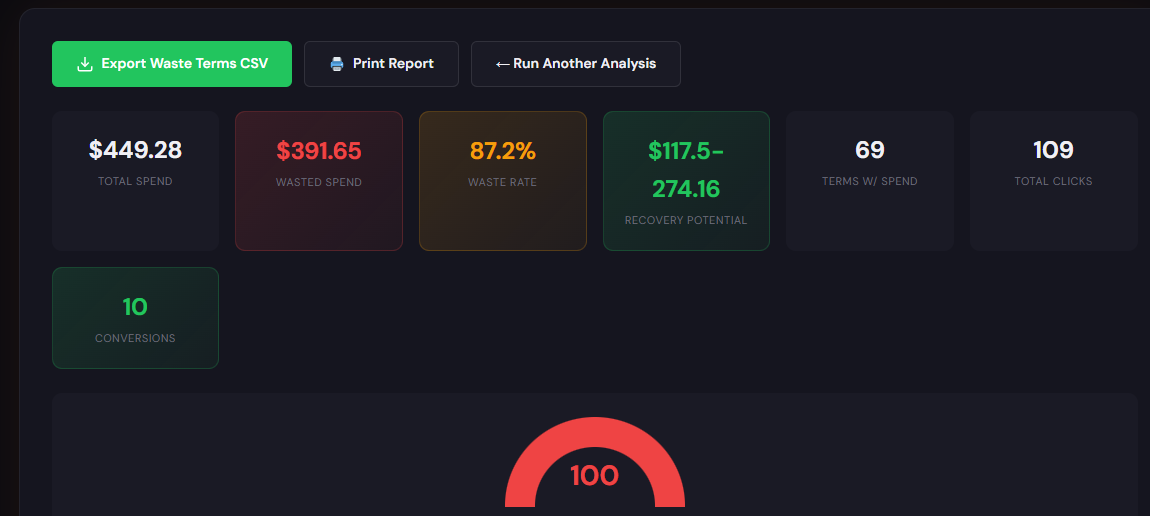
What it outputs: Dashboard-style snapshot with total wasted spend, top leakage sources (search terms, audiences, campaigns), and a ranked recovery plan you can action in hours.
How to use it — 3 steps
- Upload or connect a 30–90 day Google Ads export and run the snapshot to surface top waste areas.
- Review the recovery plan and export negative keyword and pause recommendations.
- Apply the quick wins (negatives, pauses, conservative budgets) and re-run after 7 days to measure improvement.
Free AI Keyword Generator
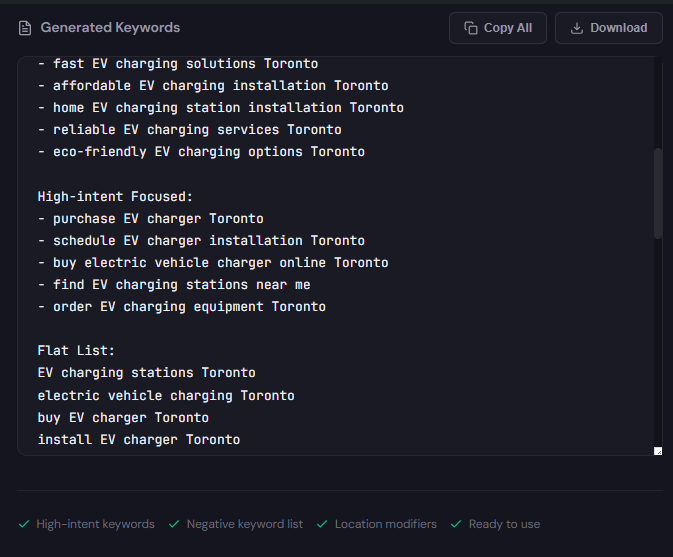
What it outputs: Intent-segmented keyword lists, negatives suggestions, and structured ad-group templates you can export to Google Ads Editor.
How to use it — 3 steps
- Enter seed keywords, top landing pages, or primary offers to generate high-intent and informational keyword buckets.
- Accept or edit suggested negatives and export grouped keyword CSVs for Editor import.
- Create matching ad copy using the grouped intent and deploy one rebuilt campaign as a control test.
Try the Free AI Keyword Generator
Note: These two tools together stop immediate leakage and rebuild structure: Wastage Snapshot finds and prioritizes fixes; the Keyword Generator rebuilds clean, intent-driven ad groups.
90-minute account triage playbook
Use this checklist as a timed playbook. Focus on action, not analysis.
- 0–10 minutes: Open Wastage Snapshot and start the account scan (or pull last 30 days if running offline).
- 10–25 minutes: Export top 50 search terms by spend and filter by zero/low conversions. Build negatives list.
- 25–40 minutes: Identify campaigns/ad groups with CPA >2x target and pause or lower budgets.
- 40–55 minutes: Pull hour-of-day CPA table; set ad schedule reductions for worst hours.
- 55–70 minutes: Use the Free AI Keyword Generator on one core campaign; export structured ad groups and negatives.
- 70–85 minutes: Deploy negatives, import new ad group CSV to Editor, and update ad schedules.
- 85–90 minutes: Annotate changes, set a 7-day check-in, and capture baseline metrics.
Combine the Wastage Snapshot and Free AI Keyword Generator to stop leaks and relaunch structured campaigns. Fast diagnostics, exportable fixes.
FAQ
Q: How quickly will I see improvements after applying negatives?
A: Expect CTR and conversion rate improvements within 3–7 days. Cost improvements often show immediately for paused leaks, but allow 7–14 days for full bid automation to stabilize.
Q: Can these tools fix Quality Score issues?
A: Yes—Wastage Snapshot highlights relevance gaps and landing page mismatches. Pair it with focused ad + landing page changes and you can improve QS within a few weeks.
Q: Are the tools safe to use with automated bidding?
A: Yes. The tools provide recommendations (negatives, schedules, structured keyword lists). Apply recommendations conservatively and monitor performance before scaling adjustments.
Q: What data window should I use for audits?
A: Start with 30 days for recent signals, extend to 90 days for seasonality-sensitive accounts. Use at least 30 days to capture representative hourly patterns.
Leave a Reply