If your Google Ads account feels like it spends more than it converts, this guide gives an operator-level triage path and checklist. Use fast audits and targeted fixes — or run data-backed tools at ExecWrite to surface the exact actions to take.
- Most wasted spend comes from search-term mismatch, poor dayparting, and low ad-to-landing relevance — identify them fast.
- Run two focused tools (waste snapshot + search-term bid analyzer) to prioritize recoverable budget and bid moves.
- Follow a 90-minute triage playbook to lock down waste, recover budget, and deploy 1–3 high-impact fixes this week.
Table of Contents
Why PPC feels harder now
Performance pressure, rising CPCs, and fuzzier intent signals make Google Ads feel like a moving target. Three structural shifts make execution harder:
- Noise at the query level — automated match types and broad-match learning create more irrelevant queries.
- Less manual leverage — automation only helps when the account structure and signals are clean.
- Higher expectations — stakeholders expect scale and efficiency simultaneously, forcing trade-offs you must manage with data.
The 5 biggest PPC problems marketers face
1) Wasted spend and budget leakage
Symptoms
- High spend with flat or falling conversions.
- Many low-value clicks across multiple campaigns.
- Daily budgets exhausted without corresponding business leads.
Why it happens
Leakage is typically a combination of irrelevant queries, inefficient bidding, and unmonitored placements or audience overlap. Without a snapshot that isolates the top leak areas, you chase symptoms, not causes.
Fix this week
- Run a quick waste audit to list top leakage areas (search terms, placements, campaigns).
- Pause or reduce budgets on low-converting, high-cost campaigns temporarily.
- Add negative keywords from the top 10% of non-converting search terms.
2) Search-term control and negative-keyword gaps
Symptoms
- Irrelevant queries consuming budget.
- High CPA for particular ad groups or keywords.
- Frequent reactive negative-keyword additions instead of proactive lists.
Why it happens
Broad match and automated bidding surface more long-tail queries. Without query-level analysis you miss patterns that should be blocked or shifted into new exact/ad-group structures.
Fix this week
- Export last 90 days of search terms and tag by intent quickly.
- Create 3 negative-keyword lists: brand-mismatch, informational, and irrelevant-product terms.
- Move high-intent, low-volume queries into new exact-match ad groups.
3) Dayparting and inefficient ad schedule
Symptoms
- Huge CPA swings by hour or day.
- Conversions clustered in narrow time windows, spend spread evenly.
- Manual ad schedule rules are out of sync with performance.
Why it happens
Default ad schedules and automated bidding can ignore hour-by-hour signal noise. When you don’t daypart, you bid equally for low- and high-intent hours.
Fix this week
- Analyze hour-of-day CPA/ROAS and set conservative ad schedule bids for poor-performing hours.
- Increase bids + budgets during top-converting hours, reduce others by 10–30%.
- Monitor for one business cycle and refine.
4) Low Quality Score / landing-page mismatch
Symptoms
- High CPCs for keywords with weak CTR.
- Landing pages that don’t match ad messaging or intent.
- High bounce rates and low conversion rate despite relevant traffic.
Why it happens
Quality Score drops when ad relevance, expected CTR, or landing-page experience are poor. Misaligned ad-to-page messaging kills conversion efficiency and raises costs.
Fix this week
- Map top ad groups to landing pages and align headlines with dominant search intent.
- Create a simple A/B test of a headline/CTA aligned to the most common query theme.
- Reduce bids on keywords with persistent low QS until landing experience improves.
5) Scaling without structure (campaign sprawl)
Symptoms
- Many overlapping keywords, duplicate audiences, and cross-campaign cannibalization.
- Automated rules and scripts produce conflicting bid moves.
- Difficulty attributing conversion responsibility to the right campaign.
Why it happens
Scaling quickly without a governance model creates noise: signals conflict, automations fight each other, and nobody owns normalization across channels.
Fix this week
- Establish one naming convention and a simple ownership/exception rule for bid automation.
- Consolidate or pause overlapping campaigns for 2 weeks to measure net impact.
- Document a 30/60/90 plan that separates testing lanes from scale lanes.
Fixes you can apply this week
- Run a 7–90 day search-term audit; tag the top 200 queries by intent and action (negative / move / keep).
- Run a spend-wastage snapshot to list top leakage sources and recoverable budget.
- Implement conservative dayparting: cut bids -20% for bottom-performing hours, +15–30% for top hours.
- Align top 3 ad groups’ headlines to landing pages and launch a single control test.
- Build three reusable negative-keyword lists and apply them account-wide.
Kick off a wastage audit that finds recoverable budget and negative keyword opportunities automatically.
Tool-based workflow
Two focused tools reduce time-to-action: a Wastage Snapshot to find recoverable spend, and a Search Term Analyzer to lock in bid and negative-keyword moves.
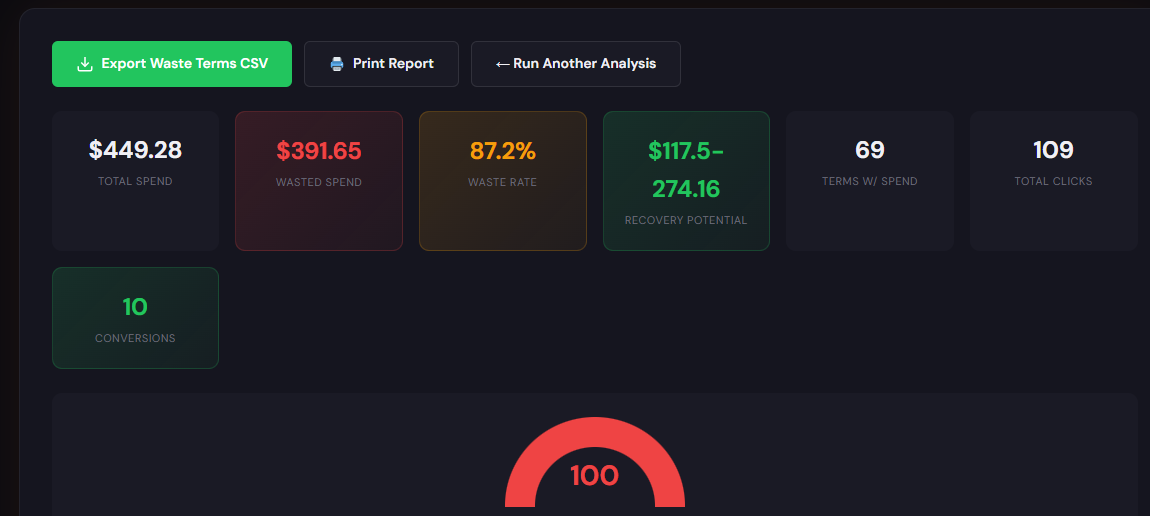
Where it helps: wasted spend, placement leakage, negative keyword discovery, recovery plan.
What it outputs:
- Dashboard-style snapshot with total waste and top leakage areas.
- Line-item recovery plan with recommended negative keywords, campaigns to pause, and budget reassignments.
- Quick-win list you can action in Ads editor.
How to use it (3 steps)
- Connect your account and run the snapshot for the last 30–90 days.
- Review the top 10 leakage items and apply the recommended negative-keyword lists and paused items.
- Export the recovery plan and implement the highest-impact actions over 48 hours.
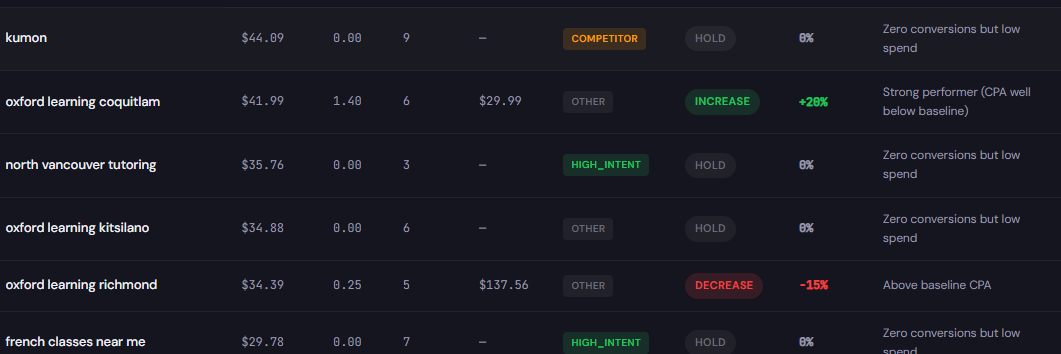
Where it helps: search-term level bidding, negative-keyword identification, and hour-of-day bid signals when paired with the hourly bid adjuster.
What it outputs:
- Row-level search-term table with spend, conversions, CPA, and recommended bid actions.
- Tags for intent and suggested moves: reduce bid, raise bid, move to exact ad group, or add as negative.
- CSV export ready for Google Ads Editor.
How to use it (3 steps)
- Run the analyzer for the past 30–90 days and sort by spend and CPA.
- Tag top non-converting terms as negatives and high-intent winners to move to exact-match ad groups.
- Export bids and import them via Google Ads Editor to implement in bulk.
90-minute account triage playbook
Follow this timed checklist to convert analysis into action in 90 minutes.
- 0–10 min: Pull account-level snapshot (last 30/90 days) and open the Wastage Snapshot tool.
- 10–30 min: Identify top 3 leakage sources and mark immediate pausing candidates.
- 30–50 min: Export search terms, run the Search Term Analyzer, tag negatives and high-intent winners.
- 50–70 min: Implement negative lists and pause low-value campaigns or placements via Ads Editor.
- 70–90 min: Set conservative dayparting and bid adjustments for poor hours; document changes and schedule a 48-hour review.
Use the Wastage Snapshot and Search Term Analyzer together to find and implement recoverable budget in hours.
FAQ
Short answer: yes for speed. A targeted tool surfaces systematic leaks and prioritizes recoverable budget faster than manual inspection.
Run it monthly as a baseline and after any major bid or structure change. Quick snapshots are valuable after holiday or promo periods.
Good negatives improve scale efficiency by removing low-intent clicks. Use staged negatives and monitor for suppressed legitimate traffic.
Expect directional changes in 48–72 hours; statistical significance for low-volume accounts will take longer.
Sources
- Google Ads Help — About search terms
- Google Ads Help — Ad schedule & dayparting
- Google Ads Help — Improve Quality Score
- WordStream — How to Reduce Wasted Ad Spend
- Search Engine Journal — Negative Keywords Best Practices
Ready to run the snapshot and search-term analysis? Start at ExecWrite and apply the recovery plan in hours.
Leave a Reply