PPC performance is under pressure: rising CPCs, automation that drifts, and hidden leakage in accounts. Use this playbook to triage waste and apply high-leverage fixes in the next 7 days. Run fast checks and exports from ExecWrite to speed every step.
- Most accounts leak budget from poor search term control and hour-of-day swings—target those first.
- Use a short 90-minute triage to find top waste, fix bids, and recover spend.
- Two ExecWrite tools (Wastage Snapshot and Search Term Analyzer) automate the audit + remediation exports.
Table of Contents
Why PPC feels harder now
Google Ads hasn’t gotten simpler even as automation has matured. Three structural trends make experiments noisier and mistakes more costly: higher baseline CPCs, more auction competition, and smarter—but brittle—automated bidding that amplifies data issues. That combination turns small account health problems into performance cliffs.
The 5 biggest PPC problems marketers face
1) Hidden wasted spend from irrelevant search terms
Symptoms
- High impressions / clicks from low-converting queries.
- Poor conversion rate in broad or phrase match groups.
- Negative keyword list that hasn’t changed in months.
Why it happens
Match-type updates and AI-driven query matching expand what your ads show for. Without frequent search-term audits, irrelevant queries quietly eat budget.
Fix this week
- Export last 30–90 days of search terms and sort by spend and no-conversion clicks.
- Add negatives for top irrelevant terms and move high-intent queries into exact match ad groups.
- Tag or label repeat offenders for exclusion at the campaign level.
2) Hourly/dayparting swings, wrong ad schedule
Symptoms
- CPA or ROAS swings by hour-of-day.
- High spend during low-conversion hours.
- Automated bidding increasing bids when traffic quality is poor.
Why it happens
Automated bid systems react to short-term signals. If the time-of-day signal isn’t configured, bid algorithms can overpay in low-value windows.
Fix this week
- Pull hour-of-day performance and look for consistent underperforming windows.
- Apply -20% to -100% bid adjustments on low-value hours for a test week.
- Monitor and roll back only if conversion rate improves when reduced.
3) Poor Quality Score and ad-to-landing mismatch
Symptoms
- High CPC with low impression share despite good budgets.
- Low CTR and low landing page conversion rates.
- Discrepancies between ad promises and landing page content.
Why it happens
Quality Score is a compound metric—ads, keywords, and landing pages must align. Teams often optimize ads without aligning landing page messaging or technical UX.
Fix this week
- Identify top keywords with low QS and map to landing pages used by those ads.
- Align headline + hero copy to the top 1–2 search intents for each ad group.
- Run a focused landing page variant with one clear CTA to validate impact.
4) Overbroad campaign structure and duplication
Symptoms
- Multiple keywords competing in the same auction from same account.
- Ad groups with dozens of loosely related keywords.
- High internal auction overlap and wasted impressions.
Why it happens
Quick campaign builds and legacy naming lead to overlap. Overlap causes inflated CPCs and prevents clean signal for automated bidding.
Fix this week
- Run a duplicate keyword report; pause or consolidate duplicate keywords across campaigns.
- Break broad ad groups into tighter, single-intent groups (3–10 keywords).
- Use negatives to enforce ad group boundaries.
5) Automation amplifying bad data
Symptoms
- Bidding strategies oscillate after noisy conversion events.
- Conversion count drops after site tracking changes.
- Budget reallocation to underperforming segments.
Why it happens
Automated bidding trusts signals. If conversion tracking, attribution, or labels are noisy, automation makes systematic mistakes fast.
Fix this week
- Audit conversion definitions and pause low-quality events from optimizing bids.
- Switch to a conservative target for automated strategies while you stabilize signals.
- Tag experiments and keep budget caps on new scripts or rules.
Fixes you can apply this week
- Run a Wastage Snapshot to find top leakage by campaign, query, and audience.
- Export search-term data and add negatives for top irrelevant spend items.
- Identify worst 6 hours by CPA and apply test-level bid adjustments or pause deliverability.
- Group low-QS keywords into a remediation project and rewrite headlines to match landing page promises.
- Freeze aggressive automated bid strategies while you stabilize conversion data.
Start with a single audit that produces a ranked list of waste and a recovery plan.
Tool-based workflow: map problems to ExecWrite tools
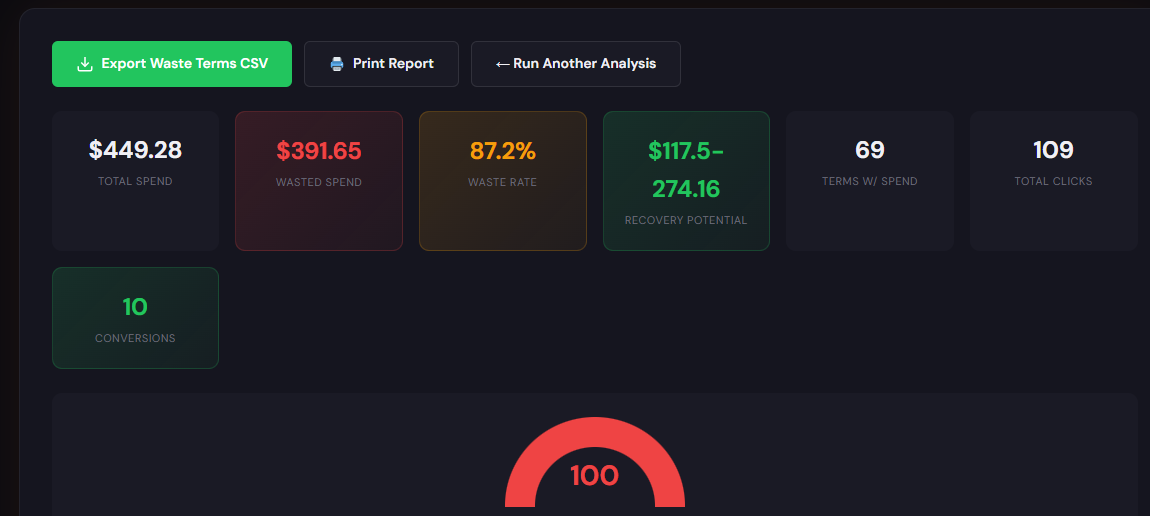
What it outputs: A dashboard-style snapshot with total wasted spend, top leakage areas (search terms, campaigns, audiences), and a prioritized recovery plan with suggested negative keywords and campaign actions.
How to use it — 3 steps
- Upload your account export or connect via the tool and run the snapshot to get waste sorted by impact.
- Review the top 10 leak items and approve the auto-generated negative keyword and pause suggestions.
- Download the recovery CSV and import changes into Google Ads Editor for a safe bulk apply.
Tool link: Wastage Snapshot & Recovery
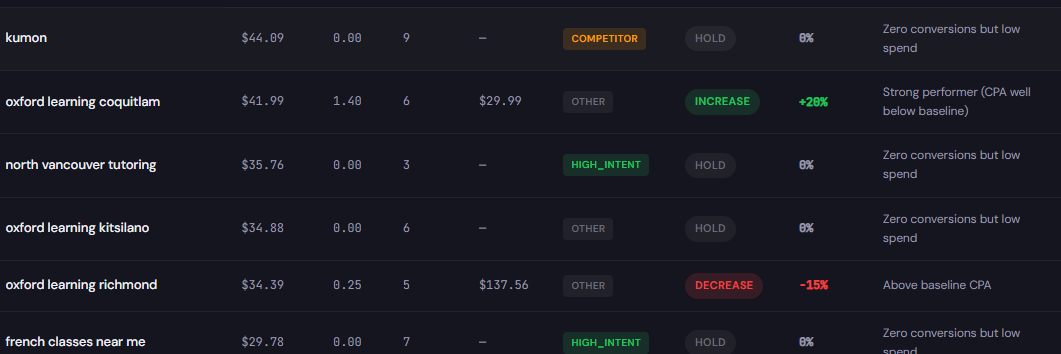
What it outputs: A search-term table showing spend, conversions, CPA/ROAS, and automated bid recommendations or tag suggestions per term (keep, negative, promote to exact).
How to use it — 3 steps
- Paste your search term export into the analyzer and filter by a recent window (30–90 days).
- Apply the tool’s bid recommendations for high-spend, high-CPA queries (promote or reduce bids by the recommended percentage).
- Export the negative keyword list and recommended exact-match promotions; import via Ads Editor or the keyword upload tool.
Tool link: Search Term Analyzer
90-minute account triage playbook
Run this precise, time-boxed audit to find the highest-impact fixes quickly.
- 0–10 minutes: Grab 90 days of account data (search terms, campaign spend, hours, conversion events).
- 10–30 minutes: Run the Wastage Snapshot to get top leakage and immediate negative keyword candidates.
- 30–50 minutes: Load top-spend search terms into Search Term Analyzer and accept negatives/promotions for the top 20 items.
- 50–70 minutes: Export hour-of-day performance and apply a conservative bid adjustment test for the worst 6 hours.
- 70–85 minutes: Audit top 10 keywords with low Quality Score—map to landing pages and prepare headline/CTA alignment tasks.
- 85–90 minutes: Create a short change log and rollback plan; schedule a check-in at 72 hours to validate impact.
Start the 90-minute playbook with tools that produce export-ready fixes.
FAQ
A: You get prioritized leakage and negative recommendations in 10–30 minutes; filling those negatives and importing them typically produces visible CPL/CPA improvement within 72 hours.
A: Not if you pair fixes with conservative bid caps and a 72-hour monitoring window. Treat automation as a layer that requires clean signals—pause aggressive strategies during remediation.
A: Yes. Even low-volume accounts benefit because the tools surface the highest-impact terms and hours to focus limited budget.
A: Track CPA/ROAS, conversion rate, and waste as reflected in the Wastage Snapshot. Compare a rolling 7–14 day window pre/post-change and use the exported change log for attribution.
Leave a Reply