If ROAS is flat or CPA is creeping up, this is for you. Below are operator-level diagnostics and week-one fixes plus a tool-driven workflow using ExecWrite to recover wasted spend and adjust bids by search term and hour. Try the tools at ExecWrite for fast, repeatable results.
- Major causes: wasted spend, poor query-level bidding, ad/landing mismatch, time-of-day swings, and automation gaps.
- Week-one fixes: run a wastage snapshot, tag bad queries, apply negative keywords, and implement hourly bid adjustments.
- Use ExecWrite’s Wastage Snapshot and Search Term Analyzer to map issues to action in under 90 minutes.
Table of Contents
Why PPC feels harder now
Competition, privacy changes, and platform automation make predictable performance rare. Bidding signals are noisier, audiences fragment, and small budget leaks compound. The result: accounts that once scaled now show volatility and wasted spend.
The 5 biggest PPC problems marketers face
Pain 1 — Wasted spend and budget leakage
- Symptoms: High impressions on low-converting queries, low conversion rate, rising CPA without higher volume.
Why it happens: Poor query control, missing negatives, and legacy keyword lists let low-intent traffic absorb budget.
- Fix this week: Run a spend-by-query audit, flag top spenders with zero/low conversions, and add negatives on low-intent terms.
Pain 2 — Search-term level bid mismatch
- Symptoms: High CPA on certain queries inside otherwise healthy ad groups; inconsistent conversion rates by phrase.
Why it happens: Broad match + automated bidding hides query-level performance; account-level bids don’t reflect individual intent.
- Fix this week: Identify high-spend, low-conversion queries and set explicit bid adjustments or move them into exact/phrase ad groups with tailored ads.
Pain 3 — Poor ad-to-landing relevance (Quality Score drain)
- Symptoms: High CPCs, low CTR, declining conversion rate after a landing page change.
Why it happens: Messaging mismatch between search intent, ad copy, and landing page content reduces Quality Score and raises cost per click.
- Fix this week: Run headline and landing page alignment audits; test ad copy variants that match top-performing queries.
Pain 4 — Time-of-day and dayparting volatility
- Symptoms: Strong performance for a few hours and sudden drop-offs; nightly spends that never convert.
Why it happens: Uniform schedules assume steady intent. Many businesses have clear time windows for buyer activity—others are leaking bids into low-intent hours.
- Fix this week: Pull hour-of-day conversion metrics, reduce bids or pause low-performing hours, and re-allocate budget to peak windows.
Pain 5 — Automation that masks problems
- Symptoms: Smart bidding keeps conversions but ROAS slides, little clarity on which queries or creatives failed.
Why it happens: Automated strategies optimize for the metric you set but can’t fix bad inputs—bad keywords, landing pages, or creative still drive waste.
- Fix this week: Backtest campaigns with manual rules, audit top contributing queries, and lock in negatives before trusting automation to scale.
Fixes you can apply this week
- Run a quick wastage snapshot to quantify leakage by campaign, ad group, and query.
- Export top-spend search terms; tag high-spend/low-conversion queries for negatives or bid cuts.
- Implement hour-of-day bid adjustments for the worst-performing hours.
- Match top queries to tailored ads and landing pages to protect Quality Score.
- Set a 7-day hold on broad automation changes—apply conservative manual adjustments first.
Scan for wasted spend and get a recovery plan in minutes with ExecWrite’s Wastage Snapshot.
Tool-based workflow: map pain points to ExecWrite tools
ExecWrite — Wastage Snapshot & Recovery
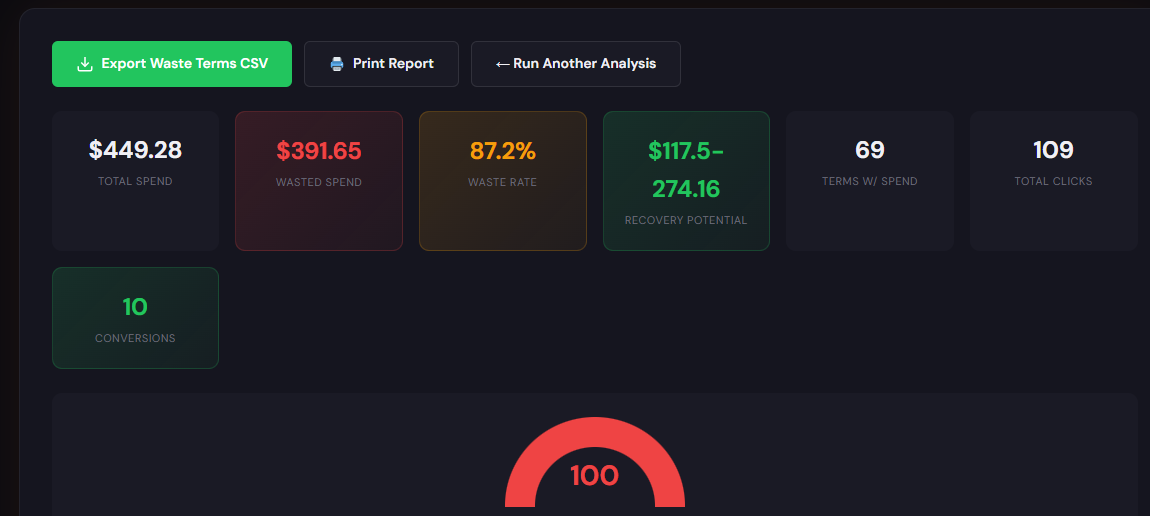
What it outputs: A prioritized dashboard showing wasted spend, top leakage channels (queries, campaigns), and an action-first recovery plan.
How to use it (3 steps):
- 1) Connect your account and run the snapshot to surface leakage by spend and conversion rate.
- 2) Review the top 10 leakage items the tool recommends—negatives, paused placements, and low-intent queries.
- 3) Export the recovery plan and apply negative lists, budget reallocations, and quick ad swaps. Re-run in 7 days to measure improvement.
Use for: recovering wasted budget, building a tactical recovery plan, and educating stakeholders with a clear summary.
Open Wastage Snapshot & Recovery
ExecWrite — Search Term Analyzer (Bid Adjustment by Search Term)
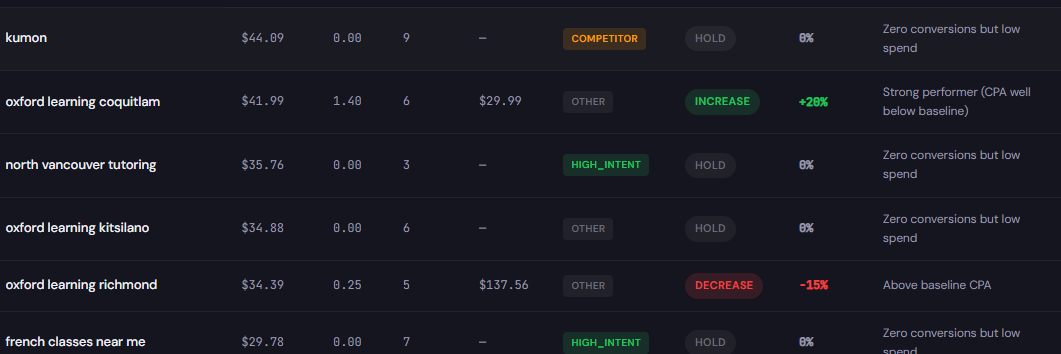
What it outputs: Query-level table with spend, conv., CPA/ROAS, tags and recommended bid actions (increase, reduce, negative).
How to use it (3 steps):
- 1) Upload your search term report or link the account to get query-level performance across date ranges.
- 2) Apply the tool’s suggested bid adjustments and tag queries you want to move into new ad groups or add as negatives.
- 3) Export the bid action list as a Google Ads Editor CSV or use the recommendations to set hourly and query-level rules.
Use for: immediate bid corrections, removing low-intent traffic, and precise recovery from query-level waste.
90-minute account triage playbook
Follow this sequence with a focused analyst and access to ExecWrite tools.
- 0–10 min: Scope and KPI alignment. Confirm target CPA/ROAS and recent change events (landing page, bids, budget).
- 10–30 min: Run Wastage Snapshot. Export top 20 leakage items and total wasted spend by campaign.
- 30–50 min: Run Search Term Analyzer on the same date range. Tag the top 15 high-spend/low-conversion queries.
- 50–70 min: Apply immediate actions—add negatives, reduce bids on flagged queries, pause worst-performing hours.
- 70–85 min: Fix quick ad/landing mismatches for top queries (swap headlines or route to better pages).
- 85–90 min: Document changes, set a 7-day measurement window, schedule a quick re-scan in ExecWrite.
Use ExecWrite to export recovery actions and implement bid adjustments without guesswork.
FAQ
No. Start with a Wastage Snapshot to quantify leakage and then use the Search Term Analyzer on top spend queries. You’ll get prioritized actions in minutes.
Not if you apply manual negatives and bid rules first. Treat automation as scaling only after you’ve fixed input quality (keywords, landing pages, negative lists).
Every 7–14 days during optimization phases, and monthly in steady state. Run a quick snapshot after any major site or campaign change.
Yes. The Search Term Analyzer provides export-ready CSVs for Editor and the Wastage Snapshot exports recovery action lists for fast application.
Leave a Reply