Google Ads
Marketing Ops
If your Google Ads account is burning budget with little ROI, this post gives an operator-level triage: what to check, exact fixes you can apply this week, and a tool-based workflow using ExecWrite to recover wasted spend quickly. Consider this a playbook—paired with fast audits from ExecWrite.
- Wasted spend usually comes from mismatched intent, poor keyword coverage, and ad schedule leaks—stop high-cost losers first.
- Quick fixes: negative keywords, ad schedule/bid adjustments, and landing-page alignment—implementable in a week.
- Use the ExecWrite Wastage Snapshot to find leaks and the AI Keyword Generator to rebuild intent-driven keyword lists fast.
Table of Contents
Why PPC feels harder now
Costs and competition have risen, automation masks root causes, and attribution frictions make optimizations risky. Two structural facts make modern PPC friction-heavy:
- Automation increases velocity but hides which queries and hours are profitable.
- Broader match behavior and auction complexity mean you inherit low-intent queries unless you audit them.
The 5 biggest PPC problems marketers face
Pain 1: Wasted spend on irrelevant search queries
Symptoms
- High impressions and clicks from long-tail queries with zero conversions.
- High cost with low conversion rate in Search Terms report.
Why it happens
Mismatched match types and insufficient negative keywords let broad and modified queries enter auctions at scale. Automation can amplify the problem by bidding on volume, not intent.
Fix this week
- Export Search Terms for the last 30–90 days, sort by cost and zero conversions—add top offenders as negatives.
- Collapse overly-broad keywords into phrase/exact or split by intent.
- Pause high-cost, low-intent automated bidding rules until you add intent signals.
Pain 2: Budget leaks by time-of-day or day-of-week
Symptoms
- Spikes of spend in specific hours with poor CPA/ROAS.
- High daily spend but flat conversions—sawtooth performance across hours.
Why it happens
Ad schedules are often set-and-forgotten. Shifts in user behavior or seasonality make previously profitable hours wasteful.
Fix this week
- Pull hour-of-day performance and identify hours with CPA > 2x the account average—reduce bids or exclude those hours.
- Implement conservative bid adjustments (-20% to -50%) on suspect hours and monitor for 7 days.
- Use ad scheduling only where conversion density supports bids.
Pain 3: Poor ad-to-landing page relevance
Symptoms
- Low conversion rate despite good CTRs.
- High bounce rates on ad landing pages and low Quality Score.
Why it happens
Ads that overpromise or use different messaging than landing pages create drop-offs. Quality Score penalties increase CPCs and reduce visibility.
Fix this week
- Match headlines and CTAs between top-performing ads and their landing pages.
- Create 1–2 tailored landing page variants for highest-volume ad groups.
- Check load speed and remove distracting elements that block conversion paths.
Pain 4: Cannibalized or poorly-structured campaigns
Symptoms
- Multiple campaigns bidding on similar keywords; internal auctions inflate CPA.
- Unclear account structure prevents precise bidding and tracking.
Why it happens
Accounts often grow organically without governance—broad match, duplicates, and overlapping audiences create self-competition.
Fix this week
- Identify duplicate keywords across campaigns and consolidate where appropriate.
- Use campaign-level priorities and negative lists to stop internal auctions.
- Standardize naming and structure for future scaling.
Pain 5: Measurement and attribution blind spots
Symptoms
- Conversions drop suddenly after tracking changes; inconsistent cross-channel signals.
- High last-click CPA but downstream value isn’t visible.
Why it happens
Attribution mismatches, broken tags, or recent site changes can break conversion reporting, making good traffic look bad or vice versa.
Fix this week
- Validate conversion tags, server-side events, and GA4 import; compare events to server logs where possible.
- Run a short split-test or liquidity check to confirm true conversion rates.
- Apply conservative bid caps until measurement is confirmed.
Fixes you can apply this week
- Run a Search Terms export; add negatives for high-cost, zero-conversion queries.
- Identify worst-performing hours and add hour-of-day bid reductions.
- Pause or tighten broad match keywords; move volume into phrase/exact and tightly themed ad groups.
- Audit top ad-to-landing-page pairs and implement headline/CTA parity.
- Confirm conversion tracking and set temporary bid caps for volatile campaigns.
Use ExecWrite’s Wastage Snapshot to find top leakage areas and get a prioritized recovery plan you can action this week.
Tool-based workflow: map problems to ExecWrite tools
We recommend using two focused tools to triage and rebuild: the Wastage Snapshot for leakage identification and the Free AI Keyword Generator for rebuilding intent-safe keyword lists.
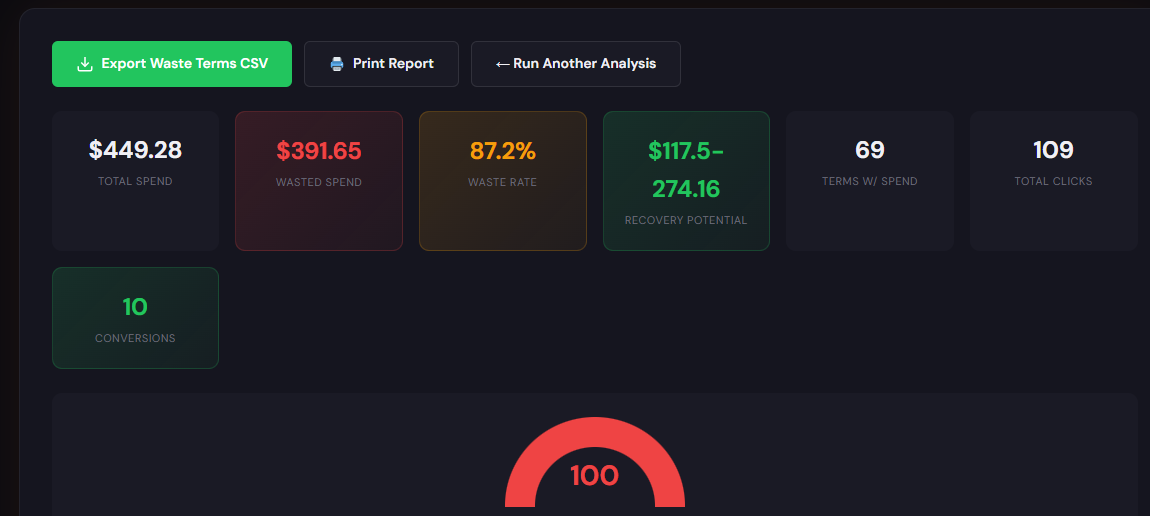
What it outputs: A dashboard-style snapshot showing total wasted spend, top leakage areas (search terms, hours, campaigns), and a prioritized recovery plan with negative keyword and pause recommendations.
How to use (3 steps)
- Upload a Search Terms + hourly performance export into the Wastage Snapshot.
- Review the top leakage list and apply the suggested negatives and campaign pauses for the quickest wins.
- Download the recovery checklist and implement the top 3 actions in your account today.
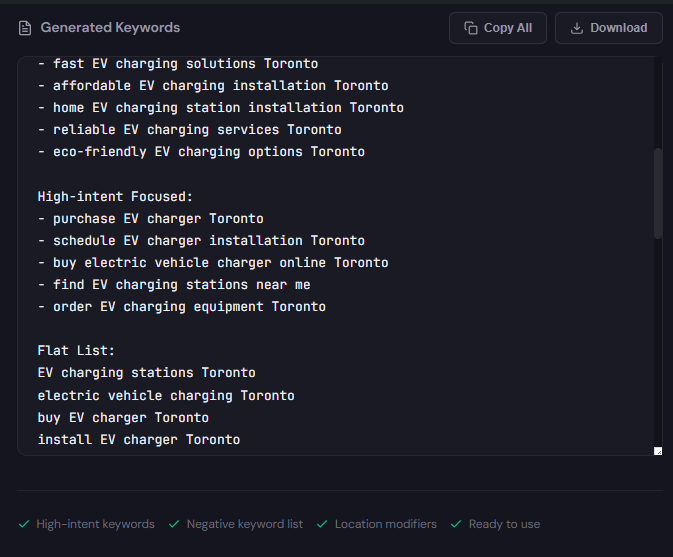
What it outputs: Structured keyword lists (high-intent, informational, negative keywords, and modifiers) organized by ad-group and intent—export-ready for Google Ads Editor.
How to use (3 steps)
- Enter your landing page or primary offer to seed intent-based keyword generation.
- Review the grouped output, mark which sections map to existing campaigns, and accept negatives automatically suggested.
- Export CSV for Google Ads Editor and upload as new tightly themed ad groups.
90-minute account triage playbook
Run this live with your account open. Target: 90 minutes to pause the worst leaks and leave with a 7-day action plan.
- 0–10 min: Open Search Terms and Hourly reports; note total spend last 30 days.
- 10–30 min: Sort Search Terms by cost with zero conversions—add top 10 as negatives and document recurring patterns.
- 30–50 min: Load the Wastage Snapshot and confirm the top leakage areas; accept the top 3 recovery recommendations.
- 50–70 min: Run hour-of-day analysis; apply bid reductions on hours with CPA > 2x account average or exclude them.
- 70–85 min: Use the AI Keyword Generator to create focused ad group keyword lists for your top-converting landing pages.
- 85–90 min: Deploy immediate changes (negatives, bid adjustments, campaign pauses) and set a 7-day monitoring report to watch CPA/ROAS trends.
Get a prioritized recovery plan and export-ready fixes from ExecWrite. Fast audits reduce the noise so you can restore profitable traffic.
FAQ
Expect initial spend reductions immediately; conversion rate improvements usually show within 3–7 days as Google re-learns. Watch conversion volume—if it drops too far, back off adjustments slightly.
Negatives remove low-intent or irrelevant queries. The goal is higher-quality traffic, not raw reach. Proper negatives typically improve ROI by eliminating low-value clicks.
Don’t disable all automation. Pause or limit automated bidding strategies on the worst-performing campaigns until you fix intent and measurement. Keep safe, conservative rules where needed.
The Snapshot uses your account exports to surface high-cost/zero-conversion queries and hourly leakage. Cross-check recommendations against raw Search Term and hourly reports before bulk applying changes.
Sources
- Google Ads Help: Ad scheduling — official guide on setting and managing ad schedules and bid adjustments.
- Google Ads Help: About Quality Score — how relevance, expected CTR, and landing page experience affect performance.
- Google Ads Help: Use negative keywords — best practices for negative keyword lists.
Leave a Reply