If your account feels noisy — spending more without commensurate leads — start with an operational audit and targeted fixes. This article outlines a repeatable triage, week-one fixes, and how two ExecWrite tools can turn audit findings into immediate bid and recovery actions. Learn more at ExecWrite.
- Run a wastage snapshot to find top leak sources and recover budget fast.
- Use search-term bid adjustments to stop bidding on low-value queries and raise bids where intent is high.
- Follow a 90-minute triage playbook to create prioritized fixes and capture quick ROI wins.
Table of Contents
Why PPC feels harder now
Expectations are higher, automation is ubiquitous, and account complexity has exploded. Advertisers juggle automated bidding, inconsistent search intent, and multiple landing experiences — while leadership still expects predictable CPA/ROAS. The result: more spend, more variance, and less signal where you need it most.
The 5 biggest PPC problems marketers face
1. Wasted spend and budget leakage
- Symptoms: rising CPC with flat or falling conversions, unexplained daily spend spikes, or many low-intent conversions.
Why it happens — Campaigns inherit historical targeting and bids that no longer match business goals. Automation masks leakage by smoothing spend without handling intent or negative match needs.
- Pull a 30-day wasted spend snapshot (top campaigns, keywords, and placements).
- Pause or reduce budgets on top leakage sources and add negative keywords.
- Redirect recovered budget to high-converting ad groups for controlled experiments.
2. Poor search-term control
- Symptoms: irrelevant query clicks, low click-to-conversion rate, and frequent “close variants” wasting higher CPC.
Why it happens — Broad match and loosely structured ad groups expose accounts to noisy queries. Without systematic search-term analysis, negative keywords and bid posture lag far behind.
- Export last 30 days of search terms, tag by intent, and add top negatives immediately.
- Move high-intent terms into Exact/Phrase ad groups with tailored ads and landing pages.
- Apply search-term-level bid adjustments for high-value queries.
3. Hourly and dayparting swings
- Symptoms: predictable hour-of-day CPA spikes, wasted impression share at low-intent times, or missed peaks.
Why it happens — Generic ad scheduling and global bidding policies ignore local buying rhythms. Automated bidding can be slow to react to intra-day trends.
- Analyze performance by hour and tighten schedules for low-performing windows.
- Apply conservative bid multipliers during low-conversion hours; increase during high-value hours.
- Monitor for 3–5 days and revert if automation rebalances incorrectly.
4. Quality Score and landing-page mismatch
- Symptoms: low quality scores, high CPC for keywords that should be cheap, low landing-page conversion despite good CTR.
Why it happens — Messaging drift between ad copy and landing pages reduces perceived relevance. Quality Score penalties cascade into higher costs across the account.
- Audit top ad groups for headline/landing-page alignment and mismatched CTAs.
- Deploy targeted landing page copy tweaks and run A/B tests on one high-traffic ad group.
- Report Quality Score impact weekly and prioritize pages that move the needle.
5. Broken account structure and keyword cannibalization
- Symptoms: duplicate keywords across ad groups, poor ad relevance, and automated bidding bouncing between conflicting signals.
Why it happens — Over time multiple managers, quick fixes, and automation generate structural entropy. Conflicting keywords and overlapping audiences confuse learning systems.
- Consolidate duplicate keywords and enforce one-topic-per-ad-group discipline for top traffic areas.
- Use campaign-level negatives to prevent cross-campaign cannibalization.
- Document a structure baseline and freeze structural changes during experiments.
Fixes you can apply this week
- Run a rapid wastage audit (30–90 days) and list top 10 leakage items by spend.
- Apply immediate negatives for top 20 irrelevant queries and pause non-performing placements.
- Promote high-intent search terms to tighter match types with tailored ads and 10–20% bid increases.
- Implement hour-of-day bid multipliers for clear peaks and push conservative caps for low-value hours.
- Align ad headlines and landing pages for the top 5 converting ad groups and measure Quality Score changes.
Run a Wastage Snapshot to find the highest-impact leak points and generate a prioritized recovery plan you can action in hours.
Tool-based workflow: map problems to ExecWrite tools
Wastage Snapshot & Recovery — what it outputs
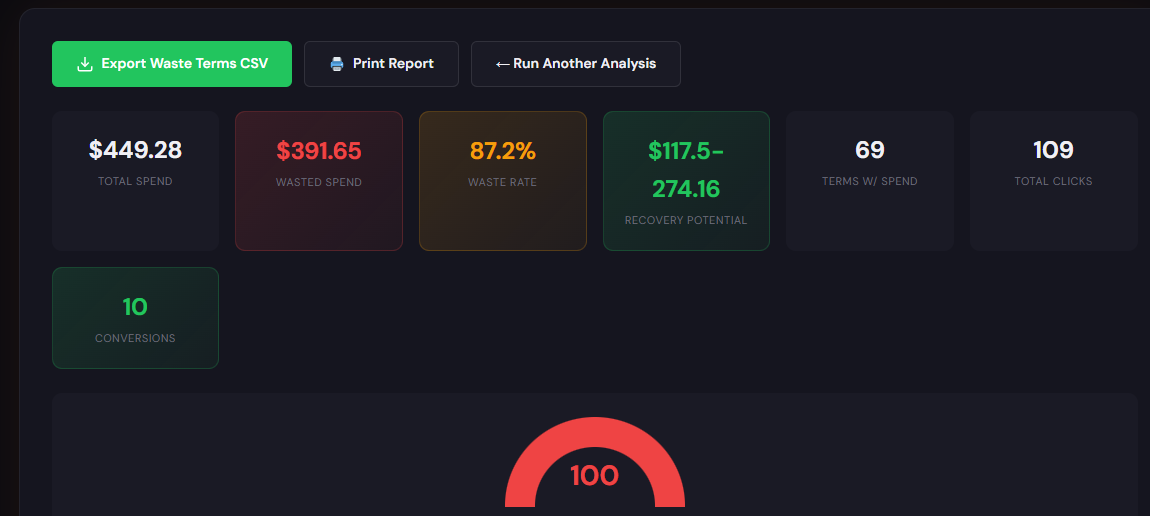
Outputs a dashboard-style snapshot listing total wasted spend, top leakage dimensions (queries, placements, campaigns), and an actionable recovery plan with prioritized fixes.
How to use it in 3 steps
- Upload a 30–90 day export or connect your account; run the snapshot to get leakage totals.
- Review the top 5 leak sources and apply recommended negative keywords and campaign pauses.
- Download the recovery checklist and assign actions to owners; re-run weekly to measure recovered budget.
Search Term Analyzer — what it outputs
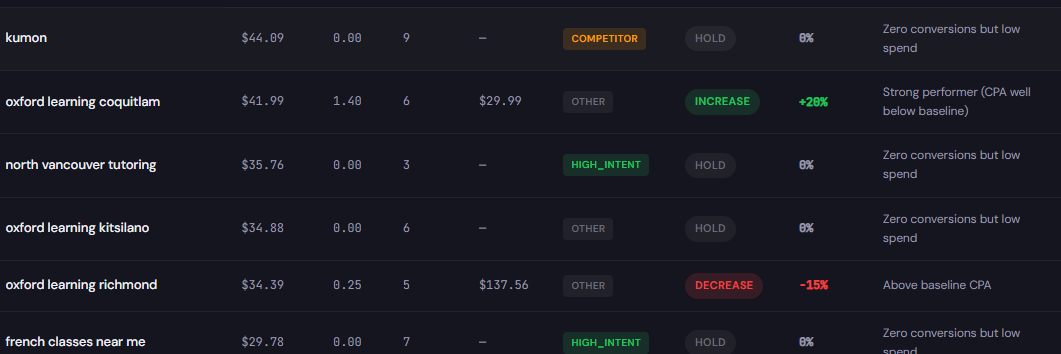
Generates a table of search terms with spend, conversions, suggested tags (intent), and recommended bid actions at the search-term level.
How to use it in 3 steps
- Export search-term report and import into the Search Term Analyzer.
- Tag queries by intent and accept recommended bid adjustments for high-intent winners and negatives for losers.
- Export bid adjustments and apply via Google Ads Editor or the API for faster rollouts.
90-minute account triage playbook
Use this timed agenda to convert auditing into prioritized actions.
- 0–10 min: Pull top-level KPIs (cost, conv., CPA, CRO) and spot obvious spend spikes.
- 10–30 min: Run Wastage Snapshot to identify top 5 leakage areas.
- 30–50 min: Export top search terms and load into Search Term Analyzer; tag top negatives and winners.
- 50–70 min: Apply immediate fixes — top negatives, pause worst placements, and adjust budgets.
- 70–90 min: Set up monitoring (hourly checks for 48–72 hrs) and create a prioritized task list: landing page tweaks, QC on Quality Score, and structure fixes.
Begin with a Wastage Snapshot and a Search Term Analyzer pass to create a prioritized recovery plan and bid adjustments you can apply in hours.
FAQ
You should see reduced wasted spend and improved CPA within 48–72 hours for immediate negatives and budget pauses. Quality Score and conversion-rate improvements typically take 1–3 weeks to stabilize.
Yes. Apply conservative caps and monitor for 3–7 days. If automation rebalances too aggressively, switch to a more constrained bidding strategy while you stabilize signals (quality, conversions, and structured keywords).
Start with the Wastage Snapshot to identify top leak points, then use the Search Term Analyzer to act on query-level fixes and bid adjustments.
Yes. Outputs are export-ready for Google Ads Editor and formatted for quick API or bulk upload. Use the Search Term Analyzer export for direct bid adjustment uploads.
Leave a Reply