If your Google Ads account feels like it’s getting more expensive for less return, this guide gives a practical triage, quick fixes you can run this week, and a tool-based workflow using ExecWrite to reclaim wasted spend and scale sustainably. Try a fast snapshot at ExecWrite to baseline your account.
- Most performance drops come from leakage: wasted keywords, time-of-day swings, and landing-page mismatch.
- Fix these in one week with targeted negative keywords, ad schedule tweaks, and a landing-page quality check.
- Use ExecWrite’s Wastage Snapshot and Free AI Keyword Generator to find waste and rebuild campaigns faster.
Table of Contents
Why PPC feels harder now
Competition, automated bidding, and noisy data make execution riskier. Advertisers see the same metrics—CPC, CPA, ROAS—but fewer clear levers that consistently move them. That raises three operational stresses: diagnosis takes too long, fixes are partial, and automation hides root causes.
Diagnosis needs to be fast and repeatable. This article focuses on repeatable checks, what to fix quickly, and how to use two ExecWrite tools to shorten the feedback loop.
The 5 biggest PPC problems marketers face
1) Wasted spend on low-intent search terms
Symptoms
- High spend with few conversions from many search terms.
- Low click-through rates on broad modifier queries.
- Conversion rates drop when account-level volumes increase.
Why it happens
Broad match and loose keyword structuring capture irrelevant queries. Without frequent search-term audits, negative keywords lag, and spend flows to low-intent queries.
Fix this week
- Run a 30-day search-term export and flag terms with spend > X and conversions = 0.
- Add high-frequency negatives to exact match exclusions and campaign negatives.
- Temporarily pause or reduce bids for query patterns that are low intent (e.g., “free”, “cheap”, unrelated brand names).
2) Hourly/daypart performance swings
Symptoms
- CPA or ROAS varies dramatically by hour of day or day of week.
- Automated bidding cycles amplify swings instead of smoothing them.
- Conservative ad schedules were never rebuilt after market shifts.
Why it happens
Bidding algorithms react to recent signals; if conversion windows change by hour, the algorithm chases noise. No hour-level analysis means missed bid adjustments and poor dayparting.
Fix this week
- Pull hour-of-day performance for the last 30–90 days and identify the top/bottom 3 hours by CPA.
- Set +/− bid modifiers for clear high-value hours and cut bids for low-performing hours.
- Freeze auto-bids while hour modifiers ramp to avoid compounded adjustments.
3) Landing-page mismatch / Quality Score drops
Symptoms
- Impression share drops without major bid changes.
- Quality Score components—expected CTR, ad relevance, landing page—are low.
- Landing pages that previously converted now have lower conversion rates.
Why it happens
Creative drift and messaging mismatch between ad copy and landing pages erode Quality Score. Even small discrepancies (CTA wording, headline) can reduce relevance.
Fix this week
- Map top-performing keywords to the landing pages they send traffic to.
- Align headlines and primary CTAs to the keyword intent for high-volume groups.
- Run an A/B test focusing on headline and above-the-fold CTA alignment for the worst-performing ads.
4) Poor keyword structure and account drift
Symptoms
- Campaigns with mixed intent across ad groups.
- Excessive single broad-match keywords covering many intents.
- High overlap and internal competition between campaigns.
Why it happens
Quick fixes and incremental edits over time create structural debt. Without periodic restructuring, performance degrades and attribution blurs.
Fix this week
- Group keywords by intent and create tight ad groups (3–10 keywords each).
- Change top offending broad-match keywords to phrase/exact and add negatives to prevent overlap.
- Export a simple campaign CSV for cleanup and future bulk edits.
5) Automation mask: algorithms hide root causes
Symptoms
- Automated bidding makes a sudden bid change and performance drops, but the reason isn’t reported.
- Performance recovers or deteriorates randomly, dependent on bid strategy.
Why it happens
Automation optimizes for the metric you set, not for structural health. It can cover symptoms while the underlying issues persist.
Fix this week
- Switch a test subset of high-volume campaigns to manual or enhanced CPC for 7–14 days to observe direct effects.
- Document changes and rollback windows so you can attribute effects to the right levers.
- Use conservative automation with clear guardrails (max CPC/CPA caps).
Fixes you can apply this week
- Run a search-term waste audit: add negatives for high-spend zero-conversion queries.
- Pull hour-of-day data and add bid modifiers for top/bottom hours.
- Map ads-to-landing pages for top 20% of spend and align headlines + CTAs.
- Group keywords by intent and export cleaned campaign structures for bulk edits.
- Temporarily test manual bidding on a controlled sample to reveal automation side-effects.
Use a fast account snapshot to find wasted spend and get a prioritized recovery plan in minutes.
Tool-based workflow: map problems to ExecWrite tools
Below are two high-impact tools from ExecWrite that map directly to the problems above. Each section shows what the tool outputs and how to use it in three pragmatic steps.
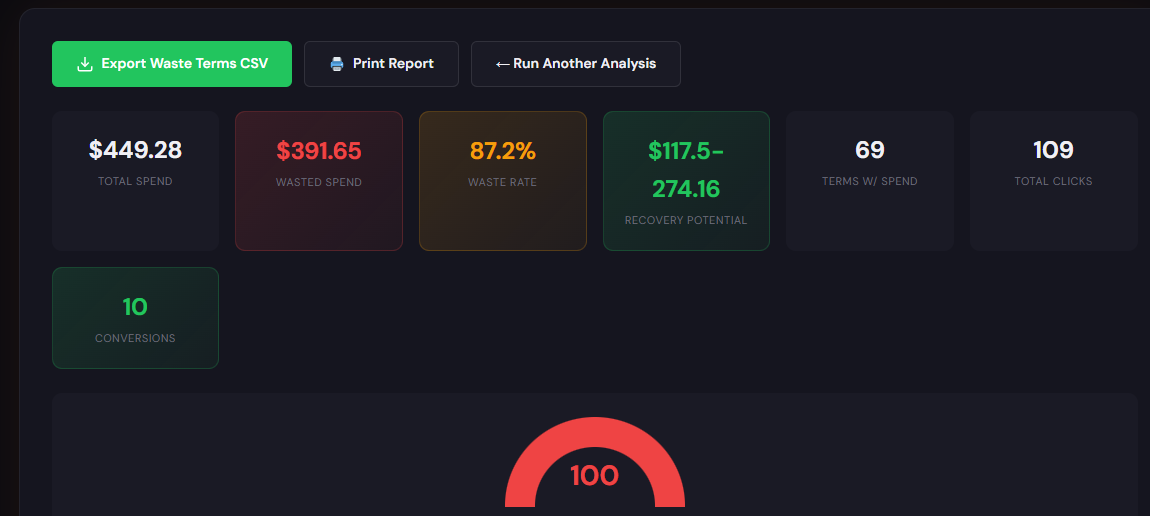
What it outputs
- Dashboard-style snapshot with total wasted spend, top leakage areas, and a recovery plan summary.
- Quick list of negative keyword recommendations and budget reallocation suggestions.
How to use it (3 steps)
- Connect or upload a search-term and performance export to the Wastage Snapshot.
- Review the top 5 leakage areas and apply the recommended negative-sets and budget reallocations.
- Export the recovery plan and run the recommended changes in a controlled rollout (10–20% traffic first).
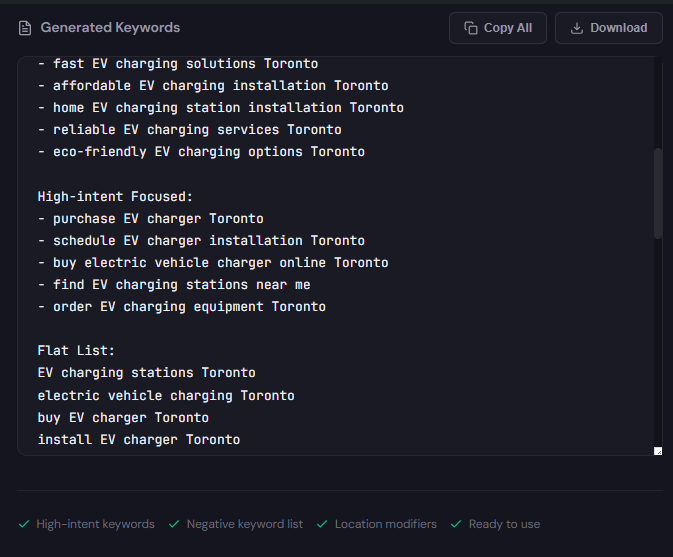
What it outputs
- Structured keyword sections: high-intent keywords, long-tail modifiers, and negative keyword suggestions.
- Campaign-ready grouping suggestions and CSV export for Google Ads Editor.
How to use it (3 steps)
- Paste your seed keywords or landing page URL into the generator.
- Review grouped outputs and accept high-intent lists; add suggested negatives.
- Export the campaign-ready CSV and import to Google Ads Editor to rebuild tightly themed ad groups.
90-minute account triage playbook
Follow this time-boxed playbook to get a clear diagnosis and actions within 90 minutes.
- 0–10 min: Pull top-line metrics (last 30 days vs previous 30). Identify the worst KPIs (CPA, ROAS, impressions).
- 10–30 min: Run a search-term export and sort by spend with conversions = 0. Flag top 10 terms to add as negatives.
- 30–50 min: Pull hour-of-day report. Mark top 3 high-value and bottom 3 low-value hours for bid modifiers.
- 50–70 min: Map the top 20% of spend to landing pages. Note headline/CTA mismatches.
- 70–85 min: Implement negatives, schedule hour modifiers, and pause the top low-intent terms. Document changes.
- 85–90 min: Run the ExecWrite Wastage Snapshot for a validation report and export the recovery plan.
FAQ
You should see CTR and conversion-rate improvements within 24–72 hours, but allow 7–14 days for stable statistical effects as automation and attribution align.
Yes, but only after structural issues (negatives, ad/landing alignment, hour modifiers) are fixed. Reintroduce automated bids on a test subset first.
Monthly for active accounts, bi-weekly for high-spend or rapidly changing campaigns.
No. Use the Free AI Keyword Generator to accelerate structured lists and negative ideas, then validate with your account data and search-term history.
Run a snapshot and get an actionable recovery plan in minutes. Use the results to feed the keyword generator and rebuild clean campaigns.
Sources
- Google Ads: About Quality Score — Explains the components that affect Quality Score and why landing-page relevance matters.
- Google Ads: Ad scheduling — How ad schedules and bid modifiers work and why dayparting impacts performance.
- Search Engine Journal: How to Audit Google Ads — Practical audit steps and recommendations for account triage.
- WordStream: Common Google Ads Mistakes — Common structural and execution mistakes that cause wasted spend.
Leave a Reply