If your Google Ads account feels like a money pit — poor conversion rates, rising CPA, and unclear next steps — this walkthrough gives an operator-level checklist to stop leaks fast and a tool-based workflow using ExecWrite to recover wasted spend. For quick experiments and exports, check the tools at ExecWrite.
- Most PPC waste is operational: bad search terms, misaligned ad-to-landing messaging, and incorrect bid schedules.
- Run a 90-minute triage (steps provided) to find quick recoverable spend and time-of-day bid swings.
- Use the ExecWrite Wastage Snapshot and Search-Term Bid Adjustment tools to output recovery actions and bid recommendations you can implement this week.
Table of Contents
Why PPC feels harder now
Two structural shifts make today’s paid media harder: automation hides decision levers, and privacy-driven signal loss reduces predictability. Automation (smart bidding, Performance Max) aggregates control and often masks where the account is leaking budget, while fewer user-level signals increase variance in conversion reporting. The result: higher CPAs, ad groups that underperform without a clear cause, and more time spent diagnosing than fixing. For context on how automated bidding changes control, see Google’s guidance on automated bidding.
The 5 biggest PPC problems marketers face
1. Waste from irrelevant search terms
Symptoms
- High spend in broad or phrase match with few conversions.
- Poor search term-to-conversion mapping — many clicks, no leads.
- Search terms appear in negative keyword reports but not blocked.
Why it happens
Automated match behavior plus sprawling keyword lists let low-intent queries consume budget. Without constant search term reviews, negative keyword coverage lags and spend accumulates on irrelevant queries.
Fix this week
- Export last 30 days of search terms, sort by cost and zero conversions.
- Add top irrelevant terms as negatives at campaign level.
- Convert repetitive irrelevant matches to exact negatives and pause overly broad keywords.
2. Poor ad-to-landing relevance (Quality Score and CR drops)
Symptoms
- High CTR but low conversion rate.
- High impression share but poor page engagement / high bounce.
- Quality Score falling on top queries.
Why it happens
Ads that promise one thing and land users on a generic page cause drop-offs. Quality Score penalizes these mismatches and raises CPCs for the same visibility. See common Quality Score drivers and fixes.
Fix this week
- Map top ad groups to specific landing pages; align headlines and CTAs.
- Run a short A/B of focused landing page vs. generic page for core ad groups.
- Adjust ad copy to match the strongest landing pages, pause ads with poor post-click metrics.
3. Hour-of-day and dayparting bid leaks
Symptoms
- CPA variance by hour greater than 50%.
- Campaigns performing well overall but losing efficiency overnight or during off-hours.
- Manual bid changes don’t stick or improve performance.
Why it happens
Automated systems optimize for aggregate goals; they may not react quickly to intra-day performance swings. Without hourly analysis, you miss predictable windows to bid up or down.
Fix this week
- Pull hour-of-day performance for last 30 days and flag worst and best-performing hours.
- Apply temporary ad schedule bid modifiers to reduce bids in losing hours.
- Monitor for 7 days and iterate on modifiers.
4. Budget fragmentation and poor portfolio prioritization
Symptoms
- Multiple campaigns compete for the same keywords or audience.
- Some campaigns hit budget caps while others underdeliver.
- Confused conversion paths and inconsistent attribution across campaigns.
Why it happens
Teams add campaigns and tactics without central rules for overlap and budget hierarchy. This creates internal competition and wasted impression-share turnover.
Fix this week
- Inventory overlapping keywords/ad groups and merge or apply negative lists to reduce overlap.
- Reassign budgets to highest-margin campaigns for a week to test impact.
- Establish simple prioritization rules: brand > high-intent > discovery.
5. Measurement and conversion lag (attribution blind spots)
Symptoms
- Reported conversions shift week-to-week; last-click and data-driven tell different stories.
- Large discrepancies between GA4 and Google Ads conversions.
- Delayed conversion reports create missed bid adjustments.
Why it happens
Signal loss, delayed offline conversion imports, and mismatched attribution windows create lag. That lag makes real-time bid changes noisy and increases risk of overreacting.
Fix this week
- Standardize conversion windows across platforms for a test period.
- Import one clean offline conversion event if available and validate it.
- Hold bidding steady for 7 days when testing structural changes to avoid confounding lag.
Fixes you can apply this week
- Run a 30-day search terms export; add top 20 irrelevant terms as negatives.
- Map top 10 ad groups to dedicated landing pages; align headlines and CTAs.
- Pull hour-of-day CPA and apply -30% modifier to losing hours.
- Pause low-performing broad keywords and test narrower match types.
- Consolidate budget to top 2 campaign portfolios for 7 days and measure CPA change.
Use the ExecWrite Wastage Snapshot for a fast audit and the Search Term Analyzer to convert search terms into bid and negative actions. Get export-ready lists and a prioritized recovery plan.
Tool-based workflow (map each pain point to ExecWrite tools)
Below are two core tools that convert diagnosis into operations. Each tool output and three-step usage to make fixes this week.
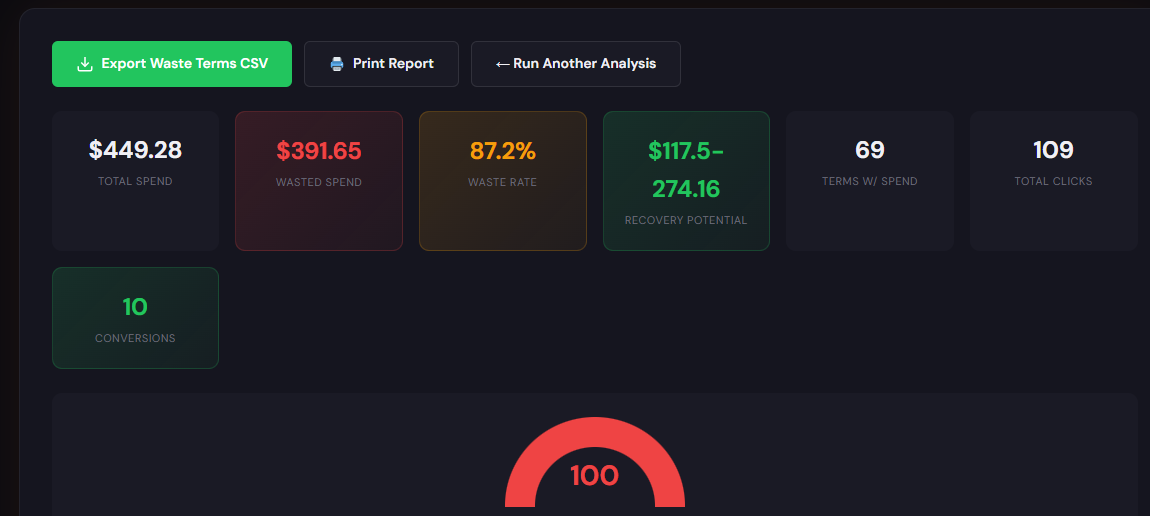
What it outputs: Dashboard-style snapshot showing total wasted spend, top leakage areas (search terms, audiences, placements), and a prioritized recovery plan with specific negative keywords and budget moves.
How to use it (3 steps)
- Upload or connect a 30-day Google Ads account export and run the snapshot.
- Review the top 5 leakage recommendations (negatives, low-value placements, campaign budget reassignments).
- Download action lists and implement: add negatives, reassign budgets, pause low-value placements; re-run after 7 days.
Preview: the snapshot surfaces quick wins you can recover immediately, backed by spend and CPA metrics.
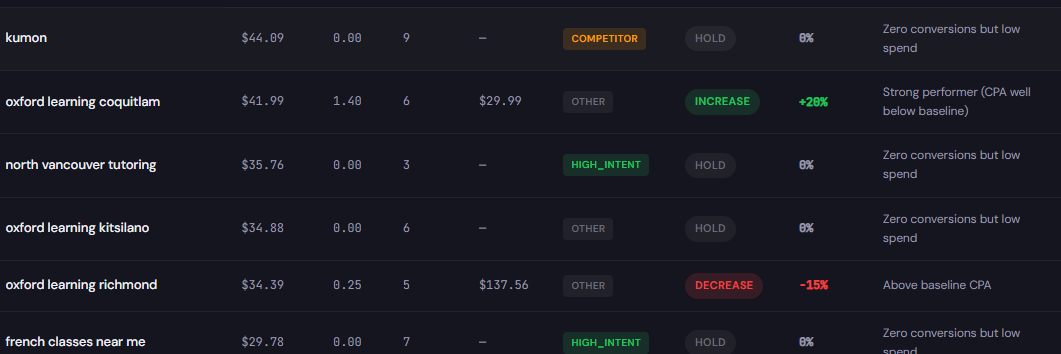
What it outputs: A table of search terms with spend, conversions, intent tags, and recommended bid actions (raise, lower, negative) plus CSV export for Editor.
How to use it (3 steps)
- Upload search term report (30 days) and filter by cost-per-conversion thresholds.
- Review recommended actions: negative for no-intent queries, bid up for high-value converters, or schedule adjustments for time-based patterns.
- Export to Google Ads Editor or apply changes directly; monitor results over two bidding cycles.
Preview: the tool gives granular recommendations you can batch upload, reducing manual rule writing.
90-minute account triage playbook
Run this play in a single session to produce a prioritized recovery list.
- Minutes 0–10: Pull account-level metrics (30 days): spend, conversions, CPA by campaign.
- Minutes 10–25: Run Search Term Analyzer on top-spend campaigns; mark top 20 negatives and top 10 high-intent terms.
- Minutes 25–40: Run Wastage Snapshot; export top leakage recommendations and a recovery plan.
- Minutes 40–55: Apply top 10 negatives and pause the worst 3 placements/ad groups. Schedule bid modifiers for worst hours based on snapshot.
- Minutes 55–75: Realign ad-to-landing pairs for top 5 ad groups; push focused headlines and landing URLs to live A/B tests.
- Minutes 75–90: Export action CSVs for Google Ads Editor, document changes and the 7-day test plan, set reminders to review impact after 7 days.
FAQ
No — you can upload exports. Connecting accounts speeds diagnostics but manual CSV import is supported for sensitive accounts.
Expect small wins (reduced wasted clicks) within 7 days; larger Quality Score and conversion changes require 2–4 weeks of stable testing.
Smart bidding adapts. When making manual changes, use short test windows and limit simultaneous algorithmic changes. The tools give recommendations compatible with automated strategies.
Yes. Both the Wastage Snapshot and Search Term Analyzer provide CSV/Editor-ready exports for batch uploads.
Recover wasted spend fast: run the Wastage Snapshot and export search-term actions into Editor. Reduce time-to-action and get a prioritized recovery plan.
Sources
- Google Ads Help — Automated bidding — overview of how automated bidding works and its implications for control.
- WordStream — How to stop wasting money on PPC — practical ideas for reducing wasted spend and improving negatives and match types.
- Search Engine Journal — The Ultimate Guide to Negative Keywords — guidance on managing negatives to prevent irrelevant clicks.
Leave a Reply